Why B2B Paid Media Underperforms Without Institutional Memory
Campaigns lose their most valuable asset when each reset discards what previous ones learned.

B2B paid media underperforms when campaigns generate learning that the next campaign cannot use. Compounding campaign intelligence for B2B growth marketing means retaining audience signals, exclusions, creative evidence, and attribution context, then applying them to each new decision. This requires an operating system for learning, with continuous execution, usable memory, and accountable human judgment.
Why B2B paid media programs systematically discard their most valuable asset
A new campaign kicks off. The brief looks right, the targeting looks familiar, and the team is effectively starting from scratch. Search terms that attracted the wrong intent return to the account. Creative hypotheses already disproven get another audition. The campaign may be competently built, yet it has inherited almost none of the intelligence its predecessors paid to acquire.
That is a different diagnosis from bad creative or the wrong platform. Every campaign produces signals about who converts, which messages attract unqualified traffic, and where targeting departs from the original spec. Most programs fail to capture those signals in a form that shapes subsequent decisions. The evidence exists, but it has no operational job. A report can describe a mistake without preventing its return.
This reflects a failure in information architecture. When a new owner takes over or a campaign launches, the discovery cycle begins again, including its waste. Meanwhile, the market has moved and the account’s usable knowledge has not. Each reset becomes more costly because the program must rediscover old lessons while making sense of new conditions.
What institutional memory actually means in a paid media account
Institutional memory is campaign intelligence kept in a form that can be queried and used to make the next decision.
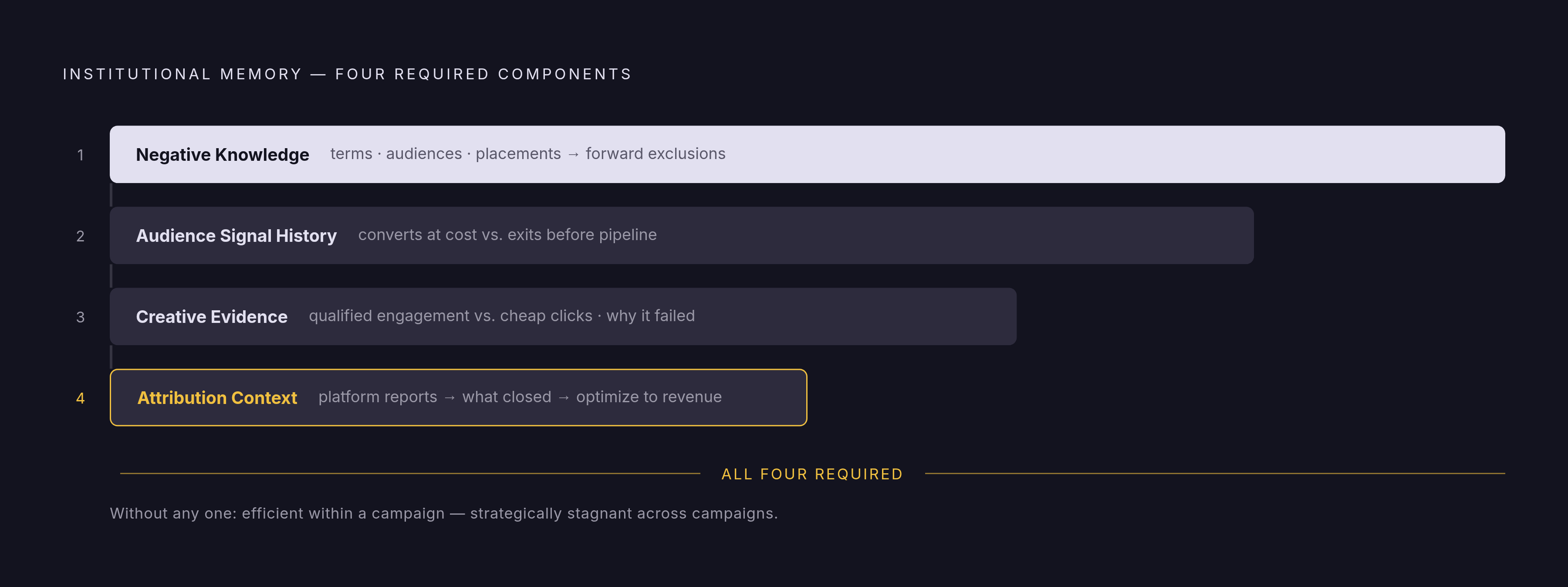
That memory has four components with distinct jobs. Negative knowledge records search terms, audiences, and placements that attract unqualified traffic, encoded as exclusions that move forward automatically. Audience signal history tracks which job titles, firmographic segments, and behavioral cohorts convert at a cost the business can accept, and which leave the funnel before they reach pipeline. Creative evidence distinguishes qualified engagement from cheap clicks, retaining what failed and why as well as what won. Attribution context connects platform reports with what actually closed, calibrating optimization to revenue.
Without all four, an account can become efficient within a campaign while remaining strategically stagnant across campaigns. That distinction separates a campaign from a program. A campaign has a start and an end, while a program has a memory that makes the next start better informed.
How the absence of memory turns targeting drift into a silent pipeline leak
Targeting drift shows what happens when that memory is absent. The audience gradually moves away from the intended buyer, but click and engagement metrics give the team little reason to object. The dashboard need not look alarming. By the time the decline in lead quality becomes clear downstream, sales may already have lost confidence in marketing-sourced pipeline.
On Google, defaults that push toward broad-match keywords and expansion features such as Optimized Targeting can pull in traffic that appears engaged but never enters the buying process. The revealing connection is between attributed pipeline and keyword-level source data. Without that connection, the account tracks activity but cannot tell which of it brings in pipeline and should get more spend. Broad-match bleed and audience expansion become recurring costs, with their evidence left unused in future targeting.
Why would a platform stop doing what its available signals reward? Platforms behave predictably when they optimize for cheaply measured clicks, impressions, and engagement. External memory of qualified pipeline gives platforms a signal that can correct this. Without it, the damage extends beyond wasted spend into the relationship between marketing and sales. Sales evaluates lead quality through the deals it remembers, so a corrected data set does not automatically repair a damaged reputation.
Why attribution window mismatches make the problem invisible to leadership
Targeting drift is harder to correct when the measurement system also forgets. Short attribution windows designed for consumer e-commerce can hide B2B pipeline influence from the channels that generated it. A channel may help move a buying committee without getting credit within the reporting window.
Consider the allocation decision under a 30-day window. LinkedIn appears to contribute no pipeline, so it gets cut and Google gets all the budget. Nine months later, the loss of pipeline resulting from the earlier attribution decision gets attributed to market conditions. This is how measurement can erase a causal connection.
Short windows reward demand capture over demand creation, starving the top of the funnel while over-funding the bottom. The program then fails to learn which channels move buying committees because its measurement rules keep excluding part of the evidence. The account needs to preserve enough context to learn from the revenue it helped create.
What a program looks like when memory does accumulate
A program with memory begins each campaign from a better-informed starting position. Its negative keyword list reflects earlier waste, its audience exclusions reflect disqualification, and its creative choices reflect qualified engagement. Each iteration also adds firmographic evidence about likely conversion. Discovery still happens, but it is not all remedial. More spend can go toward converting suitable buyers as less is spent relearning who they are not.
Madison Logic’s AgentSync case shows how this works in account-based marketing. AgentSync used ML Insights and the ML Platform to identify target accounts and coordinate display, LinkedIn, and content syndication. The case links strong ROI to learning which account signals showed that buyers were ready to buy.
That changes what a quarter’s investment is worth. Pipeline is one output, while reusable intelligence is another, because it can reduce the cost of generating pipeline in the following quarter. A campaign that produces results but leaves no usable learning spends that second asset. A program that retains it gives future campaigns an advantage before their first impression runs.
Where AI agents fit as the engine of continuous execution
Maintaining that advantage requires more observation and follow-through than periodic reviews can sustain. Human teams lack the capacity to observe, log, and act on the full volume of signals while also running the platforms. Synter’s Joel Horwitz described a pre-agent baseline in which platform administration consumed most marketers’ time. Execution crowded out the work needed to make execution improve.
Agents make continuous monitoring and logging part of normal operations. They can observe Google Ads, LinkedIn, and other channels simultaneously, flagging targeting drift, creative fatigue, and budget inefficiency in real time. Each bid adjustment, negative keyword addition, or audience exclusion leaves a decision and its rationale. The rationale is the useful part of the record. It gives later campaigns queryable, transferable intelligence by explaining account changes.
Synter’s early deployments reduced platform administration from most of the working day to under a fifth and tripled campaign iteration velocity. Faster iteration gives the program more chances to learn in the same amount of time. PubMatic and Butler/Till’s December 2025 autonomous CTV campaign for Clubtails, part of Geloso Beverage Group, offers a separate execution example. The companies described it as the industry’s first fully autonomous end-to-end campaign, with dramatic reductions in setup time and faster issue resolution.
The judgment problem and why faster execution can accelerate the wrong direction
More learning cycles help only when the program is learning about the right thing. Speed can compound an error just as readily. If the platform controls targeting, creative rotation, placement, and bidding while revealing little about which inputs drive outputs, changes in ROAS or CPA do not explain themselves. A poor result could reflect creative, a leaking landing page, audience drift, or an attribution window that misreports the outcome.
Those possibilities call for different responses. Generating more creative will not fix an attribution gap, and changing bids will not diagnose a landing page problem. Diagnostic judgment identifies the constraint before execution applies pressure. That requires seeing beyond the variables a platform exposes and asking what is actually limiting qualified pipeline. Otherwise, the system becomes very good at answering the wrong question.
AI-generated creative makes the risk especially clear. If the brief addresses the audience the platform happens to deliver rather than the audience the business intends to reach, faster production reinforces the targeting error. Budget automation can make the same attribution error too, moving spend toward the strongest short-window signal and away from demand creation. Neither failure requires a malfunction. Both can arise from faithful execution against a poorly chosen target.
A named expert must be accountable for consequential, ambiguous decisions. Agents handle continuous execution, while that expert diagnoses the constraint and governs what gets optimized. This requires keeping the authority to define success separate from the machinery that pursues it.
How do you build a B2B paid media strategy where campaign data compounds?
The delegation model joins execution, memory, and judgment into one system. Creative, landing pages, attribution, and campaign operations cannot function as sealed workstreams when any one of them may constrain pipeline. The accountable expert needs visibility across them to diagnose the problem. Otherwise, each workstream can get better at its own job while results for the business stay the same.
Within that system, campaign decisions leave logged rationales that later campaigns can query. Audience changes, bid adjustments, creative rotations, and negative additions become usable evidence instead of disappearing with the person who made them. Attribution calibrated to revenue and pipeline then keeps that reasoning connected to the business goal.
Madison Logic supplies the account-intelligence example, Synter illustrates agent execution and iteration speed, and the PubMatic and Butler/Till campaign demonstrates autonomous execution in CTV. None of those examples, by itself, establishes every layer. The complete model also needs persistent decision records and accountable diagnosis.
Commercial incentives belong in the architecture as well. A retainer decoupled from media spend removes the incentive to recommend more spend as the answer to a creative or landing page problem. Delegation works when responsibility extends to finding the constraint.
The compounding gap between programs that build memory and programs that do not
The difference may be hard to see in month one. Both programs can launch campaigns that look well made, buy on the same platforms, and write reports that seem sound. Over years, however, one develops a progressively more accurate model of qualified pipeline while the other repeatedly purchases lessons it already paid for. The gap becomes structural because the advantage resides in accumulated intelligence.
That intelligence reduces rediscovery, narrows waste, and makes subsequent decisions better informed. A program that resets has to compete with those gains while building its own starting point again every quarter. Matching a creative format or changing a bid does not recover the lost history. The disadvantage is time spent failing to retain what the account learned.
Growth leaders therefore need to ask more of this quarter’s campaigns than that they be well built. Will they make next quarter’s campaigns meaningfully smarter, and will that learning survive a change in ownership? Those questions distinguish a productive quarter from a program that grows more capable with age.