AI Agents That Run B2B Google and LinkedIn Ads End-to-End Without Human Execution
Agents handle research, creative, launch, and optimization across platforms without human execution.

An AI agent for B2B Google and LinkedIn Ads management runs research, campaign building, launch, optimization, and learning as one continuous system. “Without human execution” means people retain judgment while leaving tactical implementation to the system. The distinction is whether the system can act across platforms, learn from pipeline outcomes, and keep its actions traceable and reversible.
Why agentic advertising is a structural shift, not an incremental one
Traditional marketing automation follows if/then rules that someone has already written. An agent instead receives an objective, perceives the environment, reasons through a plan, and acts inside ad platforms, CRMs, and analytics systems. Given “generate qualified demos from mid-market SaaS accounts this quarter,” the agent independently determines channels, content, targeting, and when to pivot. Google Marketing Live 2026 formalized this shift under the label “agentic advertising,” with marketers supervising systems that handle optimization, creative iteration, bidding, and audience adjustment.
At the same time, the buying environment has changed. B2B buyers now use AI assistants more often to assess vendors before they search on Google or visit company websites, so early research happens sooner and LinkedIn has an edge in reaching people before they search. Google is changing from within as well. Its ads can appear within AI Overviews through eligible Search campaigns using broad match, Shopping campaigns, AI Max for Search, and Performance Max, while reporting offers limited visibility into when and why an ad served. An external agent therefore operates inside a platform making more autonomous decisions of its own, which changes what oversight must catch.
The five-layer architecture that makes end-to-end execution possible
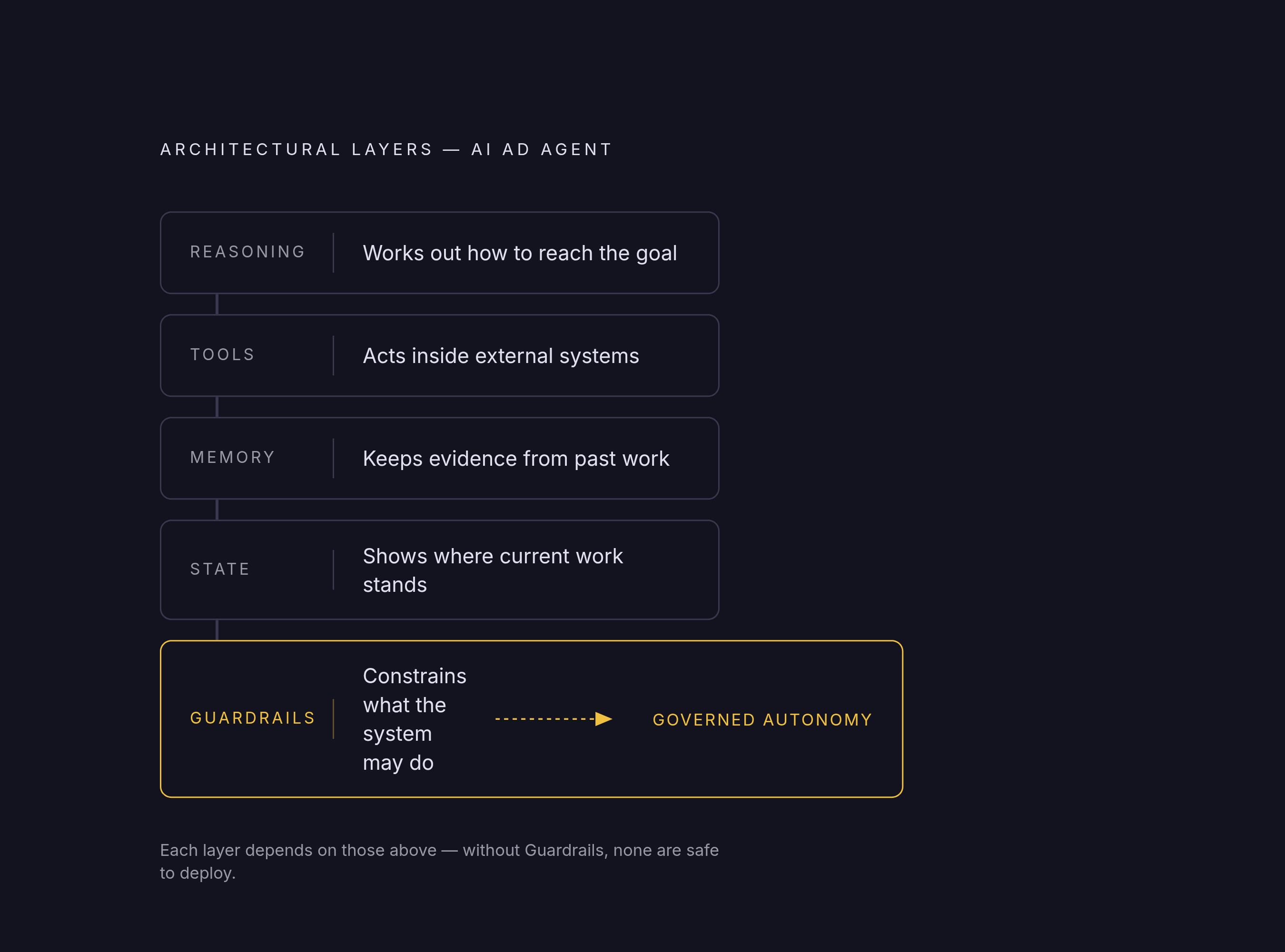
PingCAP describes a useful mental model with five layers, which are reasoning, tools, memory, state, and guardrails. Reasoning works out how to reach the goal, while tools let the agent act inside external systems. Memory keeps evidence from past work, and state shows where the current work stands. Guardrails constrain what the system may do. These are interdependent functions because an execution tool without memory cannot accumulate learning, and one without guardrails cannot provide governed autonomy.
The Model Context Protocol, or MCP, is a standard that lets an agent call a customer data platform, ad platform, or CRM exposing an MCP server without bespoke integration code for every connection. That qualification is important because the other system must expose the connection. Without a shared standard, each connection needs integration work of its own. MCP connects the systems, but clean data, sound objectives, and judgment must come from elsewhere.
A strategy agent defines audience cohorts and budgets, a content agent creates assets, and a distribution agent launches them across platforms. A performance agent monitors and reallocates, while a sales-sync agent alerts reps to qualified leads. Their shared view depends on ingestion quality, since agents drawing on CRM data, website behavior, conversation history, and competitive signals have a richer basis for conversion than agents seeing only one or two sources. For buyers, the sharpest questions follow from that architecture. Does the product merely recommend changes, or execute them, and can every executed action be traced and reversed?
What the agent actually does at each stage of a campaign
Research begins with first-party signals, as the agent draws on CRM data, website behavior, and competitive signals to build audience cohorts and allocate budget across channels. That planning becomes the basis for the build. Creative assets, campaign structure, targeting parameters, and bid strategies are generated and pushed through official API connections, rather than handed to someone who must log into each platform. “End-to-end” describes this continuity.
Synter illustrates an operator model in which teams describe what they want in natural language and agents implement it through official ad platform APIs. The marketer sets direction without translating it into each platform’s controls. Yet building and publishing need not be the same permission. HubSpot’s Campaign Agent, presented at HubSpot UNBOUND, 2026, takes an objective plus context including brand guidelines, ICPs, past performance, and uploaded briefs or transcripts. It plans the campaign and builds landing page, form, and email assets, but leaves them as drafts for a person to review and edit before publication.
Once campaigns are live, the agent checks them throughout the week. The agent follows conversion signals, rewrites copy variants, adjusts audience segments, and shifts budget between campaign types without waiting for the next review meeting. Google’s AI Max complicates that task in a useful but consequential way, as it is becoming the default setting for new Search campaigns and can match ads to queries the advertiser never explicitly bid on. The agent’s optimization loop is interacting with another autonomous loop. Learning then preserves which audiences converted, which creative performed, and which attribution paths produced pipeline, so the next campaign inherits evidence.
Why Google and LinkedIn are not competing choices but complementary instruments in an agentic system
LinkedIn gives an agent ways to reach buyers before they express search intent. Targeting by company size, job title, industry, and seniority supports that early reach, particularly when vendor shortlists are forming inside AI assistants. Google Search captures a different moment in the journey. A VP of Engineering searching “API monitoring tool pricing” supplies a more urgent signal than the same person being shown a LinkedIn ad. Prior familiarity can make that search more valuable, so treating the channels as rivals mistakes the relay team for a boxing match.
A prospect who saw a LinkedIn ad and searched on Google three days later represents a different path from a cold search, and connecting those events can change budget allocation. PaidSync connects LinkedIn Ads, Google Ads, and GA4 in one AI session to show these cross-channel patterns without someone having to export the data by hand. Its workflow can tell which campaigns bring trial users who activate and which bring users who bounce. That demonstrates concrete integration capability, with autonomous campaign execution still to be established.
An agent can flag LinkedIn audience saturation and the need for a refresh before spend continues at the same pace, rather than judging each channel only by its current cost per lead. AI-native B2B advertisers already allocate more to LinkedIn and place more emphasis on engagement objectives than the broader market does. That mix reflects a judgment about where useful quality signals appear. An integrated system manages how exposure and intent lead to results, looking across the two dashboards together.
How attribution closes the loop — and why it breaks without an integrated system
Dreamdata’s B2B benchmark work describes buying journeys averaging roughly 4 channels, with timelines measured in months. Those journeys also involve multiple touchpoints and stakeholders, so the final click offers only a narrow view of what produced a deal. If the agent sees form fills as success, cheap form fills become its target. The machine need not misunderstand the assignment to produce the wrong business result.
Google’s agentic advertising model makes the practical implication clear. Connecting CRM data allows the system to see which clicks become meetings and which meetings close, rather than stopping its education at the form submission. For B2B SaaS with long sales cycles, GA4 signals such as time on the pricing page, docs visits, and demo request behavior are better proxies for lead quality than a count of conversions alone. These signals capture intent beyond a form fill while serving as proxies for the eventual commercial outcome.
When attribution links cleanly to closed-won revenue, it shows how deal quality differs across channels. Budget can then follow pipeline quality. Attribution is part of the control loop that shapes the next action during execution. A siloed system can get very good at hitting its own success metric while losing sight of the journey that gives that metric value.
What human judgment still does — and why governance is not optional
Agents can continuously handle bid adjustments, negative keyword management, audience tests, budget pacing, creative variants, and cross-channel reporting. Humans retain the decisions that are ambiguous and consequential, including which conversion goal is right and which constraint on growth deserves attention first. Is weak performance a creative problem, a landing-page problem, an attribution gap, or a funnel issue? Google Marketing Live 2026 captured the distinction in the phrase “the strategic layer becomes more valuable,” because the objective and conversion signal determine what all that execution serves.
Governance sets rules that enforce that split in who is responsible for what. Once an agent has write access to live campaigns and real budgets, approval workflows, action traceability, and rollback capability become architectural requirements. Synter makes its changes inspectable through natural-language explanations and provides one-click rollback. The explanation lets a team examine not just what changed but why the agent chose it. HubSpot’s draft-before-publication boundary shows another form of the same principle, separating the ability to build from permission to reach a buyer.
An ICP can drift, a value proposition can stop matching what sales is hearing, or a landing page can convert while attracting the wrong segment. Someone who is responsible for the system must judge whether it is solving the right problem, even when the metrics it uses look healthy. “Without human execution” leaves people responsible for deciding what the controls are for while freeing them from operating every control.
The compounding advantage that accumulates over time — and why starting from scratch is the real cost
An integrated system retains more than a record of spend. It accumulates evidence about which audience segments converted at which stage, which content worked, and which paths produced qualified pipeline. Speed can compound as lead response time shortens and MQL-to-SQL rates improve. Content can compound as AI-generated briefs support more published assets that generate more organic data. Attribution can compound as cleaner touchpoint data improves allocation, which improves pipeline per dollar and the evidence available for the next decision.
That accumulation changes what the system can diagnose. After multiple campaigns across both channels, with CRM-connected attribution, it has a broader basis for distinguishing weak creative from a landing-page problem, an attribution gap, or a funnel issue. A single-platform tool has a narrower field of view. Its answer may default to “spend more on ads” when the constraint lies elsewhere.
A percentage-of-spend fee creates an incentive to recommend more media spend whether or not spend is the constraint. A fee structure decoupled from media spend removes that particular conflict and better aligns optimization with customer growth. Memory has a comparable ownership question, because tribal knowledge can disappear when an agency contract ends or an in-house specialist leaves. Saving the evidence gathered over time keeps that knowledge in the system when people leave.
For B2B marketing and growth leaders, purchasing a tool therefore entails choosing an operating model. The useful distinction is between a system that preserves campaign evidence and one that leaves the next team to reconstruct it. Does the history gathered over time help the system tell what is wrong, and can teams still use that history when a vendor relationship changes? The real cost of starting over is losing the evidence needed to tell what growth requires next.