Automated Bidding Risks and Failure Modes in B2B Google Ads
Smart Bidding's confidence exceeds the conversion data B2B programs can reliably provide.
Google Ads is running automated bidding on 86% of campaigns right now. That's not a trend piece anymore, that's largely how the platform works. And yet B2B advertisers keep watching Smart Bidding produce weird, confident, wrong decisions. The technology isn't broken. The conditions B2B programs create — thin conversion data, long sales cycles, signals that don't match what the business actually wants — break the assumptions the technology was built on.
Let's get the taxonomy straight first, because Google keeps changing the names. Smart Bidding is a family: Maximize Conversions, Maximize Conversion Value, and (as of 2026) Target CPA and Target ROAS aren't separate strategies anymore. They're optional constraints you attach to Maximize Conversions or Maximize Conversion Value. Enhanced CPC is gone too, deprecated for Search and Display the week of March 31, 2025. If you had a campaign that never got migrated, it's likely running on plain Manual CPC right now, whether you meant it to or not.
Every version of Smart Bidding runs on the same core assumption: there's enough clean, timely conversion data to predict, at the moment of each auction, how likely this specific query, from this specific user, in this specific context, is to convert. When that signal is thin or late or pointed at the wrong thing, the prediction doesn't get cautious. It gets confidently wrong.
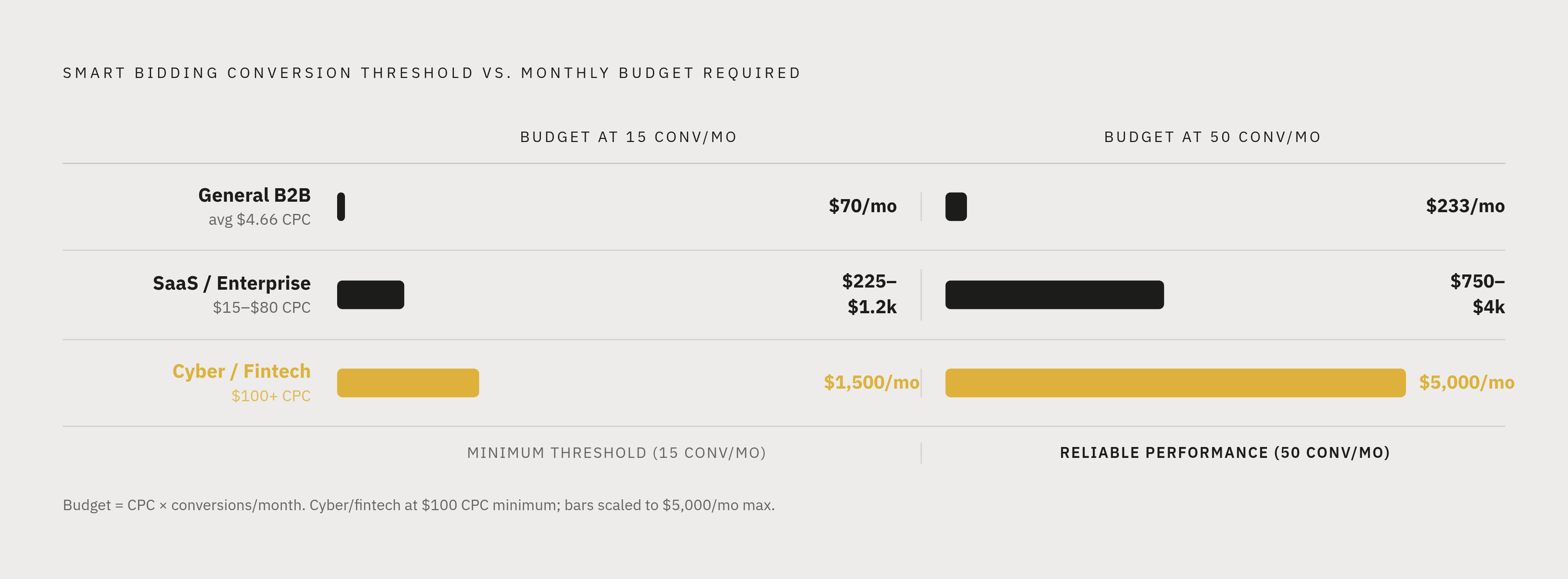
Here's the number that frames everything below: Google recommends at least 15 conversions a month per campaign for Smart Bidding to work, and says performance tends to improve around 50. Many of the failure modes in this piece trace back to that threshold, and to what happens when a normal B2B program can't hit it.
Why B2B conversion data is structurally too thin to meet Smart Bidding's requirements
Enterprise software. Industrial equipment. High-ticket professional services. These deals run $50,000 and up, and a good month might bring in a handful of them. That's not a failing program. That's a normal B2B program sitting well below the volume the algorithm needs to do its job.
Here's the part that trips people up: when a campaign falls short of the threshold, Smart Bidding doesn't pause and wait for more data. It keeps bidding, and it keeps bidding like it knows what it's doing. To fill the gap, it relies on contextual proxies: device type, time of day, the pattern of the search query. Those proxies have a loose relationship with B2B buyer intent. They have almost no relationship with deal size.
That sets up a genuinely painful contradiction. The B2B programs that most need bidding efficiency, because their CPCs are brutal, are exactly the programs least able to feed the algorithm what it needs. Average B2B CPC hit $4.66 in 2024, up roughly 10% from the year before. SaaS and enterprise software terms routinely run $15 to $80 a click. Cybersecurity and fintech keywords regularly clear $100. Do the math on hitting 50 monthly conversions at those rates on a single campaign, and you'll see why most B2B budgets can't get there.
So here's a practical answer for a lot of B2B advertisers: manual CPC, on purpose, until there's enough conversion history to justify handing over the wheel. That's not giving up on sophistication. That's just following the math.
How proxy signal optimization hollows out lead quality
When deal-close data is too sparse to bid on, the natural fix is to track something more common instead: form fills, demo requests, whitepaper downloads. Makes sense on paper. Here's where it goes sideways.
Smart Bidding optimizes for the action you told it to track. Not the outcome downstream of that action. If 50 demo requests turn into 2 paying customers, the algorithm sees 50 conversions worth chasing and goes and gets you more of them. It has no way to see the 48 that led nowhere. Your dashboard shows volume going up. Your qualified pipeline often does not follow.
This isn't a sales team problem, and it isn't a product problem. It's a bidding signal problem. The algorithm did what it was told to do; the instructions were just wrong.
Low-intent traffic that fills out a form cheaply looks great to Smart Bidding, because cheap-and-frequent is what it's optimizing for. Search conversion rates in B2B average 3.04%, but that figure is measuring form fills, not sales-qualified leads. Average B2B search CPA sits around $116.13, and that can look perfectly healthy on a report while pipeline yield per lead quietly falls apart underneath it.
Here's the loop: the algorithm rewards what it can measure, the program doubles down on the measurable thing, the sales team gets flooded with leads that go nowhere, and the platform dashboard says everything's working. The fix isn't turning off micro-conversion tracking. It's weighting those actions correctly and connecting them back to what actually happens after the form gets filled out (more on that later).
Attribution windows that don't match sales cycles produce confidently wrong bids
B2B buying cycles now average 11.5 months. Multinational deals can stretch to 16 months or more. Smart Bidding's default attribution window sees a fraction of that timeline, and it makes bid decisions based only on what falls inside that window, not on what actually moved the deal forward.
Most B2B organizations, 73% by one measure, are running 30-day attribution windows regardless of how long their sales cycle actually is. Put a 30-day window on a 6-month sales cycle and most of the campaigns that helped close the deal get little to no credit for it. From the algorithm's point of view, those campaigns just don't work. So it pulls bids back on the upper-funnel searches that kick off long buying journeys, and pushes spend toward bottom-funnel terms where the attribution trail is short and clean. The result: budget concentrates near the end of a journey the algorithm never even saw begin.
And there's a stakeholder problem stacked on top of the timing problem. B2B deals typically involve 6 to 10 decision-makers; multinational deals average around 15.2. That's a lot of different people touching a lot of different ads over a long stretch of time, and the algorithm is going to hand most of the credit to one click.
Extending conversion windows well beyond the default 30 days is a necessary step for most B2B accounts. For enterprise sales cycles, even a generous window is often too short.
Performance Max as an extreme version of every Smart Bidding failure mode
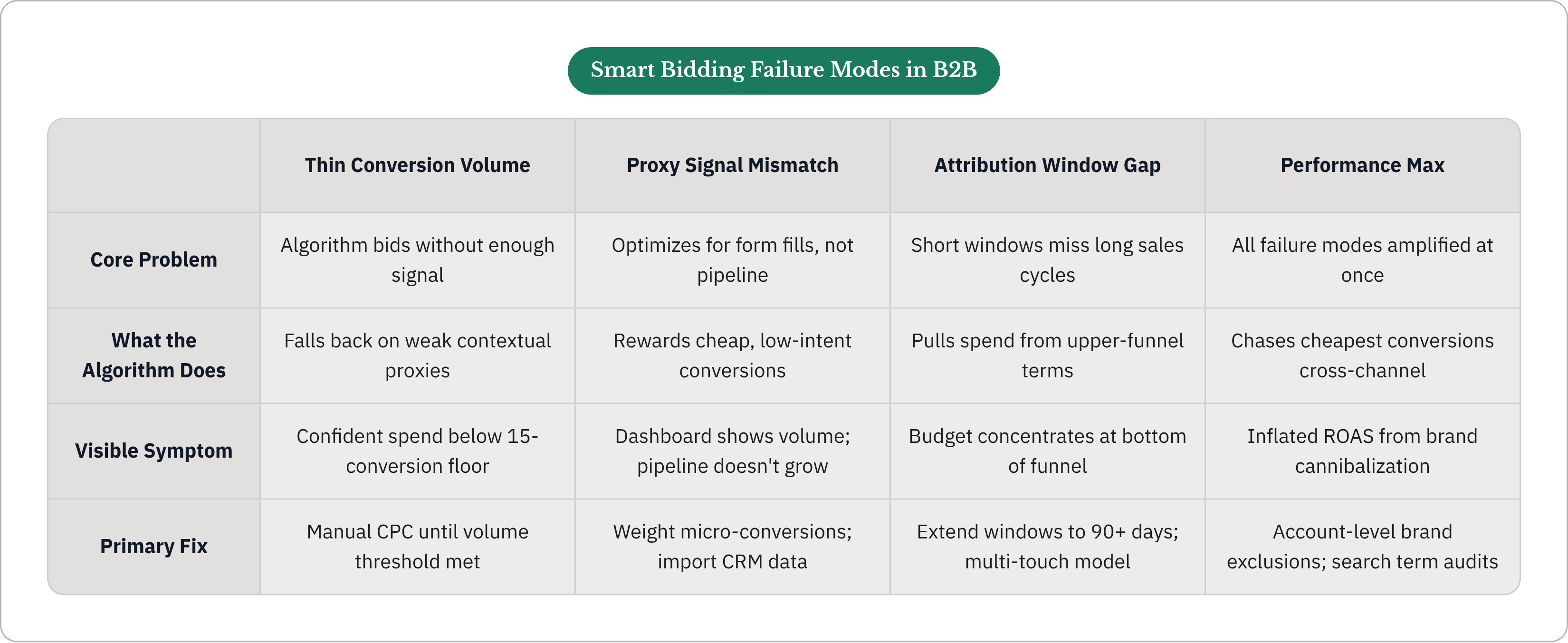
Performance Max is Smart Bidding taken to its logical extreme. One campaign, one algorithm, controlling inventory selection, audience targeting, creative rotation, and bids across the entire Google network at once. Every problem already covered in this piece gets worse inside PMax.
The volume problem gets worse because now one campaign is trying to gather signal across every inventory type simultaneously instead of just Search. The proxy problem gets worse because the algorithm has more surfaces (Display, YouTube, Discover, Gmail) to go find cheap, low-intent conversions on. The attribution problem gets worse because cross-channel attribution inside PMax is largely opaque by design; you don't get a clean view of what drove what.
Then there's a failure mode that's fairly unique to PMax: brand cannibalization. PMax bids on your own branded terms by default, your company name, your product name, close variants. People searching your brand name already know who you are and convert at high rates for cheap. That inflates PMax's apparent ROAS, because the campaign is getting credit for demand it didn't create.
Audit data from GrowthSpree's MCP work across 300+ B2B SaaS accounts (Q1 2026) found that without account-level brand exclusions, 8 to 15% of PMax spend in B2B SaaS was going to traffic that would have converted organically anyway. That cannibalization inflated apparent PMax ROAS by 15 to 30%. In the worst cases, brand spend share climbed past 25%, which on a $25,000-a-month PMax budget works out to somewhere between $24,000 and $45,000 a year in recoverable waste, per account.
For years there was effectively no way to see this happening, because PMax gave advertisers little search term visibility. No way to know what queries your spend was actually landing on. Google has since added search term reporting and campaign-level negative keywords (up to a large number of them), which is a real improvement, but it only helps if someone's actually watching. Without that governance, PMax stays close to a black box that chases whatever converts cheaply, and in B2B, cheap and correct are rarely the same thing.
The industry seems to be figuring this out. PMax's share of ad cost peaked at 82% in May 2024, then dropped about 6 percentage points by early 2025, as advertisers moved budget back to Standard Shopping and Search. The all-in-on-PMax era is already backing off.
What misconfigured conversion tracking does to an automated bidding system
Smart Bidding is only as good as the signal you feed it. Misconfigured tracking doesn't produce a neutral, slightly-off result. It produces confidently wrong bids, because the algorithm has no way to know the data is bad.
The common B2B tracking mistakes are almost mundane: the wrong actions counted as primary conversions, low-intent interactions carrying the same weight as high-intent ones, and conversion windows set shorter than how long people actually take to decide.
Each of these hands the algorithm a high-confidence signal about the wrong thing. Deciding which actions are primary (what Smart Bidding actually optimizes toward) and which are secondary (what you just observe) isn't a nice-to-have setting buried in a menu. In B2B, it's arguably the single most important configuration decision in the whole account.
Fraudulent clicks make this worse, not better. In an automated bidding setup with sloppy tracking, a small batch of fraudulent click activity with zero real conversions doesn't just waste $400. It corrupts the signal environment the algorithm is operating in.
So before anyone argues about which bidding strategy to run, the conversion tracking needs an audit. The algorithm will execute, confidently and at scale, against whatever it's handed.
The corrective infrastructure B2B programs need to make Smart Bidding work
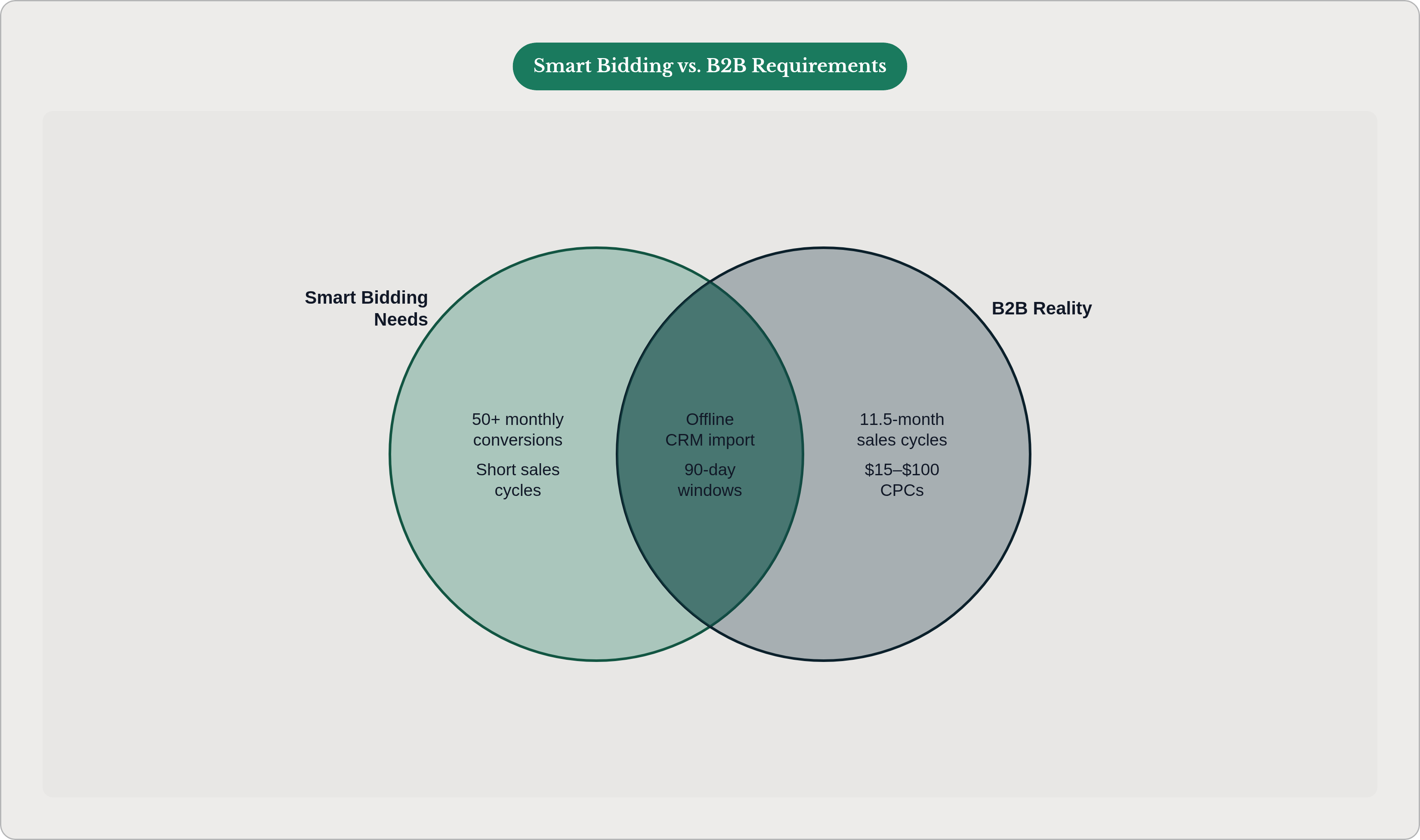
Offline conversion import is one of the highest-leverage fixes available. Send CRM data back into Google Ads so the algorithm finally learns which ad interactions turned into revenue, not just which ones turned into form fills. Assign conversion values by outcome quality so Smart Bidding is optimizing toward actual business results. Smart Bidding uses those values to go find more people who look like your best customers, not just people who fill out forms.
Campaign consolidation helps too. A fragmented account keeps every individual campaign stuck below the conversion threshold; pooling that volume into fewer, better-structured campaigns lets the algorithm accumulate signal faster. The tradeoff is less granular control, so this only works if you're deliberate about keyword and audience segmentation inside those consolidated campaigns.
Attribution windows need to match reality. Extend to 90 days minimum for B2B, longer for enterprise cycles, and use an attribution model that spreads credit across the actual multi-touch journey instead of piling onto one click.
Brand exclusions in PMax aren't optional hygiene, they're close to mandatory. Set them at the account level to reduce the cannibalization described above, and check search term reports regularly to catch irrelevant query categories before they burn budget.
And manual CPC deserves a permanent seat at the table, not just a temporary one. For any campaign generating fewer than 15 conversions a month, manual CPC with deliberate, hands-on bid adjustments often beats Smart Bidding outright. That's a math call, not a philosophical one. Some B2B programs may not generate enough volume per campaign to make automated bidding reliable, and that's fine.
One enterprise SaaS provider saw a 70% cost reduction and 3x engagement, and the win didn't come from picking the right bidding strategy alone. It came from ultra-precise targeting matched to actual sales capacity, treating targeting, volume, and signal quality as one connected system instead of three separate levers.
Why automated bidding governance cannot be delegated to the platform itself
Every failure mode covered here is the algorithm doing its job correctly on bad inputs. That's the part worth sitting with. Smart Bidding has no built-in way to notice its own inputs are wrong; it just executes.
Google's product incentives point in a specific direction: more automation, more spend, wider reach. None of that is inherently aligned with B2B pipeline efficiency. Smart Bidding is on by default for new Search campaigns. PMax is built to spread budget across the whole network without a human picking inventory. The recommendations engine inside Google Ads tends to suggest raising targets and widening audiences, because that's what grows spend.
The decisions that actually determine whether Smart Bidding works in a B2B account aren't bidding decisions at all. They're signal architecture decisions: what to track, how to value it, how to close the loop with the CRM, how wide to set the conversion window. Making those calls well requires understanding the sales process and the pipeline economics, not just the platform settings.
A workable governance model splits the labor: let automation handle the continuous, reactive work, bid adjustments, pacing, small tweaks, and put a person in charge of the signal infrastructure, the conversion weighting, and the structural decisions the algorithm has no way to fix on its own. Someone still has to watch for brand cannibalization, for a learning period that never settles down, for attribution drift. Someone still has to figure out whether underperformance is a bidding problem, a signal problem, a creative problem, or a landing page problem, because the algorithm can't tell you that. It just optimizes toward whatever you told it mattered.
The programs that struggle with Smart Bidding tend to share one habit: they handed the platform the keys and called that "managed." Automated and managed sound similar. They are not the same thing.