Customer Acquisition Cost Targets as Google Ads Bidding Inputs
Align your tCPA bids with actual unit economics, not Google's suggestions.

I've spent enough time in Google Ads accounts to tell you the tCPA field lies to you before you even type a number into it. That little suggested bid Google shows you is not advice. It's a summary of your recent history, warts and all, dressed up to look like a recommendation.
Here's the instinct almost everyone follows: open the campaign settings, see the suggested tCPA, accept it or nudge it slightly, move on. Google clearly ran some analysis to produce that number. Why not trust it?
Because that number describes what already happened, including your worst months, and it's usually attached to the wrong conversion event anyway. A customer's actual worth to your business is a completely different question, and Google Ads has no way to answer it for you.
A tCPA isn't a budget preference. It's more like a statement about economics: what does a customer generate, and what can you afford to spend to get one? Skip that question and the algorithm will do exactly what you told it to do, efficiently, at auction speed, thousands of times a day, chasing a number that has nothing to do with revenue.
So let's build the number the right way.
Working backward from unit economics to a maximum acquisition cost
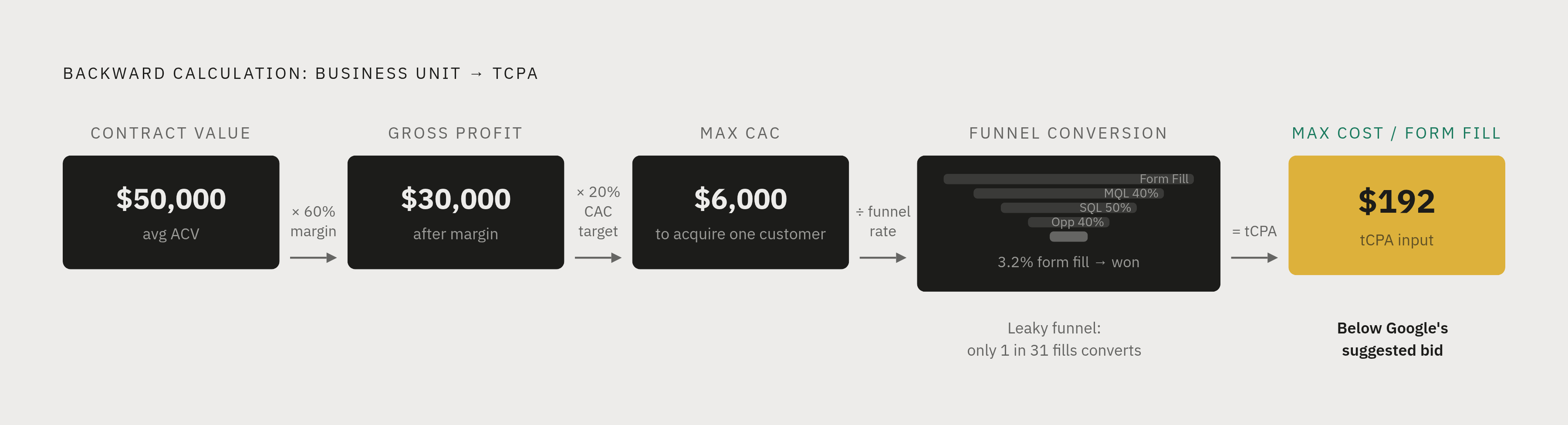
Start with what a customer is worth. Consider average contract value, or average order value if you're selling something transactional instead of a subscription.
Then margin. Not all revenue is equally profitable to chase, and pretending otherwise is exactly how "growth" turns into "revenue that costs more than it earns." Apply gross margin to that contract value and you get a dollar figure that represents what's actually available to spend on acquiring the customer in the first place.
Now the real decision, and this one belongs to the business, not Google Ads: what share of that margin is the business willing to put toward acquisition? That's a growth-investment call. Whoever owns that tradeoff makes it. Marketing doesn't invent this number; marketing gets handed it.
What comes out the other end is a maximum blended CAC, in dollars per closed customer. That's your ceiling.
Except that ceiling isn't in the units Google Ads actually bids in. Google doesn't bid on closed customers. It bids on whatever conversion event you told it to optimize toward, usually something way earlier in the funnel, like a form fill. So you have to convert your CAC into a cost-per-conversion-event number, and that means walking the whole chain: form fill to MQL, MQL to SQL, SQL to opportunity, opportunity to closed-won. Each step has a rate. Multiply them together to get your answer.
Divide your maximum CAC by that product and you get the maximum tolerable cost per form fill. That's the number that goes in the tCPA field. Not the closed-customer CAC, and not Google's suggestion, but this one.
In a long B2B funnel, where early-stage-to-close rates are low, only a sliver of form fills ever become customers. So the permissible cost per form fill ends up being a small fraction of the maximum CAC. Done carefully, this math almost always produces a tCPA lower than what Google recommends, because Google has no idea your funnel is long and leaky. You're the only one who knows that.
One thing worth remembering: this number is a ceiling, not a goal. It's what the business can sustain, and it's rarely what the algorithm will hit on day one. Mixing those two up is how people panic three weeks into a campaign that hasn't even finished learning yet.
If you can assign different dollar values to different conversion events (a demo request worth more than a whitepaper download, say), tROAS becomes the better tool. Same revenue-and-margin logic, just more granular.
What conversion event the target gets attached to, and why that choice dominates everything else
What is Google actually optimizing toward? Not what you care about, but whatever conversion action you marked Primary. That's the entire instruction the algorithm gets.
The default mistake: marking form fills as Primary because they're easy to track and produce a lot of volume. Lots of green numbers in the dashboard, in other words.
But who actually fills out a B2B form? Students doing research, job seekers, competitors scoping your pricing page, small businesses that were never going to be a fit. Most of them won't close. The algorithm doesn't know that. It just knows form fills got rewarded, so it goes and finds more form fills. It chases volume, not customers.
This is where the account quietly starts lying to you through its own reporting. Conversion volume looks great. Cost per conversion looks efficient. Meanwhile pipeline quality is degrading, because the platform's version of success drifted away from the business's version of success. That gap is the whole problem, and it stays invisible on the dashboard until it's already cost you money.
The fix is a hierarchy:
- Primary conversion action: the event closest to revenue that still has enough volume to optimize against. A qualified lead stage, a closed-won import, an opportunity created.
- Secondary conversion actions: earlier funnel events you still track for visibility, but that stay completely out of the bidding signal.
There's real tension here worth naming: optimizing toward a later-stage event means fewer conversions per month, and Smart Bidding needs a certain volume of data to learn well. You're trading a cleaner signal for less of it. There's no universal right answer, since it depends on your funnel's actual rates.
When accounts switch from form-fill optimization to MQL optimization, the first month usually looks worse. Reported conversions drop. Cost per reported conversion climbs. It's tempting to call it a failure right there, but resist that instinct. Give it a few more months and pipeline quality improves, and revenue per dollar spent starts beating the old baseline. The algorithm was rarely the problem; the goal it was chasing was.
How offline conversion import closes the gap between ad click and actual revenue signal
Google sees the click. Your CRM sees whether that lead ever became a customer. Nothing connects those two systems by default, which means the algorithm is optimizing in the dark for everything that happens after the landing page.
Offline conversion import closes that loop. It takes outcomes from your CRM, qualified lead status, opportunity stage, closed-won, and sends them back to the exact campaign, ad group, keyword, and ad that produced the original click.
Once that's wired up, a few things become possible that were previously out of reach:
- The algorithm can learn which keywords and audiences actually produce customers, not just which ones produce form fills.
- You can report on pipeline value attributed to Google Ads divided by total spend, which is a far more honest number than cost per form fill ever was.
There's an upgraded version worth knowing about: enhanced conversions for leads, which uses hashed data collected at form submission (email address, mainly) to improve how well conversions get matched back to the original click, especially for users signed into a Google account.
One infrastructure note, since nobody sends out a memo when these things change: as of mid-2026, Google moved offline conversion import workflows over to the Data Manager API. If your pipeline was built on an older route, go check that it still works.
Mechanically: the ad click generates a GCLID, a Google Click Identifier, which needs to land in the CRM record the moment the form gets submitted. When that lead reaches a qualifying stage later, the GCLID and the conversion event get sent back to Google Ads. The algorithm ties that outcome to the auction conditions that produced it and adjusts future bidding accordingly.
Get this infrastructure in place and your tCPA stops being an abstraction. It's attached to a conversion event that represents real pipeline value, and the optimization pressure across the account starts pointing at revenue instead of form volume.
The data volume and learning period constraints that govern how aggressively a target can be set at launch
Smart Bidding is a machine learning system. Machine learning systems need data, specifically a decent volume of correctly labeled conversion events, to build a model that predicts anything useful. Starve it of that and it optimizes against noise, because noise is all it has to work with.
Google's own guidance puts the useful minimum around thirty conversions a month at the campaign level, with meaningfully better performance above fifty. Below that, there isn't enough signal for the algorithm to tell real patterns apart from random variation.
Then there's the learning period. Google's documentation cites two weeks as a minimum. In practice, especially in B2B where conversion windows stretch out, stable performance usually shows up closer to four to six weeks in. The gap exists because the stretch of time between a click and a qualified lead event can run one to two weeks or longer. The algorithm can't judge whether a bid decision was good until the delayed conversion actually shows up, and that lag pushes the real learning period well past whatever the minimum on paper says.
What does this mean at launch? An aggressive tCPA on day one starves the algorithm before it's had the chance to explore the auction space it needs to explore in order to find the conversions that would teach it anything. It's a little like judging a new hire's performance after one week and cutting their responsibilities before they've learned the job. Nobody does their best work under that kind of pressure, algorithms included.
A steadier approach: launch with Maximize Conversions (no target at all), or a tCPA set generously above your derived ceiling. Let volume build, then tighten once the model has something real to work with.
Budget plays into this too. A constrained budget limits how much of the auction space the algorithm can explore, which means a campaign that can't spend enough to hit that minimum conversion volume can sit in a kind of prolonged limbo, no matter how long you let it run.
There's also a compounding effect worth knowing about, because it explains why patience actually pays off here: an account with clean conversion data built up over a year or more will typically beat a brand-new account chasing the same target. Smart Bidding draws on signals across the account's entire history, not just what one campaign did last week. Time in the account, with clean data, is its own advantage, and there's no shortcut that replaces it.
How to adjust the target over time without destabilizing what the algorithm has learned
Once a target is working, when do you tighten it? Watch for consistency, meaning you're hitting your tCPA across several consecutive weeks, with conversion volume holding steady or growing. One good week is noise, not a trend, and treating it like one is how people talk themselves into bad timing.
When you do adjust, go small. Anything beyond a modest percentage change in a single move risks pushing the algorithm into an emergency bidding restriction, which can collapse volume right when things were finally going well.
Worth knowing, because the answer isn't always intuitive: what actually resets the learning process? Changing the tCPA target by itself has minimal effect. Google's own documentation confirms that what the system has learned about auction signals carries forward. What does restart learning: switching bid strategies entirely, adding or removing ad groups, making significant keyword changes. Those are structural changes to the campaign, and they invalidate the model's prior signal. Budget changes on a mature campaign are usually safe, though a dramatic cut can starve a healthy campaign the same way an overly aggressive starting target does.
This is also where human judgment has to stay in the loop, because the algorithm mostly can't do this part. It handles bid adjustment across thousands of auctions a day without blinking. Stepping back to ask whether the conversion event it's chasing still represents what the business actually values is a different skill entirely, and it's one the algorithm simply lacks. Deciding when to tighten a target, whether conversion quality has quietly degraded, whether a structural change is worth the learning cost it triggers, whether the offline data pipeline is still sending clean signal, none of that is an optimization task. It's a governance task, and it needs someone who understands the business and how the algorithm behaves, not just one or the other.
In a well-run account, each campaign cycle leaves something behind: cleaner conversion data, sharper audience patterns, a more accurate read on which auction conditions actually produce pipeline. The next campaign starts from that accumulated evidence instead of a blank slate.
Here's the failure mode I'd flag above all the others: treating a stable tCPA as something you set once and walk away from. Without someone actively watching conversion quality, and checking that the offline data pipeline hasn't quietly broken, the algorithm can drift back toward optimizing for the wrong signal. It happens slowly, and the dashboard keeps reporting stability the entire time. That's the trap: stability on the dashboard was never the same thing as revenue in the bank.