Target CPA vs Target ROAS Bidding for B2B Lead Gen
Choose Target CPA when Google can see your actual sales-qualified leads—not just form fills.

Let's start with a confession. Most of the writing you'll find about Google Smart Bidding was written with an e-commerce store in mind. Known product prices. Same-session purchases. Revenue signals flowing back to Google within hours of a click. Clean, fast, tidy.
B2B lead gen is none of those things.
A form fill is not revenue. A demo request is not a closed deal. And the $50,000 contract that started with a LinkedIn ad click six months ago? Google's algorithm has no idea that happened, unless you told it.
So when someone asks "should I use Target CPA or Target ROAS for my B2B campaigns," the answer is: it depends on a much more boring question first. What signal is your algorithm actually receiving?
The Real Question Google's Algorithm Is Asking (And Why B2B Usually Gets It Wrong)
Google's Smart Bidding processes an enormous number of auction signals every single day, but here's the thing: it can only optimize toward the conversion signal you give it. Garbage in, garbage out.
There are hard volume thresholds that matter here. Target CPA needs 30 or more conversions per campaign per month to optimize reliably. Target ROAS needs 50 or more conversions per month, plus a reliable dollar value attached to each one. Below those thresholds, Smart Bidding underperforms manual bidding. The algorithm lacks enough data to learn from.
Now think about what happens in a typical B2B account. Google's default lookback window is 30 days. That means the algorithm sees the click cost today and the form fill this week. But the $50K deal that closes six months later? Invisible.
Without offline conversion imports pushing CRM data back into Google Ads, the algorithm does the only logical thing it can: it optimizes toward whoever fills out forms the fastest.
Who fills out forms the fastest? It's not your best buyers. Often it's low-intent traffic, people who click everything, job seekers, and competitors. The algorithm gets very good at finding them. You get more conversions, worse pipeline, and a growing suspicion that Google Ads just doesn't work for B2B.
It works. It's just optimizing toward the wrong thing.
For Target ROAS specifically, the problem compounds. If a demo request is worth $500 to your business and a newsletter signup is worth $5, those values need to be assigned, tracked, and passed back to Google. Most B2B accounts are running on flat values, fabricated values, or no values at all. Asking the algorithm to optimize for revenue when you haven't told it what revenue looks like is a bit like asking someone to find a needle in a haystack you described as "just a pile of stuff."
A study of B2B SaaS firms found that companies optimizing for qualified lead value rather than raw lead CPA saw meaningfully lower customer acquisition costs, because the algorithm stopped bidding on behavior that never progressed past the first form.
When Target CPA Is the Right Default for B2B Lead Gen
Target CPA is built for one specific scenario: every conversion is roughly comparable in value. That's the default condition in most B2B lead gen programs. Most accounts have one primary conversion action. A demo request. A contact form. A free trial signup. And while lead quality varies, the conversion action itself is a reasonably consistent proxy for intent.
The conditions that make Target CPA the right call are fairly straightforward:
- A single conversion action with relatively uniform lead value
- 30 or more conversions per month per campaign
- Offline conversion data uploaded from your CRM so the algorithm is learning from qualified leads, not just form fills
That third point is where most accounts stumble. And it's also what separates accounts that generate pipeline from accounts that generate form fills.
Say your form fill CPA is $150 and your MQL-to-SQL rate is 15%. Your actual cost per sales-qualified lead is $1,000. If you set your Target CPA at $150 and optimize to the form fill, you're optimizing for a funnel stage that's 85% noise. Set the Target CPA at $1,000 and mark the SQL as your primary conversion event. Now you're asking the algorithm to find people who become real pipeline.
That's the shift. It sounds simple. It takes real CRM infrastructure to pull off.
One more thing on Target CPA mechanics worth flagging. Set your initial target at or slightly above your trailing actual CPA, not below it. When you set an aggressive target too early, Google restricts delivery to only the cheapest auctions it can find. Volume collapses. The strategy looks like it "doesn't spend." Tighten by 10 to 15% at a time. Let each step stabilize for one to two weeks before moving again.
Per a large-scale audit of B2B SaaS Google Ads accounts conducted between 2024 and 2026 (GrowthSpree, 300+ accounts): Target CPA delivered 18 to 38% lower CPA than Manual CPC, at 25 to 55% higher conversion volume, in accounts with 30 or more conversions per month and offline conversion data active.
When Target ROAS Becomes Viable (And What Has to Be True First)
Target ROAS earns its place in a very specific situation: lead value varies meaningfully, and you can prove it with data.
Think about what that actually requires. You need multi-tier deal structures where enterprise deals are worth five to fifteen times more than SMB deals. You need different conversion actions carrying measurably different downstream close rates and deal sizes. And you need a reliable way to pass those dollar values back from your CRM into Google Ads.
The mechanics look like this. You assign conversion values to lead stages. A newsletter signup might be worth $5. A demo request worth $500. A qualified opportunity worth $5,000. The algorithm can then bid proportionally, spending more to win auctions likely to produce higher-value outcomes.
The minimum conditions for ROAS to actually outperform CPA:
- 50 or more conversions per month per campaign
- Reliable value tracking by deal size or customer lifetime value, ideally pulled directly from your CRM
- Enough historical data to validate that the assigned values actually correlate with revenue (not assumed, validated)
From the same GrowthSpree audit: Target ROAS delivered 12 to 28% higher ROAS than Target CPA, at 8 to 18% lower conversion volume. It trades volume for quality. That trade only makes sense when quality is measurable.
The best fit for Target ROAS is B2B SaaS with $25K or higher ACV, meaningful deal-size variance across segments, and a clean CRM-to-ads attribution chain. A practical example of this working: Rocketlane (customer onboarding SaaS) ran Target CPA on standard campaigns while layering Target ROAS on high-value enterprise campaigns with HubSpot deal-value pass-through. The result was 3.4x ROAS and significantly lower cost per demo on the enterprise segment.
The hybrid approach worth naming explicitly: use ROAS for high-value enterprise tiers where deal size variance is large, and CPA for entry-level or lower-ACV offerings. This works particularly well in verticals like marketing tech, sales tech, and data/analytics where deal size can swing dramatically by customer segment.
The Bidding Progression B2B Accounts Should Actually Follow Over Time
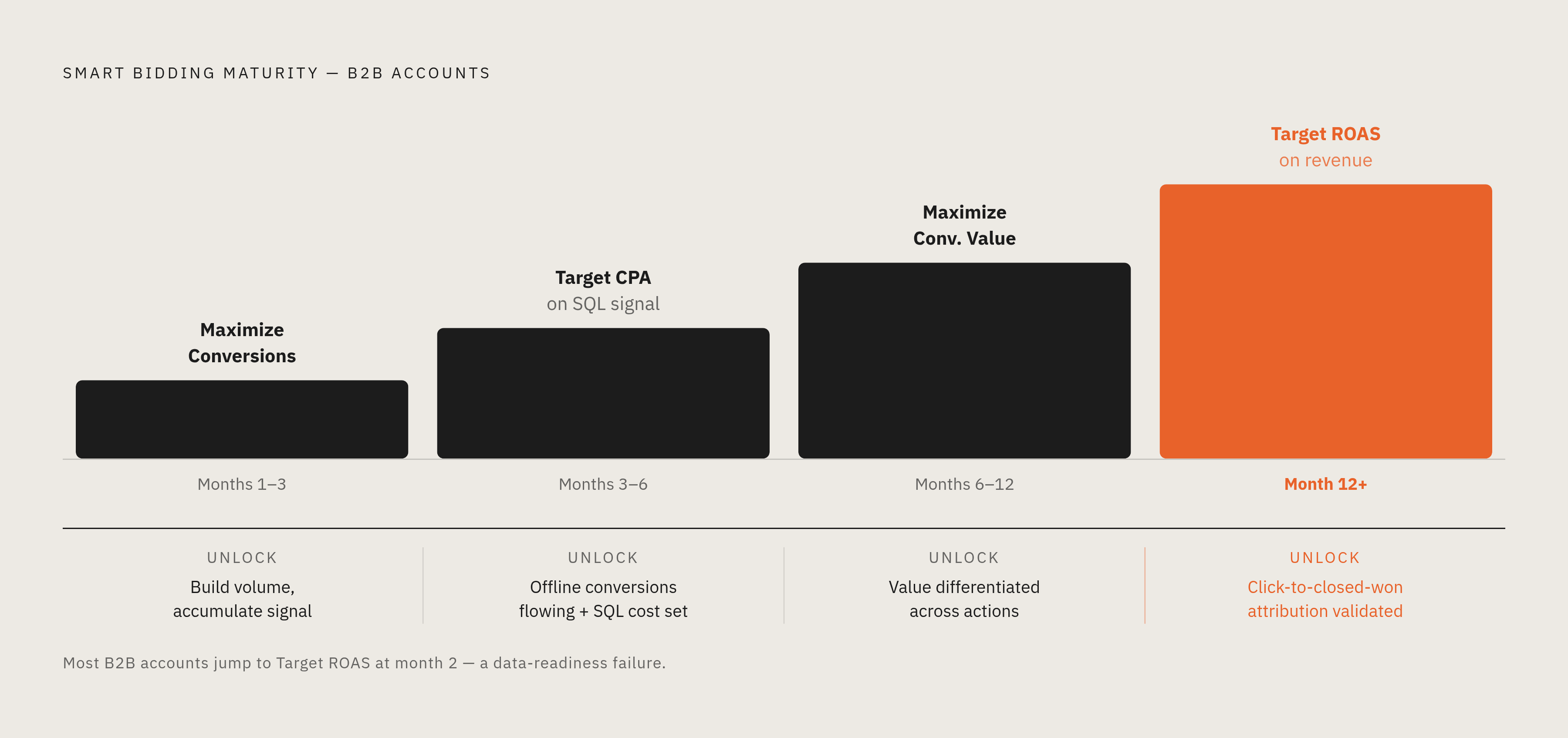
Neither strategy is a permanent destination. The right choice evolves as the account matures and attribution improves.
The progression that makes sense for B2B SaaS with three to twelve month sales cycles looks like this:
- Months 1–3. Run Maximize Conversions. Build volume. Accumulate signal. Identify which patterns actually convert before you set any targets at all.
- Months 3–6. Move to Target CPA on SQL signal. Once offline conversions are flowing and SQL cost is measurable, set the target there.
- Months 6–12. Introduce Maximize Conversion Value. Start differentiating value across conversion actions as deal-stage data accumulates.
- Month 12 and beyond. Consider Target ROAS on revenue. Only when the attribution chain from click to closed-won is validated and reliable.
The most common mistake is jumping straight to Target ROAS at month two because it sounds more sophisticated. The conversion volume and value data to support it simply do not exist yet. It's a data readiness problem, not a sophistication problem.
One mechanical issue worth flagging. Switching strategies too frequently is its own failure mode. Every strategy change triggers a two-to-four-week learning period. Switch three times in three months and you've spent six or more weeks in volatile, unpredictable performance. A reasonable rule of thumb: lock a strategy for at least eight weeks before evaluating whether it's working.
Broad match keywords can accelerate the progression here. They let the algorithm explore additional auctions and learn faster, pairing well with Smart Bidding as conversion data accumulates. For long-cycle verticals like cybersecurity, fintech B2B, and HR tech, offline conversion uploads matter at every stage of this progression. Bidding on form fills in those categories produces too much low-quality signal regardless of which Smart Bidding strategy is active.
A Platform Change Arriving August 2026 That Affects Budget-Limited Campaigns
This one is worth knowing before it catches you off guard.
Effective August 17, 2026, Google is changing how Target CPA and Target ROAS campaigns behave when they're constrained by budget. It also involves a naming update: "Maximize conversions with a Target CPA" becomes simply "Target CPA." "Maximize conversion value with a Target ROAS" becomes "Target ROAS." The underlying bidding behavior is unchanged.
The behavioral change to budget-limited campaigns is more consequential.
Current behavior: many budget-limited campaigns outperform their bidding targets. Smart Bidding enters only the auctions most likely to convert efficiently, so actual CPA ends up lower than the stated target, or actual ROAS ends up higher.
Post-update behavior: Google will optimize those campaigns more closely toward the advertiser-set target. More predictable performance when you adjust budgets. But if your account was benefiting from that self-correction, you may see performance degrade.
What to do before August 17:
- Identify budget-limited campaigns running Target CPA or Target ROAS
- Check whether current performance is exceeding the stated targets (actual CPA lower than target, or actual ROAS higher than target)
- If it is, lower your bidding target before the rollout to reflect actual performance. Google is providing a Bid Target Adjustment Tool and account notifications to flag affected campaigns.
Target-setting discipline becomes more consequential after this change. The "set it and forget it" approach that worked when the algorithm self-corrected will produce worse outcomes on the other side of August.
How Broken Attribution Causes Smart Bidding to Optimize Against Pipeline
The bidding strategy debate is actually secondary to a more fundamental problem: what signal is the algorithm receiving in the first place?
Consider the canonical B2B failure mode. A B2B SaaS company scales Google Ads budget. Conversions go up. Pipeline doesn't move. Smart Bidding had optimized for trial sign-ups instead of revenue-adjacent events. The algorithm did exactly what it was asked to do. It just wasn't asked the right question.
The fix, in that documented case, was rebuilding the conversion architecture around offline CRM signals. MQL, SQL, and opportunity data were imported back into Google Ads with timestamps. Bidding shifted to optimize for qualified pipeline. The result was roughly tripled SQL volume and a substantially reduced customer acquisition cost.
Why does this keep happening? Because a significant portion of B2B leads are not sales-ready when first generated. If the algorithm is trained on form fills, it's being trained on a population that mostly isn't going to buy. More signal isn't better signal when the signal is wrong.
The attribution chain that makes Smart Bidding work in B2B looks like this:
- CRM captures lead stage progression (MQL to SQL to opportunity to closed-won)
- Offline conversion imports push those signals back into Google Ads with timestamps
- The bidding strategy is set to the conversion event closest to revenue that still has enough volume (30 or more per month per campaign)
- For Target ROAS: deal values from the CRM are passed back as conversion values
One more concept worth introducing here. Pipeline velocity. The number of days from form fill to SQL, SQL to opportunity, opportunity to closed-won. A 28-day form-to-SQL conversion is worth more to your campaign intelligence than an 84-day conversion at the same rate. Faster feedback loops mean the algorithm learns faster. It compounds.
PriceLabs is a useful example of what this looks like at scale. They moved from 0.7x to 2.5x ROAS by migrating to Target CPA with offline conversion uploads, training Google to optimize toward closed-won deals rather than form fills. The strategy didn't change as much as the signal did.
Choosing Between the Two Strategies in Practice: The Decision Logic
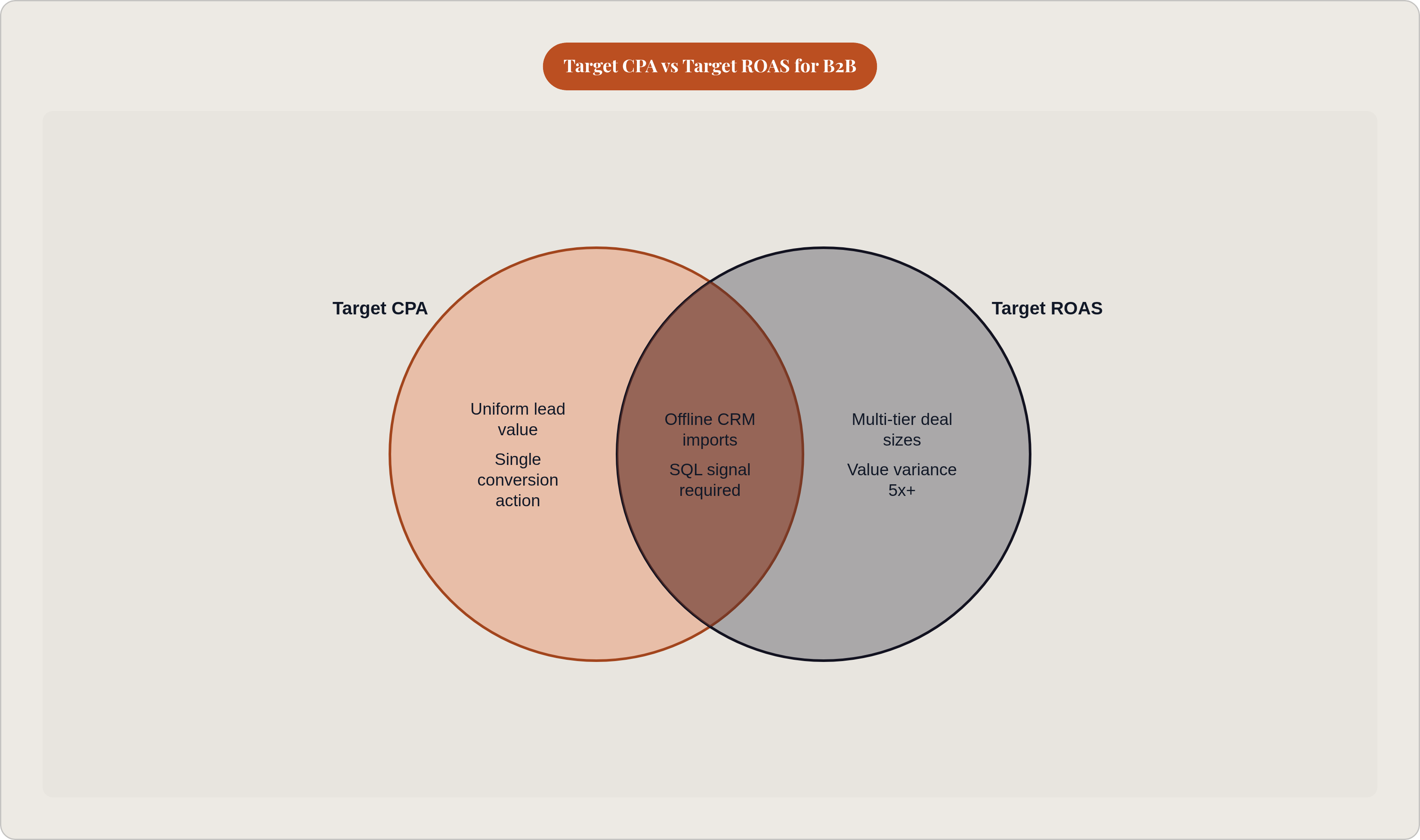
All of this collapses into three questions. Work through them in order.
First: Do you have 30 or more conversions per campaign per month?
If not, neither strategy is ready. Run Maximize Conversions to build signal first. This isn't a consolation prize. It's the correct starting point.
Second: Does lead value vary meaningfully and measurably across conversion actions or deal tiers?
If no, Target CPA is your answer. If yes, and you have 50 or more conversions per month with CRM value pass-through, Target ROAS becomes viable.
Third: Do you have offline conversion imports connecting CRM stage data back to Google Ads?
If not, fix this before choosing a strategy. It matters more than which strategy you pick.
In most B2B accounts, the answer is: you're not ready for Target ROAS yet, and that's fine. Target CPA with SQL as the primary conversion event and offline imports active is not a stepping stone. It is the correct steady state until you can prove value variance with real data.
Target ROAS is the right upgrade when ACV is $25K or higher, deal-size variance is five times or more across segments, conversion volume exceeds 50 per month per campaign, and CRM-to-ads attribution is validated, not assumed.
The hybrid approach for multi-tier portfolios: Target ROAS on enterprise campaigns with high deal-value variance, Target CPA on entry-level or lower-ACV offerings. This works only when the enterprise side actually meets the conditions above.
B2B attribution is messy, sales cycles are long, and the algorithm can't solve problems you haven't given it data to see. The goal isn't to find the perfect bidding strategy. It's to give the algorithm the best available signal, then pick the strategy that matches what you can actually measure.
Start there. Everything else follows.