Maximizing Impression Share for High-Intent B2B Keywords
Split impression share targets by keyword intent to capture deals at the bottom of your funnel.

Impression share only tells you something useful when it's tied to buyer intent. A campaign showing up 80% of the time on "what is CRM" and a campaign showing up 80% of the time on "enterprise CRM software demo" are not achieving the same thing, even though the number on the dashboard looks identical. One of those is a rounding error. The other is pipeline.
Most teams chase one blended IS number across the whole account, treating 80% as a win no matter what it's attached to, without asking what the term was actually for.
How funnel stage should determine your IS targets, not campaign-level averages
Start with a simple question: what is this keyword actually for?
If the answer is "closing a deal," the target should be aggressive. If the answer is "someone Googling a term they heard in a meeting," the target should be modest, maybe even low. Averaging those two together into one campaign-level IS number hides the thing you actually need to know. It can sit at a healthy-looking 55% while the bottom-funnel terms underneath it are bleeding out at 40%, propped up by top-funnel volume nobody is scrutinizing.
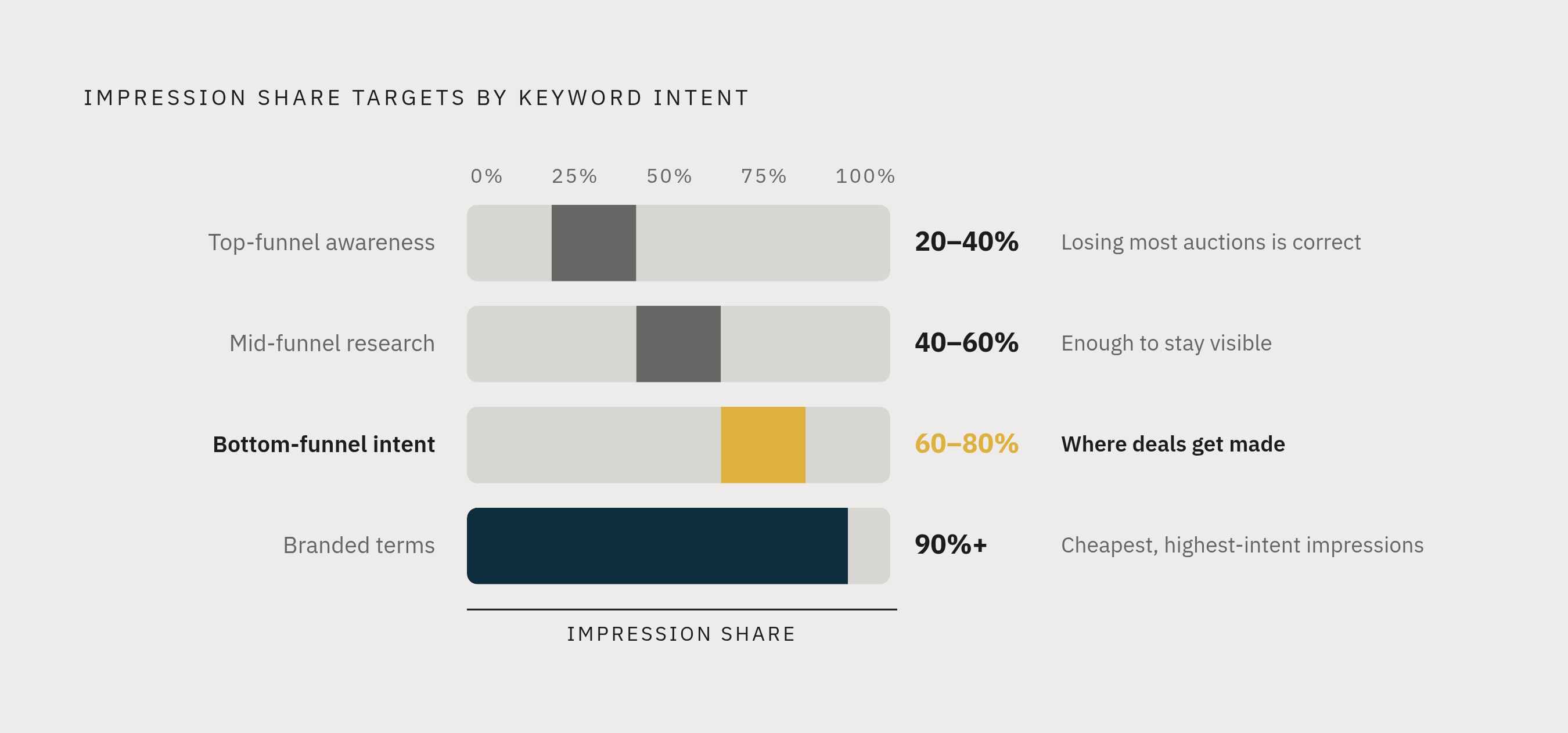
Here's a four-tier model, based on intent:
- Bottom-funnel, high-intent terms (competitor alternatives, pricing, demo requests, "[category] + buy" phrases). Target 60-80% IS. This is where deals get made.
- Mid-funnel, research terms (people who know they have a problem and are comparing solutions). Target 40-60%. Enough to stay visible, not enough to burn budget chasing every impression.
- Top-funnel, awareness terms (broad, informational, early-stage curiosity). Accept 20-40% IS. Losing most of these auctions is typically the correct outcome, not a failure.
- Branded terms (your own company name, product name). Target 90%+. These are the cheapest, highest-intent impressions available, and letting a competitor's conquest ad sit above yours here is a costly mistake.
Drop below 50% IS on your core money keywords, and real revenue is often sitting uncaptured. Push above 80% on non-brand terms, and you're paying a premium for the last few impressions in the distribution — the ones that tend to convert worse than everything before them.
IS targets need checking against pipeline results on a regular basis, rather than typed in once at launch and forgotten.
The campaign architecture that makes tiered IS targets operationally possible
Tiered targets sound good on a slide. They only work if budget can move independently between tiers, and in most accounts it can't, because budget gets allocated at the campaign level. Mix high-intent and low-intent keywords into the same campaign or ad group, and they fight over the same dollars, with nothing protecting the bottom-funnel terms from getting eaten by the top-funnel ones.
The fix is structural, not a bidding tweak. A four-campaign structure works for B2B search on Google:
- Campaign 1 (Brand). All branded keywords, exact and phrase match. Use Target Impression Share bidding here. This campaign exists partly to keep competitors from running conquest ads on your own name.
- Campaign 2 (High-intent non-brand). Competitor alternatives, pricing queries, category-plus-buy-intent phrases. Phrase and exact match, target CPA bidding. This is where IS discipline matters most, because every dollar here is close to a decision.
- Campaign 3 (Mid-intent non-brand). Problem-aware, solution-aware search terms. Phrase match, max conversions bidding, so the algorithm has room to learn. Lower IS here is typically by design, not by accident.
- Campaign 4 (Retargeting). Website visitors segmented by behavior: who hit the pricing page, who hit the demo page, who spent a lot of time browsing. IS matters less here, because audience data is already doing much of the work impression share does elsewhere.
If value-based bidding is in play, split intent tiers by ad group inside one campaign instead of by separate campaigns. Google's bidding algorithm needs clean signals about which conversions are worth more, and it reads those signals at the ad group level.
Negative keywords matter here too, functioning as a budget-protection tool rather than an afterthought: they stop spend from leaking into searches that were unlikely to convert. When a high-intent campaign loses impression share because it ran out of budget mid-day, wasted spend on the wrong queries is often what pushed it there.
B2B buyers run a lot of searches, over a long stretch of time, before they ever land on a vendor's site, and the buying cycle often runs well into the decision stage before sales is ever contacted. Campaign architecture needs to support that whole stretch, rather than just the one moment someone finally clicks.
The three levers that actually move impression share on bottom-funnel terms
When impression share drops on a high-intent campaign, Google Ads will tell you why:
- Lost IS (budget): the campaign ran out of money before the day was over. The impressions were available. The money wasn't.
- Lost IS (rank): the budget was there, but the ad lost the auction anyway. Quality Score, bid, or both, came up short.
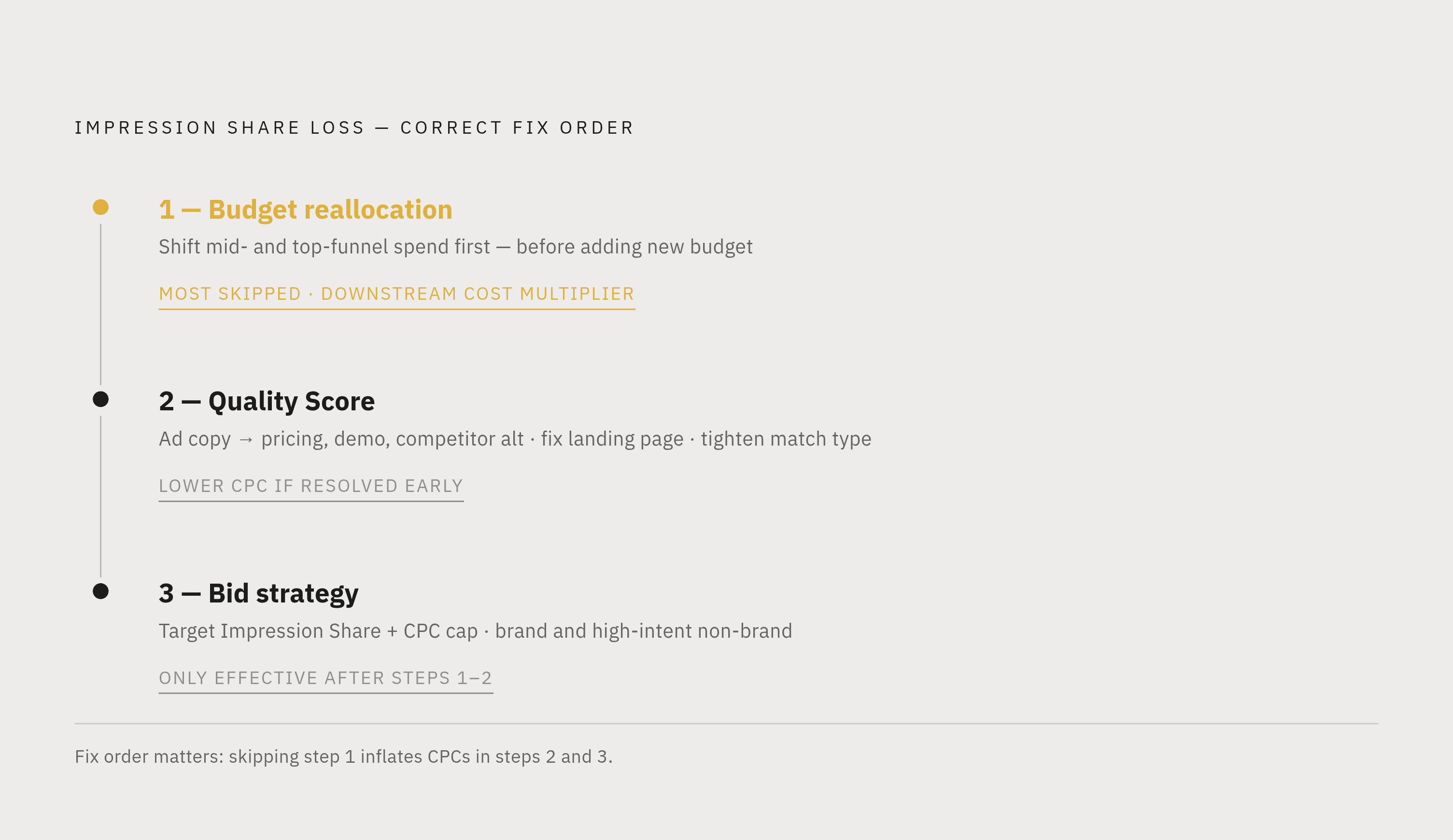
Diagnosing which one it is comes before fixing anything. Here's the order that works, cheapest lever first:
Lever 1: Budget reallocation, not budget increase. Before adding a single new dollar to the account, move money out of the mid- and top-funnel campaigns and into the high-intent ones. Losing impression share on awareness terms on purpose is what funds winning it on the terms that close deals.
Lever 2: Quality Score. Three parts to this:
- Expected CTR: ad copy has to match the exact buying signal in the query. "Pricing," "demo," "alternative to [competitor]" need to show up in the ad itself. Generic copy tends to lose auctions even against a competitive bid.
- Landing page experience: where the click lands matters to Google, and it matters to the buyer. Sending high-intent pricing traffic to a generic homepage costs twice: once on Quality Score, once on conversion rate.
- Ad relevance: exact and phrase match on bottom-funnel terms keeps this predictable. The looser the match type, the messier the signal.
Lever 3: Bid strategy. Target Impression Share bidding lets a campaign manager set a target percentage, choose page location (top of page vs. absolute top), and cap CPC so the strategy doesn't just pay any price to win. This fits brand campaigns and high-intent non-brand campaigns well, where IS is the actual goal. It fits mid-funnel campaigns poorly, where the real goal should be conversion efficiency, not visibility.
Fix Quality Score before raising bids. Fix budget allocation before asking for more budget. Pulling the expensive lever first, before checking the cheap ones, tends to compound wasted spend.
When low IS on a high-intent term is actually a signal to scale, not just a problem to fix
Low impression share on a core money keyword isn't automatically a problem to patch. Sometimes it's one of the clearest signs in the account that more spend would pay off — but only if pipeline quality backs it up, and this is where a lot of teams jump the gun.
Two conditions, and both need to be true before you scale:
- Impression share on the high-intent campaign sits below roughly 70%.
- SQL-to-Won conversion rate sits meaningfully above the median benchmark.
Condition one says there are winnable impressions being missed. Condition two says the leads already coming through are real, sales-qualified pipeline, not just volume. Scale spend to win more of a low-quality keyword's impressions without checking condition two, and cost goes up without pipeline following it.
There's a ceiling too. Once impression share on core non-brand terms is already sitting above 85%, more budget tends to buy less and less. The remaining impressions are the ones the most aggressive competitors already priced up.
There's a bigger complication underneath all of this for B2B specifically: at any given moment, most B2B buyers are not actively shopping. Winning every available impression on bottom-funnel search terms only ever touches a slice of the total market, because most of the market isn't searching yet. Impression share optimization is a precision tool. It sharpens performance inside a pool of active buyers, but creating that pool is outside its job.
So what happens once IS hits its ceiling on Google? The constraint has shifted from winning auctions to the size of the addressable, in-market audience. At that point, the right move is often demand creation elsewhere, on channels like LinkedIn, aimed at the buyers who aren't actively searching yet, rather than more Google budget chasing the same buyers who are already being reached.
What IS metrics alone cannot tell you about pipeline health
Impression share answers one question: how often did the ad show up? It says little about whether showing up turned into a real opportunity. That gap is a big reason IS gets misread as a media metric instead of a pipeline metric.
Part of the problem is attribution, and this is where a lot of B2B teams are quietly measuring the wrong thing. Tools like GA4 tend to label a conversion as "Direct traffic" once there's a gap between sessions, even when a paid search click started the whole journey. Given how long B2B buying cycles run and how many touches happen before a deal closes, that mislabeling adds up fast, making high-intent search campaigns look weaker than they actually are.
The practical risk: if attribution is broken, the keywords that look like underperformers on a dashboard might be the ones actually driving revenue. Cut IS targets on those terms based on flawed conversion data, and a working program can get dismantled by mistake.
A three-tier attribution model corrects for this:
- Tier 1: GA4 data-driven attribution, used for setting annual budget across channels.
- Tier 2: Platform data inside Google Ads, used for campaign-level IS and bid decisions.
- Tier 3: CRM closed-won revenue, the ground truth for which keywords actually sourced real pipeline.
This entire structure depends on GCLID capture flowing into the CRM. Skip that step, and Tier 3 doesn't exist — there's no way to check IS investment against actual closed revenue.
Landing pages sit inside this same loop. Pages rebuilt to match the specific intent of the keyword sending the click tend to see a real lift in conversion rate. IS spend only turns into pipeline if the page on the other side of the click can close the gap between a click and a sales conversation.
How to read IS performance as a pipeline diagnostic, not a media metric
The right question to ask isn't "are we visible enough?" It's "are we winning the auctions where pipeline actually gets built, and do we know what happens after the click?"
A workable review rhythm:
- Weekly: check IS by campaign tier. Flag any high-intent campaign that drops below its floor, and figure out fast whether it's a budget loss or a rank loss.
- Monthly: line up IS on high-intent terms against MQL-to-SQL conversion rates. IS dropping while conversion holds steady points to a budget problem. IS holding steady while conversion drops points to a landing page or offer problem, rather than an auction problem at all.
- Quarterly: trace IS by keyword back into the CRM. Are the keywords getting the highest IS targets actually the ones showing up in closed-won deals?
Each check depends on the last to mean anything — together they're what separates a budget problem from a rank problem from a landing-page problem. IS without conversion data is just a media metric wearing a pipeline costume.
IS targets, conversion rates, and revenue attribution belong in the same view, checked on the same cadence, adjusted together. The account that keeps IS discipline tied to actual closed-won data is usually the one measuring the right thing in the first place.