Shared Budgets and Budget Segmentation in Multi-Campaign B2B Accounts
Optimize ad spend by splitting campaigns based on business goals, not convenience.

B2B digital ad spend is on track to hit tens of billions of dollars globally by the end of 2025, growing 13% year over year. That's a lot of money moving through Google Ads and LinkedIn campaigns that, in most accounts, are still governed by whatever budget structure got set up on day one and rarely revisited since. This piece is about that gap: the difference between a budget structure that exists and one that actually sends dollars toward the campaigns most likely to produce qualified pipeline.
Here's how it usually happens. An account starts small: one campaign, one offer, one geo. Then it grows the way most accounts grow, by addition. A new region gets added. A new product launches. Someone tries LinkedIn because a competitor is there. Nobody sits down to ask whether the original budget logic still makes sense once there are twelve campaigns instead of one. The question rarely comes up.
What piles up underneath that growth is a set of campaigns that matter very differently to the business, all fighting over the same pool of money. A high-volume, low-cost campaign selling a legacy product will often out-compete a smaller campaign selling the thing sales actually wants to close this quarter, simply because the algorithm can see more clicks coming from the first one. Platforms optimize toward what they can measure fast and cheap: impressions, clicks, form fills. None of that tells you which leads turn into pipeline. That's a judgment call platforms aren't built to make.
Then comes the complexity trap. More campaigns mean more rows in the reporting dashboard, and more rows feel like more control. That feeling is misleading. Without a real reason for how those campaigns are split up, all those extra rows just add noise. More data, worse decisions. That's the setup this piece works through, section by section: what shared budgets do and where they fall short, what segmentation logic B2B accounts actually need, how Google and LinkedIn require separate playbooks, and where AI agents fit into managing all of it without pretending they can replace the judgment calls that still belong to a person.
What shared budgets in Google Ads actually do (and where they break down in B2B accounts)
A shared budget in Google Ads is exactly what it sounds like: one daily budget number, split across several campaigns, with Google deciding in real time which campaign gets more of it. The system pulls dollars toward whichever campaign is bumping up against its limit and pulls back from the ones with room to spare.
On paper, that's a good deal. Fewer campaigns get capped early in the day. Spend paces more smoothly. Less babysitting for whoever runs the account.
But there's a wall here that trips a lot of B2B accounts up: shared budgets don't work with Performance Max, Smart Shopping, App campaigns, or Hotel campaigns. Plenty of B2B accounts run PMax next to Search campaigns these days, which means shared budgets simply aren't an option across the whole account. It's a partial fix, and only for certain campaign types.
The case for pooling budget anyway is a real one: when Google's bidding system sees more conversions flowing through one pool, it learns faster and cost per conversion tends to drop, because the algorithm isn't working with a fragmented, thin data set. That part checks out.
Where it falls apart for B2B accounts is at the point where campaigns aren't actually pursuing the same goal. A campaign built to fill the top of the funnel with a cheap, high-volume offer and a campaign built to close deals with a target account list are not the same job, even if they sit in the same Google Ads account. Put them on a shared budget and the cheap, high-volume one tends to win the fight for dollars, because it looks better on the metrics the algorithm can see. The higher-value campaign gets starved not because it's worse, but because it's quieter.
Geographic splits have their own version of this trap. Breaking a campaign into country-by-country segments feels like good hygiene (it gives you tidy reporting rows for each market), but it's only worth doing when those markets are meaningfully different: different bid prices, different language, different offer, different service coverage. If performance across regions looks basically the same, splitting them apart just thins out the conversion data each campaign has to learn from, and Google's bidding gets worse at its job.
There's a quieter fix that gets skipped a lot: labels. Tagging campaigns by margin tier, funnel stage, or which experiment cohort they belong to gives an account manager the same reporting clarity as a structural split, without breaking a single pool of data into five smaller, weaker ones. It's the analytical benefit of segmentation without the cost.
The segmentation logic that B2B accounts actually need
Here's the rule that should sit underneath every decision about campaign structure: split campaigns apart when they serve different business goals, not when it's convenient for reporting. If two campaigns have different margins, sit at different funnel stages, or target different types of buyers, they need different budget envelopes and different bid targets. Keep them together and let the data pool whenever those distinctions don't apply.
Two patterns come up again and again.
Offer segments. A core, established product and a newly launched one rarely have the same acceptable cost per lead or cost per pipeline dollar. The new launch might be worth paying more to acquire because it's strategically important, or it might need a lower cost ceiling because the margins are thin early on. Either way, mixing that budget with the core product's campaign means one of them is quietly subsidizing the other, usually without anyone noticing until the quarterly numbers come in strange.
Geographic segments. Same logic as before: split by geography only when the regions meaningfully differ in offer, language, or who controls the budget on the buying side. Splitting purely to get a country-by-country report is a reporting decision dressed up as a strategy decision.
The bigger axis, though, is funnel stage. Demand capture (campaigns chasing people who are already searching with clear intent) and demand education (campaigns reaching people earlier in the process) behave nothing alike. Different conversion timelines. Different cost per lead. Different contribution to the pipeline number sales actually cares about. Putting them in the same budget pool means comparing apples to something that isn't even fruit.
As a rough starting point (not a rule to follow blindly): most B2B accounts should put the bulk of their budget into bottom-funnel, high-intent Search campaigns, with a meaningful chunk going to mid-funnel and top-funnel efforts. But "meaningful" isn't a fixed number. It should track wherever the account can actually show pipeline coming from, not wherever it's easiest to rack up volume.
A useful way to think about the three jobs budget can do: demand capture (catching people already looking), demand education (helping people who are looking but not sure why yet), and demand creation (making people aware they have the problem in the first place). Treat these as three separate pools, and shift weight between them based on wherever pipeline growth is actually stuck, not wherever the platform's algorithm wants to push more spend.
One structural wrinkle worth naming: as Google continues expanding its AI-driven campaign tools, some previously separate campaigns may become safe to fold back together, since broader automated matching is already casting a wider net on its own. But that consolidation only makes sense if the campaigns being merged were actually chasing the same goal to begin with. Automation shifts where the line for segmentation sits; it doesn't remove the need for the logic itself.
Why LinkedIn's budget architecture demands its own logic, separate from Google's
Google and LinkedIn aren't doing the same job, and treating their budgets with the same rulebook is where a lot of accounts go wrong.
Google is good at catching someone at close to the exact moment they're looking for a solution. What it can't do is tell you whether that person is a decision maker, a junior researcher doing homework for their boss, or someone with zero budget authority. LinkedIn flips that almost entirely: it can target by job title, seniority, and company, with real precision on who someone is. What it can't tell you is whether that person is in-market today, next quarter, or not at all. Good on who, weak on when.
LinkedIn's budget also lives at a different structural level. On LinkedIn, the budget sits at the campaign level, which means every distinct audience, every ad format, every targeting approach needs its own budget envelope to be measured on its own terms. There's no shared-budget shortcut here the way there sometimes is on Google.
Format matters more than it looks like it should. Video Ads, Thought Leader Ads, Document Ads, and Message Ads all reach someone in a completely different context: scrolling a feed versus opening a direct message versus downloading a PDF. Lump them into one campaign and it becomes hard to tell which format actually drove a qualified lead and which one just ran up impressions.
A workable starting split: put the majority of LinkedIn budget behind campaigns with a track record, ones where cost-per-SQL is already proven out. Cap experimental targeting or new formats at a meaningful minority share. Then check that split regularly and move money as the evidence comes in, rather than setting it once and walking away.
On lead quality: LinkedIn Message Ads tend to convert to SQL at a noticeably higher rate than display advertising. But the cost per lead on LinkedIn also tends to run higher than on other paid channels. Put those two facts together and the conclusion is straightforward: judging LinkedIn on cost-per-lead alone will make it look worse than it is. MQL-to-SQL conversion rate is the number that actually reflects what LinkedIn is good at.
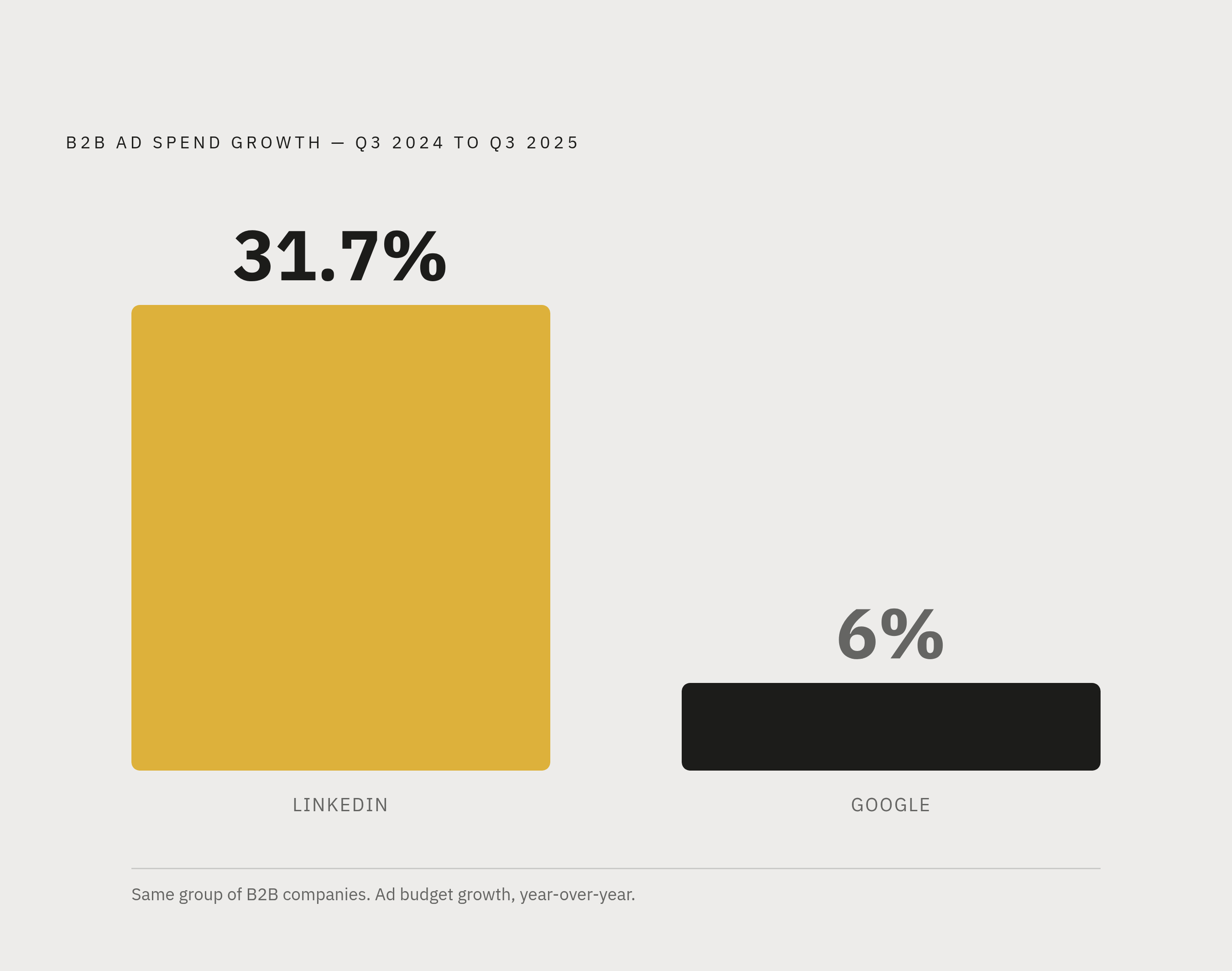
There's a spending shift underway that backs this up. Between Q3 2024 and Q3 2025, B2B companies grew LinkedIn ad budgets by 31.7%, while Google ad spend in the same group grew only 6%. That's more than LinkedIn having a moment. It reflects real pressure building on paid search: more competitors bidding on the same terms, automated bidding compressing margins, and buyer behavior shifting earlier in the funnel, to places search can't reach yet.
How to allocate budget between Google and LinkedIn at the account level
Before splitting a budget across two channels, there's a floor question worth asking first: is there even enough money to test either channel properly? Spread a modest monthly budget across Google Search, LinkedIn, and maybe a third channel, and the result is often nothing measurable anywhere. Concentration beats diversification when the total pool is small. Pick the two channels that matter most and fund them enough to actually learn something.
Once that's settled, the Google-versus-LinkedIn split is really a funnel question, not a channel preference:
- Bottom-funnel: Google Search owns the moment someone has already named their problem and started looking for a fix. That's high-intent, in-market demand, and Search is built for catching it.
- Mid-funnel and top-funnel: LinkedIn reaches the people who'll eventually be part of a buying decision, before they're actively searching for anything. That's the moment to build familiarity and trust, not to ask for a demo.
So the right split isn't a fixed ratio pulled from an industry benchmark. It's dictated by where pipeline is actually leaking out of the account today.
A concrete version of this: accounts that have shifted budget toward LinkedIn without increasing total spend have reported improvements in SQL conversion rates, precisely because LinkedIn's targeting precision means more of those leads match the actual buyer profile.
For context on baseline costs: average Google Ads cost per lead for B2B landed at $70.11 in 2025, according to WordStream, up just 5.13% from the year before. That's mild inflation, nothing dramatic. The real story isn't CPL creeping up. It's what happens after the lead comes in: whether it turns into pipeline. That's where channel mix does far more work than shaving a few dollars off cost per lead.
None of this is a set-it-once decision. Whatever split makes sense at launch will likely need revisiting six months later. Review performance weekly, and reallocate monthly based on cost-per-SQL, not cost-per-lead. That's the discipline that keeps budget from sliding back toward whichever channel just looks cheap on the surface.
What good budget governance looks like in practice across a multi-campaign account
Setting up a good budget structure and keeping one running are two different jobs, and most accounts only do the first one. New campaigns get added. Old ones that stopped working sit unpaused. Bit by bit, the platform's defaults quietly take over decisions that used to follow a real strategy, and nobody notices until performance is already off.
Two separate management actions get confused with each other a lot, and it's worth keeping them distinct:
- Pacing is making sure each campaign spends its budget on schedule, not blowing through it by noon or leaving money on the table at the end of the month in a way that throws off the performance data.
- Reallocation is deciding to shift budget from one campaign or channel to another because it's producing pipeline more efficiently. That's a strategic call, made on its own schedule, not something to bundle into daily pacing checks.
Shared budgets do have a legitimate home: geographic campaigns in the same region, with a similar offer and similar bid economics, where the only goal is to stop one country from eating the whole budget. That's a narrow, specific use case, and a poor reason to default every campaign in the account into a shared pool.
The filter that keeps all of this honest is cost-per-SQL. Campaigns beating the target get more budget. Campaigns missing it get less, or get paused outright. The discipline is in using SQL as the bar, not MQL and not cost-per-lead, because those earlier metrics reward the campaigns that generate the most volume, not the ones generating the most revenue.
Zoom out further and there's a health check that no amount of fiddling inside individual campaigns can substitute for: is the account's total spend generating enough pipeline to hit the number the business actually needs? If the answer comes back negative, the problem might not be a bid strategy issue inside one campaign. It might be that the budget is split wrong across the whole account, and no amount of optimizing a losing campaign is going to fix that.
And some calls just need a person accountable for the business outcome, not a dashboard. Pausing a brand campaign in the middle of a product launch. Pulling budget away from a channel the sales team happens to love. Deciding which experiment gets funded next quarter and which one gets shelved. None of that comes out of a performance report. It comes from someone weighing tradeoffs the platform has no way to see.
How AI agents change budget management in multi-campaign accounts (and what they don't resolve)
Here's the scale problem that makes AI agents worth talking about at all: watching pacing, catching budget drift, reacting to performance shifts across a dozen campaigns on two or three platforms, all at once, all the time. That's more volume and more speed than most teams can track continuously while still paying attention to the signals that actually matter.
What an AI agent can take off someone's plate: bid adjustments, pacing corrections, flagging anomalies, pulling performance reports, reading audience signals. That's the operational layer (the constant small adjustments that used to eat up hours), running in between the bigger strategic calls a person still has to make.
There's a compounding benefit worth noting too. An agent running across an account over time builds up a record of what targeting, what creative, and what audience segments actually generated pipeline. So a reallocation decision made in month six is drawing on months of accumulated evidence, something a brand-new manager or a newly hired agency starts without.
But here's the limit, and it's an important one: an agent can't decide which campaigns should exist in the first place. It has no basis for deciding what business objective a campaign is supposed to serve, or what an acceptable cost-per-SQL looks like for a brand-new offer nobody's sold before. Those are judgment calls that need business context no platform, however well-tuned, can supply on its own.
Gartner projects that 40% of enterprise applications will carry task-specific AI agents by the end of 2026, up from a small fraction of enterprise applications in 2025. The infrastructure is arriving fast. But deciding what those agents should be optimizing toward (that governance layer) still needs a person on the hook for the outcome.
The most useful thing a good AI-assisted budget system can do isn't spending faster or bidding smarter. It's diagnosis: figuring out whether a pipeline shortfall is a budget allocation problem, a creative problem, a landing page problem, or a gap in how conversions are being tracked in the first place. The wrong answer (the one a system defaults to if nobody's watching) is usually "spend more" or "change the bid strategy." Sometimes that's right. Often, it's just the easiest answer to reach for, and it's worth asking whether it's the correct one before reaching for it.