Multi-Touch Attribution Models for B2B Paid Media
Most B2B deals involve multiple buyers, but standard attribution models only credit the last click.

A touchpoint is any moment you can actually track where a buyer, or someone on the buying team, bumps into your marketing. An ad impression. A downloaded case study. A webinar signup. A retargeting click. A demo request.
In B2B, you're almost never selling to one person. You're selling to a committee. Picture one deal, one contract, and three completely different paths that led to it:
- The VP of Sales saw your LinkedIn ad three times. Never clicked once.
- The Director of Ops read your case study and forwarded it to four people internally.
- The CFO Googled "your company vs. competitor" the week before signing.
Same deal. Three trails. Most attribution tools were built to follow one person clicking through a funnel, not a group of people quietly influencing each other over months. If your model only sees whoever clicked last, it's blind to the other five people who actually moved the deal.
There's also a split worth understanding: milestone touchpoints versus influence touchpoints. Some moments carry real commercial weight (first brand exposure, MQL conversion, opportunity creation). Others are more like supporting evidence, a blog post that confirmed a decision someone had already half-made. Models disagree, sometimes wildly, on whether to treat these the same or weight the milestones harder.
Without account-level tracking, the deal closes, and the credit goes to whoever clicked last. The actual journey, the one that dragged five other people through a committee decision over four months, just... disappears.
How each major MTA model distributes credit — and what that choice implies
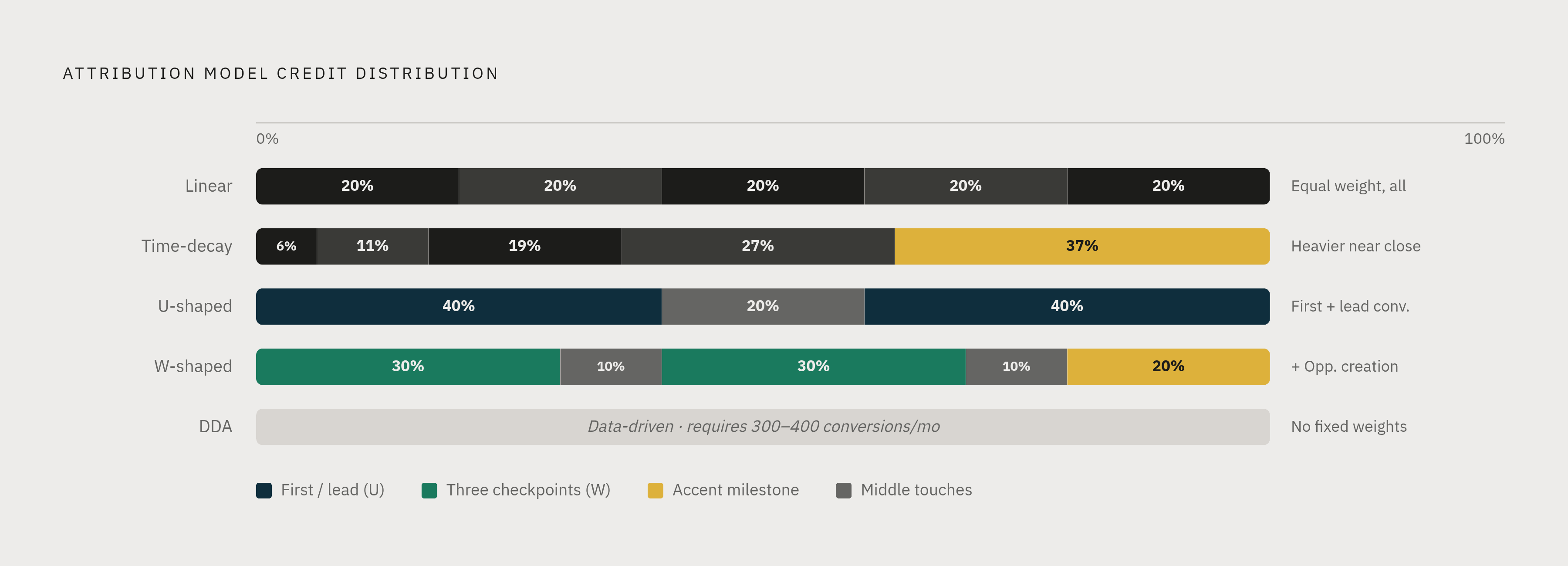
Every attribution model is really just a theory about which moments matter most. None of them are neutral. Picking one is picking an argument.
Linear model. Every touchpoint gets equal credit, no questions asked. It's the easiest place to start, and it'll give you a rough sense of which channels show up most often along the way. The catch: a brand awareness impression and an actual demo-request click get treated the same. They're worlds apart in practice.
Time-decay model. Touchpoints closer to the close get more credit. This maps to how a lot of B2B buying works, where someone disappears for three months to research quietly, then moves fast in the final two weeks. The tradeoff: it can starve the awareness channels that got the buyer's attention in the first place, even though that early exposure is arguably why the fast finish happened at all.
U-shaped (position-based) model. First touch gets 40%. Lead conversion gets 40%. Everything else splits the remaining 20%. The logic here is that introducing someone to your brand and converting them into a lead are your two highest-value moments, and that's a reasonable take for a mid-market company still balancing acquisition against conversion. The blind spot: it treats lead conversion like the finish line, when for most B2B deals, that's closer to the starting gun.
W-shaped model. Same bones as U-shaped, but it adds a third weighted moment: opportunity creation. Now you've got three commercial checkpoints instead of two. This tends to fit better when the gap between MQL and SQL is long and contested, which, if you sell into enterprise, is just... every deal. Marketing usually has fingerprints all over opportunity creation, and this model is the first one on this list that actually gives credit for it.
Data-driven attribution (DDA). The algorithmic option. Instead of a fixed rule, it studies your actual conversion patterns and works out the weights from the data itself. The catch: it needs volume, somewhere around 300 to 400 monthly conversions, before it has enough signal to be trustworthy. Below that threshold, you're getting noise wearing a lab coat instead of insight.
Worth knowing: GA4 quietly retired first-click, linear, time-decay, and position-based as primary options a while back, defaulting instead to DDA. If your reporting runs through GA4, this affects you automatically, whether or not you actually have the conversion volume to support it.
I've watched a version of this go sideways firsthand. A B2B SaaS team switched to first-click attribution specifically to prove their content program was pulling its weight. Content got the credit for starting journeys, so leadership tripled the content budget and gutted retargeting spend. Pipeline dropped hard within two quarters. Why? Because the nurture touchpoints quietly walking prospects through the middle of the funnel were invisible to a model that only looks at the very first click. The model was simply built to see something else entirely.
Pick the wrong model for your situation and you're off by more than a rounding error. You can talk yourself into gutting the channel that was quietly doing the heaviest lifting the whole time.
Matching the right model to where a B2B program actually is
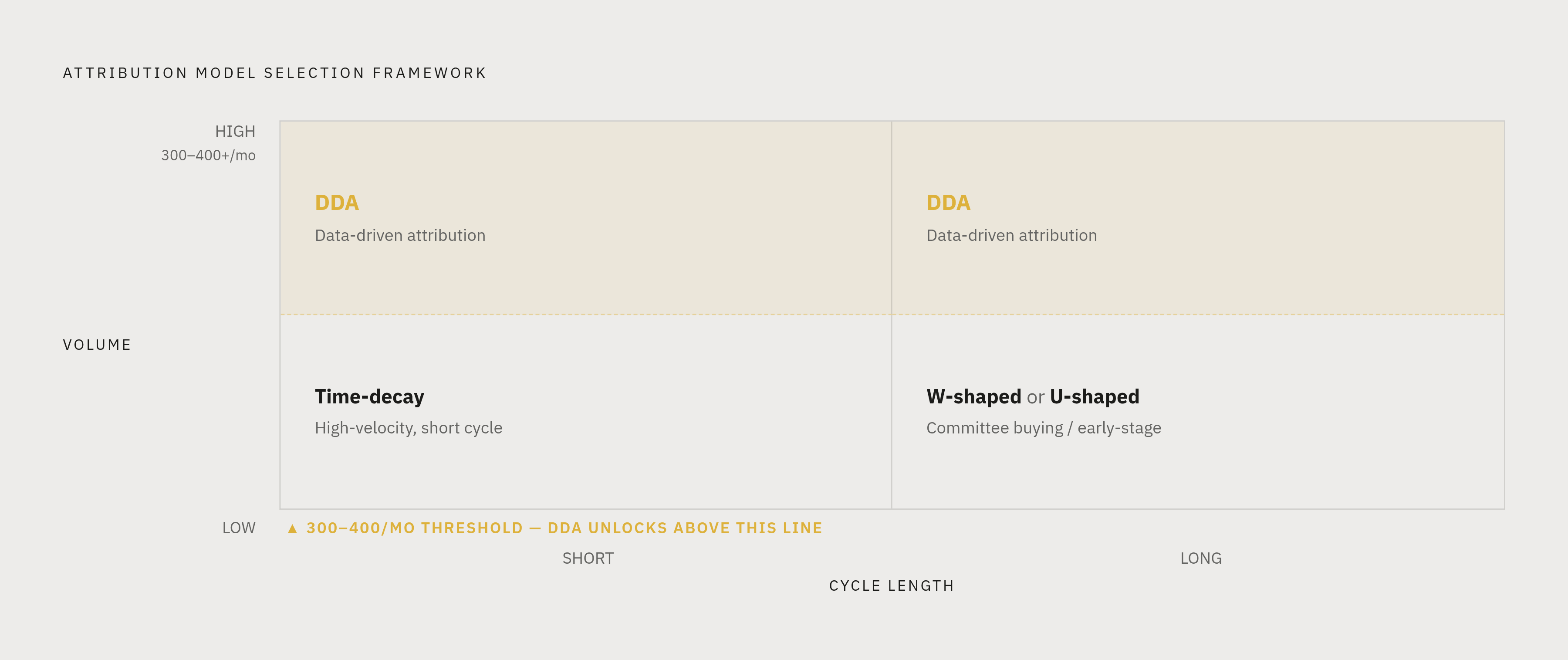
There's no permanent right answer here. The model should match where your program actually stands, rather than where you wish it stood.
- Early-stage programs, low conversion volume, thin CRM integration: start with U-shaped. It gives you both acquisition and conversion signal without needing the training data DDA demands.
- Long cycles with committee buying: W-shaped fits better, because opportunity creation is a real milestone marketing usually influences, not just a handoff point where sales takes over and marketing disappears from the story.
- Short, high-velocity cycles: time-decay makes sense, since the most recent touchpoints tend to be the most predictive of what's about to close.
- Enough volume (above that 300-400 threshold): let DDA do the work. It removes your assumptions about what matters and lets the data argue for itself.
Adoption is climbing fast, and a lot of that growth is teams running whatever model their CRM or ad platform defaulted to, rather than one they sat down and chose. That's inheritance, not implementation.
The infrastructure gap is bigger than the adoption numbers let on. A meaningful chunk of mid-market B2B companies run no multi-touch models at all, and when you ask why, the answer usually isn't strategic. It's practical: no dedicated marketing ops person to maintain it, or compliance concerns around the data connections it requires. This takes real people and real plumbing, and plenty of companies just haven't built either.
Before picking any model, ask the question most teams skip entirely: what business question is this actually supposed to answer? Channel credit, budget planning, and pipeline forecasting are three different jobs. They call for different tools. Picking a model before answering that is like buying a wrench before you know if you're fixing a leak or building a shelf.
What it actually takes to implement MTA across Google and LinkedIn
None of the model talk matters without the plumbing underneath it. Person-level and account-level tracking have to connect before any model can function at all. Ad platform IDs, CRM records, and revenue data all need a shared identifier. Skip this, and everything downstream is guesswork wearing a nice suit.
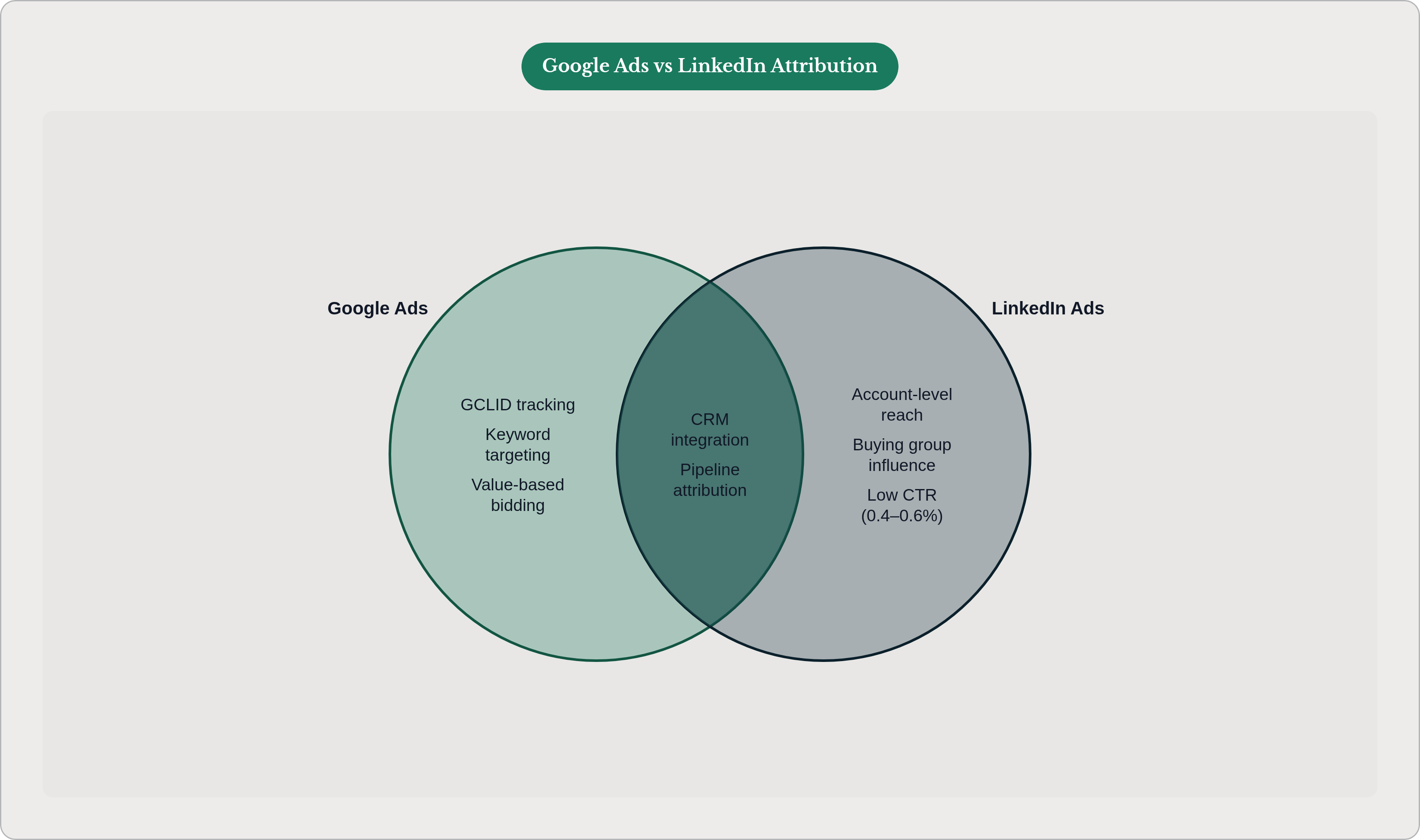
On Google Ads, the mechanism that makes this work is the GCLID loop. The Google Click ID follows the click through the landing page form and into the CRM record. When the deal closes, that revenue passes back to Google through offline conversion import. This is the whole trick behind value-based bidding: the platform learns to chase the keywords and audiences producing real closed revenue, rather than just form fills that might go nowhere.
One habit that trips people up constantly: hold off on broad match until you've got at least 90 days of offline conversion data flowing back into the system. Without that history, the algorithm optimizes toward the wrong signal, and you end up efficiently buying more of exactly the wrong leads.
On LinkedIn, the mental shift is different. LinkedIn's real strength isn't tracking individual leads, it's account-level influence. Judge campaigns by which target accounts moved forward, not which individuals clicked. That's a real reframe, because a huge share of B2B marketers use LinkedIn specifically for lead gen, and the measurement approach needs to actually match what the platform is doing in the funnel, not what it looks like it's doing.
LinkedIn's click-through rate usually sits somewhere around 0.4% to 0.6%, which looks anemic next to other channels if you're comparing raw numbers. But a tightly targeted campaign hitting a short list of high-value accounts can post a "worse" CTR and still produce far more pipeline than a broad campaign with prettier metrics. CTR alone tells you almost nothing about whether the thing is working. Connecting LinkedIn engagement to CRM account records is what actually lets you see this clearly instead of guessing.
Then there's the cross-platform problem. A real buyer touches both Google and LinkedIn, often in the same week. Your attribution model needs to treat that as one account journey, rather than two funnels quietly competing for credit behind your back.
Where this tends to fall apart: fragmented customer data, analysts stretched too thin to keep the connections alive, platforms quietly reverting to their own last-touch defaults the second nobody's watching. Teams that let this slide often find the whole thing degrading within six months, right back to the double-counting problem they started with.
One more piece worth mentioning: intent data. Most B2B tech marketers now use it to prioritize which accounts are worth chasing. Without it, your attribution model can't tell the difference between an account that was two weeks from buying and one that was just browsing. Intent data is what turns account-level attribution from "technically accurate" into "actually useful."
The pipeline metrics that MTA should actually connect to
Clicks look fine. Impressions look fine. Even form fills look fine. And pipeline can still be flat. That's the vanity metric trap, and it catches almost everyone at some point. The fix is connecting your model to opportunity creation and closed-won revenue, rather than just whatever conversions the platform happens to be able to see on its own.
A few benchmarks worth checking your program against: visitor-to-lead conversion is often cited around 1 to 3%, MQL-to-SQL around 15 to 21%, and opportunity-to-close around 20 to 30%, though these figures vary by source and segment and should be treated as rough reference points rather than hard benchmarks. If your numbers are way outside those bands, that's a signal something's off, and a good MTA model can help point at where.
At each stage, a solid model tells you something different:
- MQL-to-SQL: which channels bring in leads sales actually wants to work, versus leads that quietly die in the handoff
- Opportunity creation: which middle-of-journey touchpoints show up when accounts actually enter the pipeline, not just fill out a form
- Closed-won: which channel combinations, not single channels working alone, keep appearing in the journeys of deals that actually closed
Getting this right pays off. Teams that connect MTA properly tend to see real movement in cost-per-acquisition and a meaningful ROI lift within the first year. Budget starts flowing toward the combinations that actually correlate with pipeline, and away from the channels just inflating top-of-funnel numbers for the sake of a good-looking report.
There's also a shift happening underneath all this: a meaningful share of high-performing teams have already moved toward tracking buying groups instead of individual leads. Your attribution model has to keep up with that shift, or it starts telling you a story that no longer matches reality. A model still counting individual conversions one by one is going to miss the account-level pattern completely, and it'll keep insisting a channel is underperforming when really, it's just not being measured the way accounts actually buy.
The real value of a well-built MTA model isn't the report. It's the diagnosis. Is pipeline stuck because of a channel problem? A creative problem? A landing page problem? A handoff problem between marketing and sales? That's a much more useful answer than "spend more on whatever has the lowest cost per lead this month."
Why MTA alone doesn't solve the measurement problem in B2B
Here's the limitation nobody puts on the slide: MTA only sees what's trackable. Dark social shares, word of mouth, an analyst call, a colleague telling a colleague "you should really look at this vendor." None of that leaves a click trail. The model can't assign credit to influence it never observed. That's a limit on what's observable, period, rather than a flaw in the model itself.
Think back to how much of the buying process happens before someone ever raises their hand and talks to sales. If most of that process happens quietly, off the grid, then a model built mostly on click data is missing a huge part of the story by design.
Even a well-built account-level model only sees the committee members who clicked something. The person who read your content, formed a strong opinion, and pushed it hard in an internal meeting without ever clicking an ad? Often completely invisible to the system.
Long cycles add another wrinkle. A deal closing in month nine might trace back to a touchpoint from month one, sometimes even the previous fiscal year, sitting well outside whatever attribution window you've set up. The signal was real. The model just wasn't looking there anymore by the time it mattered.
So pair MTA with things that catch what it can't:
- Pipeline sourcing reports tracking opportunity origin by rep and channel
- Win/loss interviews that ask buyers directly what actually swayed them
- CRM velocity data showing how long accounts sit at each stage
Treat MTA as strong evidence, rather than as gospel. It gets more trustworthy as the implementation matures and more of the journey becomes trackable. It's probably never going to be the whole story, and that's fine.
How continuous campaign execution compounds attribution intelligence over time
Attribution models almost never show up calibrated on day one. They get sharper as more closed-won data flows back in and the model has more real signal to chew on. It's a compounding process, rather than a one-time setup you configure and walk away from.
Every campaign cycle produces evidence: which channel combos, which creative angles, which audience segments actually show up in winning journeys. The next campaign should start from that evidence, rather than from a fresh set of guesses because nobody wrote anything down.
Here's where it usually breaks. An agency runs campaigns in isolation, disconnected from what the last cycle actually learned. Or an in-house paid media person leaves, and the institutional knowledge walks out the door with them. Either way, the learning resets to zero, and whoever's left starts rebuilding from nothing.
Someone, or some system, has to actually close the loop. What did the attribution model surface? What changed in the next campaign because of it? An insight that doesn't move a real budget or targeting decision isn't insight. It's a slide nobody acts on.
When this works, attribution data drives real decisions: the messages showing up in winning journeys shape the next round of creative. The offers correlating with MQL-to-SQL conversion shape the next landing page. Value-based bidding gets trained on actual closed revenue instead of raw form fills that might mean nothing.
This is basically the argument for continuous execution over campaign-by-campaign resets. An agent-based system that monitors, optimizes, and learns without a break, paired with people making the judgment calls that actually require judgment, keeps evidence accumulating instead of resetting every quarter when someone changes jobs or an agency contract ends. And when the incentive structure doesn't reward spending more for its own sake, budget recommendations end up driven by what the pipeline data actually shows.
Picking the right MTA model is the starting line, not the finish line. The real payoff only shows up once that model connects to execution that actually changes because of what it reveals.