Broad Match Keywords with Smart Bidding in B2B Accounts
Modern broad match only works in B2B with Smart Bidding and quality conversion signals.

There is a version of broad match that deserves its bad reputation. It is the version from ten years ago, when "broad match" meant Google would show your ad for anything loosely related to your keyword, and your only defense was a long negative keyword list and a lot of prayer. Those of us who ran accounts back then still twitch a little when someone suggests turning it on.
But that version is not what broad match is today. And if you are still treating it like it is, you are probably leaving real pipeline on the table.
Here is the framing: modern broad match is not a match type. It is half of a system. The other half is Smart Bidding. Run broad match without Smart Bidding and you get the 2014 nightmare. Run them together, with the right account conditions in place, and something different happens. That is what this piece is about.
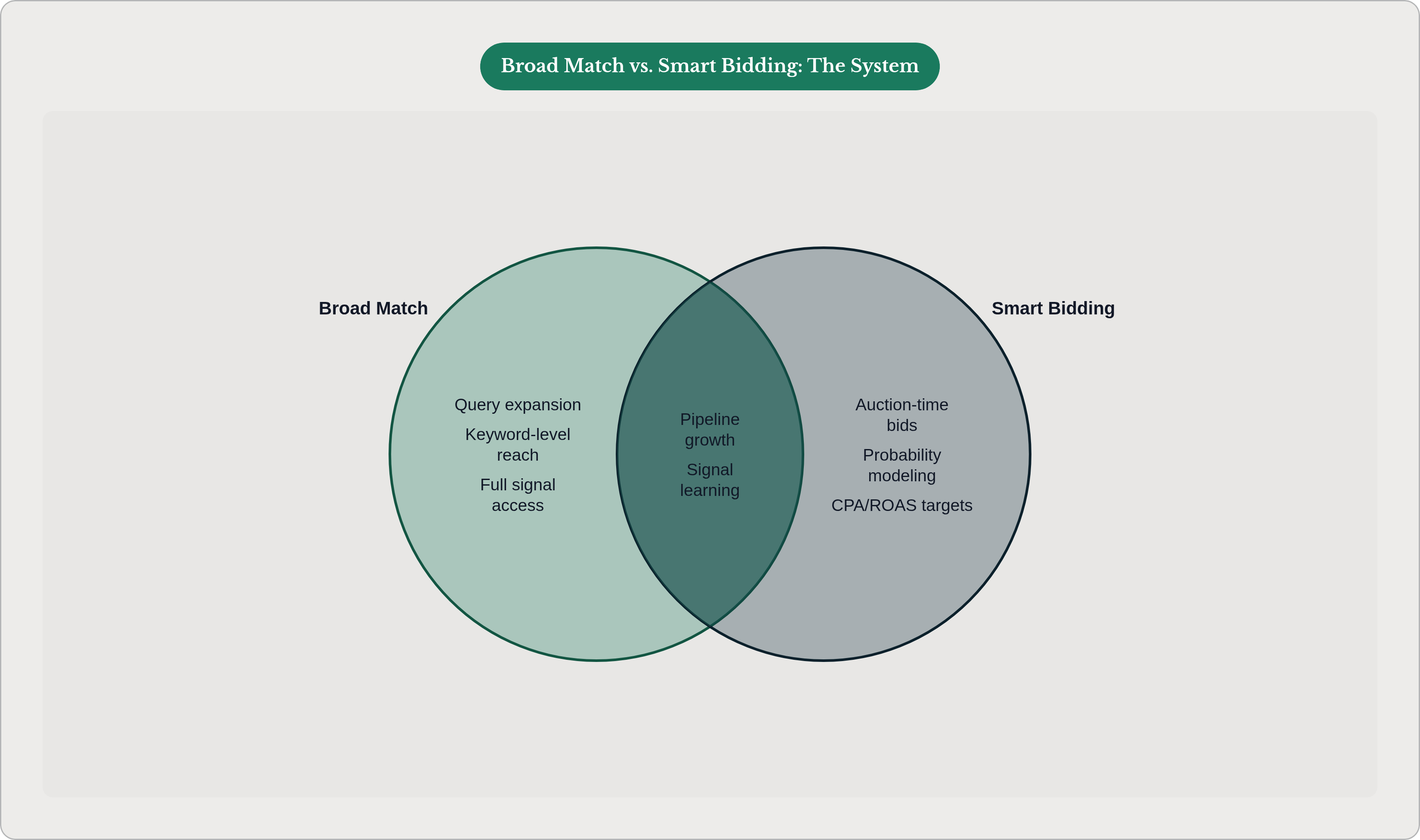
How Smart Bidding Uses Auction-Time Signals to Contain Broad Match's Reach
To understand why this works, you have to first understand what changed architecturally.
Old broad match worked at the keyword level. Google looked at your keyword string, matched it to queries that seemed related, and bid the same way regardless of who was searching or why. The "signals" it used were minimal. The result was predictably loose.
Current broad match is built differently. It is the only match type that pulls on Google's full set of auction-time signals: user intent, search context, landing page relevance, prior search behavior, audience membership, device, location, time of day. The keyword string is still the starting point, but the system uses all of that other information to decide whether this particular query, from this particular user, in this particular context, is worth competing for.
Smart Bidding is what makes that decision. At every single auction, it evaluates those signals simultaneously and adjusts the bid in real time. It competes aggressively when the probability of a valuable conversion is high. It suppresses the bid, or opts out entirely, when the probability is low.
That last part is critical. The algorithm is not trying to win every auction. It is trying to win the right ones.
But what if the algorithm does not know what "right" looks like for your account?
That is where conversion signal quality becomes the whole game. Smart Bidding optimizes toward whatever conversion event you give it. If you hand it a form fill that attracts students, job seekers, and competitors doing research, it will find more of them. Efficiently. That is the failure mode people blame on broad match when the real culprit is a weak or misaligned conversion signal.
In B2B, the conversion event almost always needs to be further downstream than a basic lead form. Demo requests are better. Qualified calls are better still. And offline conversion imports, where you feed CRM opportunity data or pipeline value back into Google Ads, are where broad match can start identifying patterns associated with high-quality pipeline rather than surface-level engagement.
Google's own data shows advertisers who switch phrase match keywords to broad match see roughly 25% more conversions in Target CPA campaigns and around 12% more conversion value in Target ROAS campaigns, while still meeting their targets. But those figures assume the conversion signal is sound. They do not mean broad match works unconditionally.
When the signal is weak or absent, the corrective mechanism breaks. Low conversion volume gives the algorithm too little to learn from. Poor tracking, missing tags, misattributed events, no offline import, produces a distorted signal that trains the system toward the wrong queries. The result is exactly what broad match critics describe, because the thing that is supposed to contain it is not functioning.
One more structural point worth knowing: Google's query-level learning does not reset between campaigns. If a query has matched and converted anywhere in the account previously, that signal carries forward. The system is not starting from zero at each auction. That means your account history is a compounding asset, which also means early decisions about conversion signal quality matter more than most people realize, because the system is building on whatever foundation you give it.
Why B2B Accounts Face a Different Risk Profile Than B2C
Most of the case studies you read about broad match success are from e-commerce or lead gen at high volume. And they are real. But B2B is structurally different in ways that change the math.
Start with audience contamination. In B2C, the wrong click is usually just a wasted click. A few cents or a few dollars, absorbed into a high-volume campaign where the conversion rate smooths out over thousands of transactions. In B2B, the wrong lead is not just a wasted click. It is a wasted sales cycle. SDR time, AE time, demo infrastructure, stakeholder coordination. Costs that compound downstream in ways that never show up in your Google Ads dashboard.
Consider what broad match expansion actually looks like in a B2B account. The common drift patterns: job listing queries, how-to and informational content searches, consumer product variants, free-tier alternatives, student research. A SaaS company running "CRM software" as a broad match keyword saw ads appearing for "free CRM tools," and lead quality dropped 18% as a result. That is not an edge case. That is a predictable expansion direction.
Now layer in the search volume problem. B2B keywords often have thin volume. When the algorithm has less data to learn from, it tends to expand reach to accumulate signal faster. That is a reasonable thing for an algorithm to do in a high-volume consumer category. In B2B, it means the system is exploring at your expense, with CPCs that are already elevated and downstream sales costs waiting at the end of each bad lead.
That raises an important question: does this mean broad match should be avoided entirely in B2B? No. But it does mean the conditions for viability are stricter, and the cost of getting those conditions wrong is higher.
The bottom-of-funnel concentration principle is worth sitting with here. The data on content conversion rates in B2B is stark: bottom-of-funnel content converts leads to customers at a rate that dwarfs top-of-funnel content. The implication for match type strategy is direct. Broad match is most defensible when the keyword themes themselves are high-intent and late-stage. "Project management software for enterprise teams" is a more defensible broad match seed than "project management." The closer you are to purchase intent, the less room there is for audience contamination.
The Minimum Conditions a B2B Account Must Meet Before Broad Match Is Viable
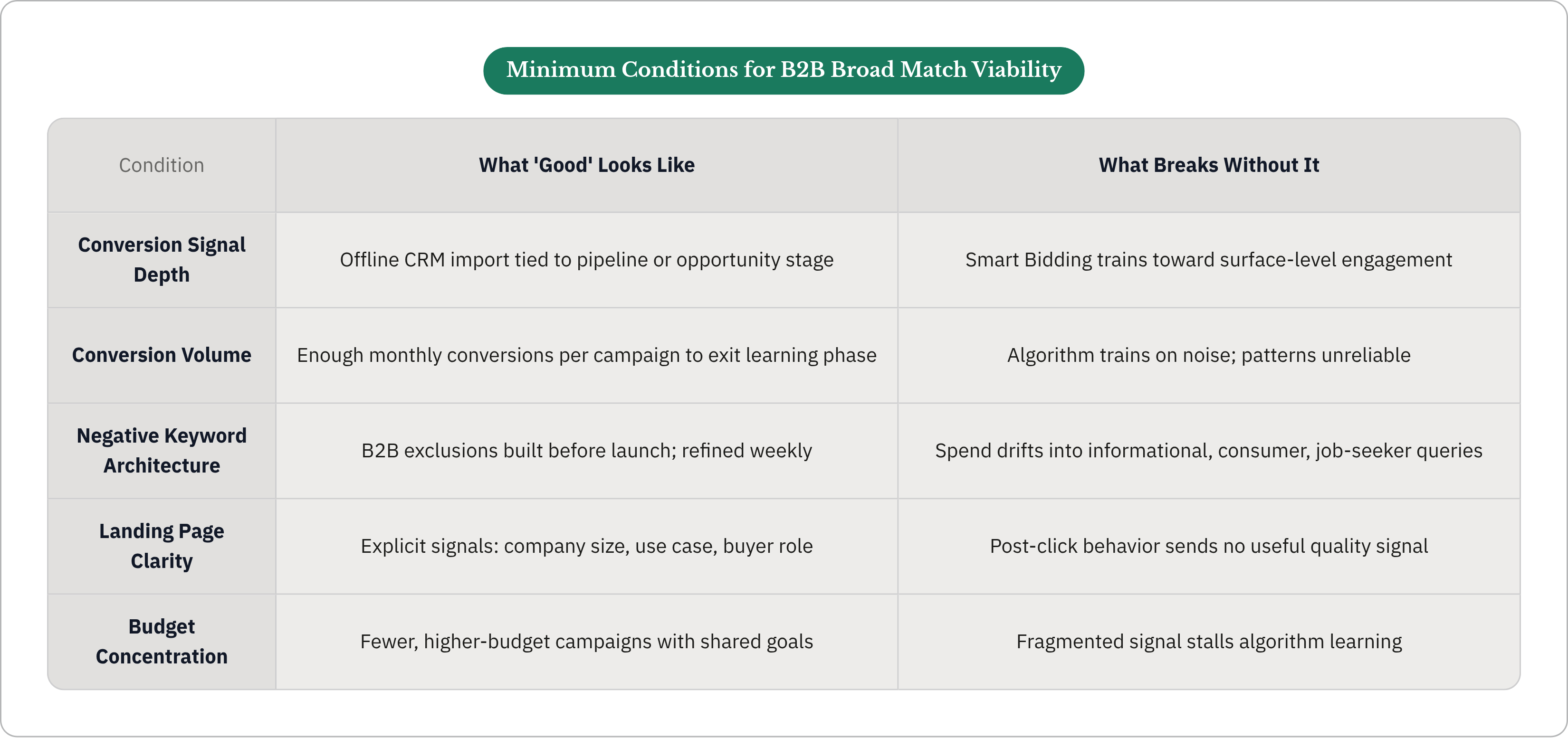
This is the part most articles skip. They tell you broad match plus Smart Bidding is the future. They don't tell you what has to be true before that future applies to your account.
Here is what actually needs to be in place.
Conversion tracking that reaches far enough downstream. At minimum, demo requests or qualified form submissions with clear disqualification logic. Better is offline conversion import tied to CRM opportunity stage or pipeline value. Without this, Smart Bidding is flying blind, and broad match's expansion is unguided.
Enough conversion volume for the algorithm to learn. Google has published guidance on volume thresholds for Smart Bidding to reliably exit the learning phase. Accounts below that threshold are not just learning slowly. They are training on noise. Qualitatively: thin accounts with only a handful of conversions per month at the campaign level should consolidate before introducing broad match at any meaningful scale. The algorithm cannot find patterns in a handful of data points.
A negative keyword architecture built before launch, not after. B2B-specific exclusions to build in from day one: informational modifiers like "definition," "example," "template," "salary." Consumer and free-tier signals like "free," "cheap," "DIY." Job-seeker terms. Academic contexts. Reviewing search term reports weekly and adding negatives consistently can reduce wasted spend by up to 25%. The cadence matters as much as the initial list. Negatives are not a setup task. They are an ongoing editorial function.
Landing page and offer clarity. If the landing page doesn't explicitly signal the B2B context, company size, use case, buyer role, the system gets no useful quality feedback from post-click behavior. A page that converts enterprise buyers and curious students at similar rates sends no useful signal to Smart Bidding. The landing page is part of the feedback loop, not decoration.
Budget scale that supports learning without catastrophic waste. Concentrating spend on one or two campaigns rather than spreading a thin budget across many creates enough volume for meaningful learning. Fragmented budgets fragment the signal and stall the algorithm.
How to Structure B2B Campaigns So Broad Match Tightens Rather Than Drifts Over Time
One of the more counterintuitive things about running broad match well is that the structure of your campaigns before you introduce broad match matters as much as anything you do after.
The phased approach is not just a risk management tactic. It is how you build the account knowledge that makes broad match function correctly.
Phase one: Launch with exact and phrase match. Exact match on known high-intent terms. Phrase match to discover query patterns. This protects budget while you build real conversion signal.
Phase two: Harvest from search term reports weekly. Identify queries that are converting. Add them as exact match keywords. This is not just list management; it is building the account's institutional knowledge about what good looks like.
Phase three: Introduce broad match on proven, bottom-funnel keyword themes. At this point, the account already knows what converts. Smart Bidding is not learning from scratch. It is refining a model that already has meaningful signal to work from.
This sequence means broad match enters a mature account, not a new one. That is a very different situation.
Campaign consolidation is the structural enabler for all of this. Fragmented campaign structures split conversion signal across too many buckets. Each campaign starves for data. Consolidating toward fewer, higher-budget campaigns with shared conversion goals accelerates learning. Roughly 62% of advertisers using Smart Bidding have broad match as their primary match type, which reflects how the platform is actually being used at scale. But they got there from somewhere.
Audience layering adds a soft guardrail on top of the structural work. Layering in-market audiences, remarketing lists, and customer match data onto broad match campaigns gives Smart Bidding additional context about who qualifies as a relevant user. In B2B specifically, layering by job function, seniority, or company size (where audience signals support it) tightens the system's working definition of a target user without hard-blocking reach entirely.
Brand controls matter too. Separating branded and non-branded campaigns keeps the conversion signal in each cleaner. Brand exclusions prevent broad match from competing in branded queries where intent is already captured.
Here is how the compounding works in practice. Each auction where the algorithm wins or loses with a given query type updates its model of what converts in this specific account. Over time, the system narrows its effective match behavior toward the query patterns that have produced pipeline. Not because the keyword list changed. Because the bidding model learned. Google's AI improvements to quality, relevance, and language understanding produced a meaningful performance uplift for broad match campaigns using Smart Bidding in 2024, and the direction of travel is continued improvement.
What to Measure to Know Whether the System Is Working in a B2B Account
This is where most accounts go wrong. They set up broad match, watch CPL for a month, and either panic or declare victory. Neither response is grounded in what the system is actually doing.
At the query level, watch the mix. What percentage of impressions and clicks are coming from recognizably on-target B2B queries versus ambiguous or off-target terms? A healthy broad match system in B2B should show the converting query set narrowing and deepening over time. More spend going to fewer, higher-quality queries. Not sprawling. If the query mix is expanding into informational, consumer, or job-seeker territory, the corrective mechanism is not working well enough yet.
At the pipeline level, watch what matters in sales-led B2B. Lead volume is a vanity metric. The signal that matters is lead-to-opportunity rate and pipeline value generated per campaign. If broad match is adding volume but the lead-to-opportunity rate is declining, the system is expanding into the wrong audience faster than Smart Bidding is correcting it. Importing CRM stage data weekly closes the feedback loop between what Google counts as a conversion and what the revenue team treats as qualified.
Watch Smart Bidding health indicators. Learning phase status tells you whether campaigns have enough conversion volume to function. Campaigns stuck in extended learning have a structural problem, not a patience problem. Sustained divergence between your target CPA or ROAS and actual performance signals that the conversion event being optimized toward does not reflect actual pipeline quality.
Run the weekly review as a management discipline, not optional hygiene. Each week's search term report produces three outputs: new negatives to add, converting queries to harvest as exact match, and a read on whether the query mix is improving or drifting. This cadence is what distinguishes a compounding system from a decaying one. The algorithm handles auction-level decisions. The operator handles strategic guardrails. Both are necessary.
It is also worth considering what that cadence demands operationally. The weekly review, negative keyword refinement, offline conversion import, and audience signal updates are individually simple. Collectively, at the cadence they require, they are demanding. Thunder, an applied-AI company whose agents run Google and LinkedIn Ads end to end for sales-led B2B companies with Forward Deployed Marketers providing governance and accountability, runs this management loop continuously rather than weekly, tightening the feedback cycle between query-level learning and campaign-level adjustments. That tighter cycle compounds across every campaign it manages, which is the structural advantage AI-managed execution has in this specific loop.
The bottom line is not that broad match is good or bad. It is that broad match plus Smart Bidding is a system, and systems need the right conditions to work. Get those conditions right in a B2B account and the compounding is real. Skip them and the critics were right all along.