Performance Max vs Standard Search Campaigns for B2B
Standard Search outperforms Performance Max for B2B lead quality and cost per qualified opportunity.

If you've spent any time managing paid media for a B2B company, you've probably had this conversation. Someone sees a case study about Performance Max crushing it for a retailer, and suddenly the question lands in your inbox: "Are we using PMax? Should we be?"
It's a fair question. Google has been pushing Performance Max hard, and the results from e-commerce are striking. But here's the thing. E-commerce and B2B lead generation are not the same sport. They share a platform, and that's about where the overlap ends.
This piece is about what the data actually shows when B2B advertisers run both campaign types and what it tells us about which one deserves the bigger slice of your budget.
What the Data Actually Shows About B2B Conversion Performance
Let's start with what we know from controlled testing.
Across a large cohort of B2B SaaS and professional services accounts tracked through 2024 and into 2025, Standard Search consistently outperformed Performance Max on two metrics that matter most: conversion rate and cost per acquisition. The Adalysis research, which covered thousands of campaigns, found the same directional result. When both campaign types competed for the same search terms, Search campaigns typically produced higher conversion rates.
That's the headline. But here's the nuance worth sitting with.
PMax still generates volume. It produces leads. The gap doesn't show up in raw lead count. It shows up in lead quality and, more importantly, in cost per qualified opportunity.
That distinction is where the real cost of the wrong decision lives. A campaign that delivers twice the leads at half the cost sounds like a win until you discover that the lead-to-opportunity rate is so poor that you've actually spent more to generate each real sales conversation.
Why does this happen? That's exactly what the next few sections are about.
Why Standard Search Converts Better for B2B Buyers Specifically
Think about how a B2B buyer actually searches.
They're not typing "software." They're typing something like "SOC 2 compliance automation for SaaS startups" or "ERP migration support mid-market manufacturing." The query itself carries information. It signals their role, their industry, their stage in the buying process, and the specific problem they're trying to solve.
Standard Search lets you meet that query with an ad that speaks directly to it. The buyer searching for a compliance-specific capability sees an ad that names that capability. The ad feels like a match because it is a match. That relevance is not a nice-to-have. It's the mechanism by which a B2B ad converts.
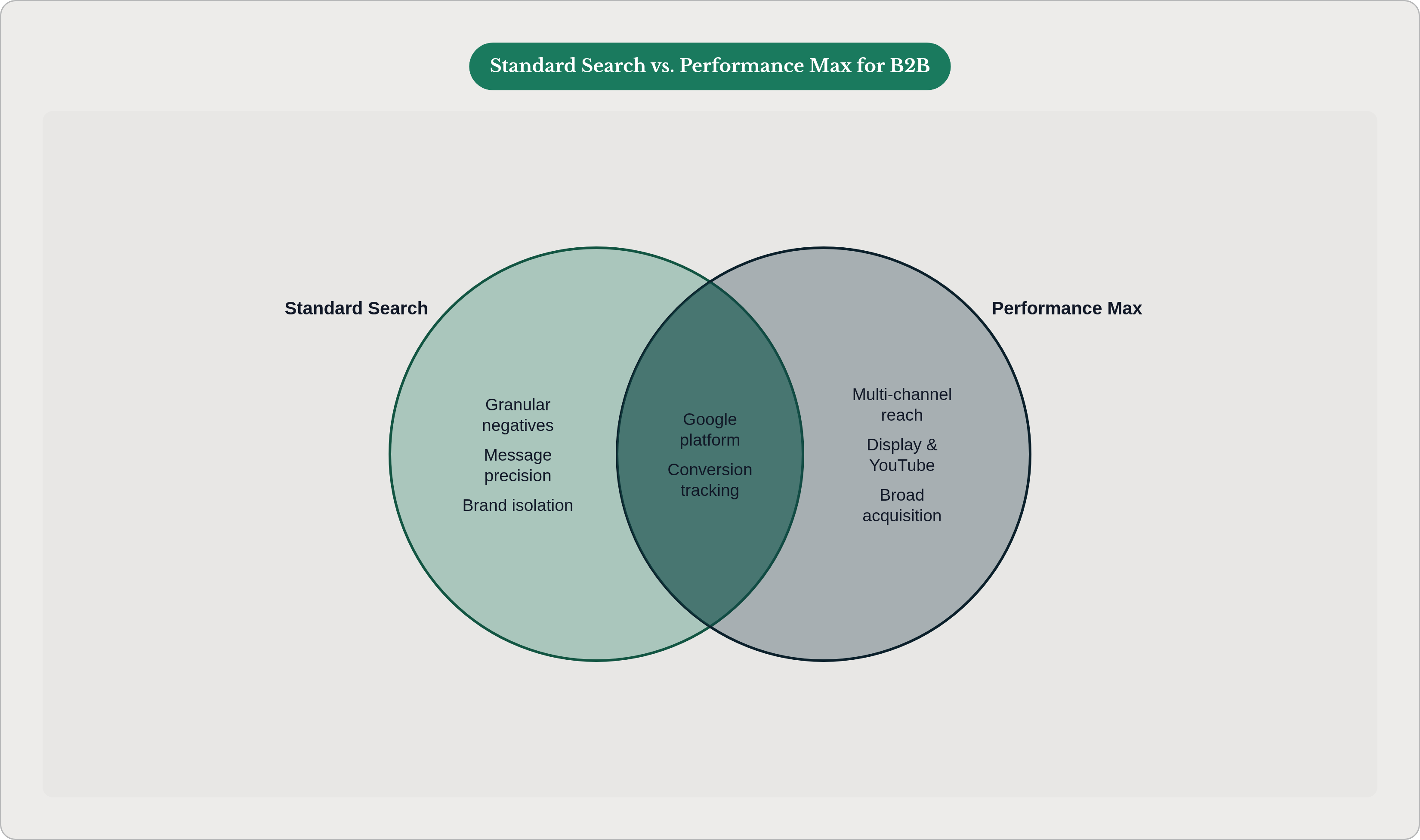
Performance Max works differently. It optimizes for conversion volume across all of Google's channels simultaneously: Search, Display, YouTube, Gmail, Discover. For a retailer selling sneakers, that breadth is a feature. Conversions are frequent, signals are rich, and the algorithm has enough data to learn quickly what works and where.
For a B2B software company generating a handful of qualified leads per month? That breadth works against precision. The algorithm is trying to optimize across too many surfaces with too little signal.
And here's the math that makes this even starker. When monthly conversions are measured in single or double digits and each deal is worth thousands of dollars, wasted spend on irrelevant traffic isn't an acceptable cost of doing business. It's catastrophic. One bad week of PMax serving your ads to students researching for a paper isn't a rounding error. It's a meaningful chunk of your monthly budget producing zero pipeline.
The CPL Fallacy and What B2B Pipeline Math Actually Demands
Cost per lead is seductive. It's clean, it's easy to pull, and it gives you something to put in a slide.
It's also largely meaningless without lead quality data sitting next to it.
Here's the pattern that shows up repeatedly. A PMax campaign delivers a lower CPL than the Search campaign running alongside it. Leadership sees the number, likes the number, and starts asking whether PMax should get more budget. Then someone actually looks at what happened to those leads in the CRM.
The lead-to-opportunity rate is terrible. The cost per sales-qualified lead, when you do the actual math, is higher from PMax than from Search. You've been optimizing toward the wrong metric.
The research includes a case that illustrates this perfectly. A cybersecurity company restructured away from a lead-volume model. Raw lead count fell sharply. Qualified pipeline opportunities more than doubled. That result sounds counterintuitive until you run the pipeline math. Fewer, better leads converted at a much higher rate, which means sales spent less time on dead ends and more time on real conversations.
The metrics B2B marketers should be tracking: cost per qualified opportunity and cost per SQL. Not CPL. Those are the numbers that make the PMax-versus-Search decision legible. Not which campaign generates more leads. Which one generates more pipeline per dollar spent.
Negative Keywords: The Hidden Variable Nobody Talks About Enough
Here's something that might be uncomfortable to hear. The gap between a mediocre Search campaign and a great one is rarely the keywords you're bidding on. It's the keywords you're excluding.
Most B2B Google Ads accounts have very few negative keywords. Some audits turn up accounts with none at all. That's not a targeting problem. That's a filtering problem.
The research cites a case where an extensive negative keyword list (we're talking hundreds of exclusions) was identified as the single biggest driver of a dramatically high pipeline-to-spend ratio. Not the bid strategy. Not the ad copy. The exclusions.
Why does this matter so much for B2B specifically? Because the cost of an irrelevant click is higher. A job seeker clicking your enterprise software ad doesn't just waste the click budget. They fill out a form. They become a lead. That lead goes to a sales rep. The sales rep spends twenty minutes before realizing this person is not a buyer. And now that form fill has polluted your conversion data, which feeds future optimization decisions.
One bad category of searchers, left unchecked, can quietly degrade your entire program.
Negative keyword strategy is also not a setup task. It's an ongoing practice. Query reports should be reviewed consistently, and the exclusion list should grow continuously. New search behavior emerges. New adjacent industries start finding your ads. The list is rarely finished.
It's also worth noting that PMax's historical inability to apply campaign-level negative keywords was one of its most significant weaknesses for B2B advertisers. The 2025 update that addressed this is meaningful. But Standard Search campaigns still offer more granular control by design. That's not a knock on PMax. It's just how the tools are built.
What Changed in 2025, and Where the Gaps Still Are
Google made a real push in 2025 to address advertiser frustration with PMax transparency, and it's worth being honest about what improved and what didn't.
The updates that matter for B2B:
- Campaign-level negative keywords. Previously impossible to apply, this was one of the loudest complaints from B2B advertisers. It's now available.
- Channel performance reporting. Rolled out late in 2025, this finally shows how budget is distributed across Search, Display, YouTube, Gmail, Discover, and other surfaces. For the first time, you can actually see where conversions are coming from.
- Search themes. A way to guide PMax toward relevant keyword territory rather than relying entirely on audience signals and asset matching.
- Asset group segmentation. Gives advertisers visibility into which creative elements are performing, enabling more targeted iteration.
And Google's October 2024 policy shift is also notable. PMax no longer automatically takes priority over Standard Search campaigns. Ad Rank now determines which ad serves. That levels the playing field operationally in a meaningful way.
But here's what these updates don't fix. PMax still needs substantial conversion volume to learn effectively. A B2B account generating a small number of conversions per month still can't feed the algorithm enough signal for it to optimize well. That structural limitation hasn't changed.
Brand traffic inflation is also still a problem. PMax frequently captures high-performing branded searches, which flatters aggregate metrics without proving that the campaign is driving incremental performance. If someone was going to search your brand name and find you anyway, PMax taking credit for that conversion isn't a win. It's an accounting trick.
The honest read: PMax in 2025 and beyond is a meaningfully better product than it was at launch. The 2025 updates are real improvements. But the structural conditions that make Search better for B2B — low conversion volume, the need for message precision, the high cost of irrelevant traffic — those conditions are still in place.
A Practical Budget Structure for B2B Advertisers Running Both
The answer here isn't "PMax or Search." It's a weighted combination, with Search carrying the load.
Here's how the structure tends to work well:
- Standard Search gets the dominant share of budget. This covers high-intent keywords, competitive terms, and brand terms where message precision is essential. This is where your pipeline comes from.
- Performance Max gets a minority share, focused on broader acquisition across Google's full channel inventory. Useful when the goal is to expand reach beyond captured demand, but only when conversion volume is sufficient for the algorithm to learn.
A few things that are non-negotiable in this structure.
Offline conversion tracking. B2B conversions happen in CRM, not on thank-you pages. If the algorithm is only seeing form fills, it's optimizing toward form fills. You need to pass qualified opportunity data and closed-won data back into the platform. Without this, you're flying blind.
Brand campaigns stay in Standard Search. Keep brand terms isolated. If PMax is running alongside a brand campaign, it will claim credit for conversions it didn't earn. That inflates PMax's numbers and makes budget allocation decisions harder to trust.
Accounts with very low monthly conversion counts should consider skipping PMax entirely. Until you have enough conversion history to feed the algorithm, you're paying for the learning curve without getting the benefit of what it learns.
Where Google Search and LinkedIn Fit Together in a B2B Pipeline Stack
These aren't competing channels. They're doing different jobs.
Google Search captures intent that already exists. The buyer is actively looking. That's what makes it the right starting channel for most B2B advertisers. It converts demand that is already in market.
LinkedIn builds against professional identity: job title, seniority, company size, industry. No other platform matches it for reaching the right decision-maker. But LinkedIn catches people before they're in active search mode. They're not looking for you yet.
The sequencing implication: start with Google Search to capture existing demand and generate early pipeline signal. Layer LinkedIn in once your Search program is optimized and you have the budget and patience to sustain a multi-month build.
Here's something worth knowing about how the channels compound. Google Search traffic can seed LinkedIn remarketing audiences. Visitors who clicked a Search ad but didn't convert become a high-intent retargeting pool on LinkedIn. You're not starting a cold conversation. You're continuing a warm one.
One honest caveat about LinkedIn. The channel's real return tends to show up at six months and beyond, not in the first 30 or 90 days. For teams with near-term pipeline pressure, Search alone is the more capital-efficient starting point. LinkedIn is worth the premium cost at deal values and monthly budgets above a meaningful threshold. Below that floor, Search is the better allocation.
How AI-Native Campaign Management Changes the Execution
Standard Search's advantages over PMax are only realized if the campaign is actively managed.
Negative keywords need to be continuously expanded. Ad copy needs to be tested against buyer personas. Bid strategies need to be adjusted as conversion data accumulates. Query reports need to be reviewed on a short cycle, not a quarterly one.
This is where execution quality separates high-performing programs from average ones. And it's where the difference between a manually managed account and an AI-driven one becomes tangible.
AI agents built for B2B paid media can monitor search term reports continuously, expand negative keyword lists in real time, and test message variants at a pace no human team sustains week over week. The compounding advantage is real. Every campaign run feeds signal back into the system. Which keywords produce qualified opportunities. Which ad copy variants resonate with which personas. Which budget allocations drive pipeline. Each iteration builds on accumulated intelligence rather than starting fresh.
Offline conversion tracking and CRM integration also require ongoing instrumentation and data hygiene. Not a one-time setup. An agentic system that monitors signal quality on an ongoing basis handles this better than a quarterly review cycle.
Thunder is built for exactly this execution model. It is a delegated paid media company whose AI agents run Google and LinkedIn Ads end to end for sales-led B2B companies, executing the work directly rather than handing tasks back to the customer's team. Forward Deployed Marketers provide the governance and judgment that make performance legible to revenue leaders who need pipeline accountability, not another dashboard to interpret.
The relevant contrast isn't AI versus human judgment. It's autonomous, compounding execution versus the manual cadence of a campaign manager reviewing accounts weekly and testing monthly. The former moves faster and learns faster.
The Decision Framework: Which Campaign Type to Run, and When to Revisit
Run Standard Search as your primary campaign type when:
- Monthly conversion volume is low. The algorithm cannot learn on thin data.
- Buyers use specific, technical search language that requires matched ad copy.
- Deal values are high enough that a single wasted conversion event represents significant cost.
- You have the keyword intelligence and negative keyword discipline to run Search well.
Consider adding PMax as a secondary layer when:
- Search campaigns are already well-optimized and the goal is broader acquisition reach.
- Conversion volume is sufficient for the algorithm to learn. The research points to a meaningful minimum monthly threshold.
- Channel performance reporting and campaign-level negatives are configured to prevent the known failure modes.
- Offline conversion tracking is in place so PMax is optimizing toward pipeline, not form fills.
Revisit the allocation when:
- Lead-to-opportunity rate declines without a change in keyword strategy. That's a signal that traffic quality has drifted.
- CPA rises without a corresponding rise in pipeline. The CPL fallacy in action.
- PMax's channel performance report shows budget concentrating in Display or YouTube rather than Search. That means the campaign is shifting toward brand awareness, not demand capture.
The through-line across all of this is actually the measurement question, not the campaign type question. Teams that track cost per qualified opportunity and pipeline-to-spend will make the right PMax-versus-Search call because they'll see the performance gap in the numbers that matter. The campaign type decision follows from the measurement. Get the measurement right first, and the rest of this becomes considerably less complicated.