Smart Bidding Signals and Machine Learning in Google Ads
Success with Smart Bidding requires quality conversion data, not just volume.

Smart Bidding is not a feature you turn on. It's a learning system you either feed well or feed poorly, and it performs accordingly — like a chef who's only as good as the ingredients you hand them.
That distinction sounds simple, but most advertisers miss it anyway.
The result is a familiar pattern: Smart Bidding gets enabled, performance looks okay for a few weeks, then stalls, then someone declares the strategy "doesn't work for B2B." What actually happened is that the system trained on bad inputs and got very efficient at the wrong thing. The machine didn't fail. The inputs did.
Let's walk through exactly how this works, where it breaks down for B2B specifically, and what you can actually do about it.
The signal architecture: what the machine sees at auction time that a human cannot
Here's the part most people gloss over because it sounds like marketing copy: Smart Bidding sets a unique bid for every single auction, in real time, based on a combination of signals evaluated fresh each time.
Not per campaign, not per ad group, but per auction.
What signals? Device type, location, time of day, day of week, the specific search query, browser, operating system, prior interaction history, in-market audience membership. And more, combined in ways that aren't visible in any dashboard you have access to.
Each auction resolves in roughly 100 milliseconds, which is not a window where human judgment is a realistic option. Even if you had perfect data, you couldn't act on it fast enough.
But speed is only part of the advantage. The more interesting part is signal weighting. The model doesn't apply the same weight to every signal for every query. Device type might dominate in one context. Time of day might matter more in another. That contextual weighting is what separates this from rule-based bid adjustments, where you say "add 20% for mobile" and apply it uniformly across every auction whether it's relevant or not.
Why does this matter? Because the patterns that predict conversion probability aren't visible at the campaign-report level. You might be able to see that mobile converts at a lower rate overall. The machine can see that mobile converts at a higher rate on Thursday evenings from people who have previously visited your pricing page and are in a specific in-market audience. Those aren't the same insight, and only one of them is actionable at auction speed.
That's the structural edge — not magic, just a capability gap between what the machine can evaluate in the moment and what a human analyst can reconstruct after the fact.
How the learning system trains — and why data quality determines output quality
To understand why this works, you have to first understand how the model learns.
Smart Bidding trains on your historical conversion data. It looks at which signal combinations preceded conversions in your account and learns to weight those signals more heavily going forward. The model is, in effect, learning what a conversion looks like for you specifically.
Which means it can only learn from the conversions you've given it. And it needs enough of them to learn anything reliable.
The commonly cited threshold is around 30 to 50 conversions in a rolling 30-day window. Below that, the training set is too thin. Predictions get noisy, and the algorithm is essentially guessing with some statistical scaffolding around it.
For B2B, this creates an immediate problem. Longer sales cycles and lower conversion volumes mean many accounts never hit that threshold naturally, at least not on anything that actually connects to pipeline. We'll get to the solution in a moment. First, the fraud problem.
Per Spider AF's 2025 Ad Fraud White Paper, click spamming accounted for 76.6% of invalid clicks in 2024 datasets, and the average ad fraud rate observed that year was 5.1%. Estimated global losses reached $37.7 billion annually.
Here's why that matters for Smart Bidding specifically: the algorithm doesn't distinguish between a real conversion signal and a fraudulent one. If fake clicks generate form fills, those form fills enter the training data. The model learns to bid toward traffic that produces those outcomes. Fraud doesn't just waste your budget in the moment. It corrupts the model going forward.
The automation doesn't detect bad signal. It amplifies it — the way a megaphone makes noise louder without asking whether the noise was worth making.
So the core reframe here is this: your job isn't to trust the machine's output. Your job is to govern the inputs. The machine is a fast, capable optimizer. But it optimizes toward whatever you point it at, including noise.
The B2B conversion signal problem — why a form fill is the wrong optimization target
Smart Bidding will optimize precisely and efficiently toward whatever conversion event you define. That's the feature. It's also, for a lot of B2B accounts, the problem.
The default move is to define conversions as form fills or raw MQLs because that's what's easy to track. The machine gets to work, volume goes up, cost per lead looks reasonable, everyone feels good. And pipeline doesn't move.
That raises an important question: what did the machine actually optimize toward?
More form fills, including the low-quality, unqualified ones that were always there but are now arriving in higher volume. It delivered exactly what you asked for. You just asked for the wrong thing. Garbage in, garbage out — except the garbage arrives faster and costs more.
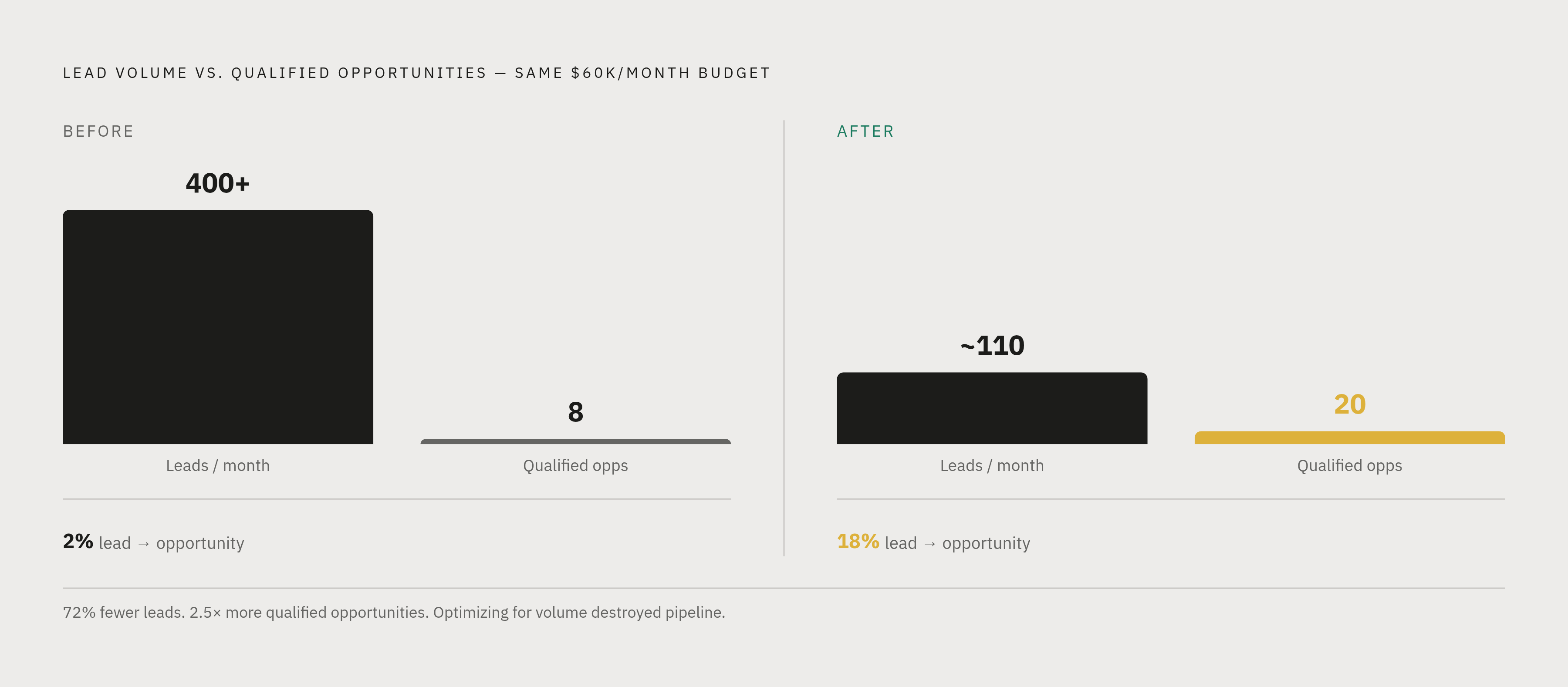
There's a case that makes this concrete. A B2B cybersecurity company spending around $60,000 per month, with the majority of budget in lead generation campaigns, was generating more than 400 leads per month. Only 8 became qualified opportunities, a 2% lead-to-opportunity rate. After restructuring the program around quality signals rather than lead volume, monthly lead count dropped to around 110. The lead-to-opportunity rate climbed to 18%. Qualified opportunities per month went from 8 to 20.
That's not a compelling CPL story. It's a compelling revenue story. And those two things pointed in opposite directions.
So what should you feed Smart Bidding instead?
- Offline conversion imports: SQL stage reached, Opportunity created, Closed-Won. Passed back through CRM integration, tied to the original click.
- Pipeline stage as the optimization target, not funnel entry.
- Micro-conversions as supplements (high-intent page visits, pricing page, time on site). Useful for volume when pipeline data is thin. But weighted lower, not treated as primary.
Here's the structural logic. A cheap cost per lead that trains the algorithm on unqualified behavior doesn't just hurt today's campaign. It makes every future auction worse, because the model carries that learning forward.
First-party data as an input layer the advertiser controls
One thing the advertiser actually controls in this system is what data goes in as a starting signal.
Your CRM is a signal source. Customer Match audiences, uploaded from your CRM, give the algorithm a picture of what a high-value customer actually looks like before it runs a single auction. That's a different starting point than relying entirely on behavioral signals inferred from Google's data.
Practically, this plays out in a few ways:
- Exclusion lists: Upload existing customers, churned accounts, and disqualified leads. Prevent wasted spend and, more importantly, prevent those interactions from polluting conversion signal.
- Audience signals for Smart Bidding and Performance Max: Tell the model who your best converters resemble so it can find more of them.
- Lookalike expansion: Google uses those lists to identify prospecting targets who pattern-match to your best customers.
It's also worth considering that this isn't just a cookie-deprecation contingency plan. It's a structural advantage inside the AI system that competitors relying only on behavioral data can't replicate in the same way. A competitor whose model is trained on your best-performing signals is a harder competitor to beat.
One important nuance: list quality matters more than list size. A single undifferentiated CRM export gives the model one blurry picture. A list segmented by ICP tier, deal stage, or product line gives it distinct patterns to work from. The model gets more specific, and so does the targeting.
The compounding dynamic here is real. Better inputs produce better outputs, better outputs generate better conversion data, and better conversion data improves future targeting. An account that feeds clean, segmented CRM signals gets better over time. One that relies on defaults starts from the same weak baseline every cycle.
Campaign structure decisions that shape what the algorithm can learn
There's a tension that comes up in almost every B2B account audit. Marketers want segmentation for control and reporting clarity. But high segmentation fragments conversion data.
Here's the problem. Fifty campaigns, each with a handful of conversions per month, means fifty models each training on thin data. None of them reach the threshold for reliable predictions. The account as a whole might have plenty of conversions, but each individual campaign doesn't.
Consolidation solves this. Fewer campaigns, more conversion signal per campaign, faster and more accurate learning. You give up some reporting granularity in the short term. You get a model that can actually predict in return.
But consolidation only works cleanly if the query universe is managed well. That's where negative keywords come in, and this is where most accounts are significantly underbuilt.
Negative keywords aren't just cost controls. They define what the algorithm trains on. Exclude irrelevant industry queries, consumer-intent terms, competitor brand terms you're not targeting. Every query that shouldn't be in your universe, and isn't excluded, is a potential data point that teaches the model something wrong.
A lot of B2B accounts have been running for years with minimal negative keyword lists. That's a conversion signal problem, not just a budget efficiency problem.
Match type interacts with this directly. Broader match types give the algorithm more signal to work with, which is genuinely useful when the account's negative hygiene is strong enough to contain query drift. Broad match without robust negatives doesn't give the model more useful signal. It gives it more noise.
On Performance Max specifically: PMax gives Google's AI control over placement and audience based on conversion signals, which means conversion signal quality is even more critical than in Search. If the signal is off, PMax has more surface area to go wrong. Demand Gen, by contrast, gives the advertiser audience and placement controls, which matters for B2B buyers who need repeated exposure across a longer consideration cycle before conversion intent even exists.
What Smart Bidding cannot do — the boundaries of the automation
This might be the most important section, because the system gets oversold and then blamed for things it was never designed to do.
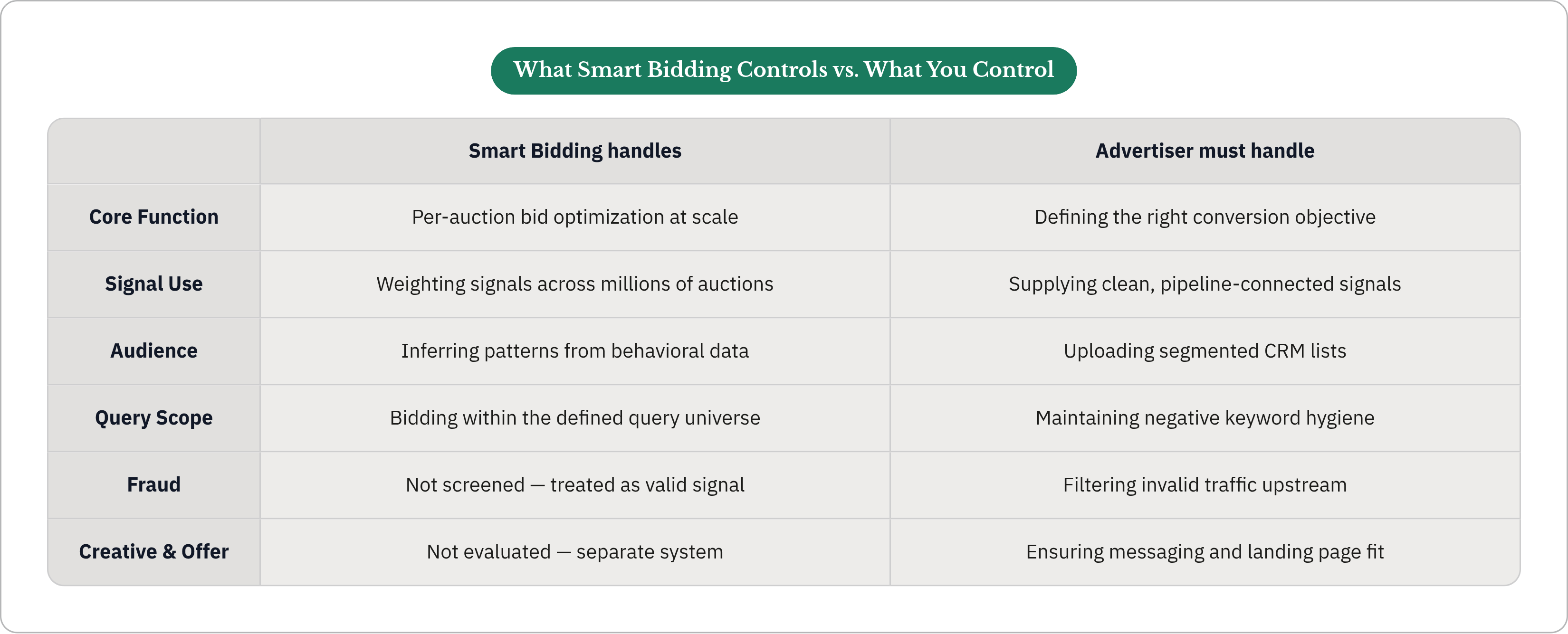
Smart Bidding optimizes within the objective and data you define. It does not question the objective. If the business goal is pipeline but the defined conversion is a form fill, the machine optimizes confidently and relentlessly toward form fills. There is no check on whether that's the right goal. That question belongs to the human.
What else is outside the automation's scope:
- Creative quality and messaging fit. Bid accuracy and ad relevance are separate systems. A well-optimized bid on a weak offer or a mismatched landing page still produces a weak result.
- Offline context you haven't imported. Deal quality, sales cycle length, ICP fit, whether a lead actually became revenue. All of this is invisible to the model unless you explicitly pass it back.
- Fraud detection. As the Spider AF data makes clear, invalid click volume is substantial, and the algorithm treats those signals as legitimate unless you filter them upstream. The machine is not screening for bad actors.
The division of labor that actually works looks like this. The machine handles per-auction bid optimization at a scale and speed that is structurally beyond human execution. The advertiser handles defining the right objective, supplying clean signal, maintaining exclusion hygiene, and evaluating whether outputs are moving toward revenue.
Both sides have to do their jobs. The machine's side runs automatically. Yours doesn't.
What effective Smart Bidding management looks like in practice for B2B
Let's make this concrete.
Before you enable Smart Bidding:
- Set up offline conversion import from your CRM. Map SQL stage, Opportunity created, and Closed-Won back to the original click. This should exist before the campaign launches, not after you realize form fills aren't working.
- Audit your existing conversion data for contamination. Check placement reports. Review Search Partner traffic. If you have been running campaigns and your conversion events are form fills, you're starting with a compromised training set.
- Build a negative keyword list before going broad, not as a day-two task.
Campaign structure:
- Consolidate to the point where each campaign can accumulate enough conversion signal to reach reliable predictions. If you have to choose between segmentation granularity and learning-threshold sufficiency, choose the threshold.
- Upload CRM lists segmented by ICP tier, deal stage, and product line — not one export, but several.
Ongoing management:
- Evaluate against pipeline metrics. Not CPL, not conversion volume. Opportunities created, pipeline sourced, revenue influenced. The algorithm will hit the metric you give it. That metric needs to be connected to something that matters.
- Treat the first 60 to 90 days as a critical period. The training data the algorithm builds during that window shapes its behavior going forward. Starting with clean inputs isn't just easier — it's harder to recover from a contaminated start than most advertisers expect, because you'd need to overwrite months of learned behavior.
One might argue that this level of operational rigor is more than most teams have capacity for. That's fair. But the alternative isn't a system that performs reasonably with minimal input. The alternative is a fast, well-funded machine that optimizes confidently in the wrong direction and gets better at it over time.
Smart Bidding's advantage is real. It's also conditional. The conditions are on you to create.