Performance Max Asset Group Strategy for B2B Offers
How to organize asset groups by buyer intent instead of campaign convenience.

Most people treat asset groups like creative folders. Drop in some headlines, a few images, a URL, and move on. That's not wrong, exactly. It's just incomplete in a way that costs you.
An asset group bundles your headlines, descriptions, images, videos, and landing page into one unit. Google's algorithm pulls from that bundle to assemble ads automatically across Search, Display, YouTube, Gmail, Discovery, and Maps. You're not building one ad. You're handing the machine raw materials and letting it construct combinations based on what it thinks will work for a given placement. Think of it like a chef working from a pantry you stocked: the quality of what comes out depends entirely on what you put in.
But the part that actually matters for B2B strategy sits underneath the creative layer. Each asset group also carries your audience signals and search themes. Those two elements are how you tell the algorithm what kind of buyer you're after.
Search themes, introduced in 2024, replaced earlier category insights. You get up to twenty-five per group. They're not keywords in the traditional sense. They don't trigger exact matches. Think of them as directional guidance that steers the algorithm toward query clusters related to a specific intent. A theme cluster built around "compliance automation" sends a fundamentally different signal than one built around "workflow efficiency," even if both fall under the same product umbrella.
Audience signals tell the algorithm who to prioritize during the learning period. Without them, Google infers targeting from your landing page content and your conversion history. That's slower and less precise, especially early on when you can least afford to waste the learning window.
One thing worth keeping in mind when you're reading performance data: asset ratings (Best, Good, Low) are relative within a group, not absolute. An asset rated Best inside a weak group may still underperform a Good asset inside a strong one.
As of 2025, the asset group insights section also shows conversion contribution broken down by channel, per group: Search, Display, YouTube, Gmail, Discovery, Maps. That's the diagnostic tool that makes structural troubleshooting possible.
The B2B Lead Quality Failure Mode PMax Creates by Default
PMax was built around e-commerce logic. Purchases. Cart adds. Signals where volume and quality tend to move together. B2B lead gen breaks that assumption in a pretty fundamental way.
When you train a machine learning system on form fill volume, it gets very good at finding people who fill out forms. Not people who become opportunities. Not people who close. People who complete a form. The algorithm doesn't know the difference between a curious student, a competitor doing research, and a buyer with budget and authority. All three filled out the form. It's like fishing with a net that catches everything in the water — you asked for fish, but you're hauling up boots too, and the net can't tell the difference.
And the thing that makes this particularly frustrating: each optimization cycle reinforces whatever signal you gave it. If that signal is low-quality leads, the algorithm compounds toward increasingly efficient production of low-quality leads. It's not doing anything wrong. It's doing exactly what you asked.
Early PMax made this almost impossible to catch. Aggregate metrics only. No asset-level breakdown, no channel-level reporting. The campaign would show great conversion numbers, everyone would feel good, and then the pipeline review would happen and things would get quiet.
The 2024 and 2025 updates improved transparency. Brand exclusions, search themes, channel-level reporting. These were real improvements. But the underlying structural discipline problem stayed squarely on the advertiser's side of the table.
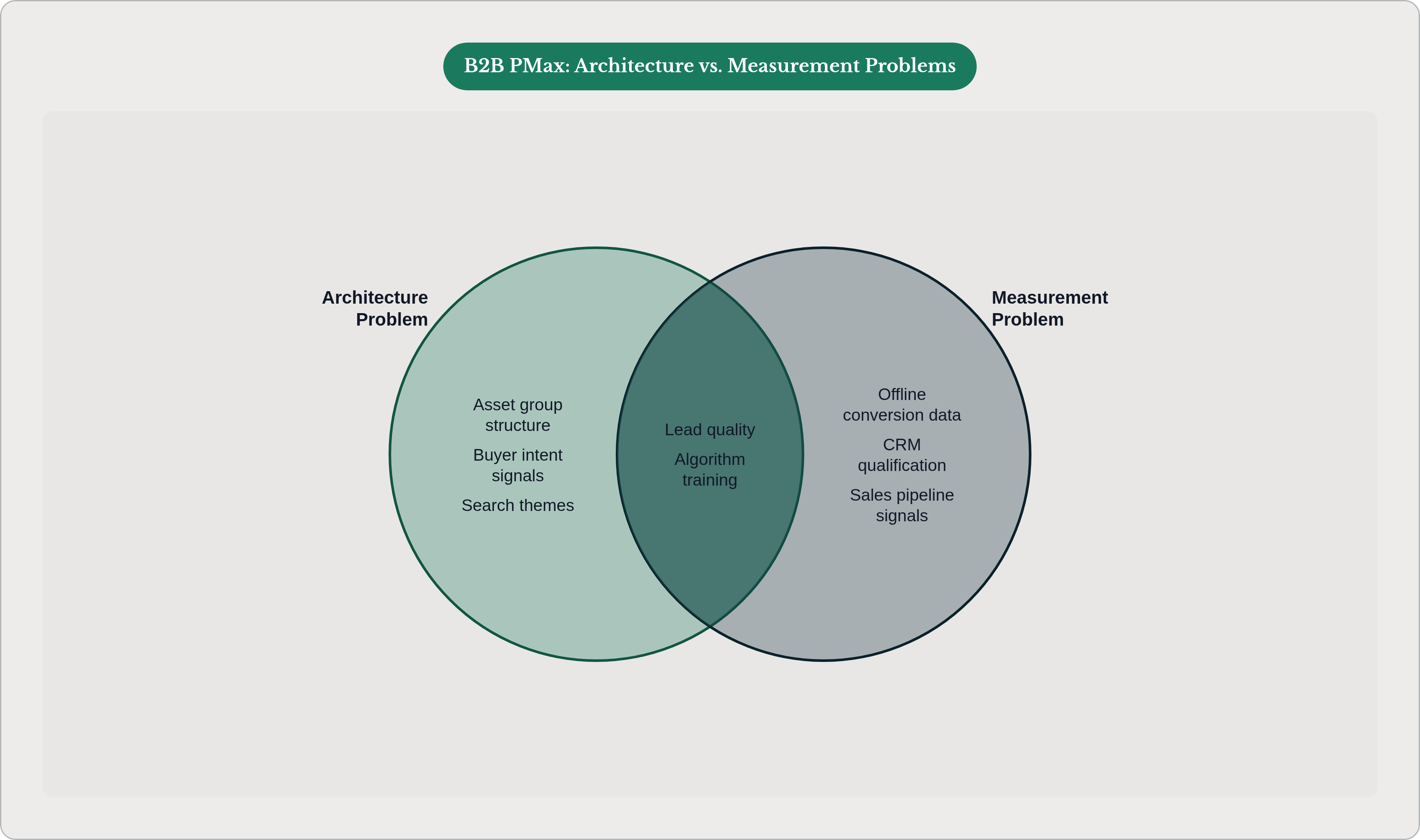
What's worth separating out: there are actually two distinct problems here, and they look identical on the surface.
- Architecture problem. Asset groups organized for management convenience rather than buyer intent, giving the algorithm undifferentiated signals.
- Measurement problem. Conversion signal that doesn't reflect sales qualification.
Both need fixing. Fix the architecture but keep the form fill as your conversion goal, and you'll produce more volume of the wrong leads, more efficiently. Fix the measurement but keep a lazy asset group structure, and you've got a good signal going into a poorly organized system.
Neither partial fix is a real fix.
Why Offline Conversion Tracking Is a Prerequisite, Not an Advanced Tactic
Offline conversion tracking has this reputation as something you graduate into after you've figured out the basics. That framing is exactly backwards. It's not advanced. It's the foundation. Everything else in a B2B PMax setup depends on it.
Here's the mechanical reality. A form submission is the beginning of a qualification process, not the outcome. When PMax optimizes toward form fills, the algorithm has no visibility into what happens after someone hits submit.
Offline conversion tracking closes that loop. You capture the Google Click ID (GCLID) in a hidden field on every lead form. When a lead reaches a meaningful sales stage in your CRM, you push that event back to Google as a conversion. Now the algorithm actually knows which leads mattered.
That raises a practical question: what counts as "meaningful"? That's a judgment call specific to each business, but the general principle is to pass back signals that reflect real sales qualification. Marketing-qualified, sales-qualified, closed-won. If you can assign different conversion values to each stage, even better. Value-based bidding combined with offline conversion tracking gives the algorithm a richer optimization target than a binary form-submitted signal, and it will use that richness.
The volume threshold problem is real, though. PMax needs enough qualified conversion events to optimize meaningfully. Too few signals and the learning period stalls, or the algorithm falls back to proxy metrics. Each asset group also needs its own conversion volume to differentiate performance between groups. A structurally correct group that starves on data is still a problem.
Without offline conversion tracking, every other structural improvement you make is producing better-organized noise. The architecture work is real. But it's optimizing toward the wrong signal.
How to Organize Asset Groups Around Offer Intent Rather Than Campaign Convenience
"Campaign convenience" means organizing by whatever makes your management easiest. One asset group per product. One group per geography. One group for all audiences. These structures make sense to the person managing the campaign. They mean almost nothing to an algorithm trying to figure out who to find.
"Offer intent" means grouping by what a specific buyer is trying to evaluate or decide, matched to creative and a landing page that addresses that specific evaluation. The difference sounds subtle. It isn't.
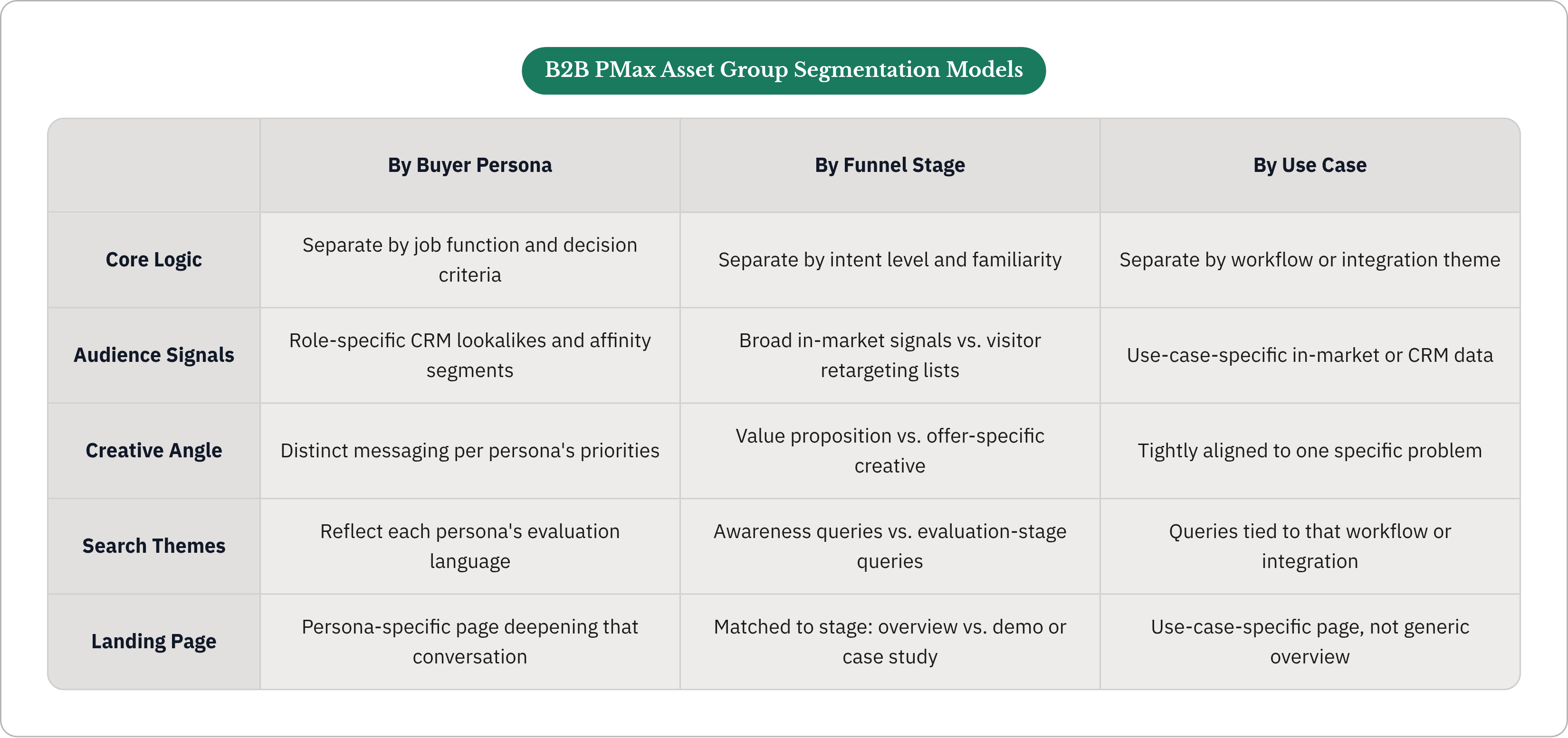
Three segmentation models worth considering for B2B:
By buyer persona. Separate groups for job functions with genuinely different decision criteria. An operations leader evaluating efficiency outcomes thinks about completely different things than an IT lead evaluating security and integration, who thinks about different things than a finance leader evaluating cost and risk. Each group gets persona-specific creative and audience signals. Not generic copy with a few swapped headlines. Actually different messaging about actually different concerns.
By funnel stage or intent level. A prospecting group uses broader value proposition messaging with in-market or affinity audience signals. A retargeting group uses offer-specific creative (case studies, demos, trials) with website visitor lists as signals. These two groups should have no audience overlap. The buyer who has visited your pricing page three times does not need the same message as someone who has never heard of you.
By use case or integration theme. When a product serves multiple distinct workflows, a use-case group keeps the creative, search themes, and landing page tightly aligned around one specific problem. Otherwise you're asking the algorithm to guess which use case applies to a given searcher. It will guess wrong with some consistency.
A practical four-group architecture for a B2B SaaS account might look like this:
- Core product for persona A
- Core product for persona B
- Use-case or integration theme group
- Retargeting group for warm audiences (pricing page visitors, feature page visitors)
One thing that can't be fudged here: each group needs its own landing page. Sending all groups to a homepage collapses the intent signal the structure was designed to encode. An operations manager who clicked on efficiency messaging should land somewhere that deepens that specific conversation, not a generic overview page that forces them to reorient.
Messaging discipline matters as much as structural separation. Operations managers evaluating supply chain software respond to efficiency metrics, compliance outcomes, and P&L impact. HR directors want to see employee outcomes. IT leads want integration specifics and security documentation. Write to results and strategy. Use imagery from professional environments. Consumer-facing emotional appeals and culture copy tend to signal nothing in particular to anyone in particular.
Audience Signals, Search Themes, and the Controls That Shape Each Group's Behavior
Something to get clear early: audience signals are not targeting in the traditional sense. You're not locking the campaign to a specific audience. You're telling the algorithm where to start looking. Google will expand beyond your signals. A well-chosen signal just accelerates the learning period toward higher-quality traffic.
For prospecting groups, useful signals include in-market segments relevant to the use case, affinity audiences aligned with the buyer's job function, and CRM lookalike audiences built from existing customer data.
That last one is worth dwelling on. First-party CRM data as an audience signal is a structural advantage. The algorithm uses it to find similar users, and as your conversion data accumulates, that signal compounds. Prospecting quality improves over time because the system has increasingly specific information about who actually converts.
For retargeting groups, segment your website visitor lists by behavior. Someone who visited your pricing page signals higher intent than someone who hit your homepage. Treat them differently. Customer match lists of current customers are useful either for expansion messaging or for exclusion, depending on your strategy.
Search themes per asset group should reflect the specific intent of that group, not describe the product in general terms. A retargeting group's themes should reflect evaluation-stage queries. An awareness-stage group needs different themes entirely.
A few operational controls that are not optional:
Brand exclusions at the campaign level. Without them, PMax absorbs branded search traffic that would have converted anyway, inflates your numbers, and misattributes performance to the campaign structure.
Negative keywords. PMax has no campaign-level negatives by default. Account-level negatives apply across all campaigns simultaneously, so add them carefully. For B2B, consumer-intent terms (personal, home, family, free, etc.) should be excluded from the start. Pull the search terms report weekly. This is where you see what the algorithm is actually chasing and catch drift before it compounds into a real problem.
Structural stability during the learning period. The algorithm needs several weeks to accumulate enough signal to differentiate performance between groups. Adding new asset groups, switching bid strategies, or making large budget changes during this window resets the learning clock. Batch your structural changes, then leave things alone long enough to generate real data.
Video and Creative Assets in B2B PMax: What Happens When You Skip Them
PMax spans YouTube. Video is baked into the product.
So what happens if you skip it? You don't get a YouTube-free campaign. Google auto-generates a video from your existing image and text assets. The output is usually low quality and almost certainly doesn't reflect the specific intent signal you spent time building into your asset group.
Think about what that means in practice. You built a retargeting group with tightly aligned search themes, persona-specific copy, and a focused landing page. Then an auto-generated video undermines all of it with a generic visual that could belong to any company selling anything to anyone. You've essentially handed a tailor a pile of fine fabric and let a machine stitch it into a potato sack.
Google's Asset Studio, available within Google Ads as of 2025, can generate assets directly in the interface using their AI image and video models. It's not going to replace a production team, but it's functional, and brand guidelines can be applied to keep outputs consistent with your visual identity. For B2B teams without video production resources, it's a practical path. Better than auto-generation by a meaningful margin.
The creative role in PMax is also different from traditional ad creative in a way that takes some adjustment. You're not designing the ad. You're supplying building blocks and letting the algorithm assemble combinations per placement. That shifts the job from "produce the perfect ad" to "provide enough high-quality raw material that strong combinations are possible."
A few practical implications of that shift:
- Thin asset groups (minimum required inputs only) give the algorithm fewer options. Performance ratings suffer consistently.
- Performance ratings are relative within a group. Improving the weakest assets raises the floor, which affects how the algorithm allocates resources across the whole group.
- Creative testing in PMax is not traditional A/B testing. Add multiple variations within a group, give it several weeks, and analyze performance. The algorithm auto-optimizes, but you control what options it's choosing from.
Reading Asset Group Performance Data to Refine Structure Over Time
The 2025 channel-level reporting update is the most practically useful diagnostic tool PMax has offered. It shows which channels are driving conversions within each asset group. That matters because it tells you whether a group is functioning as designed, or drifting somewhere you didn't intend.
A few patterns to look for:
Prospecting group showing nearly all conversions from Search. This group may be capturing navigational or branded queries rather than net-new demand. Pull the search terms report. The algorithm may have drifted toward easier conversions rather than the incremental reach you built the group to generate.
Retargeting group showing heavy Display and minimal Search conversion. The creative may not be specific enough to drive evaluation-stage action. Tighten the offer, sharpen the CTA, make it clearer what you're asking someone to do next.
Asset-level data (impressions, clicks, cost, conversions per individual creative element) enables pruning. Assets consistently rated Low should be replaced, but replacement assets should be tested against the group's specific intent, not swapped in generically. The goal is raising the floor of what the algorithm has to work with.
Here's the operational tension, though. Structural changes restart learning. That means your review cadence should inform a queue of planned changes, not trigger immediate reactive adjustments.
Over time, the compounding dynamic is real. Accumulated conversion data, especially when enriched with offline conversion signals, makes the algorithm more precise about each group's specific intent. The early structural discipline pays out later in performance.
Groups that remain too thin on conversions should be evaluated for consolidation. A well-built group needs fuel to run.
Where PMax Fits in a B2B Paid Media Program Alongside Search
PMax is not a replacement for Search. Google's own framework treats them as distinct campaign types, and that distinction is meaningful in practice.
For most B2B accounts, the majority of paid search budget should stay in standard Search campaigns. Keyword control and match type discipline are still the highest-precision tools available for capturing demand that already exists. PMax's structural advantage is cross-channel reach with a unified optimization target. It can find buyers on YouTube and Display who would never encounter a Search ad. But it can only do that well if the intent-based asset group architecture is giving it the right signals to pursue.
The risk of introducing PMax too early, or without structure, is specific. It cannibalizes Search budget. It inflates reported conversions with low-quality leads. It obscures the performance of the Search campaigns doing the real work.
Running PMax and Search together requires managing the interaction deliberately. Brand exclusions and campaign priority settings prevent cannibalization. Without them, the campaigns compete with each other in ways that benefit neither and confuse the reporting for both.
It is also worth considering the full-stack nature of what effective B2B PMax actually requires. Offline conversion tracking integrated with the CRM. Intent-based asset group architecture. Persona-specific creative. Offer-aligned landing pages. Ongoing structural refinement. Each dependency compounds the others. A gap in any one element doesn't just limit that element. It limits the whole system.
None of that is a reason to avoid it. It's just a reason to go in with eyes open about what you're actually building.