Sales Funnel vs Pipeline for B2B Revenue Teams
Marketing and sales need separate scorecards to stop arguing about the same leads.
I've spent a lot of quarterly meetings watching marketing and sales argue about the same fifteen leads. Here's why that argument tends not to end.
What the sales funnel actually measures and where teams misread it
The funnel measures one thing: conversion efficiency. At each stage, how many people moved forward, and how many quietly walked away.
You know the shape. Awareness, interest, consideration, intent, evaluation, purchase. Fine in a textbook. In real B2B life, that shape gets stretched or squashed depending on deal size and how many people are sitting on the buying committee. A low-four-figure tool doesn't move through the funnel the same way a six-figure platform does, even though someone will often draw them as the same diagram on the same slide.
What the funnel is actually good for:
- Spotting where your message is failing (a big drop at awareness usually means the message is off, not that you need more leads)
- Telling you if demand gen is cranking out volume without quality
- Showing which channels bring people who convert, and which bring people who click around and vanish
Revenue's down, so what happens? More top-of-funnel spend. More ads, more webinars, more gated PDFs nobody reads. But if the actual problem is a conversion bottleneck, dumping more people into the top just means more people falling off at the same broken stage, faster than before. You made the leak bigger.
Only a small slice of B2B buyers are actively evaluating anything at any given moment. Everyone else on that buying committee isn't ready. So most of what happens at the top of the funnel isn't supposed to convert this quarter. It's trust-building with someone who'll be ready in six or twelve months. Call it a long-cycle asset, not wasted spend, even though it feels that way in a monthly report.
The funnel has a finish line. Once a lead's qualified, its job is done. What happens next isn't a funnel question anymore — it's a pipeline question. Where exactly that line sits should be something marketing and sales agreed to together, not something marketing decided alone and mailed over.
What the sales pipeline actually measures and where teams misread it
The pipeline tracks deal management. Qualified opportunities moving from first meeting through proposal, negotiation, close. It's the seller's view of the world, and it reads very differently from the funnel.
What the pipeline actually tells you:
- How much revenue is realistically closeable in a given window
- Where deals are stalling and why (too many stakeholders, a competitor sliding in sideways, a budget cycle that doesn't line up with yours)
- Whether the forecast number sales calls out in the Monday meeting has any real basis, or if it's just a confident guess
Forecast accuracy has been a stubborn problem across B2B for years. Pipeline forecast reliability is a stubborn problem, and research consistently finds that only a small minority of sales leaders trust their forecasts.
The classic misread is coverage-as-health. "We've got three times quota in the pipeline, we're fine." Except three times quota tells you almost nothing without knowing your stage conversion rates. It's a bigger number standing in for a number you don't actually have.
Deal size changes the whole behavior of a pipeline too. Smaller deals close at meaningfully higher rates than big enterprise ones, where stakeholder count and competitive noise and layers of approval all work against you. A pipeline full of smaller deals and a pipeline full of large enterprise deals are different jobs. They just happen to live in the same CRM view, which makes people forget that.
The pipeline only turns into a real forecasting tool once stage conversion rates are stable enough to project. That stability comes from consistency upstream, on the funnel side, in what's even allowed to enter the pipeline in the first place.
The handoff between funnel and pipeline is where most B2B revenue actually leaks
If you're only going to focus on one number in this whole system, make it MQL-to-SQL conversion. It's the single most consequential stage most B2B teams have, because it's the exact moment marketing's output either turns into real pipeline or quietly disappears into a CRM nobody checks again.
Industry benchmarks keep that conversion rate in a fairly narrow band across most B2B companies. Moving it even a few points has an outsized effect on everything downstream.
Two failure modes show up, over and over, in nearly every company I've watched work through this:
- Marketing sends volume, not quality. SQL criteria exist on paper but don't get enforced, so sales gets handed a pile of leads that don't fit the ICP, rejects most of them, and everyone walks away annoyed. Marketing thinks sales is lazy. Sales thinks marketing doesn't understand the business. Both are a little right.
- Sales lets qualified leads sit. A large share of leads that check every box never get a real follow-up, because nobody's actually accountable for what happens the second a lead crosses over.
Speed is the sneaky variable nobody budgets time for. Engage a qualified lead quickly and you're in a live conversation. Wait too long and you're cold-calling someone who's already moved on.
This isn't really a tooling problem. It's a definitional one. MQL and SQL definitions usually get set by one team, unilaterally, and then get quietly re-litigated by the other team in practice, every single week, in Slack threads nobody archives.
The fix is fairly simple on paper: a shared service level agreement between marketing and sales. What counts as qualified. What sales commits to doing about it. How both sides get held to it. Simple to write. Much harder to actually keep.
How to define MQL, SQL, and opportunity in a way both teams will actually honor
Let's get specific, because vague definitions are exactly what caused the mess above.
MQL (Marketing Qualified Lead): someone who's shown enough interest and fits enough of the ICP that marketing thinks it's time for sales to step in. Should combine demographic fit (right title, right company size) with behavioral signal (visited pricing, downloaded the deep-dive content, sat through the demo webinar).
SQL (Sales Qualified Lead): someone sales has actually talked to and confirmed meets the bar for a real opportunity. Budget, authority, need, timeline. Some version of BANT, present or clearly forming.
Opportunity: a qualified conversation where an actual deal is being worked. It has a dollar value, an expected close date, a defined next step. A real, trackable thing, not a hope.
Why do these definitions drift apart in most organizations?
- Marketing sets the MQL bar based on what it can produce, not what sales can actually close
- Sales quietly adjusts SQL criteria based on whatever deals happen to be sitting in front of them that quarter
- Nobody sits down and reconciles the gap, so the handoff runs on two different sets of assumptions until someone finally gets frustrated enough in a QBR to bring it up
A working SLA needs a few specific pieces:
- ICP criteria both teams actually wrote together, not one team's doc the other has never opened
- Explicit behavioral signals for an MQL, not just "right title, filled out a form"
- A written response-time commitment from sales, once an MQL gets flagged
- A feedback loop where sales reports back on lead quality, so marketing adjusts sourcing instead of guessing in the dark
The goal isn't a perfect taxonomy that lives forever in a slide deck nobody opens again. It's a living agreement, one that gets revisited when the market moves.
Funnel metrics and pipeline metrics serve different questions. Conflating them produces bad decisions
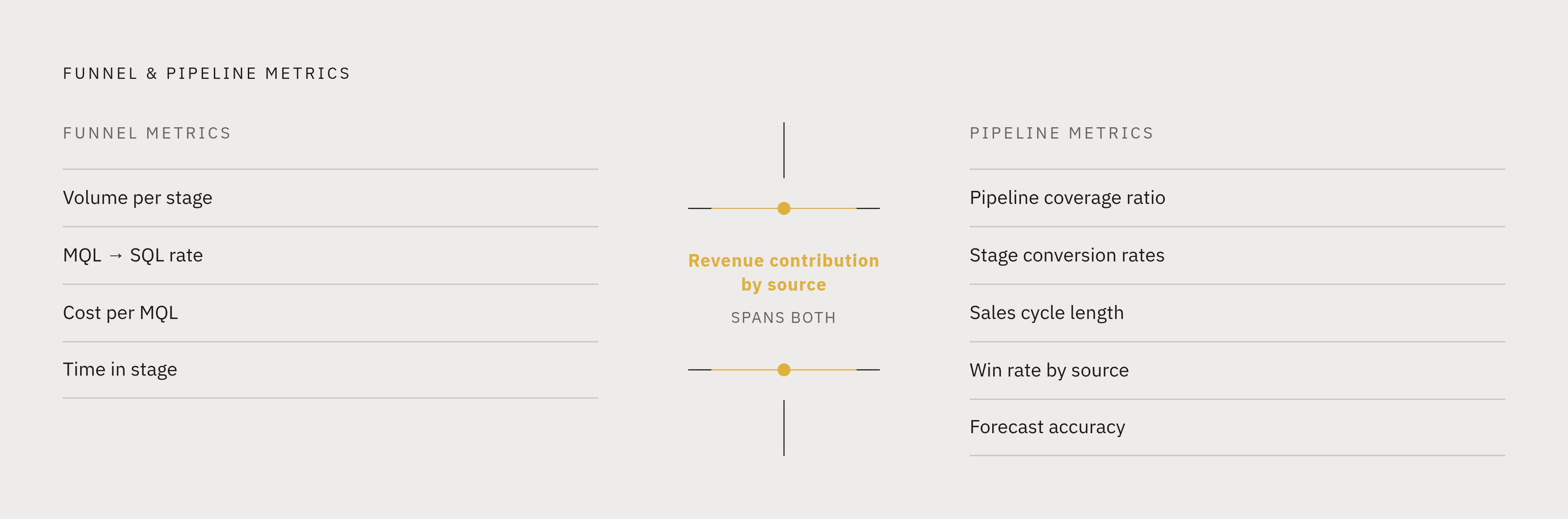
Funnel metrics answer: is the top of the system healthy? Are we generating enough of the right kind of demand?
- Volume at each stage: visitors, leads, MQLs
- Stage conversion rates, especially MQL-to-SQL, the bottleneck that matters most
- Cost per MQL by channel, so you know which sources are efficient and which are expensive noise
- Time in stage, which tells you where prospects stall before they convert or drop off entirely
Pipeline metrics answer something else entirely: is what's already in the system going to close, and when?
- Pipeline coverage ratio, how much pipeline relative to quota
- Stage conversion rates inside the pipeline, a different number from funnel conversion
- Average sales cycle length, broken out by deal size and segment
- Win rate by source, so you see which funnel inputs actually produce good pipeline, not just more of it
- Forecast accuracy over time, a check on whether your pipeline predicts anything real
One metric bridges both worlds: revenue contribution by source. Which channels and campaigns actually produced closed-won revenue. Not leads. Not pipeline entries sitting untouched in some stage.
Use pipeline coverage to judge marketing, and you're punishing marketing for a number sales controls. Use MQL volume to judge sales, and you're rewarding sales for a number marketing controls. Each team optimizes for the metric it can move, and the system stays misaligned, no matter how many QBR slides get made about it.
One more thing worth flagging: cadence. Funnel metrics move fast and deserve a weekly look. Pipeline metrics move slower and belong in monthly or quarterly forecast reviews. Mixing up that rhythm is its own quiet, boring way of staying misaligned.
Where paid media fits in the funnel-to-pipeline system for sales-led B2B
Paid media's job here is to fill the top of the funnel with people who actually fit the ICP, and help the qualified ones move toward the handoff faster. It's support, not a direct pipeline tool. But pipeline health depends a lot on what paid media hands it.
Two separate jobs are happening at once:
- Demand capture: reaching people already searching for a solution. Google Search is the main vehicle, going after bottom-funnel intent, the people typing "best [category] software" into a search bar right now.
- Demand creation: building trust with the much larger group who aren't in-market yet. LinkedIn is the main vehicle, reaching people by title, seniority, and account, long before they're ready to buy anything.
Most of a target account's buying committee sits outside the active evaluation window at any given moment. Paid media that only chases existing demand hits a ceiling fast, because there's only so much existing demand out there to chase. Demand creation is what actually grows the addressable pipeline over time, even though it's harder to point to on a weekly report.
Google and LinkedIn serve different points in the funnel and arguably deserve different scorecards:
- Google: cost per lead, quality of intent signal, how well it converts to MQL
- LinkedIn: influence on target accounts, pipeline sourced or influenced, visibility inside the buying committee itself
Last-click attribution systematically under-credits LinkedIn, which does its work earlier in the funnel, and over-credits Google branded search, which often just scoops up demand that got created somewhere else entirely. Look only at last click, and you'll probably cut the exact channel building your future pipeline. Multi-touch or data-driven attribution is a far more reliable way to see what's actually driving results.
The real question paid media needs to answer isn't cost per lead. It's cost per qualified opportunity, and eventually, cost per closed-won deal.
How AI agents are changing execution across the funnel-to-pipeline system
AI agents in B2B marketing are a real shift from the old kind of automation, where a machine just repeats a fixed task on a schedule. An agent gets an objective, figures out what actions are needed across platforms, executes them, and adjusts based on what happens, without waiting for a human to sit down and review anything first.
Where that's already changing things at the funnel-to-pipeline seam:
- Real-time lead scoring against behavioral and intent signals, surfacing the right leads for immediate follow-up instead of batching qualification into a once-a-day review
- Faster MQL-to-SQL handoffs, with outreach triggered the moment a lead crosses the threshold, not at the next morning's standup
- Continuous campaign optimization, adjusting bids, creative, and targeting in real time instead of on a weekly cycle
- Attribution and reporting that connects funnel inputs to pipeline outcomes without someone manually stitching spreadsheets together at 11pm before the board meeting
There's a real shift happening in what "qualified" even means. Call it the move from MQL to Agent-Qualified Lead. When an agent scores intent in real time and acts on it immediately, the lead that used to sit in a queue waiting for a rep gets engaged before a human ever sees the name.
McKinsey's 2026 B2B Pulse Survey found that growth leaders embedding AI into core workflows point to seller efficiency (59%) and better customer experiences (53%) as the primary benefits. The value is doing the handoff faster, with better information behind it.
Adoption is uneven, though. Demand Gen Report's 2026 survey found 96% of B2B marketers report using AI in some form. Using AI for a task and scaling it into the full revenue system are two very different things, and the second one is still rare. The teams that have actually done it move faster, with pipeline contribution that's more predictable than teams still treating AI as a point solution here and there.
There's a compounding effect worth naming too. Every campaign cycle run through an AI-native system leaves behind data: what audiences responded, what creative worked, where leads stalled. The next cycle starts from evidence instead of a guess. Teams that skip building this infrastructure start nearly from zero, cycle after cycle.
What it takes to run funnel and pipeline as one system in practice
This only works if marketing and sales share accountability for the same revenue number, rather than getting graded on separate scorecards with an awkward handoff sitting in between.
Four things need to be in place:
- A shared ICP definition and agreed qualification criteria. Not a document marketing wrote that sales has never opened.
- A live SLA governing the handoff: what marketing delivers, when sales responds, what feedback flows back.
- One attribution model both teams can actually see, so funnel inputs and pipeline outcomes tell the same story instead of two competing ones.
- A regular revenue review where funnel and pipeline metrics get read together, in the same room, instead of in separate meetings that never talk to each other.
Where this breaks down organizationally is usually predictable, if you've seen it once:
- Marketing gets measured on MQL volume, so it optimizes for quantity and under-invests in quality signals
- Sales gets measured on quota, so it cherry-picks the highest-probability deals and lets mid-funnel leads that need nurturing quietly die on the vine
- Nobody owns the handoff itself. It's treated like a box getting passed across a table, not a process the two teams actually share
The diagnostic skill matters as much as the execution. Can your team tell whether a revenue miss is a funnel problem (not enough qualified demand coming in), a handoff problem (MQLs not turning into SQLs), or a pipeline problem (deals stalling after they're already qualified)? Teams that can answer that fix the right thing. Teams that can't just throw more budget at the top and hope something sticks to the wall.
McKinsey's 2026 research also found high-growth companies increased AI investment by double digits, 71% of them year over year, versus just 25% of their slower-growing peers. That gap is about building a system where the funnel and pipeline keep feeding each other better information every cycle, instead of resetting to zero each time.
The revenue team that treats the seam as a shared problem hits its numbers; the one that treats it as a boundary doesn't
The funnel and the pipeline were never rival frameworks fighting for the crown. They're two instruments reading the same system, and reading only one is like navigating with half a map. You'll get somewhere. It just probably won't be where you meant to go.
Teams that consistently hit their number tend to share a few habits:
- They define the stages and handoff criteria together, revisit the agreement when the market shifts, and actually hold both sides to it
- They measure the whole system end to end, from the first paid touch through closed-won, so a miss can be located and fixed instead of argued about across a boundary nobody agreed on in the first place
- They invest in execution infrastructure, AI-native systems included, that sharpens the handoff instead of just piling on more volume at the top and hoping the math works out this time
Treat the seam between funnel and pipeline as a shared problem, and you get a revenue system that gets a little smarter every cycle. Treat it as a boundary where one team's job stops and blame starts, and you get the same argument in the same quarterly meeting, over and over.