AI Automation Agencies for Google Ads Management
Learn which AI actually runs your campaigns versus which just hands you suggestions.
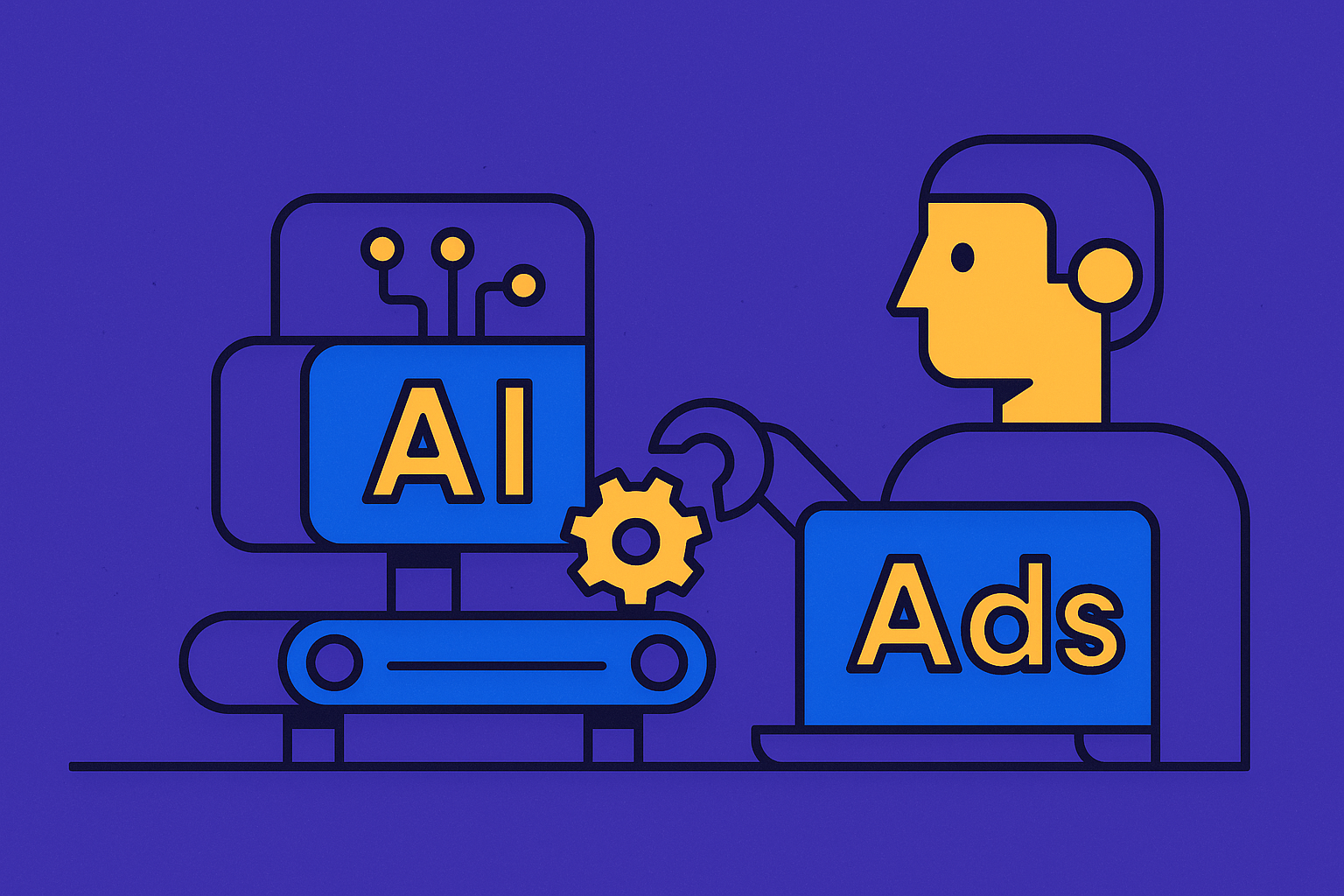
"AI automation agency" is one of those phrases that got vague before most buyers even had a chance to figure out what it means. Right now it covers at least three different things wearing the same name tag: traditional agencies that bought some AI tools and updated their pitch deck, software platforms that decided "agency" sounds better than "SaaS," and purpose-built operations where AI agents run the campaign day to day. Those are not the same product. They shouldn't be priced the same, or judged the same way. You won't find that distinction in the marketing, though. You have to go dig for it.
The part that actually matters isn't whether AI is involved. Nearly everyone's got some AI involved at this point. What matters is where it sits in the workflow. Three setups show up over and over:
- AI as an assistant. A human account manager still runs the account. The AI suggests things. A person decides.
- AI as the primary executor. Agents run the day-to-day work. Humans step in for exceptions and judgment calls.
- AI as a dashboard. The "agency" is really just software with a nicer front end, and the client is still the one operating it.
Only the middle setup changes what you're paying for. The pitch behind an AI automation agency is execution that rarely stops: something watching the account every day, not once a week. That pitch only holds up if the AI is actually doing the work, rather than just handing a person a list of suggestions to act on later, which is just a slower version of the same old thing.
Google itself has started closing part of this gap. Ads Advisor and Analytics Advisor, rolled out in December 2025, put AI recommendations straight into the platform. That raises the bar for what a third-party layer needs to prove. If an agency's whole pitch is "we read your Google Ads dashboard so you don't have to," that pitch just got a lot thinner.
What the AI actually runs in a Google Ads program — and what it doesn't
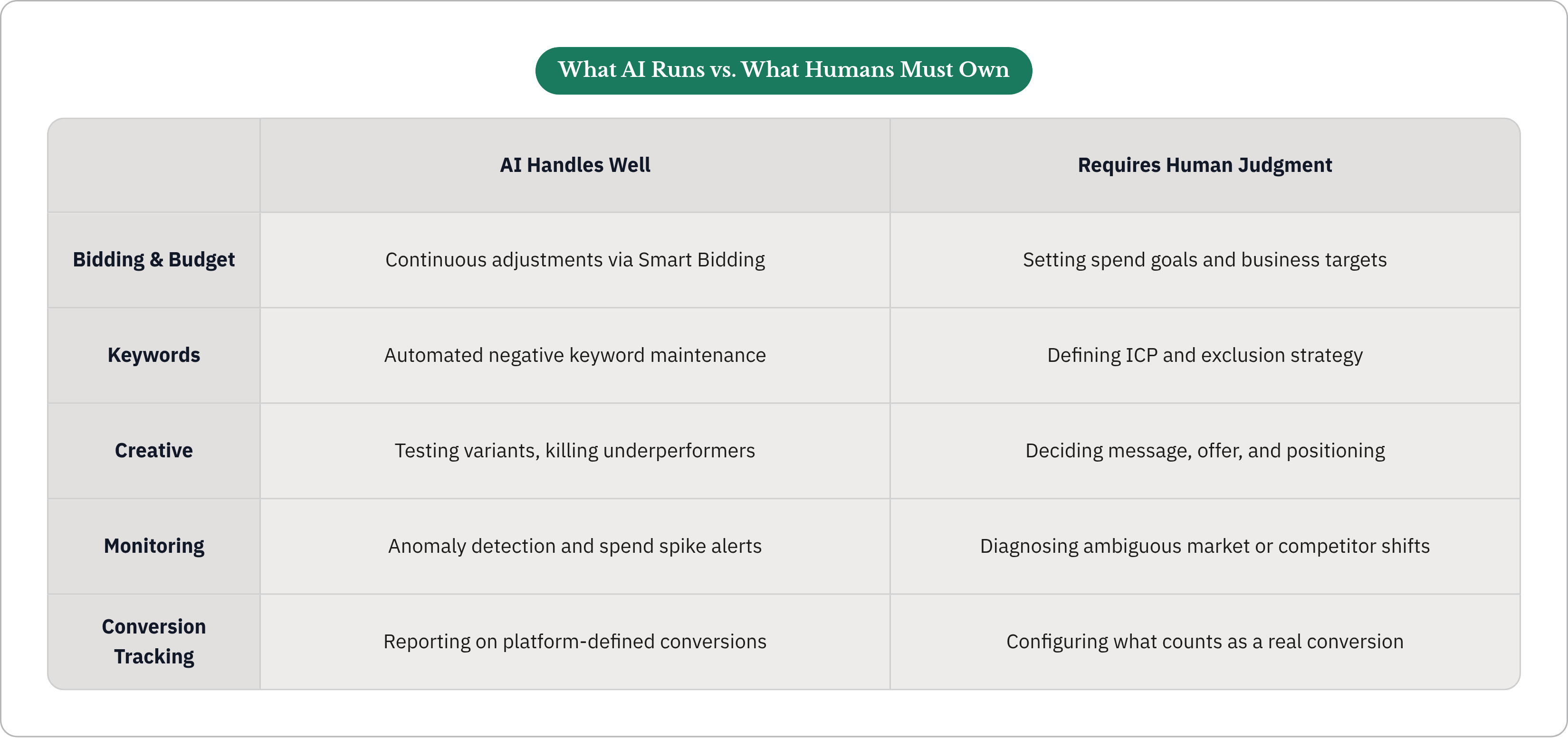
Here's where AI agents earn their keep, often running things without a person needing to sign off each time:
- Bid and budget adjustments. The most mature piece of the puzzle, close to a solved problem now through Smart Bidding.
- Negative keyword management. Skipped more than people think, even in accounts that call themselves "automated." One documented B2B case found that a large, well-built negative keyword list was a major driver behind a much better pipeline-to-spend ratio. Not a new bidding strategy. Not a clever ad. A list of words to exclude.
- Ad copy testing and rotation. Write variants, launch them, watch what performs, kill what doesn't.
- Anomaly detection. Catching a spend spike or a quality score drop before a person would even open the dashboard.
- Campaign structure changes. Match type tweaks, ad group splits, keyword consolidation.
Here's what mostly stays out of the machine's hands, even when the model behind it is strong:
- Conversion configuration. Deciding what actually counts as a real conversion, wiring up offline conversion tracking, closing the loop back to the CRM. That's a call about your business. Not a technical setting.
- ICP definition. Somebody has to tell the system what a good lead looks like before it can go find more of them.
- Creative strategy. The AI can test message variants all day. It can't decide what the message, offer, or positioning should be in the first place. That call sits upstream of anything it's able to optimize.
- Exception handling. When something breaks in a weird, ambiguous way (a market shift, a competitor move, a landing page quietly falling apart), figuring out why takes a person. Not a pattern-matcher.
Google's own Smart Bidding guidance calls for a meaningful volume of conversions each month before the algorithm can learn anything reliable. A lot of B2B accounts rarely hit that number in a given month, so the AI ends up optimizing on thin, noisy signal. Left alone, it'll chase whatever's easiest to count as a "conversion" rather than what's actually a qualified lead. The tool is doing what it's told; it isn't broken. The real question is whether anyone told it the right thing.
The structural problem AI automation is solving for — and why traditional agencies don't solve it the same way
Paid search in B2B runs all day, every day. The auction rarely stops moving. But most agency setups run on a weekly call, a monthly report, maybe a quarterly deck. That mismatch is the actual problem AI automation is trying to fix.
A campaign left alone for a week can drift. Quality score slips. Impression share shrinks. Cost per click creeps up. None of that waits politely for your Tuesday check-in.
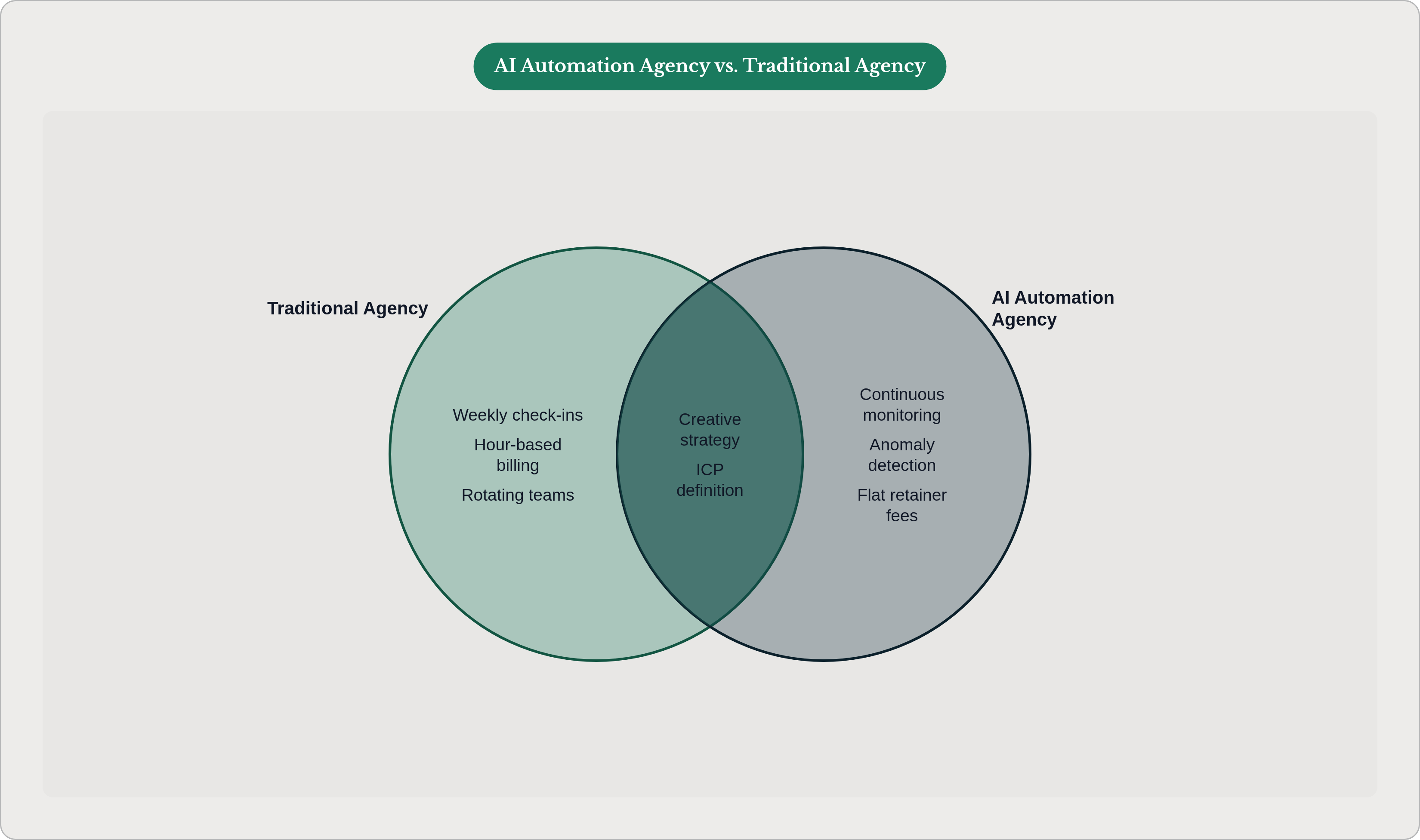
Traditional agencies get staffed and billed around hours. Watching an account all day, every day is expensive to staff for, so the natural move is to staff each account at the minimum level that keeps the client happy. That's not a knock on the people doing the work. It's a knock on the model they're stuck in.
AI automation changes that math. Execution stops scaling with hours worked. Agents can watch and adjust an account all day without anyone clocking extra time to do it.
The traditional agency model still wins on a few things: strategic diagnosis, walking a client through what's actually happening and why, creative judgment, and plain accountability. Someone whose job it is to own the outcome, not just answer a Slack message. Windmill Strategy's framing of this debate gets at something worth sitting with: agency versus automation isn't really the right fight to be having. The real question is which decisions need a human, and which ones can safely go to something that runs continuously and rarely sleeps.
Which raises an uncomfortable question. If an AI automation agency removes the human account manager but never actually replaces the judgment that person brought, what you get is very fast optimization toward the wrong goal. Speed isn't the same thing as direction.
Why B2B Google Ads specifically strains pure automation
B2B is where pure automation hits its hardest test, and the reasons are baked into how B2B sales actually works.
Start with volume. Low monthly conversion counts make it hard for Smart Bidding to build any kind of reliable model in the first place. Now add time: B2B sales cycles often run six to eighteen months, so the thing Google can actually see (a form fill, a demo request) sits way upstream of any real revenue. Without offline conversion tracking and a CRM feeding data back in, the AI just optimizes for the cheapest thing it can count. Usually that means more form fills, not more pipeline. Unqualified leads look great on a dashboard and terrible on a sales rep's calendar.
Then there's the negative keyword gap again, just bigger. Most B2B accounts have short negative keyword lists, and the gap between a mediocre B2B campaign and a genuinely strong one often comes down to what gets excluded, not what gets bid on.
AI Overviews add more friction on top of that. They now show up on a large share of searches, and Seer Interactive's analysis found a real drop in paid click-through rate on the queries where they appear. B2B tech searches specifically have seen sharp growth in how often AI Overviews show up year over year. That's fewer clicks reaching the ad at all, before any bidding strategy gets a chance to do anything.
Performance Max adds one more wrinkle. More automation, more efficiency, sure. But without strong audience signals and real first-party data feeding it, PMax can quietly burn budget on placements and audiences that have little to do with your actual buyer.
Put it together and the takeaway is simple: B2B Google Ads needs more setup on the front end and more human oversight on an ongoing basis than B2C automation does. Anyone evaluating an AI automation agency should ask specifically how it handles conversion quality, not just conversion volume. Volume is easy to report and easy to fake. Quality is the actual point of running ads at all.
What a full-stack AI automation agency coordinates beyond the ad account
Here's a failure mode worth naming straight out: an agency, AI-powered or not, optimizes the ad account in isolation while the landing page is weak, the offer's unclear, and attribution is broken. Platform metrics look great. Click-through rate's up. Pipeline barely moves. Sound familiar?
Real coordination across the whole stack looks like this:
- Creative. AI-generated variants tested against real performance data, not just swapped headlines. Different offers, different formats too.
- Landing pages. Making sure the message on the ad matches the message on the page it sends people to. The conversion rate on that page is very often the actual bottleneck, not anything happening inside the ad account.
- Attribution. Connecting ad clicks to real CRM outcomes, not just whatever the platform reports as a "conversion." That means offline conversion imports and multi-touch modeling, not one pixel firing on a thank-you page.
- Reporting. Showing qualified pipeline and revenue, not just click-through rate and impression share. Numbers that feel good but don't pay anyone's salary.
BCG's 2025 look at AI agents in B2B go-to-market systems describes this as a layered setup: data and intent signals feed a decision layer, the decision layer feeds orchestration, orchestration feeds execution across channels, and each layer reads from and writes back to the same shared pool of context. The point underneath all that: when campaign results feed back into the same system that built the campaign, the next round of work starts from evidence, not a blank page. It knows which audiences converted last time. It remembers which creative actually worked.
The real test for a buyer isn't "can you adjust my bids." It's this: can this agency tell you whether your problem is the creative, the landing page, or a hole in your attribution? If the answer only covers what happens inside the ad account, you're getting in-account tuning, rather than full-stack diagnosis.
How to evaluate an AI automation agency's actual capabilities against its marketing
"AI-powered" is a marketing line, not a description of what happens. It tells you almost nothing about what the AI does, what a person does, and who's on the hook when something breaks. Here are five questions worth asking any agency in this category before you sign anything:
- How do you handle conversion quality, not just conversion volume? Ask about offline tracking, CRM integration, lead scoring feedback. A vague answer is the answer.
- What does a person actually do in your model, and who specifically is accountable for outcomes? You want a name. Not "our team."
- How does your system improve over time, and where does that improvement live? Does each campaign build on the last one, or does every engagement start from zero?
- How do you figure out whether underperformance is a campaign problem, a creative problem, or a landing page problem? Same full-stack diagnosis question, asked a different way.
- How is your fee structured relative to media spend? A flat retainer and a percentage of ad spend create very different incentives. The second one quietly rewards an agency for telling you to spend more, whether or not spending more is actually the right call.
That fee question matters more in B2B than almost anywhere else, because a percentage-of-spend model pushes an agency toward bigger budgets regardless of whether bigger actually helps.
One more gut check: does this agency run the system for you, or does it just hand you a nicer screen to run it yourself? Only one of those is actually delegation. The other's just software with better marketing behind it.
Benchmark against Google's own Ads Advisor and Analytics Advisor, launched December 2025. If a third-party AI layer can't clearly say what it does that Google's native tools don't already do, that's not a small gap. That's the whole pitch falling apart in front of you.
Where Thunder fits in this category and how its model differs
That middle spot between a traditional agency and a software platform is deliberate, and it maps onto every gap covered above.
The agent layer runs continuously: building campaigns, managing bids and budgets, maintaining negative keyword lists, testing creative, lining up landing pages with ad copy, handling attribution, reporting on results. All of it across Google and LinkedIn together, as one system, not a pile of separate tools that don't talk to each other.
Alongside that sit Forward Deployed Marketers, actual people who handle the calls agents shouldn't make alone: governance, exception handling, conversion configuration, ICP alignment. A name the customer can actually hold accountable, instead of an anonymous rotating team.
The compounding part matters too. Every campaign leaves behind real evidence: which audiences converted, which creative worked, where the funnel actually broke down. The next campaign starts from that history instead of a blank page.
Offline conversion tracking and CRM integration are built into the system from day one, rather than as an add-on you buy later. Optimizing for whatever Google's platform happens to report as a "conversion" is, in a lot of B2B accounts, optimizing for exactly the wrong thing.
On fees: flat retainer, decoupled from media spend. No built-in reason to tell you to spend more. Success gets measured in qualified pipeline and revenue, not how much money moved through the ad account.
This model fits a specific situation: paid media matters enough to move the business, but you don't want to be the one operating it day to day. That's the agency relationship that's gone quiet and passive. The contractor relationship that turned purely transactional. The in-house person who left and took the program's only owner with them. If that's where you're sitting, this whole category, and understanding what it actually does versus what it claims, is worth the hour it takes to ask the right five questions.