Controlling Search Term Visibility in Performance Max
Google finally shows you where Performance Max money actually goes.

Performance Max has been called a lot of things since it launched. "Black box" is the polite version. For B2B advertisers watching budget disappear into Display placements they couldn't see, on queries they couldn't identify, optimizing toward form fills that never became pipeline — it felt less like a campaign type and more like a donation box with no receipt.
Then, over the course of 2025, Google released a sequence of updates that materially shifted how much visibility advertisers actually have into what PMax is doing. By March 2025, individual search queries were visible in a standard report. By August 2025, a channel performance breakdown showed how budget was splitting across Search, YouTube, Display, and the rest.
More visibility, though, does not automatically mean more control. The information environment improved. The control environment is a more complicated story — like finally getting a window into a room you still can't enter.
So let's walk through what actually exists now. Three distinct visibility layers, each serving a different purpose. Conflating them is easy to do and expensive to get wrong.
The Search Terms Report
This is the one practitioners had been asking for since PMax launched. Individual queries. Real ones. No categories, no themes. Actual search terms driving impressions and clicks in your campaign.
As of March 2025, this data lives inside the standard Search Terms report, and negative keywords can be added directly from that view. The workflow advertisers were used to in Search campaigns is now replicated here. You can also pull this via the API using the campaignsearchtermview resource (not searchterm_view, which is the Search campaign version) and get full performance metrics including cost.
Campaign-Level Negative Keywords
Up to 10,000 negative keywords can now be applied at the campaign level across Search and Shopping inventory. Shared negative keyword lists (the ones you've probably been using across Search campaigns for years) can now be applied to PMax campaigns too. That matters for accounts running multiple PMax campaigns, because it means managing exclusions from one place instead of maintaining them everywhere separately.
One hard limit: negatives cannot be applied at the asset group level. Everything operates campaign-wide. If you have multiple asset groups targeting different products or audiences within the same campaign, you cannot segment exclusions between them. That's a meaningful constraint, not a minor footnote; it shapes how you should structure campaigns.
Search Themes
Search themes are how you tell the algorithm what your business is actually about. The limit increased from 25 to 50 per asset group, which gives meaningful room to cover both core product or service topics and more solution-aware query patterns.
These are inputs to the algorithm, not keyword targeting. They influence where Google's AI directs traffic; they do not force exact query matching. The "Source" column in reporting separates which conversions are attributable to your themes versus what the algorithm found on its own. Watch that column. It tells you how much of your campaign is running on your signal versus Google's.
The Channel Performance Report
Found under Insights & Reports → Channel Performance, this report breaks out delivery and results by surface: Search, YouTube, Display/GDN, Discover, Maps, and Gmail. It launched in beta at Google Marketing Live in August 2025.
One constraint that catches people off guard: the data only goes back to June 6, 2025. No historical backfill. Any comparison to pre-June performance requires separate benchmarking outside this report.
In the API, channel granularity comes from segments.adnetworktype, with values like SEARCH, CONTENT, YOUTUBESEARCH, YOUTUBEWATCH, and MIXED.
Device and Age Controls
Not directly tied to search term visibility, but worth naming here: device and age targeting controls are now fully available in PMax. When you're trying to shape who actually sees your campaigns, these belong in the same conversation.
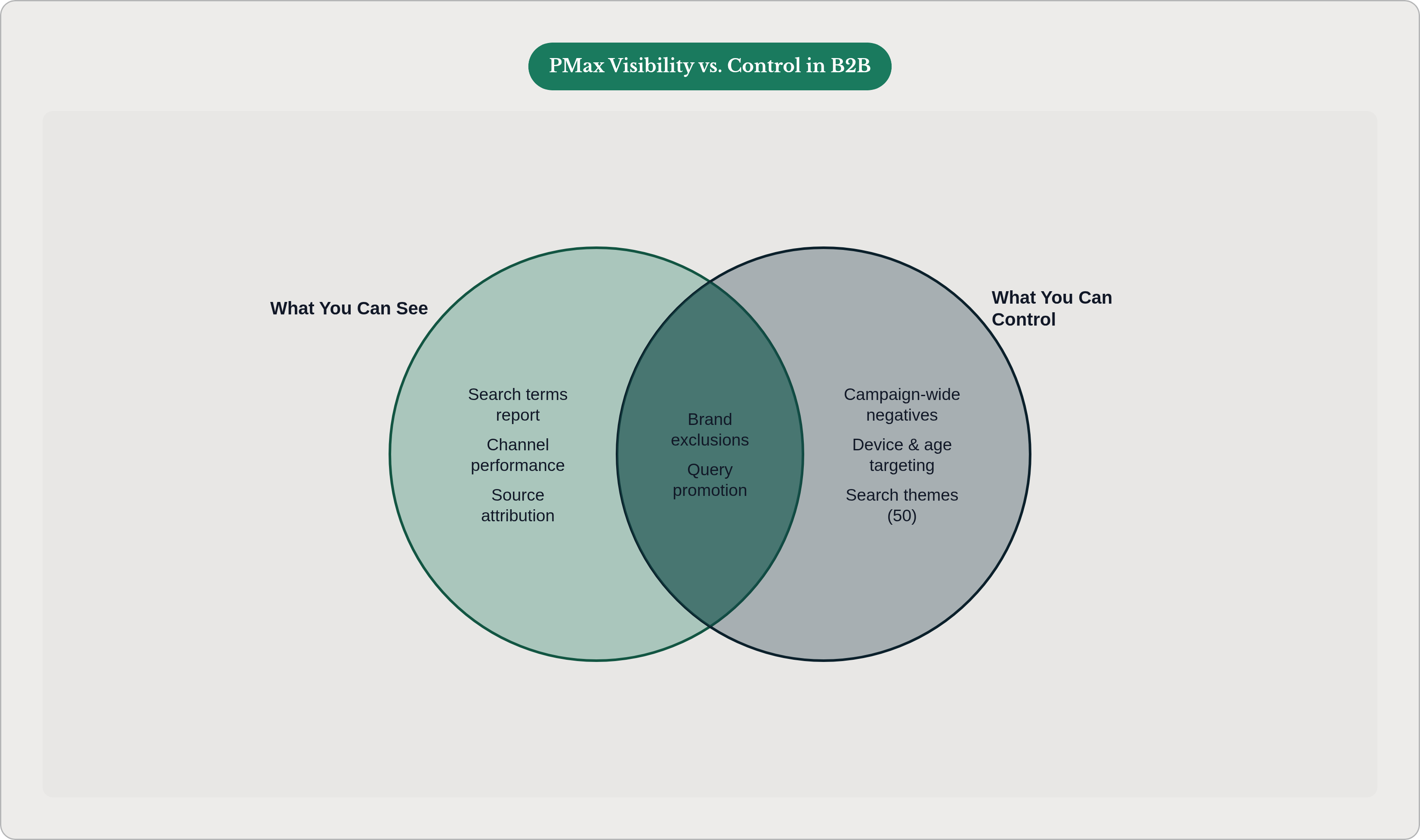
What the Channel Performance Report Reveals That the Search Terms Report Cannot
Here's something that shows up repeatedly when auditing PMax accounts. In many of them, the largest share of actual conversions is coming from a single channel. Meanwhile, a meaningful portion of budget is flowing to Display and YouTube with little measurable return.
The search terms report cannot show you that. It can tell you which queries are triggering Search inventory, but it cannot tell you whether Search is where your budget is actually concentrated, or whether a large share of spend is quietly exiting through Display placements you can't see.
That's the channel report's job. It shows where the money is going across surfaces, and it lets you compare conversion rates and cost per conversion by channel. For B2B advertisers, that surface-level breakdown matters because query-triggered Search traffic and audience-targeted Display traffic behave very differently. A form fill from someone who searched "enterprise contract management software" is a different animal than a form fill from someone who was served a Display ad while reading industry news. The algorithm doesn't always know the difference. You need to.
But what the channel report still cannot do is equally important.
- Placement-level data within Display remains hidden. You can see that Display is spending. The specific sites or apps that received those placements remain invisible.
- There is no mechanism to opt out of Display within PMax. It's included by default, with no exclusion control.
- Attribution across touchpoints remains opaque. No visibility into how credit is distributed across channels within a PMax campaign, no option to switch attribution models, and limited integration with multi-touch analytics unless offline tracking is heavily customized.
Think of the channel report as diagnostic, not prescriptive. It tells you where money is going. What you do about it is a different question entirely.
How to Sequence the Controls: A Working Order for B2B Advertisers
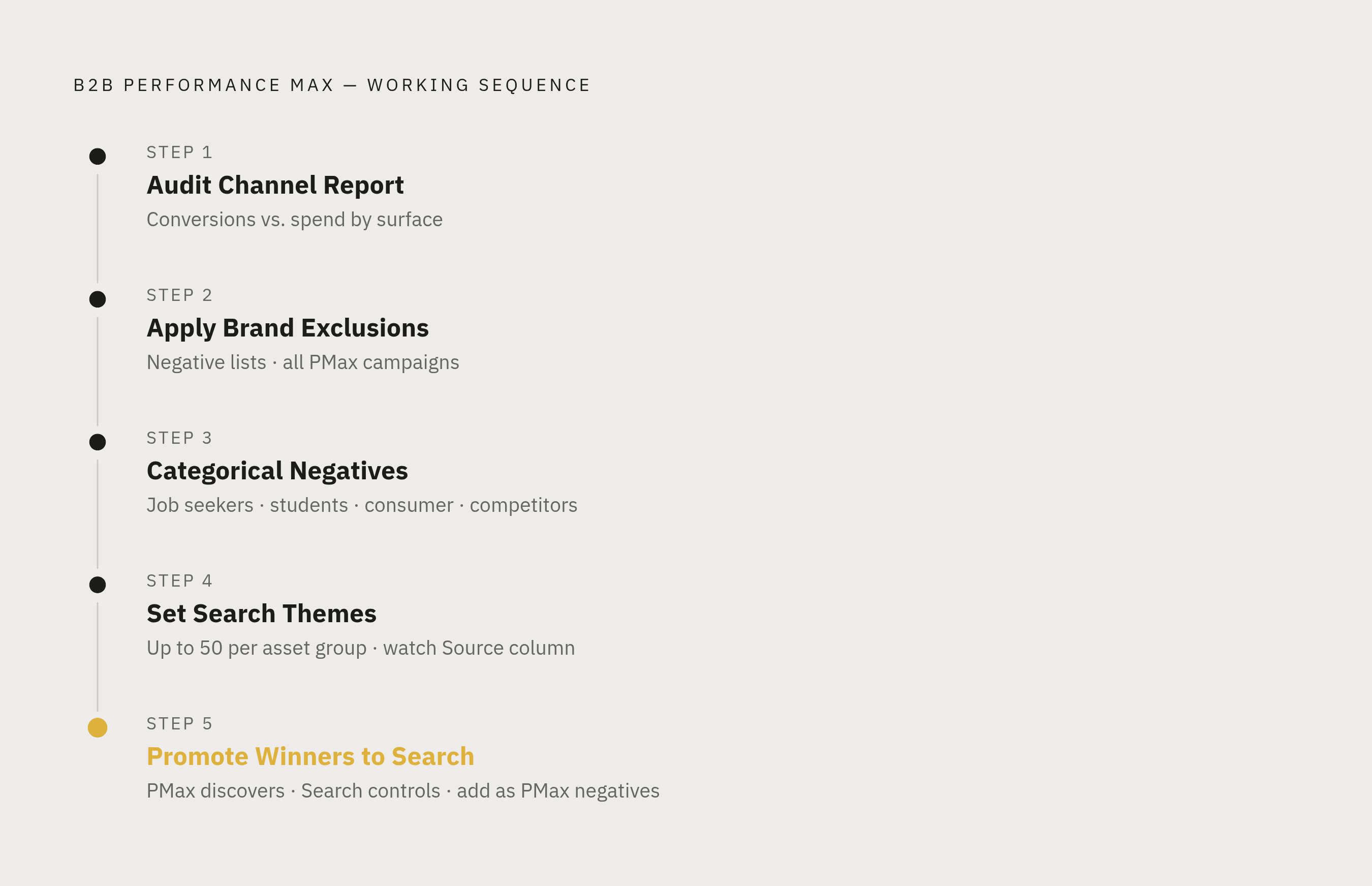
The order matters here. Jumping straight to negative keywords before understanding where budget is flowing is a common mistake, and it leads to exclusions that address the wrong problem.
Step 1: Audit the Channel Report First
Before touching negatives or themes, open the channel performance report and establish the baseline. Which surfaces are driving conversions? Which are absorbing spend without measurable return? This context informs everything else. How aggressively to apply negatives, whether themes need to be narrowed or expanded, where the biggest efficiency gaps actually live.
Step 2: Apply Brand Exclusions
First and most urgent negative keyword action: exclude brand terms so PMax doesn't cannibalize your dedicated brand Search campaigns. Review near-brand queries too. Misspellings, product name variants. These can dilute ROAS without surfacing as obvious brand traffic.
Use negative keyword lists for brand exclusions. Apply the same list consistently across all PMax campaigns so you're not maintaining this separately in every campaign.
Step 3: Review the Search Terms Report and Apply Categorical Negatives
Look for query patterns that signal the wrong audience. Job seekers. Students. Competitors researching you. Consumer intent where you're selling B2B. These are the clear mismatches.
Group exclusions thematically into negative keyword lists rather than adding individual terms one at a time. More durable, easier to maintain as campaigns evolve.
One caution worth raising: Google's algorithm sometimes allows lower-performing terms to run because they're contributing to audience learning that benefits higher-value conversions downstream. Over-negating can restrict performance in ways that aren't immediately visible in the data. A reasonable working rule: exclude clear mismatches confidently. Be slower to exclude ambiguous mid-funnel terms until you have enough conversion data to know whether they're actually dead weight.
Step 4: Use Search Themes to Guide the Algorithm Toward High-Intent B2B Queries
With 50 themes now available per asset group, there's real room to communicate business context. Cover your core product or service themes, and also cover the solution-aware query patterns that signal a buyer who understands the problem they're trying to solve.
Don't treat search themes like keywords. They're not match types. They're a way of telling the algorithm what your business is about so it can make smarter decisions autonomously. Watch the "Source" column to see how much of your conversion volume is following that signal versus running on Google's autonomous matching. If Google is driving most of it, that's worth knowing.
Step 5: Promote Winning Queries Into Search Campaigns
This is where the feedback loop clicks into place. The Search Terms report is a discovery mechanism. High-performing queries that PMax surfaces can be added as exact or phrase match keywords in dedicated Search campaigns, where you have precise control over bidding, messaging, and audience layering.
Once a query is promoted to Search, add it as a negative in PMax. This prevents the two campaigns from competing against each other for the same query, which inflates auction costs and muddies performance data.
PMax discovers. Search controls. That's the intended architecture, and it actually works when you stick to it.
The B2B Lead Quality Problem That Search Term Controls Alone Cannot Solve
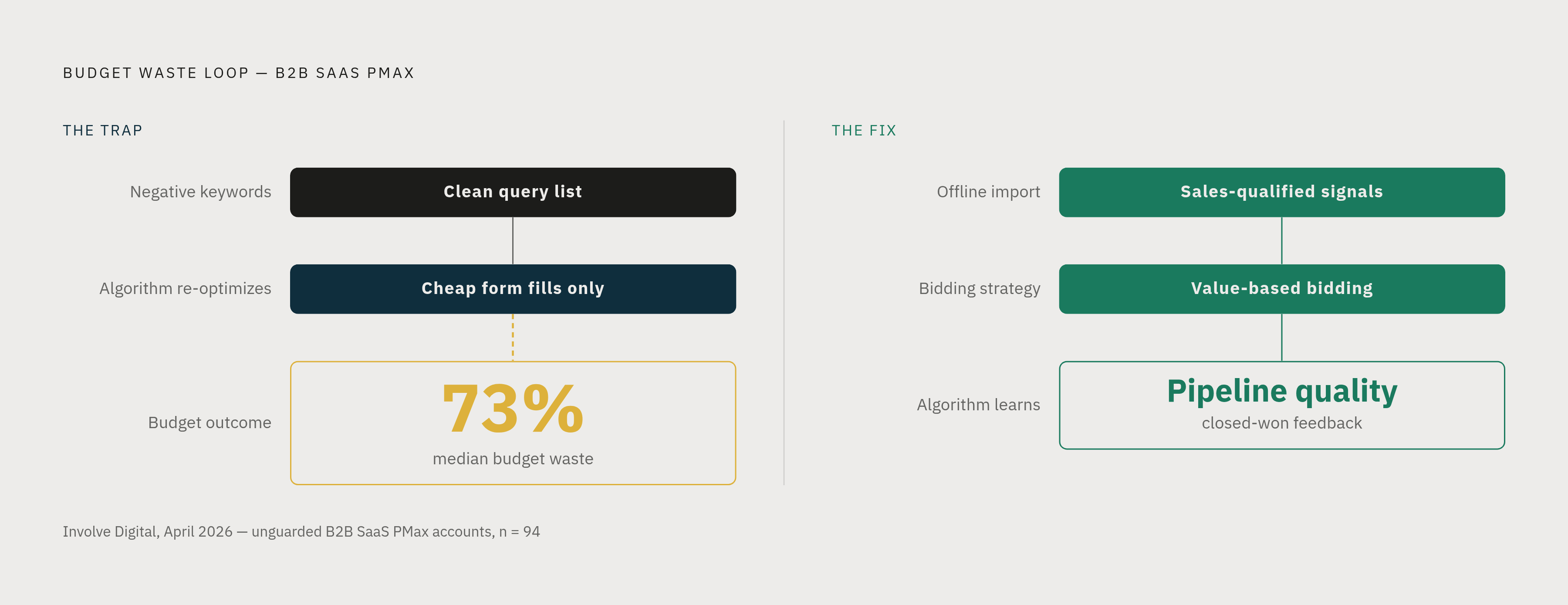
You can implement every step above and still have a PMax campaign that generates a lot of form fills and very little qualified pipeline.
Why? Because search term controls operate at the top of the funnel. They shape which queries trigger the campaign. But PMax's bidding algorithm optimizes toward whatever conversion event it can measure. And in most B2B accounts, that event is a form submission.
When the algorithm optimizes for form submissions, it finds the cheapest form submissions. Cheap form fills and qualified leads are not the same population. Practitioners have called this the "feedback loop of doom," and it shows up in B2B SaaS PMax accounts with uncomfortable regularity. The algorithm isn't doing anything wrong by its own logic. It's doing exactly what it was told. The problem is what it was told to optimize for.
Involve Digital's April 2026 analysis estimated median budget waste at 73% in unguarded B2B SaaS PMax accounts. Search term negatives alone cannot address that figure if the conversion signal remains a raw form fill. That should give you pause.
The fix operates at the measurement layer, not the keyword layer.
- Enhanced Conversions for Leads captures hashed lead data that can be matched back to actual CRM outcomes.
- Offline conversion imports feed sales-qualified lead or closed-won signals back into the algorithm, giving it a signal that reflects pipeline quality rather than form volume.
- Value-based bidding, once offline conversion data is flowing, allows the algorithm to weight high-value leads more heavily in its optimization decisions.
What happens to an account that has excellent negative keyword hygiene but no offline conversion import architecture? The algorithm re-learns its way back toward cheap form fills regardless of how well negatives are maintained. The structural incentive doesn't change just because the query list got cleaner.
Search term controls and offline conversion tracking are complementary. Not substitutes. Both are required if you want PMax to function as a pipeline tool rather than a lead volume machine.
Where PMax's Remaining Structural Limits Leave B2B Advertisers Exposed
The recent updates are genuinely useful. It would be easy to come away thinking the transparency problem is largely solved. It isn't, and being fuzzy on that distinction will cost you.
No asset group-level negative keywords. All exclusions are campaign-wide. If you're running multiple asset groups within a single campaign (different products, different audiences, different funnel stages) you cannot apply negative keyword logic at that level. Everything lives at the campaign tier.
No opt-out from Display. PMax includes the Display network by default. The channel report shows aggregate Display spend and performance. It does not show which placements received it. There is no placement exclusion interface in PMax comparable to what exists in standard Display campaigns.
Attribution is still a black box inside the campaign. No control over attribution model selection. No touchpoint-level credit visibility. Integrating PMax data into multi-touch analytics requires significant custom offline tracking work, and even then you're working around the edges of what Google surfaces.
Search themes influence but do not constrain. The algorithm can and will match PMax to queries outside the themes you've provided. Themes are a signal, not a fence.
These limits have a specific consequence for sales-led B2B. Long buyer journeys. Uneven deal values. A large quality gap between a qualified and unqualified lead. These are conditions that demand precise control over where and how budget is spent. They are also exactly the conditions where PMax's autonomy is most likely to create waste, because the algorithm doesn't know that the lower cost-per-lead it found on Display is worth less than the higher cost-per-lead it found through a high-intent Search query.
The strategic response that makes the most sense here: treat PMax as one layer in a paid media stack, rather than an all-in replacement for Search. Use it for discovery and remarketing. Route high-intent B2B queries that PMax surfaces into Search campaigns where bidding, messaging, and audience controls are fully available.
Teams running this well are doing compounding work. Auditing channel reports regularly, iterating on negatives, importing offline conversions, promoting winning queries into Search. It's an operational cadence, not a one-time setup.
One might argue that the transparency improvements Google released in 2025 are enough to make PMax viable for B2B without all of this. And that's not entirely wrong. It is more viable than it was. But viability and optimality are different standards. The question isn't whether you can make PMax work. The question is whether you're building the architecture that lets it actually get better over time, or just running it and hoping the algorithm figures it out.
Those tend to produce very different results twelve months in.