Dynamic Number Insertion for B2B Call Tracking in Google Ads
Dynamic number insertion reveals which ads drive qualified pipeline, not just cheap leads.

By the time a B2B prospect picks up the phone, they have usually already done their homework. They have compared options and decided they need a human before they commit. That call is a late-stage buying signal, often more valuable than a form fill from someone downloading a whitepaper at 11pm out of curiosity.
Google Ads does not know that, and it cannot, unless you tell it.
Out of the box, the platform treats a ten-second misdial and a twenty-minute discovery call as the same event. Both count as conversions. For a sales-led B2B company, that is not just an inconvenience. It is a slow leak in your optimization engine.
Think about what a phone call actually represents in a typical B2B buying process. The call often replaces a demo request. Buying committees tend to include at least one person who would rather call than fill out a form. And call volume can represent a real slice of inbound pipeline that simply never shows up in the conversions column.
Without dynamic number insertion (DNI), those calls are invisible to the ad platform. The spend that drove them gets zero credit. And Smart Bidding, which is constantly redistributing budget toward what it can see working, quietly pulls resources away from the campaigns driving calls it cannot measure. The account is not just missing data. It is being actively misled by its own optimization system.
That is the structural problem, and it is worth sitting with before jumping to the technical fix.
Configuring DNI for B2B Specifically. The Decisions That Separate Useful Call Data From Noise
The mechanism behind DNI is pretty simple. A JavaScript snippet on your site swaps out the displayed phone number based on how the visitor arrived. A Google Ads click triggers a unique forwarding number tied to that session. The visitor sees a local or toll-free number. The platform sees the originating keyword, ad group, campaign, and device.
Clean concept, but the mechanism alone does not make the data useful. Configuration does. And this is where most accounts quietly go wrong.
Call length threshold. This is the single most important filter you will set. A disconnected call lasting a few seconds is not a lead. Recording it as a conversion poisons the signal you are feeding Smart Bidding. A reasonable starting point for B2B accounts running discovery-style conversations is around 120 seconds. For teams with tighter qualification scripts, 60 seconds may work better. The honest answer is that the right threshold is empirical. Compare call length distributions against CRM outcomes after a few weeks of data, then calibrate. The number that makes sense for your sales motion is something you find, not something you assume.
Counting method. For net-new pipeline, count one conversion per caller within a defined window. If the same prospect calls three times in a week, that is one opportunity in your CRM, not three. Counting each call separately inflates volume and distorts bidding. Support or service calls follow completely different logic. Keep them in separate conversion actions. Mixing service call volume with pipeline-driving campaign data is one of the quieter ways B2B accounts corrupt their own performance signals, and it almost never gets caught until someone pulls the CRM records side by side.
Attribution model. Use data-driven attribution when Google flags the account as eligible. If it does not qualify, time-decay is a reasonable fallback. It weights the touches closest to the call without over-crediting broad head terms that may have been part of an awareness journey but did not close anything.
Conversion priority. Mark call actions as Primary only when the call itself is the desired outcome. For accounts also running offline conversion imports from a CRM, calls should typically be Secondary. Useful for reporting, but not competing with SQL or Closed Won signals for bidding.
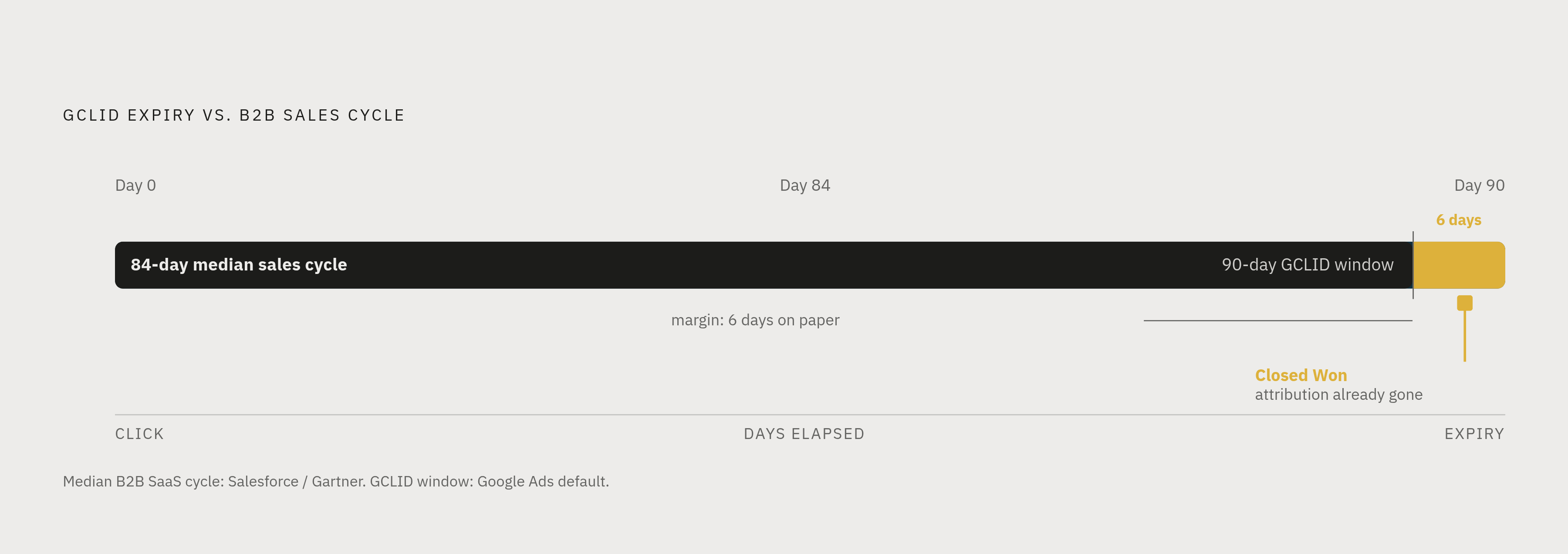
GCLID window. GCLIDs expire after 90 days. For B2B accounts with sales cycles that run close to or beyond that window, this is a real constraint. Do not wait for Closed Won to import. Import pipeline stage transitions, like MQL to SQL, within the attribution window. By the time a deal closes at the 90-plus-day mark, the attribution link is already broken, and there is no recovering it after the fact.
Number pool sizing. Pool size is determined by peak concurrent visitors, not average daily traffic. Under-pooling causes number reuse, which misattributes calls to the wrong sessions. It seems fine during normal traffic and quietly falls apart during a campaign push.
The Gap Between What the Google Ads Dashboard Shows and What the CRM Knows
The dashboard reports a cost per lead that looks manageable. You bring that number into a revenue meeting. Someone opens the CRM and shows the true cost per SQL, which is often several times higher.
The room gets quiet.
That gap is not a coincidence. It is what happens when form fills and qualified pipeline get treated as the same conversion event. And it raises an obvious question: how many accounts are making budget decisions based on a number that has a loose relationship, at best, with actual revenue?
More than you would hope. Only a small minority of B2B SaaS companies have full pipeline attribution connecting ad spend to CRM revenue. The vast majority are optimizing on cost per lead.
What does that produce in practice? Smart Bidding optimizes for what it can see. Spend concentrates on campaigns that produce cheap leads, not closeable pipeline. The account appears to be performing well by its own internal metrics while quietly underperforming on revenue. It is a self-reinforcing blind spot.
There is also a timing problem that is genuinely annoying. The median B2B SaaS sales cycle runs around 84 days. That is nearly the full length of the GCLID attribution window. Closed Won events routinely arrive after the attribution link has expired. So even companies trying to measure the right thing end up with broken data, not because they set it up wrong, but because of how the window interacts with the sales cycle length.
Here is a useful way to stress-test this. Measuring return on ad spend at 30 days shows breakeven or worse for most B2B SaaS products. The same campaigns measured at 180 days show meaningfully stronger returns. The campaigns did not change. The measurement window did. That gap is entirely an artifact of when you are looking, not a reflection of what the campaigns actually produced.
DNI is the first layer of fixing this, but it is not the whole fix.
Closing the Loop With Offline Conversion Tracking and CRM Integration
When someone clicks a Google Ad, Google generates a GCLID attached to that session. DNI captures that GCLID at call time. When that caller later becomes an SQL in HubSpot or Salesforce, that CRM event fires back to Google Ads with the original GCLID. Google now knows which keywords and campaigns produced SQLs, not just calls above a minimum duration.
DNI connects the call to the click. CRM integration connects the call to the revenue outcome. Without both, you have half a loop.
A few things worth knowing about how to structure this in practice. Google's recommended setup as of 2026 is Enhanced Conversions for Leads, which supersedes the legacy GCLID-only import path. If your account was built before 2024 and has not been audited recently, verify which path you are on. It matters more than most people realize.
Structure conversion actions by pipeline stage. Closed Won or SQL as Primary, which is what Smart Bidding optimizes toward. MQL and Opportunity as Secondary. Visible in reporting and useful for pipeline health diagnostics, but not polluting the bidding signal.
But what if the standard attribution model does not reflect how B2B deals actually work? Standard models track individual contacts. B2B deals involve buying committees. Several people at a target account might engage across multiple channels over several months before an opportunity is even created. Contact-level attribution surfaces only the two who filled out forms. Account-based attribution aggregates all touchpoints, including calls, into a single account record and connects them to pipeline creation and deal velocity. That is a fundamentally different lens, and for enterprise programs it is often the more honest one.
DNI's role in this architecture is specific: it captures the call event and preserves the GCLID that makes the downstream CRM match possible. Without it, the call and the click are permanently disconnected. Everything else downstream depends on that connection holding.
How to Choose a Call Tracking Platform for a B2B Google Ads Program
The call tracking software market has gotten crowded. Lots of vendors, lots of feature overlap, lots of decisions that feel more complex than they need to be. The core question for B2B is actually pretty simple: does the platform connect calls to CRM pipeline stages, or does it stop at which campaign drove the call? Both are useful. Only one is sufficient for sales-led companies.
Here is an honest breakdown of the main platforms.
CallRail built its reputation on DNI and it shows. Strong for marketing attribution, agency-friendly in its reporting structure, entry pricing around $50 to $55 per month. Well-suited to mid-market B2B programs that need clean source attribution without enterprise complexity.
Invoca leads the enterprise tier on AI-powered conversation intelligence and deep bid optimization integrations across Google, Meta, and Microsoft Ads. Pricing is custom, implementation takes weeks, and it holds a strong rating across nearly a thousand verified reviews on G2. That investment is justified when call volume is high and scoring call quality after the fact is operationally important. It is a poor fit for an account that will not actually use those capabilities. Buying horsepower you will not use is just expensive.
WhatConverts is particularly strong on unified multi-channel lead tracking, connecting calls, forms, and chats to revenue impact in one view. Useful for B2B programs where calls are one of several inbound lead types and you want a single reporting layer across all of them.
CallTrackingMetrics is value-oriented and well-suited to agencies managing multiple B2B accounts simultaneously.
One capability worth calling out: AI call intelligence varies significantly across these platforms. Invoca leads on post-call scoring. CallRail's Conversation Intelligence is the closest mid-market equivalent. Other platforms offer keyword spotting rather than true AI analysis. That distinction matters because qualifying a call after the fact changes how you decide which calls to import as offline conversions, and at what pipeline stage.
One thing no call tracking platform will surface on its own: who is calling, in a firmographic sense. Company size, industry, buying intent. That layer requires integrations with firm-level data sources, and it becomes more relevant for account-based programs where you care not just that someone called, but who.
The selection principle is simple. Match platform depth to the sophistication of the offline conversion import you will actually run. Buying enterprise-grade AI scoring for an account that will not use it is overspend. Buying a basic attribution tool for a team that needs post-call scoring is a capability gap. Start with what you will actually implement, not what looks impressive in a demo.
Where DNI-Powered Call Data Fits Inside a Broader B2B Paid Media Program
DNI is Google Ads-native in its original design. But the attribution problem it solves exists across every channel. A call driven by a LinkedIn ad click deserves the same source attribution logic. The fact that it often does not get it is a real gap in how most B2B programs are built.
That matters because Google Search and LinkedIn serve genuinely different roles. Search captures existing demand, people already looking for what you sell. DNI directly attributes calls from that intent-driven traffic. LinkedIn generates demand by reaching ICP accounts before they are actively searching. Calls from LinkedIn-influenced prospects may arrive later, through different paths, through multi-touch attribution rather than last-click models. The measurement approach has to reflect that difference, or you end up comparing apples to something that is not quite fruit.
When measurement is uneven across channels, Google appears to drive more pipeline than it actually does. Channel mix decisions get made based on the measurement gap, not actual performance. You might pull budget from LinkedIn not because it is underperforming, but because you cannot see what it is doing.
B2B SaaS cost per SQL on Google Ads ranges from roughly $800 to $2,500 as a median in 2026, with sharp variation by vertical. Without call attribution, SQL cost calculations exclude the portion of pipeline that entered through the phone, making cost per SQL look worse than it is for campaigns that are actually driving call volume.
Accounts that consistently import call-sourced conversions at the pipeline stage level give Smart Bidding a richer signal. The algorithm learns which keywords, times of day, geographies, and audiences produce calls that become SQLs, not just calls of a minimum duration. That is a qualitatively different kind of optimization. And it compounds over time in ways that are hard to see in a single reporting period but become obvious after a few quarters.
Running DNI as Operational Infrastructure Rather Than a One-Time Setup
Here is the thing about DNI that nobody really warns you about upfront. It gets configured once, validated at launch, and then left alone while the business and campaigns evolve around it. Tracking breaks silently. No alert fires. The conversions column quietly shrinks, and the team reads it as a demand signal instead of a tracking signal. By the time someone notices, weeks of data are already gone.
What actually breaks without active maintenance? Website redesigns or CMS changes that overwrite the DNI script. New landing pages built outside the tracked template. GCLID storage failures from cookie consent changes or browser updates. Number pool exhaustion during traffic spikes, causing number reuse and misattribution. Any one of these looks like a campaign performance problem until someone digs into the tracking layer.
A functional review cadence does not need to be elaborate.
Weekly. Verify call conversion volume is consistent with site traffic trends. A sudden drop is a tracking signal, not a demand signal, until proven otherwise.
Monthly. Cross-reference call-sourced conversions against CRM inbound call records. Systematic gaps indicate attribution breaks, not volume changes.
Quarterly. Revalidate call length thresholds against CRM outcome data. As the sales motion evolves, what constitutes a qualified call changes. The configuration should reflect that.
On offline conversion import cadence specifically: the 84-day median B2B SaaS sales cycle means pipeline stage transitions need to be imported on a schedule that keeps them within the 90-day GCLID window. Delayed imports lose attribution permanently.
Call attribution data belongs in the same weekly performance reporting you are already running. When it lives alongside traffic and conversion volume in regular reporting, breaks get caught quickly. When it lives in a setup document no one opens after launch, they do not. That is really the whole argument for treating DNI as infrastructure rather than a setup task. The value is in the maintenance, not the installation.