Account-Based Google Ads Campaigns for Enterprise B2B
Reach buying committees by treating accounts, not clicks, as your core metric.

Let me be honest about something before we get into the weeds here. Most Google Ads advice for B2B is written by people who've managed e-commerce accounts and then pivoted to SaaS. The fundamentals aren't wrong, exactly. They're just written for a different problem.
The core structural shift is treating the named account, not the keyword and not the click, as the unit of measurement. In practice that means building three layered audiences in Google Ads: Customer Match lists loaded from buying committee emails in your CRM, Custom Segments targeting the behavioral signals of committee members you don't yet know by name, and IP-based audiences that reach anyone at a target account accessing Google from a corporate network. Those audiences then feed four campaign types staged by intent: high-intent non-branded campaigns on phrase and exact match with Target CPA, mid-intent problem-aware campaigns on phrase match with Max Conversions, retargeting campaigns segmented by on-site behavior, and Performance Max operating last as a discovery layer once the intent-segmented campaigns have generated real training data. Creative and landing pages are segmented by persona, because the CISO, the CFO, and the IT Director are not in the same stage of the evaluation and should not see the same message.
Enterprise B2B is a different problem.
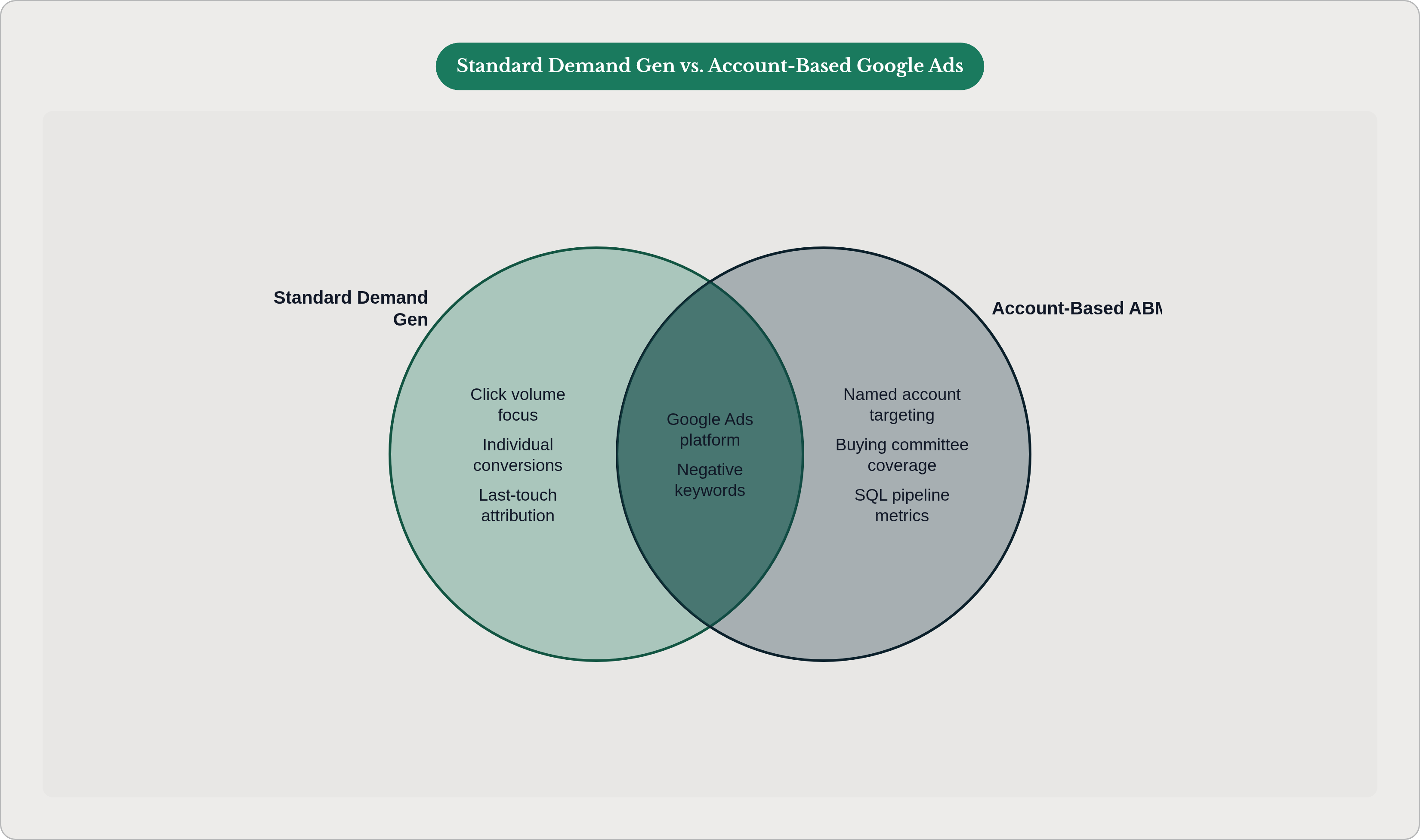
You're not selling a $49 product to one person who decides in an afternoon. You're selling a six-figure contract to a buying committee of six to ten people, across a sales cycle measured in quarters, inside a total addressable market that might be a few thousand named accounts globally. Standard demand gen logic treats every searcher as an equal opportunity. Account-based logic inverts this entirely. The identity of who clicks matters more than how many click.
Here's the number that should reframe how you think about this: more than 70% of B2B buyers begin their journey with a search engine before they ever respond to outbound. Your target accounts are already searching. Generic campaigns just have no way to recognize them when they do. The result is that a significant share of B2B SaaS Google Ads budget (research points to roughly 40 to 60 percent) ends up targeting individuals rather than buying committees. You're paying to reach people who will rarely have budget authority, rarely sit in the evaluation meeting, and rarely influence the deal.
The fix isn't a new bidding strategy. It's a different architecture. One where the named account, not the keyword and not the click, is the unit of measurement and optimization.
That reframe changes everything downstream. How audiences are built. How campaigns are structured. How creative is written. How success is measured. Let's walk through each layer.
How to build the audience layer that makes account-based targeting on Google possible
Google gives you three mechanisms for account-based audience construction. Most teams use one. The teams that get results use all three, layered together.
Customer Match is your starting point. You upload buying committee emails directly from your CRM. Google matches them across Search, Gmail, YouTube, and Display. Clean, intent-rich, first-party data. The catch is a hard threshold: you need at least 1,000 matched users for the audience to activate.
For enterprise SaaS companies with small TAMs, that number is a real constraint. If you have 200 named target accounts and two contacts per account, you're at 400 matched users. Not enough. The workaround isn't to compromise on account quality. It's to expand committee depth. Pull the CISO, the IT Director, the CFO, the Head of Risk, the procurement lead, the department head who owns the budget. Multiple decision-maker emails per account gets you to threshold faster without expanding your account list.
The other thing worth saying plainly: match rates depend entirely on CRM hygiene. Dirty data means wasted budget. Old emails, misspelled domains, personal Gmail addresses for work contacts. These don't match. This layer lives or dies on how clean your CRM actually is, not how clean you think it is.
Custom Segments solve a different problem. Procurement managers, finance analysts, and department heads often influence deals without ever entering a vendor's database. They're real buyers who will rarely show up in your Customer Match list. Custom Segments target based on active search behavior, websites visited, and tools interacted with. It's behavioral targeting for the committee members you don't know by name yet.
IP-based and CRM-synced audiences serve ads to employees accessing Google from corporate networks. Especially useful when you're targeting large named enterprise accounts where the buying committee is broad and your CRM coverage is partial. Once your core lists are loaded, Google's algorithm can identify organizations with comparable characteristics, which extends your reach while maintaining account-level relevance.
But what if you treat these as alternatives instead of layers? You underserve the committee. Customer Match reaches the people you know. Custom Segments reach the influencers you don't. IP-based targeting reaches anyone at the account who encounters a relevant query. Together, they approximate the actual committee. Separately, they approximate one dimension of it.
One more thing: this is not a one-time setup. Accounts move through the funnel. Contacts change roles. CRM data updates. Lists that aren't refreshed become stale, and stale lists optimize toward the past instead of the present.
How do you structure Google Ads campaigns around named accounts instead of keywords when selling enterprise software to a buying committee?
Enterprise buying committees don't move in unison. The CISO might be deep in technical evaluation while the CFO is still mapping out budget scenarios and the Head of Risk hasn't been looped in yet. Different stakeholders, different stages, simultaneously. Your campaign structure needs to reflect that reality, not pretend it doesn't exist.
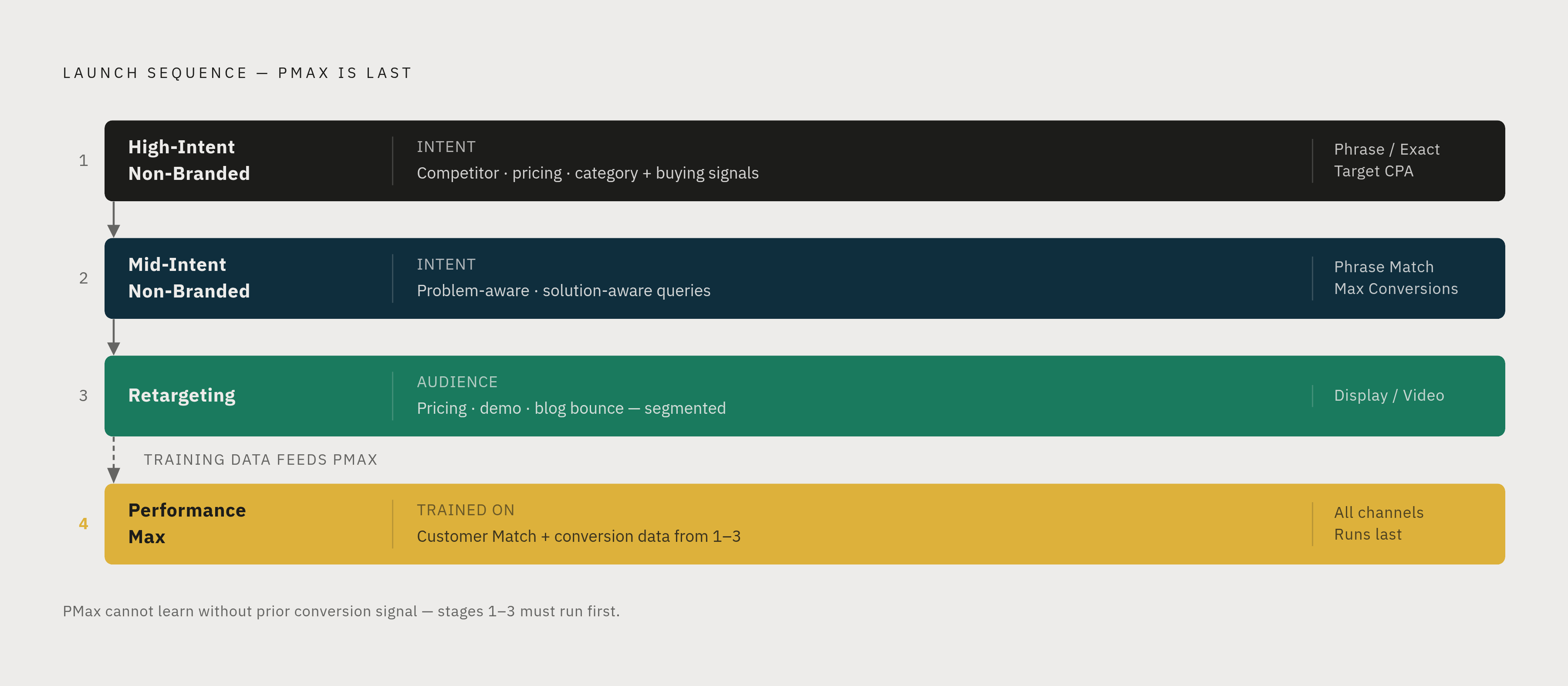
The architecture that works is built around four campaign types, each mapped to a distinct intent stage.
High-intent non-branded campaigns target competitor alternative queries, pricing searches, and product category terms paired with buying signals. Phrase and exact match. Target CPA bidding. This is where your highest-value traffic lives, and it needs the tightest controls.
Mid-intent non-branded campaigns cover problem-aware and solution-aware queries. Someone searching for how to solve the problem your product addresses, not yet searching for the product by category. Phrase match here, with Max Conversions to give Google room to learn from the broader query set.
Retargeting campaigns segment website visitors by behavior. Pricing page visitors are not the same as someone who read a blog post once. Someone who visited the demo page and then the security documentation is showing a completely different signal than someone who bounced after twenty seconds. Display and video formats work well here. The message should match where they've already been.
Performance Max comes last, not first. Feed it Customer Match lists, conversion data, and your best-performing creative assets. It functions as a discovery layer once your intent-segmented campaigns have already generated training data. Launching PMax before that data exists is a common mistake. We'll come back to why it's a particularly expensive one.
Budget allocation should shift as the program matures. Early on, when you're still validating demand, weight heavily toward search. As you identify what's working, move budget into retargeting and let PMax begin operating with real signal. At maturity, when the goal shifts from demand generation to defending market position, branded defense and competitive campaigns become more important.
The signals that tell you when to scale: impression share on high-intent campaigns below 70%, cost per SQL stable or declining over a month-plus window, and SQL-to-opportunity rate above 25%. If those signals haven't appeared, holding back scale isn't timidity. It's protecting the learning quality that makes eventual scale worthwhile.
Why negative keywords and device bid adjustments determine whether enterprise budget reaches real buyers
Here's something I've seen in almost every B2B account audit I've done. The negative keyword list is either tiny or nonexistent. We're talking fewer than 50 terms. Sometimes zero.
This is where the difference between a mediocre account and a high-performing one actually lives. Not in the bidding strategy. Not in the ad extensions. In the exclusion logic.
To make this concrete: one account I've worked with built a negative keyword list of over 800 terms. That list, more than any other single change, was the primary driver of a 58x pipeline-to-spend ratio. Not 58% improvement. 58 times.
What does a rigorous negative keyword strategy exclude for enterprise B2B? Consumer intent terms. Job seekers searching for roles at companies like yours. Irrelevant industries that happen to use the same vocabulary. Competitor brand names where association hurts. Informational queries that are ten steps removed from buying intent. The list is long, and building it is unglamorous, tedious work. It's also among the highest-ROI activities in paid search.
Device strategy is more nuanced. The temptation in enterprise B2B is to exclude mobile entirely because buying decisions happen on desktop. That temptation is worth resisting, partially. A significant share of B2B researchers now browse on mobile. You can't ignore that traffic. But conversion rates remain consistently higher on desktop, because that's where enterprise buying decisions are typically made.
The practical calibration: reduce mobile bids by 20 to 30%, rather than excluding mobile altogether. You capture research-mode attention without paying desktop prices for it.
Why does this matter more now than it did a few years ago? CPCs in B2B SaaS have been rising meaningfully, up roughly 9% year-over-year for SaaS specifically, with broader B2B up nearly 13% in 2025. Some enterprise software keywords exceed $100 per click. At that price point, exclusion discipline isn't a nice-to-have optimization. Every irrelevant click at $50 or $100 is a real number with a real opportunity cost.
How persona-level creative and landing pages convert account-based targeting into account-based pipeline
Here's the irony that kills more account-based campaigns than anything else. The targeting is precise. The creative is generic.
You've done the work to identify that the person searching is likely the CISO at a named financial services firm. You've built the audience layer to serve them a relevant ad. And then you serve them the same ad you show everyone else. The targeting says "we know who you are." The creative says "we don't actually care."
Consider a cybersecurity company targeting a global financial services firm. The CISO needs to see messaging about threat detection and incident response. The Head of Risk cares about regulatory compliance and audit readiness. The IT Director wants to know about integration depth and implementation complexity. These are not the same person. They're not in the same meeting yet. Serving them the same ad isn't neutral. It actively undermines the signal the targeting was designed to send.
Repeated exposure to relevant, persona-specific messaging builds brand familiarity before the internal buying conversation even begins. When the vendor's name comes up in that first committee meeting, it should already feel credible to the people who matter. That's what account-based creative accomplishes at its best.
Landing pages have to mirror the segmentation. A CISO landing on a page built for a CFO loses the relevance the targeting created. The click happened. The relevance didn't survive it.
Enterprise landing pages face a specific challenge that consumer and SMB pages don't: committee members with different concerns will share URLs internally. The IT Director finds something interesting and forwards it to the Head of Compliance and the VP of Infrastructure. Your landing page needs to either speak credibly to multiple stakeholders or be segmented by persona with clear navigation. Enterprise deals also require proof at scale. Named customers. Security and compliance signals. Integration depth. These aren't nice additions. They're the things enterprise buyers are actively looking for to de-risk the decision.
One more thing worth sitting with: 71% of B2B buyers initiate purchasing journeys with generic search queries. Early-stage creative needs to meet problem-aware language, not product-aware language. "How do we reduce audit preparation time" is where the CFO starts. Not "compliance automation software." Your creative has to exist at that level if you want to intercept the journey where it actually begins.
How Google AI Overviews and Performance Max change where ads appear and what that means for enterprise B2B
The search results page looks different than it did when most B2B paid media playbooks were written. Google AI Overviews now place ads inside AI-generated summaries at the top of results. Since mid-2024, organic clicks on searches with AI Overviews have dropped significantly (61% by one measure), and paid clicks have dropped nearly as much. Buyer behavior on the results page is shifting in real time.
What does this mean for how enterprise buyers actually search? A CFO isn't typing "ERP software." They're asking something like "how much does it cost to implement ERP for a 200-person accounting firm?" Conversational. Specific. Outcome-framed. Long-tail question-format queries that match how committee members actually search are increasingly where buying-intent traffic lives. Keyword strategy has to keep pace with that shift.
Performance Max is the other structural reality you can't ignore. Google is pushing advertisers toward PMax across all placements. It's not optional. But it's also not unconditional.
PMax works for B2B account-based campaigns only when it has strong inputs: Customer Match lists, conversion data, high-quality creative assets, clear conversion goals. Weak inputs don't get corrected by the automation. They get scaled. A vague audience, a generic asset group, and form-fill conversion goals fed into PMax will efficiently find you a lot of irrelevant traffic. It will do this at scale and with confidence.
The right positioning for PMax is as a downstream layer. It learns from signals generated by intent-segmented search campaigns. It shouldn't replace those campaigns. It should come after them, operate on data they've produced, and extend reach in ways the more controlled campaigns can't.
The underlying principle here applies to every automated system Google offers: the automation is only as account-based as the inputs you feed it. Google's AI isn't going to infer that you care about named accounts from first principles. You have to tell it, through the data and signals you provide.
Why account-based attribution is the hardest part of this architecture and what to measure instead of clicks
Let's talk about the hardest part. Not technically. Organizationally.
A CFO clicks a retargeting ad after seeing four display impressions over six weeks. In last-touch reporting, she shows up as a retargeting conversion. Google Ads gets some credit. The six weeks of display exposure before that click? Invisible. The influence that made her familiar enough with the brand to click in the first place? Not measured.
Standard Google Ads conversion tracking counts individual-level events. It was built for e-commerce. It counts conversions. It doesn't track account-level engagement or buying committee progression. For enterprise B2B, where the buying unit is the account and the journey spans months, individual conversion tracking tells you almost nothing about what's actually working.
What account-based attribution needs to track instead:
- Account-level engagement. How many contacts at a named account have been reached across which touchpoints?
- Buying committee coverage. What percentage of identified decision-makers at a target account have been exposed to your messaging?
- Pipeline influence. Which accounts in active sales cycles had meaningful ad exposure before or during the deal?
- SQL progression. Not MQL volume. SQLs. The only conversion metric that connects to revenue.
Retargeting's role in long-cycle attribution deserves specific attention. Only about 2% of users convert on a first visit, and in enterprise B2B, that number is lower and the cycle longer. Branded retargeting consistently shows dramatically higher return on ad spend than non-branded campaigns, because it's recapturing intent that was already built. The first touchpoint started something. Retargeting closes the loop. But last-touch reporting credits only the close.
Value-based bidding is the bridge between attribution quality and optimization quality. Companies that switch from Target CPA to Target ROAS strategies see a meaningful improvement in conversion value, but that only works if you're feeding Google pipeline-quality conversion data. Form fills are not conversion data. SQL stage, deal size, win likelihood. That's conversion data.
The measurement framework that revenue leaders should be looking at: cost per SQL, SQL-to-opportunity rate, and pipeline influenced by Google Ads. Not impressions. Not clicks. Not CTR. Weekly reporting on what changed and what happens next is what makes account-based programs improvable over time. Without it, budget decisions get made on lagging signals or misleading ones.
How the layers connect and where account-based Google Ads programs typically break down
Here's the system view: audience construction feeds campaign structure, which depends on exclusion discipline, which powers persona-level creative and landing pages, which adapts to AI Overview and PMax realities, which requires account-based attribution to close the loop. Each layer depends on the one before it.
The compounding dynamic works in both directions.
Good audience data trains better algorithms. Better algorithms produce better placement decisions. Better placements with persona-matched creative generate better engagement signals. Better engagement signals improve attribution fidelity. The whole system gets sharper over time, but only if each layer is doing its job.
Conversely, a weak layer doesn't stay contained. Bad audience inputs fed into PMax don't produce mediocre results. They produce efficiently scaled bad results. This is the version of account-based Google Ads that generates noise instead of pipeline. It often looks productive from the outside because the impressions are high and the CPCs seem reasonable. The SQLs just rarely materialize.
Where programs actually break down in practice:
Audience layer. CRM data is dirty. Customer Match lists never reach the 1,000-user threshold. Lists aren't refreshed as accounts move through the funnel. The targeting looks account-based. It's actually targeting the organizational history of who used to be at those accounts.
Campaign structure. All budget concentrated in one broad campaign with no intent segmentation. PMax launched before other campaigns have generated training data. The structure optimizes toward whatever Google's defaults prefer, which is not the same as what enterprise buying committees respond to.
Exclusion logic. No negative keyword strategy. Mobile bids not adjusted. Budget leaking to irrelevant queries at $20 to $100-plus CPCs. The audience layer was built carefully. The exclusion layer lets anyone through anyway.
Creative and landing pages. Targeting is persona-specific. Creative is generic. Landing pages don't match the persona or stage that drove the click. The relevance the targeting created evaporates on arrival.
Attribution. Pipeline influence from Google Ads isn't measured at the account level. Optimization signals fed back to Google are form fills rather than SQL quality data. The system optimizes toward the wrong outcome and does so with increasing confidence.
That last failure is particularly frustrating because it's invisible. Everything looks like it's working. The form fills come in. The reporting shows conversions. The revenue team sees no pipeline. And nobody can explain why because the measurement framework was never built to show it.
What this means for prioritization: fix the audience layer before scaling budget. Fix attribution before evaluating creative performance. Treat the system as integrated rather than as a collection of independent levers you can optimize one at a time.
Account-based Google Ads done well is difficult. There are a lot of moving parts, each with real dependencies on the others, and Google's automation doesn't automatically make it account-based just because you turned it on. But when the layers connect, and the inputs are clean, and attribution is measuring what actually matters, the results compound in ways that standard demand gen campaigns rarely match. The named account becomes the unit of measurement. And the program starts to look less like paid media and more like a system that identifies and develops pipeline.
That's the actual goal.