AI Marketing Campaigns for B2B Lead Generation
True AI agents in B2B marketing adapt decisions in real time, not just follow hardcoded rules.

Let's get something straight; "agent" is the most abused word in marketing technology right now. Almost everything being sold under that label is not actually an agent.
Here's the real spectrum, and the distinctions matter more than vendors want you to notice:
- Automation fires the next step because the clock said to. It has no idea what a prospect just did.
- Co-pilots draft, suggest, surface options. A human still makes every call.
- A true autonomous agent watches for signals, decides what to do next, and acts. Nobody prompts it.
Most "AI agents" on the market are conditional workflows in a nicer outfit. If this, then that. They don't learn. They don't reprioritize. They don't notice that a whole buyer segment started using completely different language three weeks ago. That's not intelligence. That's a flowchart with better branding.
So what actually makes something a real agent?
- It adapts creative and outreach decisions based on what it observes right now, not what it was hardcoded to expect.
- It reprioritizes leads based on live intent signals, not a static scoring model somebody built last quarter and quietly forgot to update.
- It decides the next best action without being asked. Signal comes in, firmographic fit gets checked, response gets initiated.
This changes lead qualification in a fundamental way. The old model produces MQLs: human-scored, batch-processed, reviewed on somebody's Thursday afternoon. The new model produces what you might call Agent-Qualified Leads. Scored and acted on the moment the signal is right.
That's not a naming convention; it's a different underlying logic. And if you've ever watched a hot lead go cold while it sat in a queue waiting for someone to get around to it, you already understand why it matters.
How an end-to-end AI agent architecture covers the full campaign lifecycle
Here's where I want to push back on how most people picture "AI for marketing." The instinct is to imagine one powerful system doing everything. That's not what actually works.
What works is a spine of coordinated agents, each owning a specific domain, passing live intelligence to each other. The performance comes from the coordination. No single agent has to be perfect. But the signal can't get dropped between them.
Here's how the layers actually break down.
Listening. This agent monitors prospect signals continuously. Intent spikes, pain-point language surfacing in search queries and forums, competitor mentions. It captures what the market is saying right now, not what somebody summarized in a quarterly brief that took six weeks to produce and was already stale when it landed.
Content and creative. Takes what the listening layer found and generates campaign themes, ad copy variants, and landing page messaging. All grounded in what buyers are talking about today.
Targeting and bidding. Automated bidding on Google and LinkedIn is table stakes. The differentiator is what signals you're feeding into it. This layer routes real-time intent data into the bidding logic so the platforms optimize toward buyers who are actually in-market, not just buyers who resemble your past customers on paper.
Qualification. Scores and routes leads based on live behavioral and firmographic signals. The agent does it when the signal warrants it, not when someone gets around to checking a list.
Attribution and reporting. Most teams fall short here, which is frustrating, because this is where the biggest gains actually live. This layer closes the loop by feeding offline conversion data back to the ad platforms. Closed deals. Pipeline stage changes. Most teams still don't do it.
Without that loop, creative doesn't know what targeting is doing. Targeting has no visibility into what attribution is revealing. Each campaign is a one-off experiment. With the loop, every campaign deposits intelligence into the next one. That's the whole game.
Why Google and LinkedIn together, and how to split the job between them
A question I get a lot: why both? Why not just go deep on whichever channel is working?
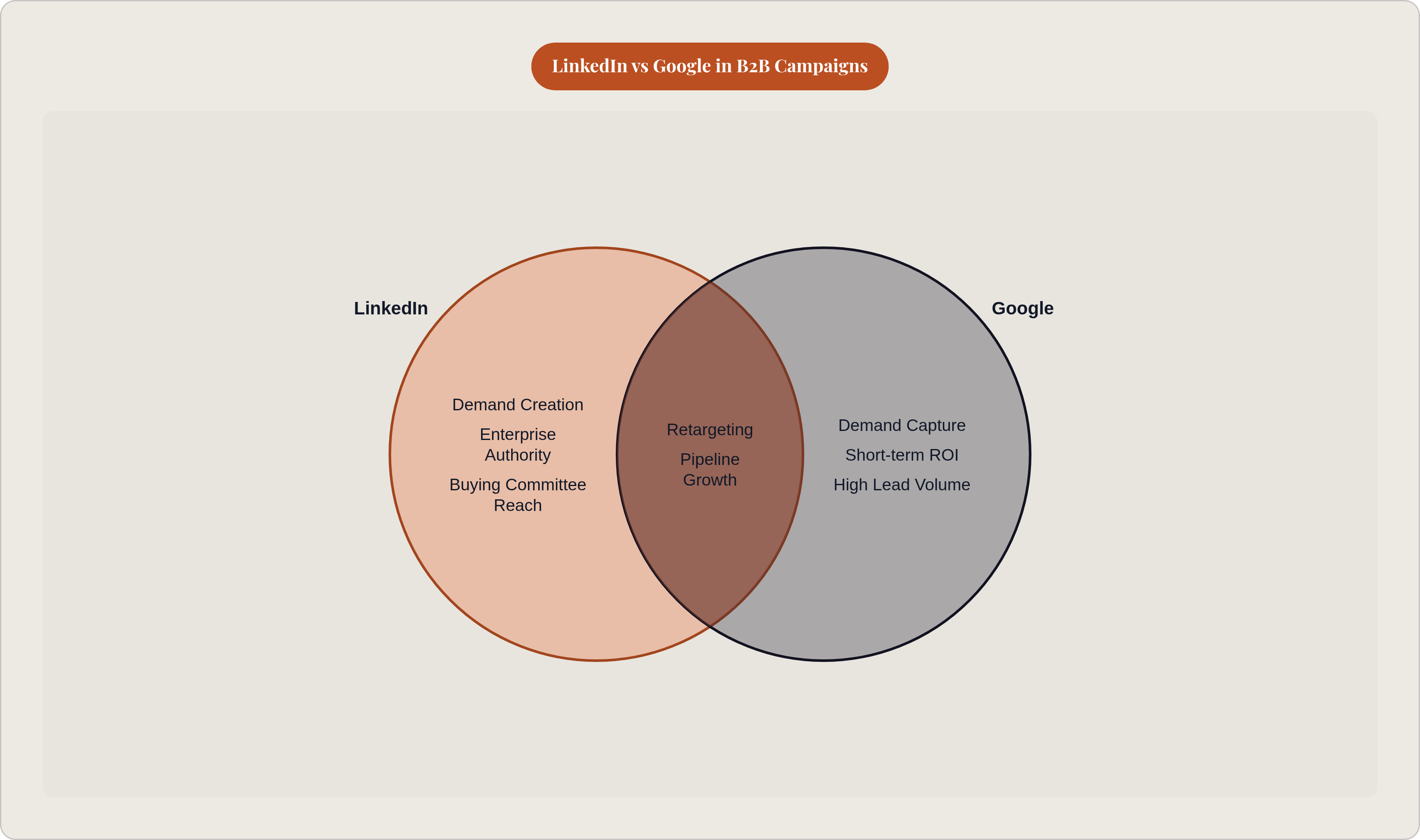
Because they're doing fundamentally different jobs. Pick one and you're either missing buyers who aren't searching yet, or missing the ones who already are.
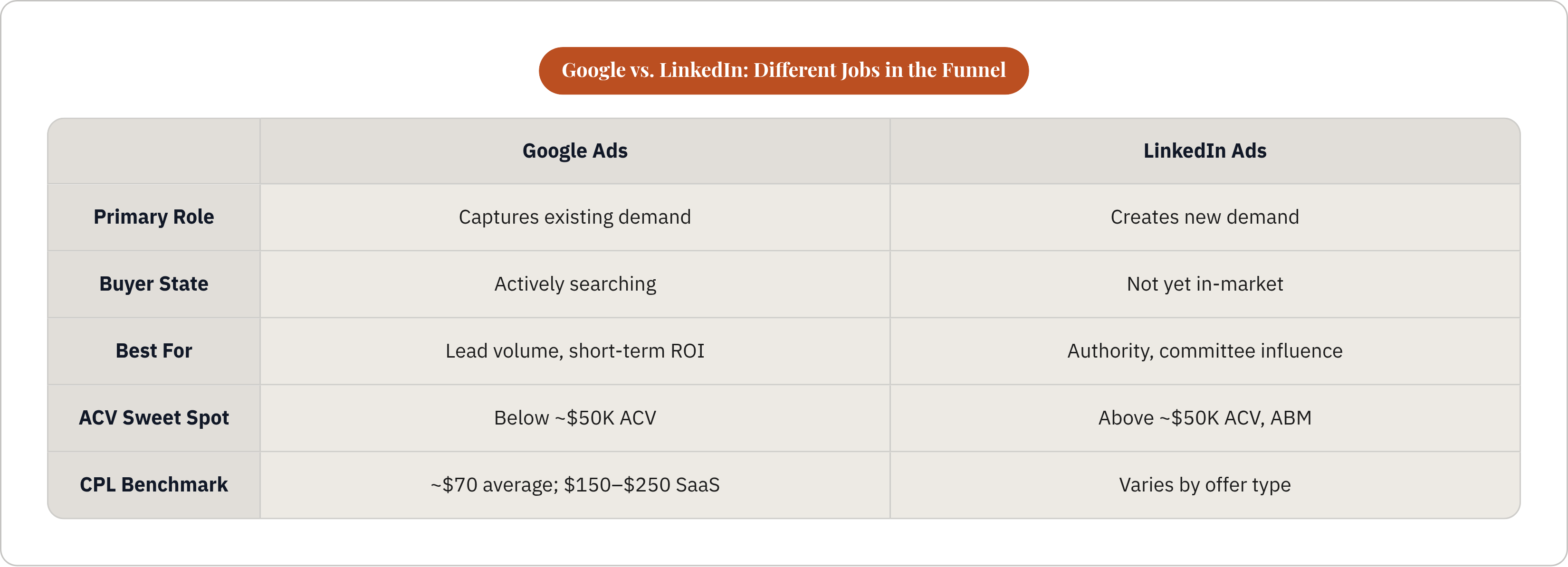
LinkedIn creates demand. It reaches buyers before they know they're in-market. It builds authority with enterprise decision-makers and shapes how a buying committee thinks about a category before they start comparing vendors.
Google captures demand. It catches buyers who already know what they're looking for. It drives lead volume and produces measurable short-term ROI when buyers are actively searching.
Between Q3 2024 and Q3 2025, B2B companies increased LinkedIn ad budgets by over 30% while Google spending barely moved. That reallocation reflects something real. You can't cut demand creation to fund only demand capture. At some point you run out of buyers who already know you exist.
The buying committee reality makes dual-channel even more important. Average B2B buying committees run eight to thirteen decision-makers, with sales cycles over ten months. A single-channel strategy hits one role type and misses the rest of the committee. It's a bit like pitching to one person in a room full of people who also have opinions, and the ones you ignored end up being the ones who kill the deal.
A rough rule of thumb on where to lean: above roughly $50K ACV, the motion tilts toward account-based marketing and LinkedIn. Below that, demand generation on Google typically drives stronger volume economics. Not a hard rule, but a reasonable starting point when the budget allocation conversation gets uncomfortable.
On cost benchmarks: Google B2B CPL averages around $70, though B2B SaaS tends to run $150 to $250. LinkedIn varies sharply by offer type. Gated content is cheaper. Demo requests cost more. Offer design is a bigger CPL lever than most teams realize. The wrong offer inflates cost regardless of how sharp your targeting is.
And in long buying cycles, retargeting isn't optional. Serving a case study to someone who downloaded a guide, or a demo offer to someone who hit the pricing page, is how passive interest becomes pipeline. The system should handle this automatically.
What integrated creative and landing page execution actually looks like
The creative layer is where most B2B teams feel most in control. That instinct makes sense. Creative feels human. It feels like the one part of this that still requires taste, judgment, someone who actually gets the brand.
But here's the uncomfortable part. A majority of business decision-makers say B2B ads lack humor and emotional resonance. Generic, over-polished banner ads aren't the exception in B2B. They're the default. And the performance penalty is steep.
So if the thing that feels most "human" about our current process is also producing the most consistently mediocre output. Well. That's worth chewing on for a second.
What AI-driven creative intelligence actually changes:
- It analyzes past performance to predict which elements (tone, imagery, CTA phrasing) work best for specific buyer segments. Based on what drove outcomes, not gut feel.
- It enables dynamic creative optimization at a scale no human team can match. Variants get generated, tested, and budget gets reallocated toward winners in near real time.
- The creative is built from what the listening layer actually heard. Real objections. Real language. Actual pain points surfacing right now, not six months ago when someone wrote the creative brief over a two-hour planning session.
Landing pages are part of the same system, not a separate project living in a different tool owned by a different person. Message match between an ad and its landing page is one of the most basic conversion principles in digital marketing, and most B2B teams still get it wrong. The ad makes a specific claim. The prospect clicks. The landing page opens to a generic product overview. The prospect leaves. Nobody notices, because nobody connected those two events.
When creative and landing page generation share the same intelligence layer, message match becomes structural. Not a process step someone has to remember to do. Built in.
One thing that keeps showing up in the data: founder-led video, behind-the-scenes content, creative drawn directly from real prospect conversations. These consistently outperform polished, generic creative. The more the content looks like it came from someone who actually understands the buyer's world, the better it tends to perform. That's not a subjective preference about authenticity. It shows up in conversion rates.
How attribution closes the loop and turns campaign data into compounding intelligence
Ad platforms report conversions based on what they can see: form fills, clicks, page visits. So that's what automated bidding optimizes toward. The problem is those metrics frequently have almost nothing to do with pipeline.
A form fill is not a closed deal. A click is not a qualified buyer. And the ad platform rarely learns the difference, because nobody tells it.
Closing the loop requires a few technical pieces working together:
- LinkedIn Conversions API connects online and offline conversion data to campaign activity, including actions that happen well after a website session ends. When a lead from a LinkedIn campaign closes six months later, that signal can travel back to the campaign that sourced it.
- CRM integration feeds offline conversion events back to both Google and LinkedIn. The bidding algorithm then optimizes toward pipeline events, not form fills.
Without this, you're running automated bidding toward a proxy metric that may have almost nothing to do with revenue. The system is working hard. It's just working toward the wrong thing.
What "compounding intelligence" actually means in practice: attribution data reveals which audience segments, creative variants, and offer types produced real pipeline. That signal feeds back into the targeting and creative layers for the next campaign. Each cycle starts from a higher baseline than the one before it.
When attribution lives in a separate tool, managed by a separate person, reporting to a separate stakeholder, the intelligence it generates rarely makes it back to the people setting bids and writing copy in time to change anything.
The metric you close the loop around matters enormously. CPL and ROAS are useful directional indicators, but cost per opportunity and pipeline contribution are the outputs that actually drive decisions. Optimizing the whole system toward form fills means optimizing toward the wrong thing. And compounding intelligence built on a flawed foundation doesn't fix the error over time. It just makes your errors faster.
Why integrated AI execution consistently outperforms human-run and tool-assisted approaches
The performance gap is becoming hard to explain away.
Companies that integrated AI into their sales pipelines outperformed peers on pipeline velocity and win rates by over 30%. More than half of B2B companies adopting AI-based lead generation saw a measurable lift in marketing ROI within the first year. Marketers using integrated AI workflows daily produce three to five times the asset volume of peers in equivalent roles.
Speed of iteration is the structural advantage, and it compounds in ways that are hard to appreciate until you've actually watched it happen. A human-run program tests one creative hypothesis per week, maybe two if the team is well-resourced and nothing unexpected breaks. An integrated agent system tests many variants in parallel and reallocates budget toward winners in real time. Over a quarter, that's not a marginal performance difference. It's a completely different performance curve.
There's also a knowledge retention problem that doesn't get talked about enough. Everything a human-run program learns lives in somebody's memory or a slide deck; it walks out the door when someone leaves or gets reorganized. A system's learning is encoded in its models and informs every subsequent decision automatically.
The majority of B2B organizations are already adopting AI agents in some form. But only roughly a third have implemented them at scale. That gap between "adopted" and "actually scaled" is exactly where the competitive advantage lives right now.
One thing worth being clear-eyed about: adding AI tools to a fragmented stack adds complexity without adding integration. Each tool optimizes its own metric. Nobody is optimizing for pipeline as the system output. More tools moving faster in different directions is not the same thing as a system. It's faster noise.
What the human role looks like in an AI-run campaign system
Some things disappear. Manually toggling bids. Building creative variants one at a time. Exporting reports and reformatting them for whoever asked. Batch-reviewing lead lists on Thursday afternoon to figure out who deserves a follow-up. Those tasks aren't going to a different team. They're going to the system.
Some things expand. Designing the agent workflow. Setting the strategic constraints the system operates within. Making the judgment calls the system escalates because they require context it doesn't have. Reading attribution data to adjust direction when the market shifts in ways the model hasn't seen before.
The highest-leverage human role is at the edges. Defining what "good pipeline" actually means for this specific company, at this specific stage of growth, with this specific sales motion. Recognizing when the signal the system is optimizing toward has quietly become a false proxy. Catching the moments when the model is confidently moving in the wrong direction.
There is a real concern worth naming here: delegating this much to a system creates a black box. That's not paranoia, it's a fair objection. The answer isn't less delegation. It's better accountability structure. Weekly reporting on what the system changed, what it decided, and why. Revenue leaders should be able to trace outcomes back to decisions. That visibility doesn't happen by default; someone has to design it in deliberately, and that is a human job.
The conversations that still require a person: late-stage deal coaching, executive relationships, situations where trust is the variable and no amount of behavioral data captures what's actually happening in the room. The system handles qualification. People handle the moments that actually move deals.
How to evaluate whether a B2B organization is ready to run campaigns this way
Not every organization is ready for this architecture right now. There's already plenty of overselling happening in this space, so let's just be honest about what the readiness questions actually are.
Is your CRM data clean? The attribution loop depends on it. Incomplete pipeline data, inconsistently entered records, systems that don't talk to each other. If that's where you are, the system can't learn from what it's being fed. Fix the data problem first. No shortcut exists.
Do marketing and revenue agree on what "qualified pipeline" means? The system will optimize toward whatever outcome signal it's given. If those signals are defined by marketing and disputed by sales, the system will efficiently produce the wrong thing. That alignment conversation has to happen before you build the workflow, not after you've already launched and are wondering why nobody in sales is following up.
Are you willing to let the system make decisions without approving each one? This sounds simple. It isn't. Many marketing organizations have approval processes and brand review gates baked into their culture for genuinely good reasons. Those processes were designed for human-run campaigns. They become bottlenecks in an agent-run system. You don't have to eliminate oversight. But you do have to redesign it.
Do you have the technical capacity to connect the pieces? LinkedIn Conversions API integration, CRM-to-platform offline conversion syncing, event tracking that captures meaningful behavioral signals. None of this is exotic. But it does require someone who can set it up and maintain it. If your marketing operations function is already at capacity, that's a real constraint.
What's your budget scale? Below a certain spend threshold, the efficiency gains from an integrated agent architecture don't offset the setup investment. The more complex your buying committee and the longer your sales cycle, the earlier this architecture starts to pay off. Simple businesses with short cycles and low ACVs may not need this yet.
The practical starting point for most organizations isn't a full rebuild; it's closing the attribution loop first. Connect your CRM to your ad platforms. Start feeding offline conversion data back to Google and LinkedIn. Let the bidding algorithms optimize toward pipeline events instead of form fills.
From there, add the qualification layer. Then the creative intelligence layer. Build the spine incrementally, and the compounding effect starts working as soon as the first loop closes.
The question isn't whether this architecture outperforms a fragmented stack. The data on that is pretty consistent at this point. The real question is what the right first step looks like from where your organization is actually starting.