UTM Parameter Taxonomy for B2B Multi-Channel Attribution
Inconsistent UTM tagging silently misattributes campaigns to Direct.

Let me start with a confession. I spent the better part of a quarter defending a campaign that the data said was failing. The leads were thin, the pipeline contribution looked like noise, and leadership was asking hard questions. Turned out the campaign was actually performing. What was failing was our UTM tagging. A single inconsistency in how one contractor named a source field meant a meaningful chunk of conversions was getting swallowed by "Direct" and disappearing from every report we ran.
That experience taught me something I now consider obvious but spent years learning the hard way. UTM parameters are not a tagging exercise. They are the foundational data layer that every downstream attribution decision sits on top of. Get them right, and your attribution data can actually drive budget decisions. Get them wrong, and you are optimizing against a story your data made up — like a navigator charting a course from a map someone drew wrong.
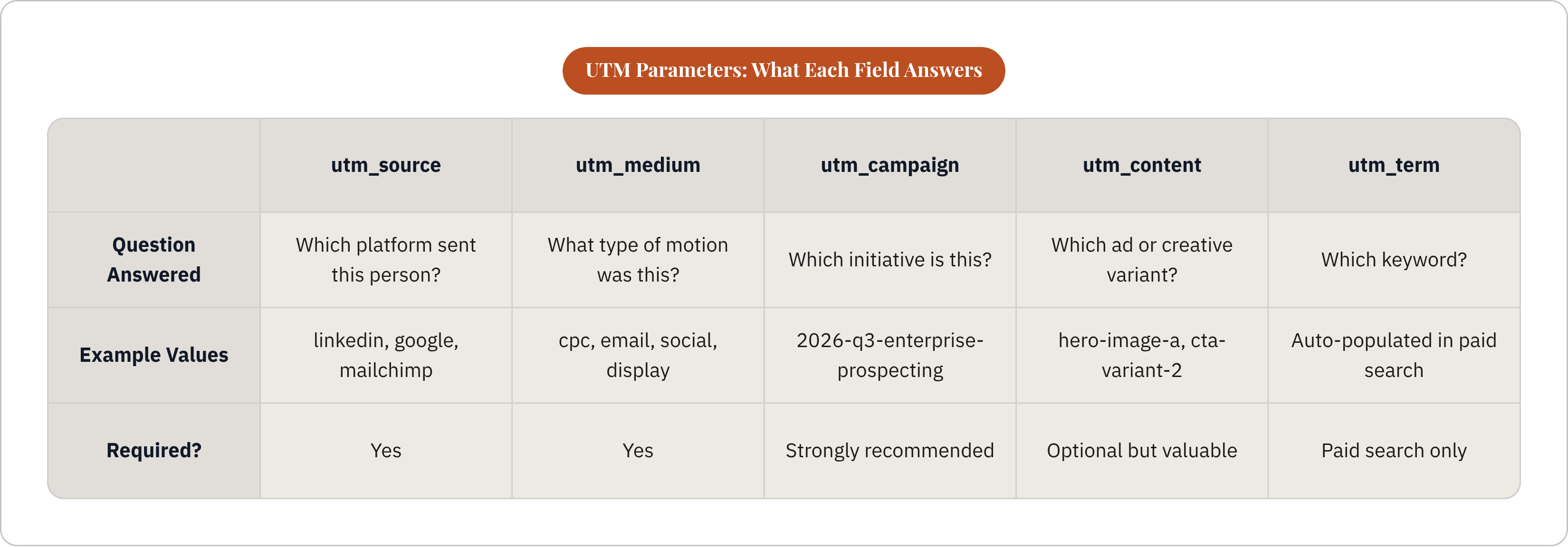
Before we get into where things break, it helps to quickly orient around what UTMs actually do. There are five standard parameters: utmsource, utmmedium, utmcampaign, utmcontent, and utm_term. Each one occupies a specific logical position in the attribution chain.
- utm_source answers: which platform or publisher sent this person? (google, linkedin, newsletter)
- utm_medium answers: what type of marketing motion was this? (cpc, email, social, display)
- utm_campaign answers: which initiative does this belong to?
- utm_content answers: which specific ad or creative variant?
- utm_term answers: which keyword? (mostly used in paid search, usually auto-populated)
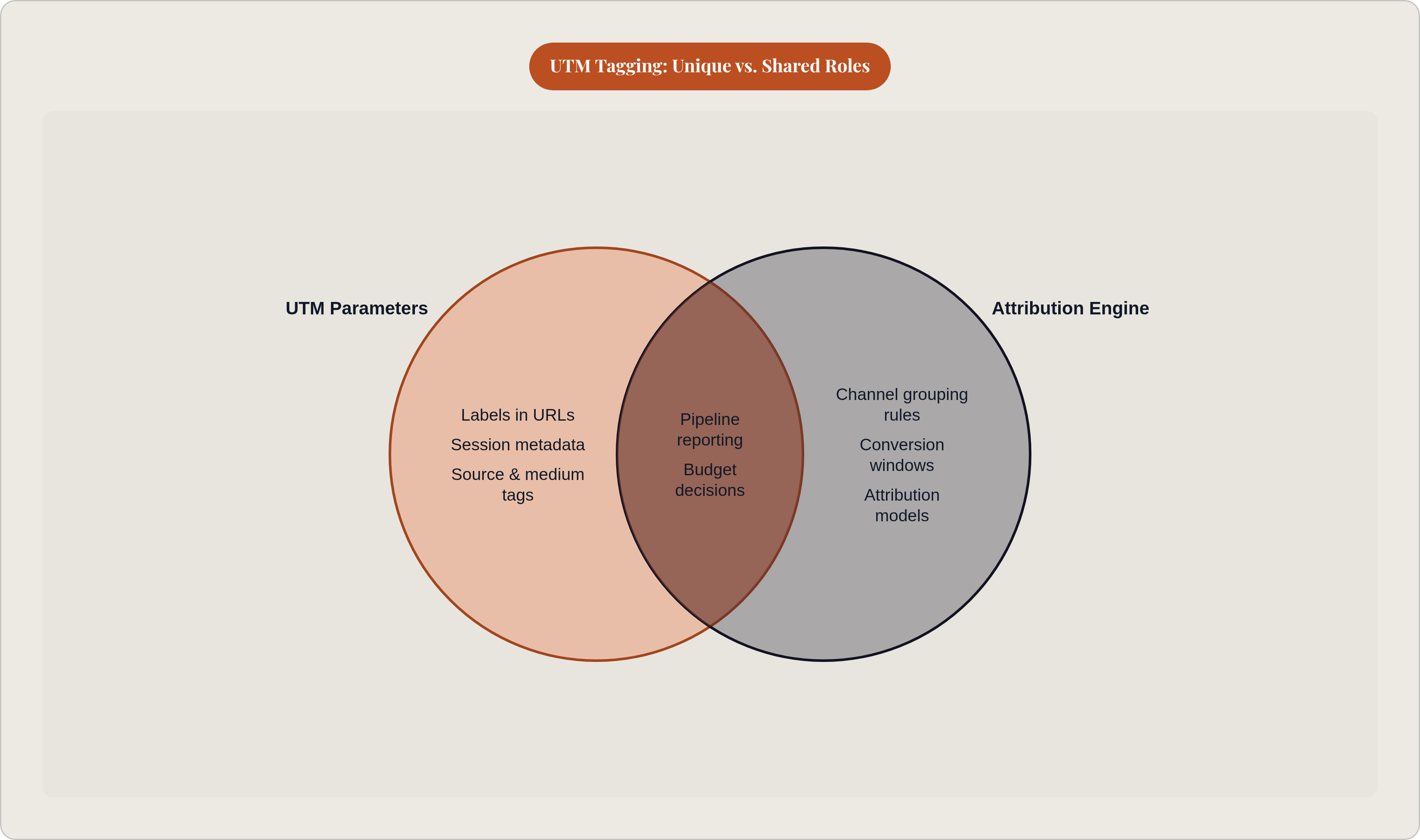
Only utmsource and utmmedium are technically required. The others add increasingly granular context. But here is the thing worth internalizing early. UTM parameters do not track anything on their own. They are labels. They travel in the URL and write session-level metadata into your analytics platform so the system can group traffic correctly. They are the inputs to attribution, not attribution itself. That distinction matters enormously when something goes wrong and you are trying to figure out why.
How GA4's Attribution Engine Reads UTM Data and Where It Breaks
GA4 groups sessions into default channels using a rules engine. That engine reads utmsource and utmmedium, cross-references them against expected patterns, and assigns each session to a channel grouping. If your parameters match what GA4 expects, the session lands in the right bucket. If they do not, it falls into "Other" or "Unassigned" and effectively disappears from your channel-level reporting.
That raises an important question. What does GA4 actually expect? The utmmedium field has a recognized vocabulary: email, cpc, social, display, affiliate, referral, organic, video, and a handful of others. Anything outside that list may not be recognized. So if someone on your team tags a campaign with utmmedium=paid-social instead of utm_medium=social, that session may not group correctly. The data is there. It is just invisible in the views where decisions get made.
There are two other errors worth spending a moment on because they are common and they corrupt your data silently.
The first is tagging internal links. If you put UTM parameters on links inside your own website, every click resets the session source. Traffic that legitimately came from LinkedIn starts looking like it came from your own site. You lose the original attribution entirely.
The second is adding manual UTMs to auto-tagged Google Ads URLs. Google Ads appends a gclid parameter automatically. When you layer manual UTM tags on top of that, the manual tags override the gclid. Your cost-per-click attribution breaks, and you lose the granular data that Google uses for optimization.
One more configuration issue that is easy to overlook in a B2B context. GA4's default conversion window is 30 days. For most mid-market B2B sales cycles, 30 days does not come close to capturing the full buyer journey. You likely want that window set somewhere between 120 and 180 days. If it is sitting at the default, you are systematically undercounting attribution for deals that close after the window expires.
It is also worth noting that since April 2024, GA4 removed several attribution models. First-click, linear, time-decay, and position-based are gone. You now have two options: data-driven (the default) and paid-and-organic last click. With only two lenses available, UTM fragmentation distorts the only views your team has left. The data has less room to self-correct.
What Misclassified Attribution Actually Costs a B2B Marketing Team
Here is the failure mode in plain terms. Without consistent UTM tagging, a large share of attributed leads defaults to "Direct." Direct traffic, in most analytics platforms, means the system could not figure out where the person came from. In B2B, a significant chunk of what lands in Direct is not actually direct. It is misclassified. It is email clicks that were not tagged. It is LinkedIn traffic with inconsistent source naming. It is a paid campaign that someone set up without following the taxonomy.
Why does this matter beyond dashboard aesthetics? Because budget decisions follow attribution data. If LinkedIn appears to underperform because its conversions are bleeding into Direct, the channel gets cut or underfunded. The budget flows toward whatever source looks productive on paper, which is often branded search capturing demand that other channels created. You end up paying to harvest intent that you had already generated and abandoned.
The problem compounds over time in a way that should concern anyone who cares about year-over-year analysis. Fragmented historical data cannot be retroactively cleaned. Every quarter of inconsistent tagging permanently degrades the baseline. You cannot trend data that was collected differently in different periods. So the cost is not just a bad dashboard this quarter. It is the erosion of your ability to learn from history.
Per Gartner's 2025 data, 64% of B2B organizations lack a formal UTM policy. HubSpot's 2025 State of Marketing report found that only 44% of marketers consistently use UTM parameters across all campaigns. That means the majority of B2B teams are making channel and spend decisions without attribution data they can actually trust. That is not a niche problem. It is the default state.
Designing a UTM Taxonomy That Maps to How B2B Buying Actually Works
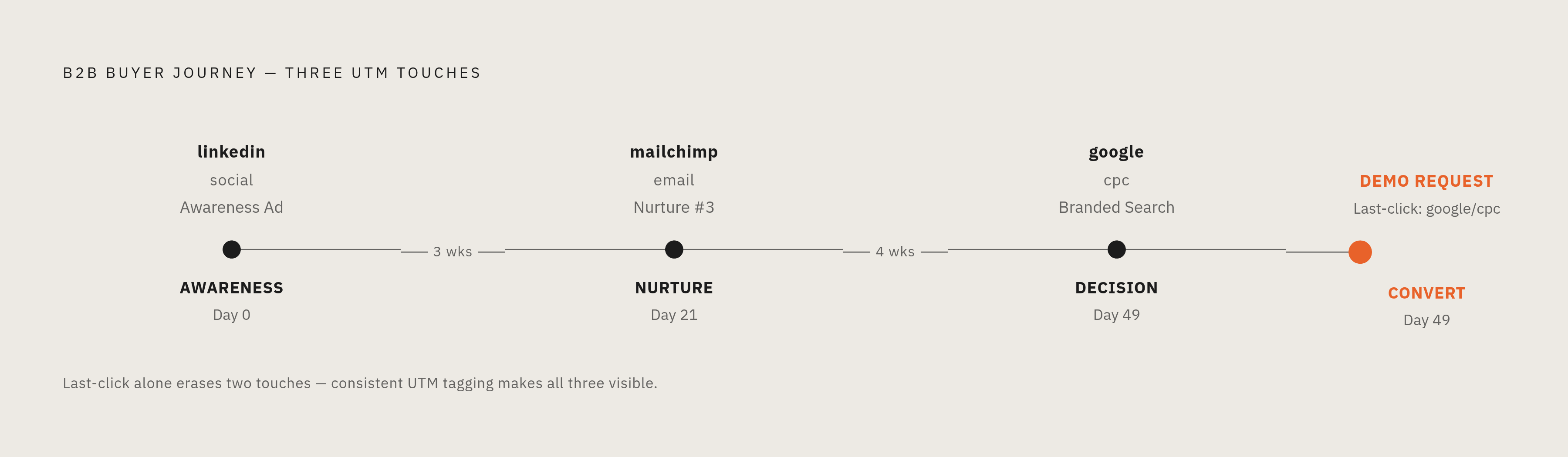
Consider a fairly typical B2B journey. Someone encounters your brand for the first time through a LinkedIn awareness campaign. They do not convert. Three weeks later, they open an email from a nurture sequence and visit your pricing page. Still no conversion. Four weeks after that, they search your brand name on Google, click a paid ad, and request a demo. Three distinct sources. Three distinct mediums. Three distinct moments of intent.
A UTM taxonomy designed for B2B must be able to distinguish those touches from each other. The goal of the structure is to make every record in your analytics layer carry enough context to answer: which channel, which motion, which creative, at which stage. Without ambiguity.
Structuring the parameters hierarchically is what makes that possible.
- utm_source tells you the platform (linkedin, google, mailchimp)
- utm_medium tells you the motion type (cpc, email, social, display)
- utm_campaign tells you the initiative and its business objective
- utm_content tells you the specific variant being tested or tracked
For campaign naming specifically, a few principles that I have seen make a real difference in B2B contexts.
Include a date or quarter prefix on time-bound campaigns. Something like 2026-q3-enterprise-prospecting. This sounds trivial. It is not. When you are trying to compare this quarter to the same quarter last year, that timestamp in the campaign name is what makes the query possible.
Include the motion type for ongoing programs. Nurture, retargeting, prospecting, pipeline-acceleration. These labels let you filter and segment by funnel stage across channels, which is exactly what you need when you are trying to understand where in the buyer journey your budget is having impact.
One mistake I see repeatedly. Teams reuse campaign names across years. Springsale runs in 2024, and then springsale runs again in 2025. Now your historical data is blended and you cannot separate the two. Version every campaign name.
Also, constrain utm_medium to a fixed, pre-approved list tied directly to GA4's recognized channel groupings. The vocabulary is short. Make it canonical. Do not let it grow organically.
Naming Conventions That Survive Team Turnover and Channel Expansion
Consistency beats cleverness. A UTM taxonomy is only as strong as its weakest tagger — and that tagger is often someone in their first week on the job. Clever naming schemes look elegant when the person who designed them is still there to explain them. They fragment the moment a new hire interprets a field differently.
A few formatting rules that are non-negotiable.
Lowercase everything. GA4 treats utmsource=LinkedIn and utmsource=linkedin as two different sources. Every capital letter creates a new, erroneous entry in your data.
Underscores as separators, not hyphens, not spaces. Spaces encode as %20 in URLs. That breaks things. Hyphens can cause parsing issues depending on the platform. Underscores are clean.
No special characters, no undocumented abbreviations. If an abbreviation is not in the canonical vocabulary doc, it does not belong in a UTM string.
The canonical vocabulary document is the artifact everything else depends on. It should include:
- Every approved utm_medium value and what it covers
- Every approved utm_source name for every platform the team uses
- A campaign naming template with required fields and real examples
For large-scale campaigns in Google or LinkedIn, UTM macros are essential. These are dynamic parameters that replace manually hardcoded values with platform-populated variables at click time. They scale in ways manual tagging cannot. But document what each macro resolves to on each platform. If the output is unpredictable, you have traded one problem for another.
One more thing. A logged library of previously generated UTM strings prevents your team from creating variants for campaigns that already have defined parameters. It sounds like overhead. It is actually what keeps your taxonomy from fragmenting the moment volume increases.
A taxonomy that is not written down is a convention held only in someone's head. When they leave, the taxonomy leaves with them. I have watched this happen more than once. It is entirely avoidable.
Enforcement Infrastructure: Why Naming Conventions Alone Fail Without Tooling
Here is the real problem with documentation-only governance. It still depends on humans typing correctly under deadline pressure. And humans, especially humans with fourteen things due by end of week, do not type correctly under deadline pressure.
The fix is to remove free-text entry from the UTM creation process entirely. What that looks like in practice:
- A shared builder tool that presents taxonomy fields as constrained dropdowns, not open text fields
- Validation against the canonical vocabulary before any URL is generated
- A log of every generated link, creating an auditable record of what was tagged, when, and for which campaign
A spreadsheet-based builder is better than nothing. But spreadsheets still accept free-text input. A governed tool with validation is the only enforcement layer that holds up at scale.
Ownership matters here too. Assign a specific person as the UTM taxonomy owner. A performance marketer, a marketing operations lead. Someone who is responsible for the vocabulary, the builder tool, and a quarterly audit cadence.
The quarterly audit is worth describing in some detail because it is where drift gets caught before it becomes catastrophic.
Pull all utmsource, utmmedium, and utm_campaign values seen in GA4 over the period. Compare them against the canonical vocabulary. Flag anything that does not match. Trace it back to the campaign and correct at source. Do this before corrupted data propagates further into your pipeline reporting or gets used as the basis for a budget decision.
Without that audit cadence, taxonomy drift accumulates silently. You will not notice it until someone asks a question that the data cannot reliably answer.
Connecting UTM Data to Pipeline and Revenue, Not Just Sessions
A session count or form fill attributed to a UTM is not pipeline. It is a candidate for pipeline. The attribution work is not complete until the UTM data is connected to CRM outcomes.
Three things need to work in parallel.
First, clean UTM architecture on every inbound URL that drives form submissions or landing page conversions. This is the foundation. Everything else depends on it.
Second, a consistent lead source field in your CRM (Salesforce, HubSpot, whatever you use) that captures UTM values at the point of conversion and carries them through the deal lifecycle. If the UTM data does not survive the handoff from marketing to sales, you cannot trace a closed-won deal back to its originating channel.
Third, a regular offline conversion import cadence that pushes deal-stage events back into Google Ads and LinkedIn. MQL, SQL, opportunity created, closed-won. These events need to travel back to the platforms.
Why? Because without this connection, ad platforms optimize toward form submissions. And form submissions may have zero correlation with pipeline quality. With offline conversion imports, the algorithms see which campaigns actually generated SQLs and closed revenue, and they shift budget accordingly. That is where UTM taxonomy stops being a reporting input and starts being a performance lever.
Both LinkedIn's Conversions API and Google's offline conversion import require reliable click identifiers and consistent UTM values to match clicks to CRM records. Inconsistent tagging at the source breaks the match. The optimization signal disappears. All the potential compounding benefit of algorithmic optimization evaporates because the data layer underneath it was noisy.
McKinsey's 2024 analysis found that B2B organizations implementing multi-touch attribution enabled by consistent UTM tagging saw average budget reallocation of 18 to 22% across channels, with CAC reductions of 12 to 19% through better channel mix optimization. That is not a marginal improvement. That is the kind of shift that changes how leadership thinks about the marketing function.
What Trustworthy Attribution Makes Possible at the Revenue and Leadership Level
The point of building this infrastructure is not cleaner dashboards. Let me say that again because it is easy to lose sight of. The point is the ability to make resource allocation decisions with confidence.
With clean multi-touch attribution in place, certain questions become answerable that were previously just guesses.
- Which channels influenced pipeline at each stage, not just which channel got the last click before form fill
- Which campaigns generate SQLs versus which ones generate volume without quality
- Where in the buyer journey budget is producing leverage and where it is producing noise
Forrester Research found in 2024 that marketers who use multi-touch attribution are 15% more likely to exceed their revenue goals. That correlation makes sense. Better signal produces better decisions, and better decisions compound.
But what if your organization is not quite there yet? One might argue that this level of infrastructure is only realistic for larger teams with dedicated marketing operations resources. That is a fair counterpoint. The floor is lower than most people think. Even a simple spreadsheet builder with a canonical vocabulary doc and a single quarterly audit is meaningfully better than nothing. The investment scales with the complexity of your operation. The principle does not.
For sales-led B2B companies, the attribution conversation is ultimately a pipeline conversation. Impressions and clicks only matter when they can be traced to revenue. The reporting that revenue leaders need from marketing, which programs are working, which should get more budget, which should be cut, is only possible when the underlying UTM data can be trusted.
UTM taxonomy is infrastructure in the same sense that CRM data hygiene is infrastructure. Invisible when it works. Catastrophic when it does not. And essentially impossible to retrofit after the fact. You cannot go back and re-tag six quarters of campaigns. You can only start now and stop losing the data you are generating today.
The teams that treat this as a one-time setup will eventually find themselves optimizing against corrupted data. The teams that govern it as an ongoing system compound the advantage of every campaign they run. The gap between those two states is not technical sophistication. It is whether someone in the organization decided this was worth owning.