Google Ads Attribution Models Compared for B2B Lead Gen
Data-driven attribution needs clean data and long conversion windows to work in B2B.

Let me be upfront about something before we get into the mechanics.
Most attribution guides treat model selection as a reporting preference. Pick the one that tells the story you like, apply it consistently, and move on. That framing is wrong, and for B2B lead gen specifically, it's the kind of wrong that quietly destroys pipeline over several quarters without ever triggering an obvious alarm.
Attribution model choice is not a reporting decision. It is a signal decision. Whatever model you select determines what data feeds into Smart Bidding. The algorithm doesn't have an opinion about your sales cycle. It optimizes toward whatever signal you give it. Get the signal wrong, and you get a campaign that appears to be working while systematically optimizing away from the deals that actually close.
There's also a foundational problem underneath all of this: the default Google Ads setup undercounts conversions. Audited accounts often show undercounting that's much worse than most teams assume, driven by three compounding factors. Cookie deletion and iOS privacy restrictions strip attribution data before it can be recorded. Default 30-day click windows close before many B2B deals do. And GA4 misclassification combined with stripped UTMs quietly sever the link between ad clicks and downstream conversions. For B2B specifically, where cycles run months and closes happen offline in a CRM, the gap between what gets measured and what actually drove pipeline can be enormous.
So the question isn't just which model to pick. It's: are you feeding the algorithm enough of the right signal for the model to do anything useful?
The Three Attribution Models Google Still Supports in 2026
As of 2026, Google Ads supports two attribution models for web and app conversion actions: last click and data-driven attribution. That's it. Four models that used to be part of every attribution conversation — first-click, linear, time decay, and position-based — were deprecated in April 2023. If you're referencing a guide built around those models, you're working from an outdated playbook.
Last click. The final ad interaction before a conversion gets 100% of the credit. Every prior touchpoint gets nothing. It's binary, blunt, and easy to understand.
Data-driven attribution (DDA). Credit is distributed fractionally across all measured ad interactions — Search, YouTube, Display, Discovery — based on machine learning analysis of each touchpoint's actual contribution to conversion patterns. DDA is now the default for all new conversion actions. Switching away from it requires a deliberate manual choice.
What Last-Click Attribution Actually Does to a B2B Campaign
Last-click is seductively simple. One ad gets credit. The one the user clicked right before converting.
The problem is what that simplicity erases.
Picture a fairly standard B2B research journey. A prospect clicks a display ad introducing them to your category. Over the next few weeks, they read a few blog posts, watch a webinar, maybe engage with a LinkedIn retargeting ad. Then, six weeks later, they search your brand name directly and fill out a demo request. Under last-click, the branded search term gets 100% of the credit. The display ad, the blog traffic, the retargeting — all of it: zero.
What happens next is where it gets expensive. The upper-funnel educational keywords look like waste in the data. They get paused. And they quietly kill the pipeline of future branded searches that depended on them existing in the first place. You've optimized away the demand generation that was feeding the bottom of the funnel. It's like pulling up the roots of a tree because you only measured the fruit.
B2B buying behavior makes this worse than in most consumer contexts. Research consistently suggests buyers go through many engagements before a lead converts. Sales cycles commonly run two to six months or more. The gap between the first meaningful ad interaction and the final click can be enormous. Last-click attribution is essentially blind to that entire journey.
Last-click also degrades Smart Bidding. Without multi-touch signal, the algorithm optimizes for the final capture moment rather than the full journey. In B2B, that usually means over-investing in branded terms and under-investing in the category-level demand that creates branded intent in the first place.
Branded search is where the intent is highest. But that intent was built somewhere. Last-click never shows you where.
Where Data-Driven Attribution Works and What It Actually Requires to Function
DDA sounds like the obvious solution to everything described above. In the right conditions, it is.
The model uses machine learning to assign fractional credit across all measured ad interactions, based on each touchpoint's actual contribution to conversion patterns. In contexts where this has been tested — a large mail-order pharmacy running DDA plus Smart Bidding saw meaningful gains in conversions alongside a significant drop in cost per acquisition; a home warranty company running DDA saw similar improvements in lead volume and efficiency. The mechanics work.
But here's the honest caveat: those examples are not B2B. The performance case for DDA in B2B rests on the mechanics of the model, not on a library of direct B2B evidence. That distinction matters.
More critically, DDA has a hard dependency that most B2B accounts struggle to meet.
It needs sufficient conversion volume to train the model. Google's own guidance specifies a minimum threshold of conversions per month before the model has enough signal to outperform simpler alternatives. When that threshold isn't met, DDA doesn't degrade gracefully. It defaults to behavior that resembles last-click — meaning a low-volume B2B account running DDA may be getting last-click performance without knowing it.
Beyond volume, DDA needs three additional things to function in B2B:
- Clean tagging. Enhanced Conversions and server-side GTM are not optional improvements — they are the data infrastructure DDA needs to see the full journey.
- Properly configured conversion windows. The window needs to match the actual sales cycle, not Google's 30-day default.
- Offline conversion import. If deals close in a CRM and that data never feeds back into Google, DDA is modeling against form fills, not pipeline.
Google formally ended Privacy Sandbox in October 2025. Third-party cookies are eroding across the board. Enhanced Conversions and server-side tracking are the practical response to that erosion — the mechanism by which DDA maintains visibility into journeys that would otherwise go dark.
The Specific Ways DDA's Machine Learning Assumptions Break Down in Long B2B Sales Cycles
DDA learns from patterns. It analyzes conversion paths that have already happened and uses that analysis to weight touchpoints in future paths. In B2C, those paths tend to be short, frequent, and relatively similar to each other. The model has a lot of comparable data to work with.
In B2B, conversion paths are long, heterogeneous, and often partially offline. A six-month deal involving a champion, a technical evaluator, a finance stakeholder, and a procurement team does not look like a clean digital journey that neatly ends in a browser conversion. The patterns DDA can learn from are noisier and sparser.
Here's where the specific breakdowns happen.
Conversion window mismatch. The 30-day default click window closes before many B2B deals do. Attribution gets cut off before conversion. The algorithm starves for signal. A 60- or 90-day window is more appropriate for cycles that extend across months, but changing it requires a deliberate configuration decision that many teams never make.
Volume problem. Many B2B accounts — especially those with niche ICP targeting, high deal values with small total addressable markets, or long cycles — simply don't generate enough conversion events for DDA to identify statistically meaningful patterns. Without volume, the model can't reliably learn.
The offline gap. B2B deals close in CRM, not in a browser. Without offline conversion import, DDA is modeling against form fills and demo requests. It may be optimizing for lead volume rather than lead quality.
Multi-stakeholder paths. DDA tracks individuals, not accounts. A champion's six-week research journey and an economic buyer's single branded search may be attributed to two separate users. The model's path analysis is working from incomplete information about how B2B buying committees actually make decisions.
The result: DDA in a low-volume, long-cycle B2B account can optimize confidently toward the wrong signal — appearing to work while quietly prioritizing conversions that look like leads but don't close. That's the scenario worth worrying about, because it's not obviously broken. The dashboard looks fine.
How to Configure Attribution Windows and Offline Conversion Tracking to Match B2B Sales Cycles
Attribution window configuration is a separate decision from model selection, and it is equally consequential. Most teams treat it as a detail. It isn't.
If your buying cycle extends across months, a 60- or 90-day window is more appropriate than the 30-day default. The window should reflect when your actual customers research and convert, not Google's default assumption. This is a configuration decision that can be made right now, regardless of which model you're running.
Offline conversion import is where B2B measurement gets closed-loop. When a deal closes in your CRM — or reaches a meaningful pipeline stage — that event gets imported back into Google Ads and matched to the ad interactions that preceded it. Every touchpoint that ran six weeks before the final search receives credit when the CRM records a qualified opportunity or closed deal. Smart Bidding receives a revenue signal rather than just a form-fill signal.
A few practical notes on the implementation:
- As of June 30, 2025, Google requires the
conversion_environmentparameter in all offline conversion imports. Missing it causes delayed or rejected imports and degraded Smart Bidding performance. - The setup sequence that tends to work: Enhanced Conversions first, then server-side GTM, then CRM offline conversion import.
- The outcome of getting this right: the algorithm stops optimizing for cheap leads and starts optimizing for leads that convert to pipeline.
Optimizing for cheap leads and optimizing for pipeline-generating leads are not the same problem. In many B2B accounts, they produce directly opposing optimization behavior. The offline conversion import is what makes the difference between those two outcomes visible to the algorithm.
Choosing the Right Model Given Your Account's Volume, Cycle Length, and Data Infrastructure
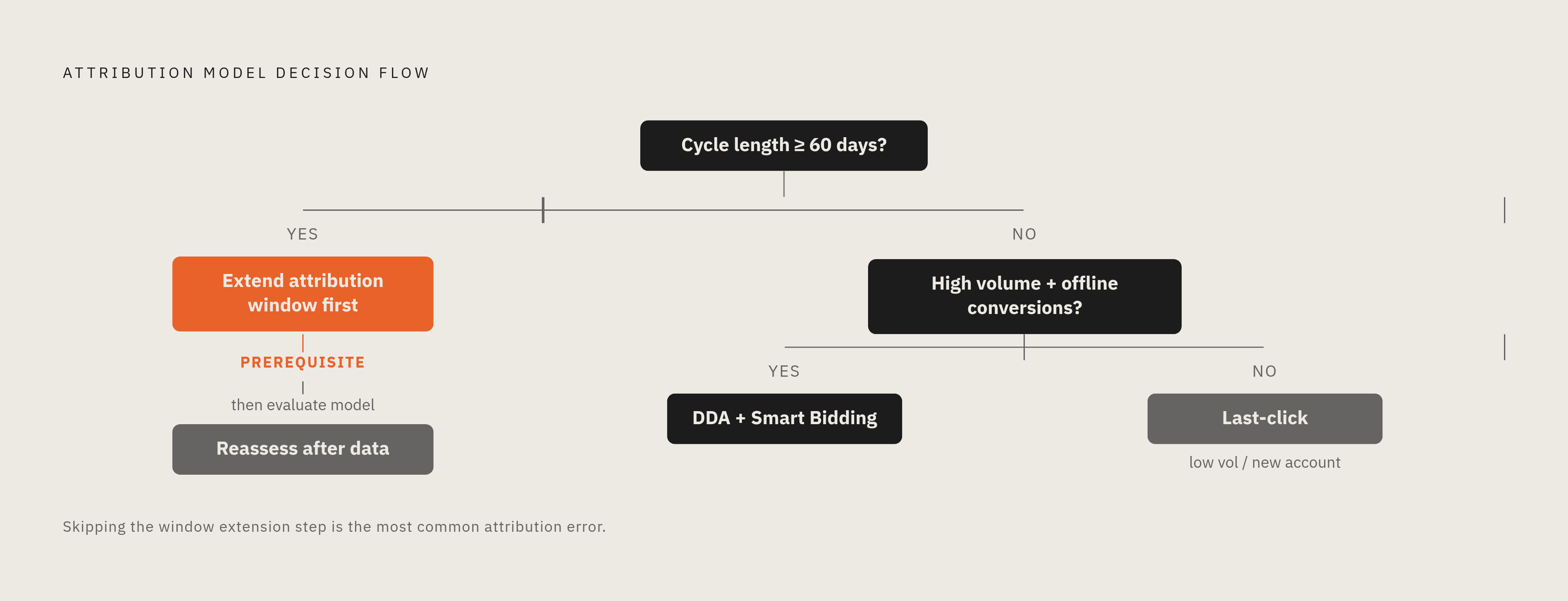
The right model is a function of three variables: conversion volume, cycle length, and whether offline data is flowing back into Google.
High conversion volume, cycle under 60 days, offline conversions imported. DDA with Smart Bidding is the right default. The model has what it needs to learn reliably. Let it work.
Low conversion volume or new account. Last-click may actually be more stable than a DDA model operating on insufficient data. It's predictable, if limited. Sometimes the blunt instrument is better than the sophisticated tool running on nothing.
Long cycle (60-90 days or more), regardless of volume. Extend the attribution window first. Without that, neither model will accurately capture the full path. This is a prerequisite, not a follow-up step.
No CRM integration yet. DDA is optimizing against form fills. The technical fix — offline conversion import — has to precede full reliance on DDA's signals. Using DDA without it isn't neutral; it's actively training the algorithm toward the wrong objective.
Attribution model selection and Smart Bidding strategy selection are connected decisions. Switching to DDA without also configuring the right bidding strategy — Target CPA or Target ROAS with appropriate targets — leaves performance on the table.
More than 80% of Google advertisers now use automated bidding. The question isn't whether to use Smart Bidding. It's whether the attribution signal feeding it is accurate enough to be trusted. For many B2B accounts, the honest answer is: not yet. And the fix isn't a model switch — it's a data infrastructure problem.
What Attribution Model Selection Means for How B2B Campaigns Are Actually Managed Week to Week
Attribution model choice determines what the performance report shows. And what the report shows determines what decisions get made.
Last-click reports flatter brand keywords and penalize awareness terms. DDA with proper offline data reports against pipeline contribution. Those two reports will produce different keyword pause and scale decisions, different bid adjustments, different budget allocations. They're not two versions of the same picture. They're two different pictures.
Teams that don't know which model they're running — or haven't verified that offline conversions are flowing — are making budget decisions based on a signal they haven't validated.
The weekly campaign management rhythm should include a few specific checks:
- Conversion volume check. Is DDA getting enough signal to learn reliably this month?
- Attribution window audit. Is the window still calibrated to the actual sales cycle, or has something shifted?
- Offline import verification. Are CRM conversions flowing into Google, and are they being accepted or rejected?
Attribution setup degrades. Cookies erode. CRM integrations break. Google's requirements change — the June 2025 conversion_environment mandate is a recent example of exactly that. What was correctly configured six months ago may not be working correctly today.
The accounts that compound performance over time treat attribution accuracy as an ongoing operational input, not a launch-day checkbox. Every optimization decision — which keyword to scale, which audience to invest in, which campaign to pause — is only as good as the signal it's optimizing against.
The whole pitch of Smart Bidding is that the algorithm handles the complexity. It does, reasonably well. The catch is that the algorithm is only as smart as the data it receives. Give it incomplete conversion data, and it optimizes competently toward the wrong thing. The sophistication of the model becomes a liability rather than an asset, because it optimizes confidently in the wrong direction.
Attribution is the upstream input that determines whether everything downstream is trustworthy. Get it wrong, and you're not running a sophisticated B2B campaign. You're running an expensive feedback loop pointed at the wrong signal.