Google Ads and CRM Integration for Pipeline Reporting
Connect Google Ads to your CRM to stop optimizing on the wrong metric.
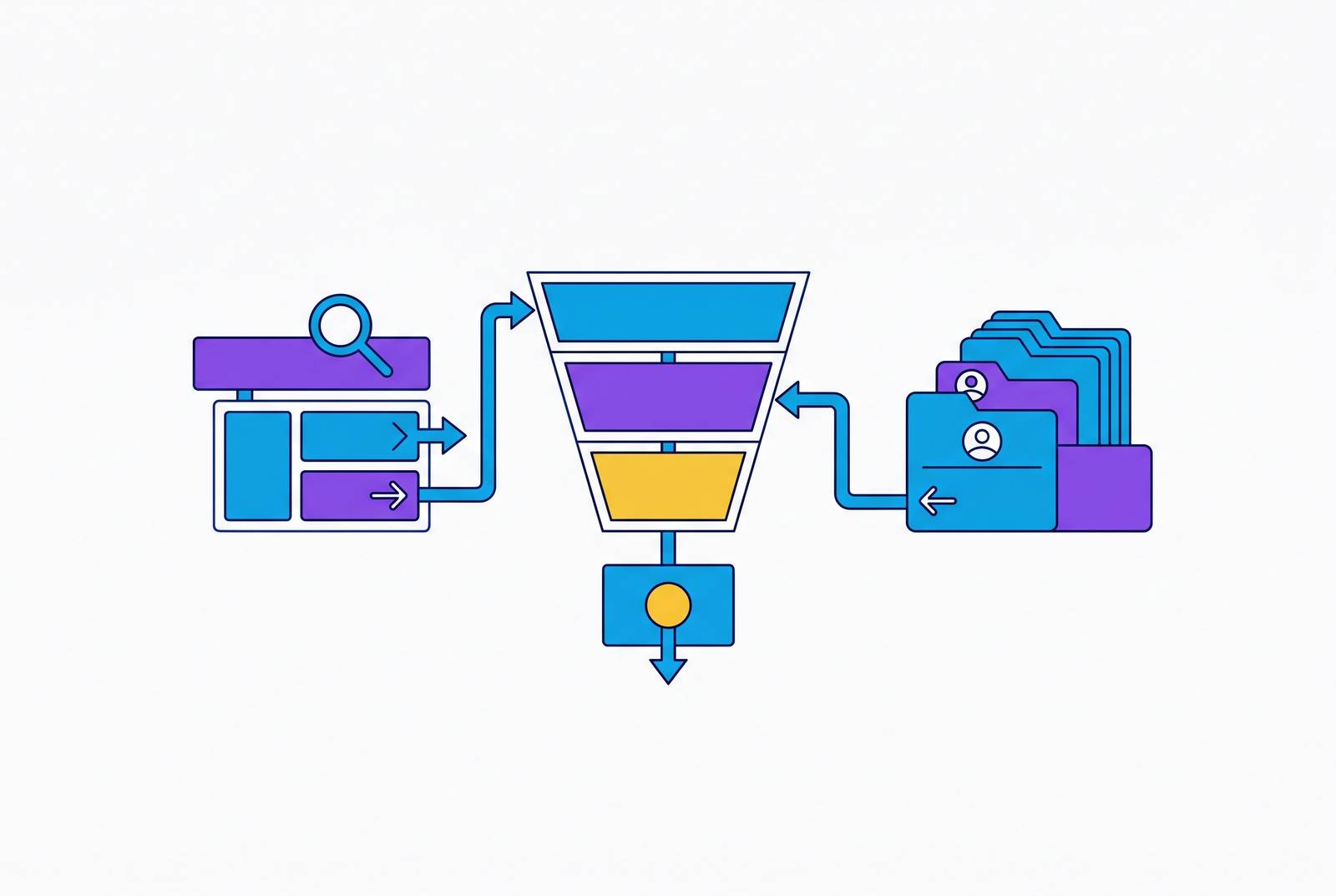
A dashboard says $127 per lead. The CRM says $1,588 per qualified lead. Same campaign, same spend, same month. Which number is real?
Both are, technically. But only one tells you whether the campaign is working, and it's not the one most teams stare at every morning.
Here's the mismatch underneath that gap. Google Ads reports what it can see: clicks, form fills, cost per lead. The CRM reports what the business actually cares about: qualified pipeline, opportunity value, closed revenue. These two systems don't talk to each other on their own. "Click ID 12345 cost $47" and "deal ID 67890 closed at $48,000" have zero connection unless someone builds the plumbing between them.
Most teams never build it. That's not a knock on their effort. It's what happens by default when you optimize on cost per lead alone. Google Smart Bidding wants more conversions at a lower cost. If the only conversion it can see is a form fill, it goes and finds more people who fill out forms. Students researching a class project. Competitors doing recon. Job seekers. Existing customers filling out the same form again by accident. None of them buy anything, but the CPL looks great.
And here's the part that should worry you more: that mismatch doesn't fix itself with time. It's not a lag that clears up once enough data rolls in. It's a loop. Wrong signal in, wrong optimization out, weaker pipeline, and then the cycle repeats with a slightly worse starting point each time.
Closing that gap takes a specific sequence of decisions, not "connect your CRM to Google Ads" as a single checkbox. It's a chain where each link has to hold for the next one to matter. Skip a link, and everything built on top of it is decoration.
What offline conversion tracking actually does and why it is the non-negotiable first step
Offline conversion tracking (OCT) is the bridge. It takes lifecycle events that happen inside the CRM, days or months after a click, and carries them back to Google Ads by matching them to the original click ID, called a GCLID, that brought the lead in.
Here's the mechanic in practice. A lead gets promoted to SQL inside HubSpot or Salesforce. That stage change fires an event back to Google Ads with the GCLID still attached. Google now knows which specific clicks produced qualified pipeline, not just which clicks produced a filled-out form. A standard setup pushes back several stages: MQL, SQL, Opportunity Created, Closed-Won, each carrying its own revenue value.
That's the signal Smart Bidding actually needs. Without OCT, the algorithm gets rewarded for form fills. With it, the algorithm gets rewarded for events that actually predict revenue. That's not a rounding error in performance. It's the difference between a campaign that works and one that's quietly burning budget on the wrong audience.
Once OCT is live, form-fill conversions should get demoted to secondary status in the account. They stay visible for reporting, but they stop driving bidding decisions. The algorithm has to stop chasing the easy signal once a better one exists.
None of this works without two things happening first. Auto-tagging has to be turned on in Google Ads, so every ad click carries a GCLID parameter in the URL. And that GCLID has to get captured in a hidden field on every lead form in the CRM. Miss that capture at the moment of submission, and the entire attribution chain breaks before it starts. Everything downstream, tiered values, revenue-based bidding, long-window ROAS measurement, depends on this one plumbing detail working every single time.
The four implementation steps and where each one breaks in practice
Step 1: Turn on auto-tagging in Google Ads. This step sounds trivial. It's also the step most often skipped by teams that inherit an ad account with no documentation and never think to check.
Step 2: Capture the GCLID on every lead record using a hidden form field. This is where most implementations quietly fail. The field exists on the form, captures the value at submission, and then gets lost the moment the lead record converts into a contact or an opportunity, because nobody mapped it to a field that persists. Salesforce makes this worse by design: Lead, Contact, Account, and Opportunity are separate objects. Unless the GCLID gets carried forward at each conversion step, attribution dies at the very first stage transition.
Step 3: Map CRM pipeline stages to Google Ads conversion actions. Each stage, MQL, SQL, Opportunity, Closed-Won, needs to be its own conversion action, not lumped into one generic bucket. A common tier structure: MQL at $50 to $100, SQL at $500 to $900, Opportunity at a meaningfully higher value, and Closed-Won at the actual deal value.
Step 4: Import offline conversions on schedule, within the right window. Google Ads supports offline conversion import beyond its default 30-day window, matching purely on GCLID. That extension matters a lot in B2B, where sales cycles routinely run 80-plus days and enterprise deals stretch past 180. Teams that skip this step are systematically undercounting pipeline and revenue from every deal that takes longer than a month to close.
There are three ways to actually build this connection, and the trade-offs are worth being blunt about:
- Native connectors (the Salesforce or HubSpot connector inside Google Ads Data Manager): no engineering needed, maintained by the platform, the sensible starting point for most mid-market teams. The catch: limited flexibility for custom objects, and it syncs on a schedule rather than in real time.
- Middleware, like Zapier: no code, near real-time sync. The catch: weaker deduplication, and cost climbs with task volume.
- Custom API: full control over mapping, deduplication, and timing. The catch: needs development resources, takes weeks to build, and carries an ongoing maintenance cost. Worth it only when the data model is genuinely complex or the volume demands real-time handling.
Start native. Use middleware for quick connections that don't justify engineering time. Reach for a custom API only when the data model actually forces the issue. Most teams that build custom first are solving a problem they don't have yet, and that's the mistake worth naming plainly: custom-first is usually ego, not necessity.
How the conversion window mismatch silently distorts B2B campaign performance
Google's default attribution window is 30 days. B2B sales cycles are not 30 days. Plenty of enterprise deals stretch past 180, which means the GCLID that started the whole thing might sit dormant in the CRM for months before a Closed-Won event ever fires.
Think through what that does to bidding. A campaign drives strong early-funnel engagement, the kind that eventually turns into revenue, but not within 30 days. Smart Bidding sees zero attributed revenue in its window and concludes the campaign is a poor performer. It deprioritizes it. The algorithm just learned exactly the wrong lesson from exactly the right campaign.
Offline conversion import solves this at the data layer, tying a CRM Closed-Won event back to its original GCLID no matter how much time has passed. Build three separate ROAS views instead of one: 90 days, 180 days, and 365 days, each tied to CRM closed-won data, so the full revenue arc of a cohort shows up instead of a truncated snapshot.
Skip this step, and the pattern that tends to emerge is misallocated spend: campaigns that convert fast inside the short window look strong, while slower-closing mid-funnel demand generation looks weak, even when it is doing the real work of building pipeline. That's backwards, and it's backwards specifically because the measurement window is too short to see the channel actually doing the work. The attribution gap doesn't just distort the reporting. It distorts where the budget goes, quietly, month after month, until someone finally asks why the pipeline looks thin despite a healthy lead count.
Tiered conversion values and what value-based bidding requires to work correctly
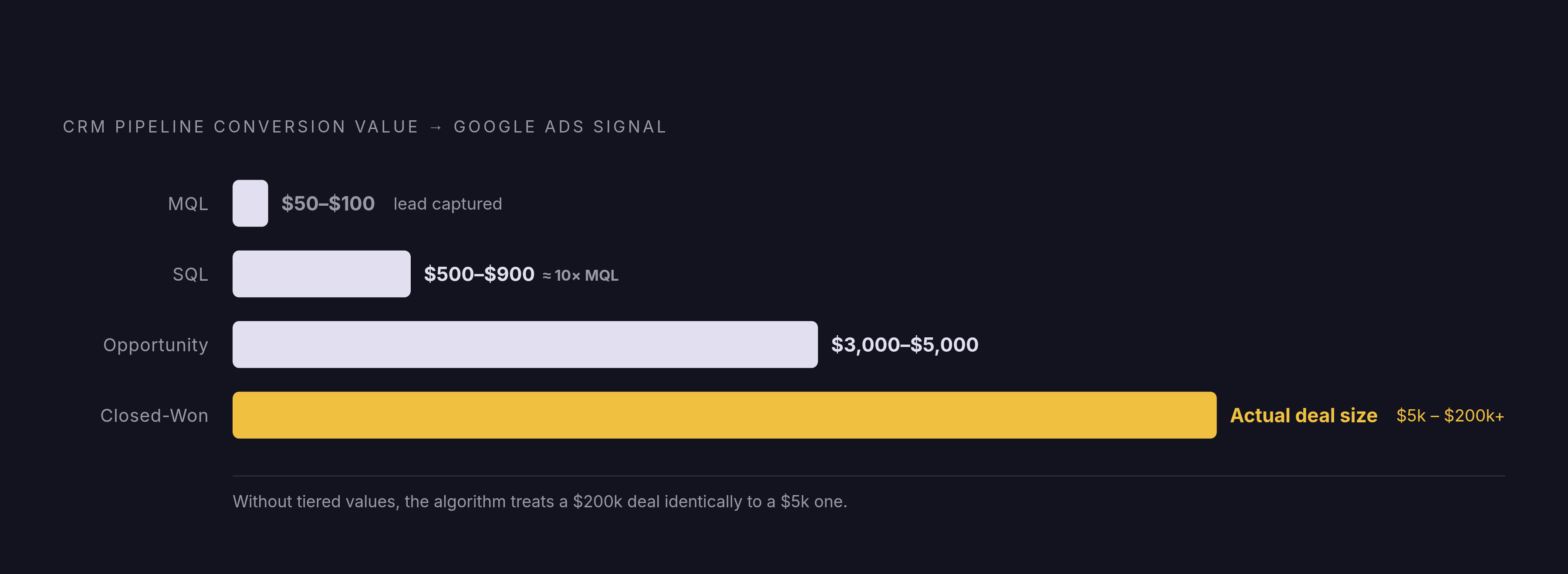
Once offline conversion tracking is live, every CRM stage event can carry a dollar value back into Google Ads. That's what unlocks value-based bidding, and it matters because not every conversion is worth the same amount.
An MQL and a Closed-Won deal are not equivalent events. A flat conversion-counting setup treats them as if they were, which is the core mistake worth calling out here: counting conversions and valuing conversions are not the same job, and most accounts are still only doing the first one. Assigning tiered values teaches the algorithm which clicks are more likely to turn into something valuable, not just which clicks are likely to convert at all. The common structure: MQL at $50 to $100, SQL at $500 to $900, Opportunity at a substantially higher value, Closed-Won at the actual deal size. The spread reflects the real odds of a lead moving from one stage to the next.
Without that tiering, even a technically correct offline conversion setup can't tell the difference between a $5,000 deal and a $200,000 deal. It optimizes for how many conversions it gets, not how much those conversions are worth.
There's a companion lever worth pulling here too: Customer Match. Feed the CRM's closed-won customer list back into Google Ads as a negative audience on acquisition campaigns, and the account stops spending money trying to re-acquire people who already bought. Simple, and it runs on the same CRM connection already built for OCT.
Performance Max deserves a specific mention, and a specific warning. Without offline conversion signal and clear ideal-customer feedback, Performance Max will spend a B2B budget on traffic that has no business being in a B2B funnel. It's built to find volume, and volume is not the same thing as fit. Value-based bidding, fed by CRM-verified conversion events, is what keeps a Performance Max campaign honest in a B2B account rather than letting it chase volume for its own sake.
What pipeline reporting actually requires from the CRM side, not just the ad platform
The integration runs in both directions. Data goes from Google Ads into the CRM (the GCLID landing on a lead record) and from the CRM back to Google Ads (stage changes with dollar values attached). A failure on either side breaks the whole loop. Here's what the CRM side actually needs to hold up:
- A GCLID field that survives every object conversion, lead to contact to opportunity to closed-won, without getting dropped along the way.
- Lifecycle stage definitions applied consistently. If one sales rep calls something an SQL and another rep would call the same lead an MQL, the signal going back to Google is just noise wearing a label.
- A target account list updated continuously rather than reviewed once a year. A stale list fed into Customer Match decays fast, and match rates drop right along with it.
Something has shifted in how marketing gets measured, too. Marketing teams used to live and die by MQL counts. That measurement has largely moved to sourced pipeline and sourced revenue instead, which means the CRM needs ad-sourced pipeline as a real, structured field, tracked natively, not rebuilt after the fact in a spreadsheet by someone trying to explain quarterly results.
Match rate itself is a useful diagnostic. Clean, consistently structured CRM data produces meaningfully higher match rates than sloppy data does. Low match rates almost always trace back to one of two things: GCLID capture failing somewhere upstream, or lifecycle stage labels applied inconsistently across the sales team.
Speed matters more than most marketing teams assume, and it's a CRM process issue as much as an ad optimization one. Responding to a new ad-sourced lead within five minutes makes contact far more likely than waiting even an hour. That's a routing problem inside the CRM, not something a better ad campaign fixes on its own.
Worth watching, too: the shift from individual Marketing Qualified Leads toward Marketing Qualified Accounts, or MQAs. Instead of tracking whether one person filled out a form, leading B2B organizations track collective buying intent across several stakeholders inside a single target account. That takes account-level fields in the CRM, not just a status flag on an individual contact record.
Multi-touch attribution and why last-click models produce systematically wrong channel decisions in B2B
Last-click attribution hands all the credit to whatever touchpoint happened right before conversion. In B2B, that's almost always a branded search: someone typing the company name into Google after they've already decided to buy. Last-click measures the last step of a journey and calls it the whole journey. That's not a small error. It's exactly backwards.
B2B sales cycles run long, with multiple stakeholders touching multiple channels along the way, so there's a long chain of activity before that final branded search ever happens. Last-click attributes the entire deal to the last link in that chain and ignores everything before it.
The distortion this causes is predictable. Awareness channels, LinkedIn, content, display, along with mid-funnel activity, get systematically undervalued. Branded search gets systematically overvalued. Teams end up cutting the channels that planted the seed and pouring more budget into the channel that just happened to be standing there at harvest time.
Why does this matter so much in B2B specifically? Because the buying decision is usually made well before anyone types a branded search term. Buyer shortlists tend to form early, often before a salesperson ever gets involved. If the shortlist forms that early, the channels responsible for early presence matter a lot more than a last-click model gives them credit for.
A practical middle ground is position-based attribution: 40% of the credit to the first touch, 40% to the last touch, and the remaining 20% spread across everything in between. It preserves credit for the channels that opened the door while still weighting the moment that closed it.
None of this requires new infrastructure. Multi-touch attribution runs on the same GCLID-to-CRM plumbing already built for offline conversion tracking. It's a different lens on the same data, not a separate system to stand up.
Worth doing on a monthly basis: run last-click and multi-touch side by side and look at where they diverge. The size of that gap is itself useful information, a rough map of where budget is probably misallocated. B2B buyers move across Google Ads, LinkedIn, organic search, and direct traffic before they ever convert, so a single view stitching all of those channels together matters. Otherwise, one platform ends up claiming credit that actually belongs somewhere else.
The three-stage maturity model teams actually move through, and the decisions each stage unlocks
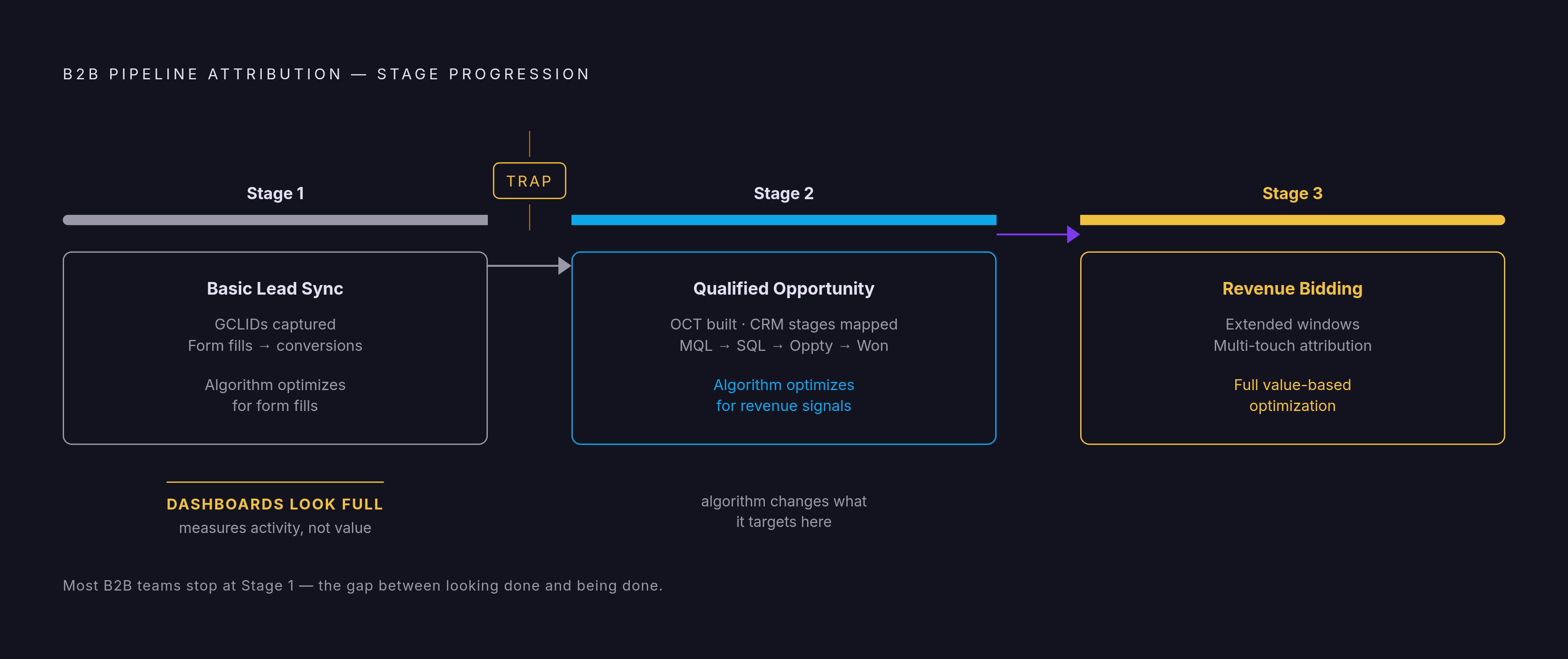
Almost no B2B team goes from nothing to full pipeline attribution in one implementation sprint. It happens in stages, as data quality improves and sales and marketing get aligned on what the numbers actually mean.
Stage 1: Basic lead sync. Google Ads connects to the CRM, GCLIDs get captured on lead records, and form fills get pushed back as conversions. This unlocks basic source attribution: seeing which campaigns drive lead volume. What it does not unlock is quality. The algorithm is still optimizing for form fills, not anything resembling a qualified outcome. Most teams stop here and assume the job is done. It isn't, and that's the trap worth naming directly: Stage 1 feels like real attribution because the dashboards look full, but it's measuring activity, not value.
Stage 2: Qualified opportunity tracking. This is where offline conversion tracking gets fully built out, CRM stages get mapped to distinct conversion actions, and tiered values start flowing back into the account. This is the stage that actually changes what the algorithm optimizes for, and it's where most of the real work lives: GCLID persistence through object conversions, extended attribution windows, tiered conversion values, clean lifecycle stage definitions on the CRM side.
Getting here takes far more than a weekend project. It's a sequence, and skipping a step, auto-tagging never enabled, GCLID never mapped through Salesforce's object model, conversion windows never extended past the 30-day default, means the whole structure sits on a weak foundation no matter how sophisticated the reporting dashboard looks on top of it. The 12.5x gap between dashboard CPL and CRM-verified cost per SQL doesn't close because someone bought a better tool. It closes because someone went through this list, in order, and made sure each link actually held.
Sources
- Measure Pipeline from Digital Ads: B2B SaaS 2026
- Google Ads CRM Integration: 2026 Revenue Optimization Guide
- Offline Conversion Tracking for Google Ads Lead Gen: The Complete Guide to Connecting Ad Spend to Revenue | NAV43
- How to Track Offline Conversions from Online Ads (Google + Meta + CRM Setup) - HYROS
- Google Ads Offline Conversion Tracking in 2026: What Changed and What to Do
- Google Ads Offline Conversions: CRM Import Guide
- saashero.net
- cometly.com