Maximize Clicks vs Manual CPC for New B2B Campaigns
Choose between reach and precision based on your conversion data—not gut feel.

These two strategies are not optimizing for the same thing. Confusing them is where most B2B campaigns go sideways before they ever get started.
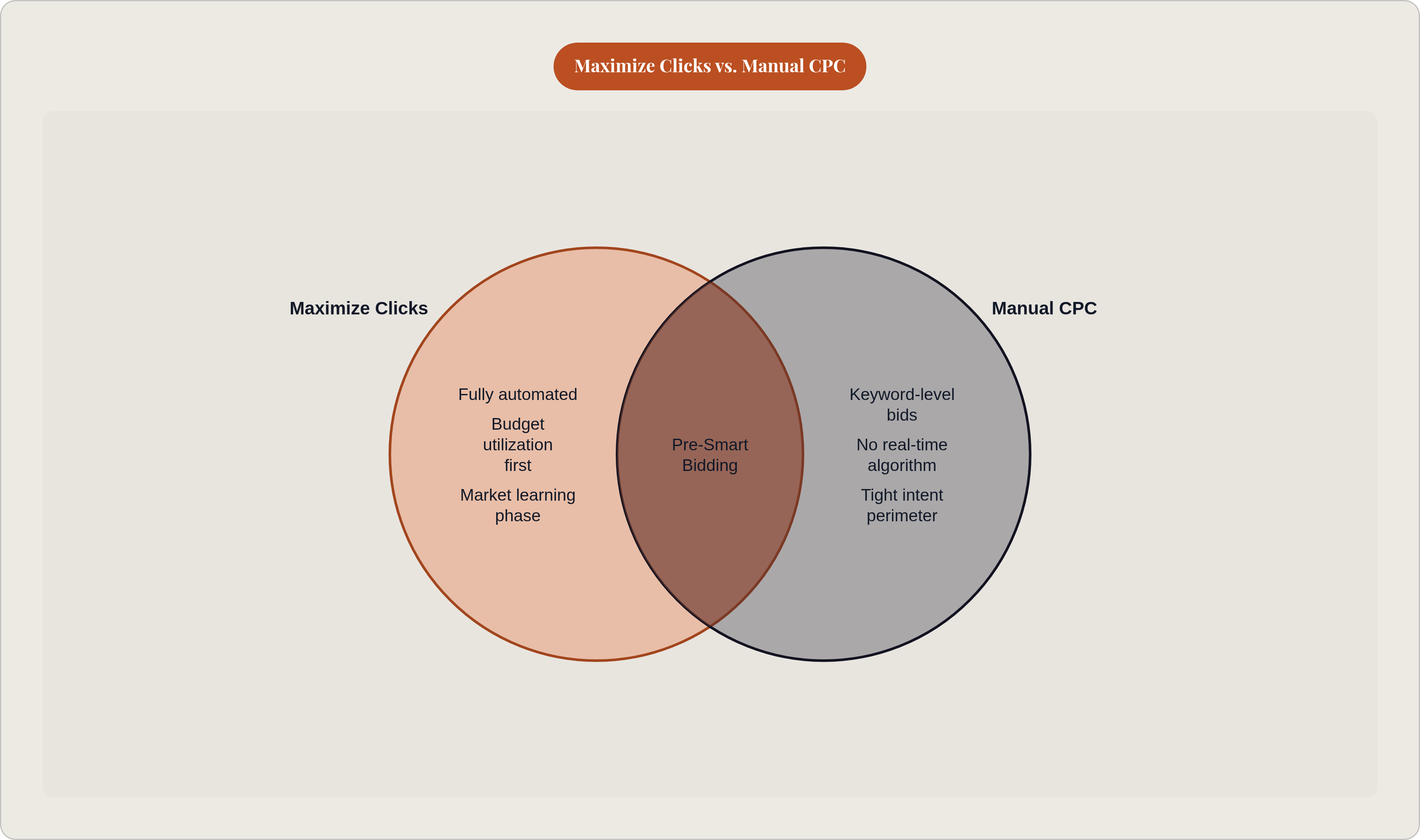
Maximize Clicks is fully automated. You don't set bids at the keyword level. Google controls everything with one goal: spend your daily budget and get as many clicks as possible. Google literally describes it as the "simplest way to bid for clicks." Simple means opinionated. Budget utilization comes first. Click quality is a distant second.
There's an optional CPC bid cap. But set it too tight and you pull the campaign out of competitive auctions, starving the data collection you were trying to fund in the first place.
Manual CPC is almost the opposite. You set maximum bids at the ad group, keyword, or placement level. No algorithm adjusting in real time. No automation second-guessing your inputs. Full transparency, full control.
One dial is tuned for reach. The other for precision. Neither is wrong in the abstract. The question is which one serves you given where your campaign actually is right now.
The Core Tension for B2B: Traffic Volume Versus Traffic Quality When There's No Conversion History Yet
Here's the bootstrapping problem nobody likes to say out loud.
Smart Bidding (Target CPA, Maximize Conversions, Target ROAS) is probably where you want to end up. When the algorithm has real data, it tends to outperform manual decisions. But Smart Bidding needs conversion data to function. The working benchmark is somewhere between 30 and 100 conversions per campaign before the algorithm can optimize meaningfully.
A new B2B campaign generating three conversions a month cannot run Smart Bidding effectively. It will just guess. And guessing is expensive at B2B CPCs.
So to get to Smart Bidding, you need data. To get data, you need traffic. But which strategy generates the right kind of traffic to bootstrap with?
B2B makes this harder than it sounds. Sales cycles are long. Buying committees are large. Conversion rates are low. Signal arrives slowly. And bad traffic in B2B doesn't just waste ad spend — it wastes sales time downstream. Low-intent leads enter the funnel like uninvited guests at a dinner party: a BDR reaches out, nothing happens, and your pipeline looks artificially healthy until it collapses at the end of the quarter. I've watched that movie more than once.
High CPCs aren't the enemy. Low-quality traffic is. But what if you can't tell the difference yet because your campaign is brand new and you have no conversion data to learn from? That's the actual problem. And it's why the Maximize Clicks versus Manual CPC decision is more consequential than it looks on the surface.
When Maximize Clicks Is the Right Starting Point
Maximize Clicks makes sense in a few specific situations.
- Conversion tracking isn't in place yet. Without it, Smart Bidding can't run. Manual CPC's "control" is optimizing toward nothing measurable, so you're paying for the illusion of precision.
- The immediate goal is market learning. What queries are triggering impressions? Which ad copy drives clicks? Which landing pages hold attention long enough to matter?
- Budget is constrained and you need full spend to generate enough data to move to the next phase.
Maximize Clicks surfaces queries that Manual CPC might not reach, which makes your Search Term reports useful. The signal you pull from those reports shapes your negative keyword lists, your match type decisions, and eventually your Smart Bidding targets.
The bid cap is your friend here, but use it loosely. Tight enough to prevent obvious waste. Loose enough that the campaign still wins meaningful auctions in your category. Finding that range takes some trial and error, and you'll probably get it wrong the first time.
Define your exit criteria before you launch. "We'll move to Smart Bidding when we hit X conversions per month" is a real plan. "We'll see how it goes" is how campaigns drift for six months and die quietly. CPCs have been rising year over year, which means a slow data-collection phase is free in theory only.
When Manual CPC Is the Right Starting Point
Manual CPC earns its place in a narrower set of conditions.
- Conversion tracking is already in place from a prior campaign, and the new campaign can inherit that signal.
- You have a tight list of high-intent keywords where a single wasted click is a real cost. Competitor alternatives, pricing queries, category terms with clear purchase intent.
- You have prior performance data on specific keywords that lets you set informed starting bids rather than guessing.
Manual CPC paired with Exact Match is a meaningful combination when lead quality matters more than volume. Exact Match constrains which queries trigger your ads. Manual CPC constrains what you pay. Together they create a tight perimeter around high-intent traffic.
But here's something worth challenging: practitioners who review hundreds of accounts will tell you there are very few genuine use cases for Manual CPC in 2025. Even with Exact Match, you tend to see more hidden search terms and lower-intent traffic than you'd expect. The most desirable inventory is inherently expensive, and it's often the inventory you're not actually winning anyway. So the control you think you have is sometimes more theoretical than real.
Manual CPC is a holding position, not a long-term answer. The exit condition is specific: enough conversion data to hand off to Smart Bidding.
How Campaign Structure Shapes Which Bidding Strategy Makes Sense at Each Stage
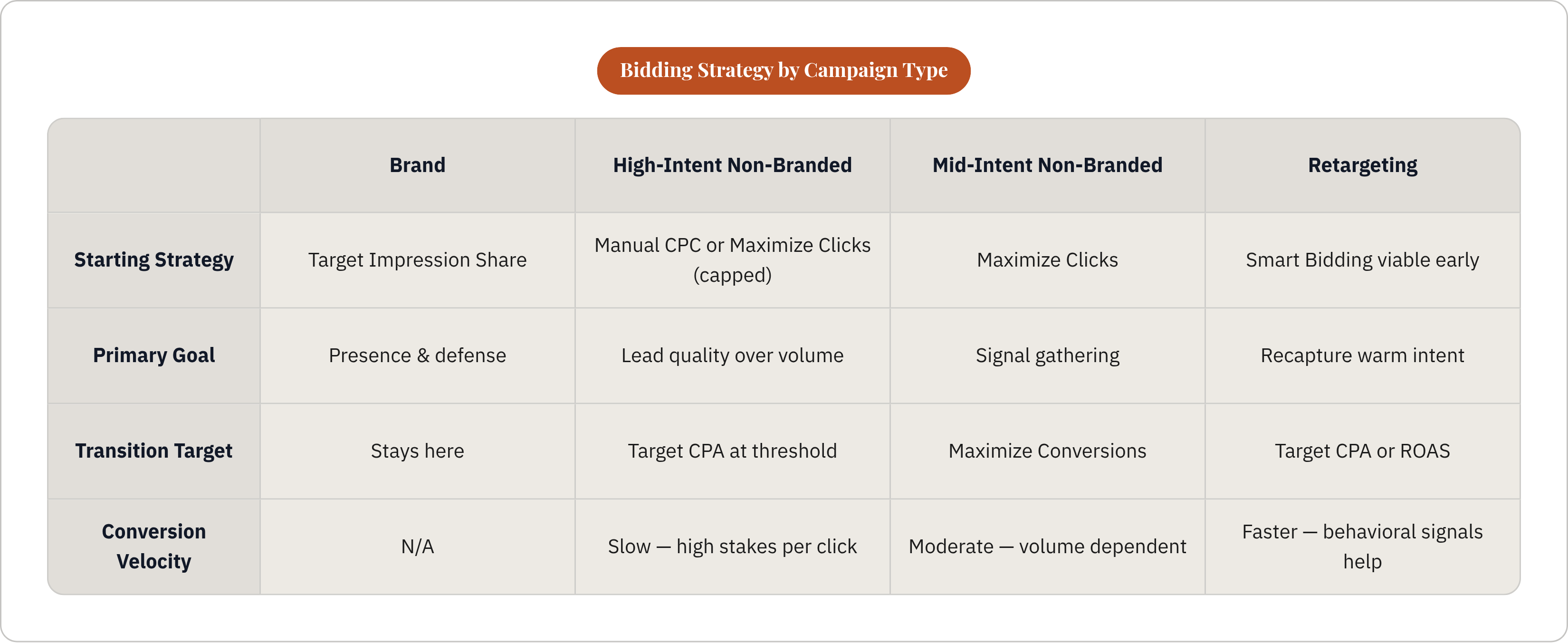
The mistake most people make is treating the Maximize Clicks versus Manual CPC decision as one choice for a whole account. It's not. It varies by campaign type, and collapsing that distinction is how you end up with a high-intent competitor campaign and a mid-funnel awareness campaign sharing the same bidding logic. They have different goals, different conversion velocities, and different risk profiles.
Brand campaigns (branded keywords, exact and phrase match). Use Target Impression Share. This is largely outside the Maximize Clicks versus Manual CPC conversation entirely.
High-intent non-branded (competitor alternatives, pricing queries, category terms with buy intent). These deserve tighter early control. Manual CPC or Maximize Clicks with a meaningful bid cap. Transition to Target CPA once you hit the conversion threshold.
Mid-intent non-branded (problem-aware and solution-aware queries, phrase match). Maximize Clicks makes more sense here because you're gathering signal, not closing deals. Move to Maximize Conversions once the data supports it.
Retargeting (pricing page visitors, demo page visitors, high-engagement sessions). These can move to Smart Bidding faster because behavioral signals substitute for conversion history. Someone who visited your pricing page three times in two weeks is telling you something the algorithm can actually use.
Performance Max. Not a starting point. Only introduce it after other campaigns have generated enough data to train it. Launching Performance Max cold is inviting chaos.
Structure your campaigns to reflect the different goals. Then let the bidding strategy follow from that, not the other way around.
Conversion Tracking Setup Determines Which Path Is Even Available
This is not a nuance. It's a gate.
If conversion tracking isn't in place before launch, Maximize Clicks is the only responsible automated option. Smart Bidding without conversion data doesn't just underperform. It misbehaves in ways that are hard to diagnose until you've already burned budget.
Conversion tracking in B2B also needs to be defined carefully. Demo requests and trial sign-ups are real conversion events, but they sit at the top of a 90 to 180 day evaluation cycle. Optimizing for last-click on those correlates poorly with actual revenue. Better practice: extend conversion windows to 90 days and use data-driven attribution rather than last-click.
There's also a quiet trap here. A campaign that looks like it's generating 30 conversions per month on a 7-day window might have fewer than 10 on a 90-day window. That's insufficient to support Smart Bidding, and you might not realize it until you've already switched and watched performance fall apart. I've seen this specific mistake made by people who absolutely knew better.
Enhanced conversions matter too. Feeding first-party data back into Google's bidding improves tracking accuracy in ways that compound over time. In long B2B sales cycles where signal arrives late, this matters more than it would in e-commerce.
The endgame is CRM integration. The only reliable measure of whether a bidding strategy is working is pipeline contribution, not MQL volume. If your Smart Bidding campaign is hitting Target CPA on demo requests but none of those demos are converting to opportunities, you're optimizing for the wrong signal. All the metrics look great. Nothing is actually working.
The Transition from Maximize Clicks or Manual CPC to Smart Bidding
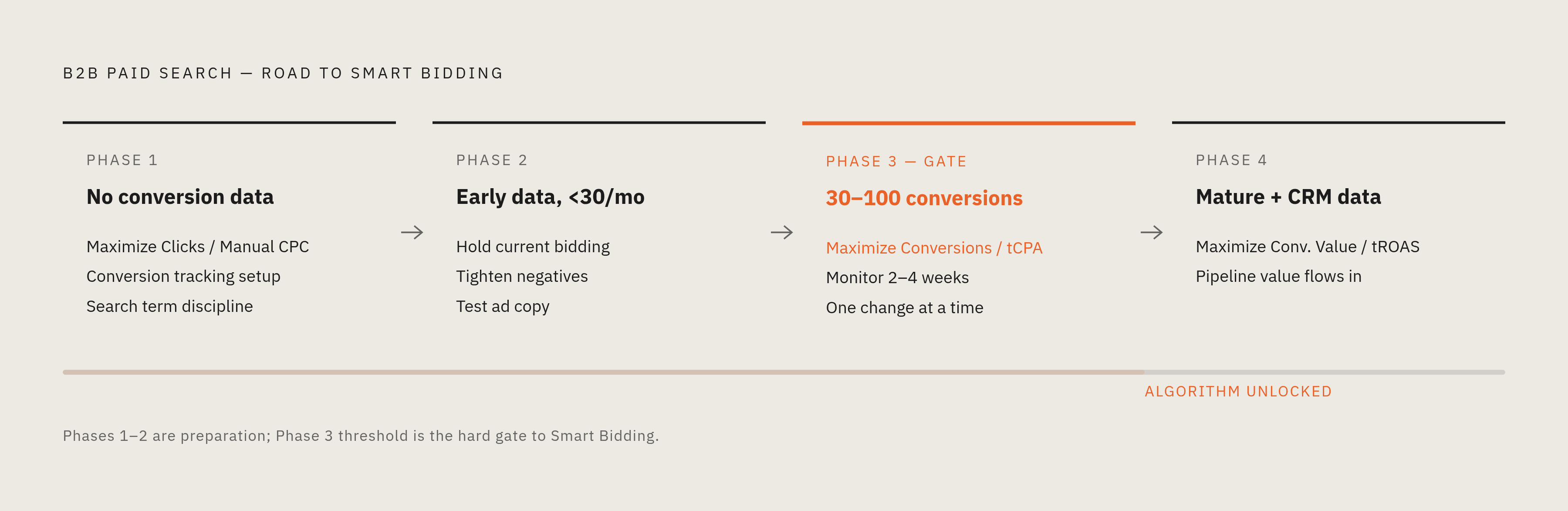
The threshold is 30 to 100 conversions per campaign. Below that, the algorithm is guessing. Above it, it has enough signal to do something useful with.
For B2B accounts with slow conversion velocity, reaching that threshold can take several months. Plan for it. Premature Smart Bidding transitions are one of the most common and most expensive mistakes in B2B paid search. The temptation to switch early is real, especially when a stakeholder is asking why you're not using "the smart bidding."
Here's a rough sequence that works in practice.
No conversion data yet. Maximize Clicks or Manual CPC depending on the intent tier. Build Search Term report discipline. Set up conversion tracking before launch, not after. This sounds obvious. It is ignored constantly.
Early conversion data, below threshold. Keep current bidding. Tighten negative keyword lists using what you've learned. Test ad copy variants to improve conversion rate. Hold off on switching strategies until the data warrants it.
Threshold reached. Introduce Maximize Conversions or Target CPA. Monitor for two to four weeks before adjusting targets. Do not change bid strategy and budget at the same time. Change one variable at a time, or you'll have no idea what actually moved performance.
Mature campaign with CRM-connected attribution. Consider Maximize Conversion Value or Target ROAS once pipeline value data is flowing back into the platform. This is where B2B paid search gets interesting. It's also where it gets difficult.
A campaign that stays on Maximize Clicks indefinitely never compounds. Each phase should push toward the next, smarter bidding state.
The more useful question isn't "which bidding strategy should I use?" but "what needs to be true before I can use the strategy I actually want?" The Maximize Clicks versus Manual CPC decision tends to become obvious once you've answered that.