View-Through Conversions and Attribution Inflation in B2B
Platforms inflate B2B conversion metrics by design, hiding the true performance of paid media.

A view-through conversion is a conversion credited to an ad someone saw but never clicked. That single design choice is why Google, Meta, and LinkedIn dashboards routinely make paid media look like it's working better than it is. In B2B, where deals drag on for months and get touched by a dozen people before anyone signs anything, that gap between "reported" and "real" occurs repeatedly across the deal cycle, not just once. It stacks, quietly, deal after deal, until the dashboard and the pipeline are describing two different companies.
The rationale platforms give isn't dishonest on its face. B2B buying cycles are long, and if you only measure clicks, you miss the ad that sat in someone's feed for two seconds and planted an idea. Fair enough. Consider how this plays out across a typical buying committee: multiple stakeholders interact with different touchpoints over different months, generating separate signals that belong to the same deal. Click-based attribution gives all the credit to whatever ad sat next to the demo booking. View-through conversions exist to fix that blind spot, because most people never click an ad in the first place. That's the gap VTC was built to fill.
So the concept isn't the problem. The exact mechanism built to fix that blind spot is also the mechanism that makes the platform look best in its own reporting. That's the business model. It's the business model.
How platforms are built to over-credit themselves
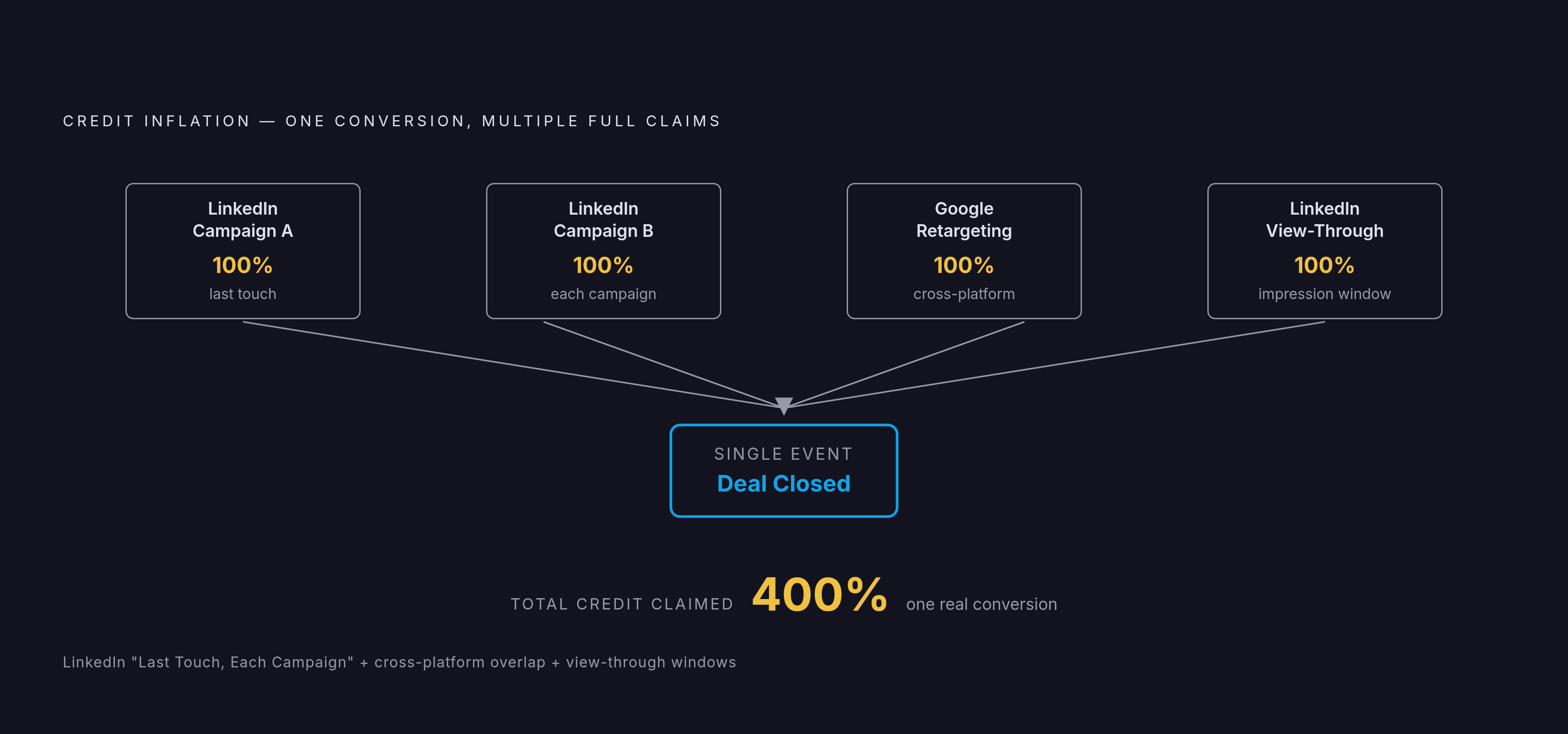
Google, Meta, and LinkedIn each run their own attribution window and their own rules for what counts as a conversion, and none of them talk to each other. When the same buyer sees a LinkedIn ad and a Google retargeting ad in the same week, both platforms can claim that conversion in full. Add the platform-reported numbers together and the sum routinely exceeds the total of what actually happened by a substantial margin. Two dashboards claiming credit for one sale is the default. Two dashboards claiming credit for one sale is the default.
It gets worse inside a single platform. LinkedIn's default attribution setting is called "Last Touch, Each Campaign." That means if the same person saw ads from three different campaigns in the same LinkedIn account, multiple campaigns can each claim full credit for the one conversion that resulted, not a fractional share each, but overlapping full credit.
Stack that on top of the cross-platform double-counting, then layer view-through windows over both, and the number sitting in Campaign Manager has been inflated several times before anyone opens a report. Nobody inside the platform has a reason to fix this. An inflated conversion count means inflated ROAS, and inflated ROAS is the thing marketing teams point to when they ask for more budget next quarter. The incentive runs in exactly the wrong direction, and it runs there by design, not by accident.
The near unavoidability of overlap, and therefore inflation, in B2B buying journeys
In B2B, overlap is the whole shape of the buying journey. It's the whole shape of the buying journey, which makes this a worse problem here than in almost any other kind of advertising. Buying committees average around ten people. Journeys stretch across a dozen or more touchpoints over many months. You're not attributing one person's browser history. You're attributing a committee's, and every member is leaving their own separate trail across email, search, social, and word of mouth that never gets logged anywhere.
By the time a deal is done, most of what mattered happened long before any platform-trackable "conversion event" fired. Shortlists tend to form early, often before a salesperson ever gets on a call. The touchpoints that actually swayed the decision are frequently invisible to the tool measuring the campaign.
Put those pieces together and ask: what's the chance any single ad campaign can claim credit that doesn't overlap with five other campaigns, three other channels, and a buying committee of ten people all moving at once? Close to zero. Overlap is the water everyone's swimming in. That's why VTC inflation doesn't just distort the numbers once. It compounds.
What the inflated numbers cause teams to do
That compounding looks a specific way when it hits a real budget. Under last-click attribution, retargeting and branded search tend to absorb most of the conversion credit, while channels like LinkedIn and organic content sit near the bottom, starved of credit. Read that as a CMO and the decision writes itself: cut LinkedIn, cut content, pour more into retargeting.
Then the same company switches to multi-touch attribution tied to the CRM, and the picture flips. The channels sitting at the bottom turn out to be the ones actually generating the pipeline. Retargeting wasn't creating demand. It was mopping up demand that other channels had already built months earlier, then taking the credit because it happened to touch the deal last.
Why does the first report get it so wrong? Because a short attribution window only sees a fraction of the actual interactions in a deal. Whatever closes it out (retargeting, branded search) gets full credit. Whatever built the relationship over the preceding months is invisible in that accounting. And this isn't a fringe mistake. A meaningful share of mid-market B2B firms still run exclusively on last-click, even while their own buying journeys stretch well past a single touchpoint. The measurement hasn't caught up to how buying actually works.
The irony sitting inside all of this is that view-through conversions were supposed to give upstream, brand-building channels the credit they'd otherwise be denied. In practice, because VTC counts impressions rather than actual influence, the credit tends to go to whichever platform served the most recent impression, even when a different channel built the buyer's preference in the first place.
And even a "complete" multi-touch report is missing a huge piece of the conversation, because so much of B2B buying now happens in places analytics can't see. The Slack thread where the buying committee debated your product against a competitor never appears in the system as a touchpoint. It never enters the system at all.
The point where attribution infrastructure itself breaks before any model is applied
Before anyone even picks an attribution model, broken plumbing usually undermines it first. A typical mid-market SaaS company runs its data through eight, ten, twelve separate systems, and identity breaks down at several of them. Translation: the same buyer gets logged as three different people under three different identifiers, and every report built on top of that data is quietly triple-counting before the model even runs.
That's the starting condition at most companies, because most enterprise software stacks are large, sprawling, and barely talk to each other. It's the starting condition at most companies, because most enterprise software stacks are large, sprawling, and barely talk to each other.
The specific ways this breaks down are mundane and everywhere. One campaign gets logged under three different names in the CRM because nobody agreed on UTM naming conventions. Marketing and sales define "qualified lead" differently, so the same contact moves through two different funnels depending on who's looking. HubSpot logs a contact where Salesforce logs an account, and the two records never reconcile. A rep closes a deal over a phone call that never touched a tracked link, so the whole conversion enters the CRM with no attribution data attached at all.
Google moved GA4 away from last-click as its default model, switching to data-driven attribution. That's a real change, and it matters. But changing the model at the platform level does nothing to fix identity breaks that happened three systems upstream. A better model applied to broken data just produces a more sophisticated-looking wrong answer. The audit has to come first, always, no exceptions.
A measurement posture that connects to real pipeline
Start here: the attribution layer has to sit outside the ad platforms. Google, Meta, and LinkedIn each grade their own homework, so whatever measurement system a team trusts has to see across all three without inheriting each platform's built-in bias toward crediting itself.
The next shift is moving from lead-level reporting to account-level reporting. B2B buying committees run six to ten stakeholders deep on average, and a report that tracks individual contacts instead of the whole account misses the dynamic actually driving the purchase. Nobody sells to a lead. They sell to a room.
The market is already reorganizing around this shift. Standalone attribution tools keep getting folded into larger revenue platforms, because attribution works better as a built-in feature of the revenue system than as something bought separately and bolted on afterward. Systems built for account-level pipeline views, native CRM integration, and every-touch modeling exist specifically for deals where a hundred-plus touchpoints is normal.
Stop trusting a single attribution model. Run several (linear, time-decay, U-shaped, data-driven) against the same data and compare what each one says. No single model answers every question. Each one answers a different slice of it, and looking at them side by side tells a team more than committing hard to any one of them ever will.
The payoff isn't just a cleaner-looking report. Companies that move to multi-touch attribution tend to reallocate budget across channels once they see the true picture, and proper attribution has been shown to reduce wasted ad spend meaningfully, mostly because they stop killing channels that were quietly driving pipeline the whole time but never got credit under last-click or VTC-inflated reporting.
Implications for how paid media programs should be run and judged
View-through conversion inflation is a symptom, not the disease. The disease is judging paid media by platform-reported metrics instead of by pipeline and revenue. No amount of better software patches that on its own.
Think about what that does to incentives. A program judged on Campaign Manager conversions gets optimized to produce more Campaign Manager conversions. A program judged on qualified pipeline gets optimized for something else. Whatever metric a team is graded on is the metric that team will chase, whether or not it maps to the outcome the business actually needs.
Running Google as one program and LinkedIn as another, each reporting into its own dashboard, makes the cross-platform double-counting invisible by design. Nobody sees it unless someone sits down and reconciles both against what the CRM says actually closed. That reconciliation isn't optional if the goal is an honest number, and skipping it is how teams end up defending numbers that were never real.
Every campaign a team runs leaves behind a record of what worked and what didn't: which audiences responded, which creative held attention, which channel actually opened doors. A program that builds on that history compounds what it learns. A program that resets its assumptions every quarter just repeats the same misallocation on a loop, forever, and calls it optimization.
VTC inflation and last-click bias set the same trap from opposite directions, and neither one points at the real constraint. When VTC inflation makes LinkedIn look weak, teams cut it. When last-click makes retargeting look dominant, teams pour more into it. Neither call is grounded in what's actually moving deals forward. Figuring out whether the real bottleneck is the creative, the landing page, a gap in attribution, or the channel mix itself requires holding the whole program accountable to revenue, regardless of whichever platform's dashboard looks best this month. There's no shortcut around that infrastructure work.
A flat retainer, decoupled from how much media spend flows through it, removes the incentive to wave an inflated ROAS number around as proof of value. When the fee doesn't grow alongside the ad spend, there's no reason left to defend a VTC-inflated conversion count as the measure of success. That alignment, more than any single attribution model, is what makes the rest of this actually stick.