Google Ads Funnel Structure for B2B Sales Cycles
Allocate budget by buyer intent stage, not lead volume alone.

Here's the uncomfortable truth about most B2B Google Ads accounts: they're built for a buyer who doesn't exist.
The most effective Google Ads strategy for B2B lead generation is a funnel-staged account structure that separates campaigns by buyer intent, allocates budget accordingly, and feeds pipeline data back into the bidding algorithm rather than optimizing for raw form fills. A widely used starting framework concentrates roughly 60% of spend on bottom-of-funnel keywords (demo, pricing, vendor comparison queries), 20% on mid-funnel evaluation terms, and 20% on retargeting audiences built from site visitors who engaged but didn't convert. That structure only performs as intended when offline conversion tracking imports pipeline-qualified events, such as MQL, SQL, and Closed Won, back into Google Ads so Smart Bidding learns to find buyers rather than form fillers. Without that data loop, even a well-segmented account teaches the algorithm to be excellent at the wrong thing.
The default Google Ads setup assumes a short window between search and purchase, and a single person making that purchase decision. That's a fine model for selling running shoes. It falls apart completely when your sales cycle runs the better part of a year and your "buyer" is actually a committee of nearly seven stakeholders, each doing their own research, largely out of sight.
Dreamdata's 2025 benchmarks put the average B2B buying journey at 211–272 days. And buyers spend roughly 70% of that time researching on their own, before a sales conversation, before a form fill, often before they've signaled intent to any vendor. Gartner found that B2B buyers spend only 17% of their journey actually meeting with potential suppliers. The rest is invisible to standard reporting.
So what happens when you run one campaign, optimizing for lead volume, across all of that? The algorithm does exactly what you told it to. It finds more people who fill out forms. And it gets very good at finding early-stage, low-intent people who fill out forms. You've taught it to be excellent at the wrong thing — like training a hunting dog to fetch newspapers instead of birds.
That's the core problem. And the fix isn't tactical. It's architectural.
Funnel-stage mapping means deliberately matching your campaign type, keyword intent, bidding strategy, and messaging to where a buyer actually is in the decision process. Not where you hope they are, and not where the algorithm defaults to.
There are four search intent categories to build around in B2B:
- Navigational (branded): They already know you. Usually covered by SEO. Low priority for paid.
- Informational (top-of-funnel): Problem awareness, category education. High volume, low near-term conversion probability.
- Commercial (mid-funnel): Comparison, solution evaluation. Actively weighing options.
- Transactional (bottom-of-funnel): Decision-ready. Pricing, demo, trial keywords.
A well-structured account treats these as separate campaigns with separate budgets, separate conversion goals, and separate definitions of success. Not one campaign with a messy mix of match types trying to serve all of them at once.
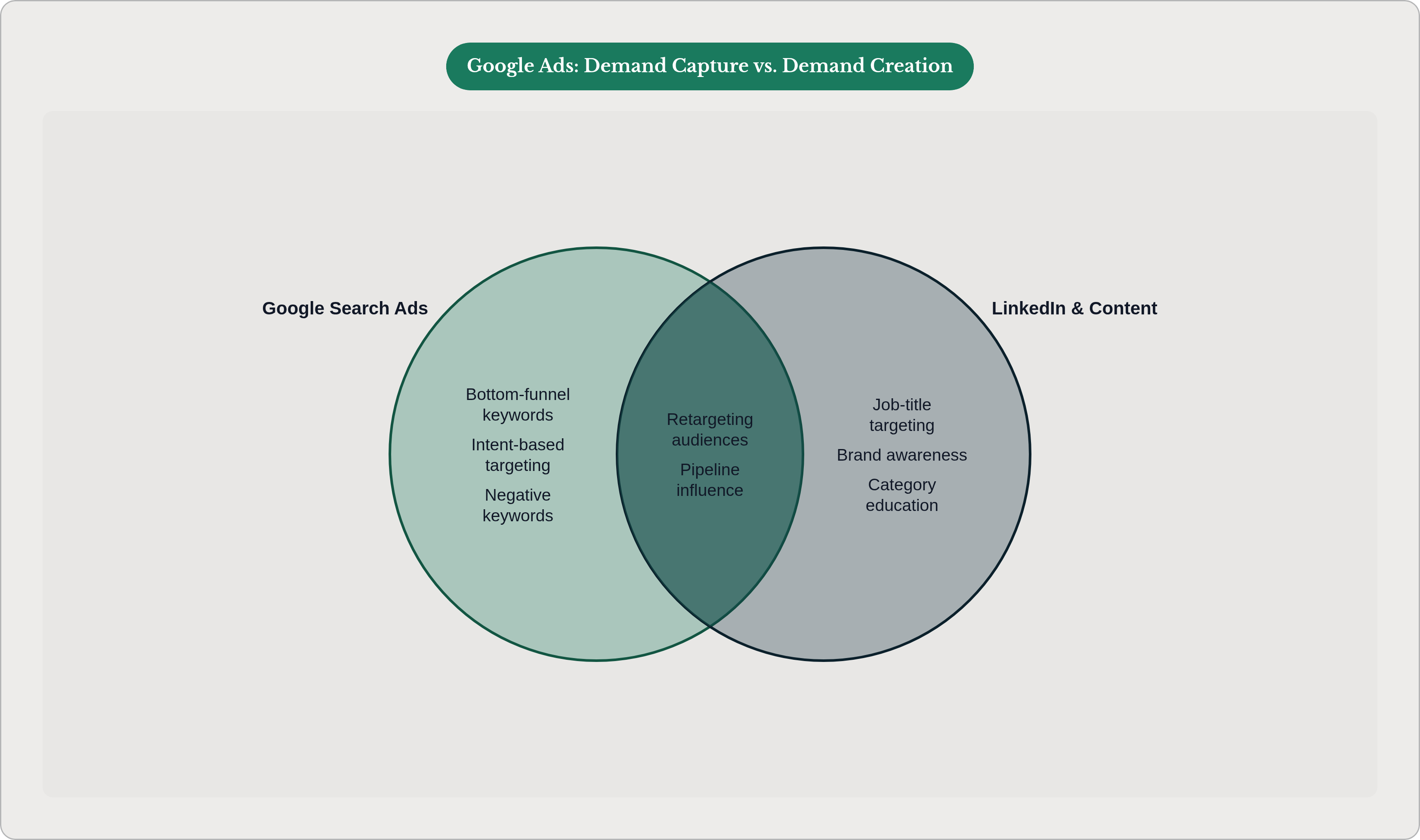
One thing worth naming clearly before going further: Google Search Ads in B2B is a demand capture channel, not a demand creation channel. Buyers have to already be searching. Your funnel structure determines whose search you win, at what stage, and at what cost.
That distinction matters a lot when you're deciding where to spend.
Where should B2B Google Ads budget be concentrated?
Bottom-of-funnel keywords look like this: demo requests, pricing pages, vendor comparisons, "[category] software for [industry]", branded competitor terms.
When someone types one of these queries, they are almost certainly deep into an internal buying process. The committee has largely reached consensus before they type that search. They're not starting their journey. They're finishing it.
This is where budget concentration makes sense. A widely used starting framework allocates roughly 60% of Google Ads spend to high-intent search. The reasoning is straightforward: CPCs in competitive B2B verticals can run $80–$150 or more. If you spread budget too thin across every funnel stage, no single stage gets enough data to optimize meaningfully. You end up with campaigns that are perpetually learning and never performing — always in school, never graduating.
A few things have to be true for this to work:
- Landing pages must match the intent. Bottom-of-funnel traffic should land on a conversion-focused page with a single CTA. Not the homepage. Not a blog post. A page built around the specific action implied by the search (a demo, not a newsletter signup).
- Smart Bidding needs real data. Google's algorithm requires at least 30 conversions per month per campaign before it has a meaningful signal to work with. Below that threshold, it defaults to optimizing for whatever conversion fires most frequently. In most accounts, that's a low-commitment top-of-funnel form fill, which is exactly the wrong signal to reinforce at the bottom of the funnel.
- Bidding strategy should reflect pipeline quality, not lead volume. Target CPA at this stage only makes sense after offline conversion tracking imports pipeline-qualified conversions. Optimizing to raw lead volume at the bottom of the funnel is how you spend $150 CPCs on people who will never buy.
The ask at this stage is high-commitment. A demo request, a sales call. Messaging has to earn that commitment by speaking directly to the problem the search implies.
Mid-funnel campaigns: capturing buyers who are evaluating but not yet deciding
Mid-funnel is where most B2B accounts underinvest. And it's also where a lot of future pipeline is quietly forming.
Mid-funnel search intent sounds like: "best [solution type]", "how does [approach] work", use-case-specific queries, category comparisons. These buyers are actively building a shortlist. They want to understand differences between solutions. They're not ready to commit. But they're paying close attention.
The 60/20/20 framework puts about 20% of Google Ads spend here, with the remaining 20% going to retargeting (more on that next). The goal at this stage is not a demo. It's a meaningful next step. A comparison guide, a case study, a webinar registration. Something that signals genuine evaluation intent without demanding a full commitment.
That said, there's a stakeholder reality worth holding onto: mid-funnel visitors are often researchers or influencers inside the buying committee, not final decision-makers. Content offers at this stage should be shareable inside a buying committee. Think reports, ROI frameworks, things someone can forward to a colleague or present in a meeting.
From a bidding standpoint, mid-funnel campaigns typically start with Maximize Clicks (with a max CPC cap) before they've accumulated the conversion volume needed for Target CPA. It takes longer to hit the 30-conversion threshold here, because the conversion actions are less frequent than raw form fills.
One more thing mid-funnel campaigns do that often goes unrecognized: they feed the retargeting pool. Visitors who engaged with evaluation content but didn't convert are some of the most valuable audiences you can build.
Retargeting as the connective tissue between stages
B2B leads typically need multiple touches over months to move down the funnel. That's not a failure of your product. It's just how B2B buying works.
Retargeting is the mechanism that delivers those touches without requiring a new search every time. It's the part of the funnel that keeps you visible during the 70% of the buying journey that happens outside any sales conversation — the quiet months when your buyer is reading, comparing, and building internal consensus without you in the room.
The core audience segments worth building for B2B retargeting:
- Site visitors who viewed solution or use-case pages but didn't convert. Highest intent, warmest audience.
- Mid-funnel content engagers. Downloaded a guide, watched a video. Ready for a stronger ask.
- Form starters who didn't submit. High intent signal, low friction failure. Something stopped them at the last step.
What matters here is message-to-stage match. A visitor who landed on your pricing page should see a demo offer in retargeting, not a top-of-funnel awareness ad. Showing someone who's nearly ready to buy a "here's what our product does" ad is a waste of a warm impression.
There's also a cross-channel angle worth mentioning. Google Ads site visitors can seed LinkedIn retargeting audiences. Use Google traffic to build the pool, then serve content to the same accounts through LinkedIn. The two channels work better together than either does alone.
The 20% retargeting allocation in the 60/20/20 framework is a floor. For companies with longer enterprise cycles, retargeting is often under-allocated relative to the actual influence it has on pipeline.
Why negative keywords determine whether the funnel structure holds
Here's something that tends to surprise people when they first see it: the gap between a mediocre B2B campaign and a high-performing one usually isn't the keywords you're bidding on. It's the keywords you're excluding.
Most accounts audited run fewer than 50 negative keywords. Many have zero. That's a B2C campaign logic applied to a B2B buying cycle, and it's one of the main reasons an estimated 40–60% of B2B Google Ads budget is wasted on structurally misaligned traffic.
Think about who else uses the same search terms as your B2B buyers. Job seekers. Students. Researchers with no purchase intent. DIY users looking for free tools. Without negative keywords, the algorithm learns from their behavior alongside your buyers. You're essentially telling Google: "these people are all equally good examples of what I'm looking for."
Every B2B account needs exclusion lists covering at least these categories:
- Job and career intent: "jobs", "careers", "salary", "certification"
- Free and consumer intent: "free", "open source", "DIY", "template"
- Informational without commercial intent: "what is", "definition of", "history of" (depending on which funnel stage you're targeting)
- Wrong company-size signals: "small business", "freelancer", "personal" (if you're targeting enterprise)
Negative keyword lists should be shared across campaigns and updated weekly during the first 90 days. The search terms report is your primary source. Before you adjust a bid or a budget, audit that report. Wasted spend on irrelevant queries is almost always the first and most fixable problem.
Performance Max adds a layer of complexity here. Until early 2025, PMax was effectively a negative-keyword-free zone. The January 2025 update added campaign-level negative keywords (up to 10,000), which made things more manageable. But that configuration still has to be set deliberately. It doesn't happen automatically.
Bidding strategy as a function of funnel maturity, not preference
Smart Bidding isn't a bad tool. It's just a tool that gets fed bad inputs in most B2B accounts.
When the conversion signal is raw form fills, Google optimizes toward whatever kind of person fills out forms. In B2B, that's often early-stage, high-volume, low-intent traffic. The algorithm isn't wrong. It's doing exactly what it was told. The problem is what it was told.
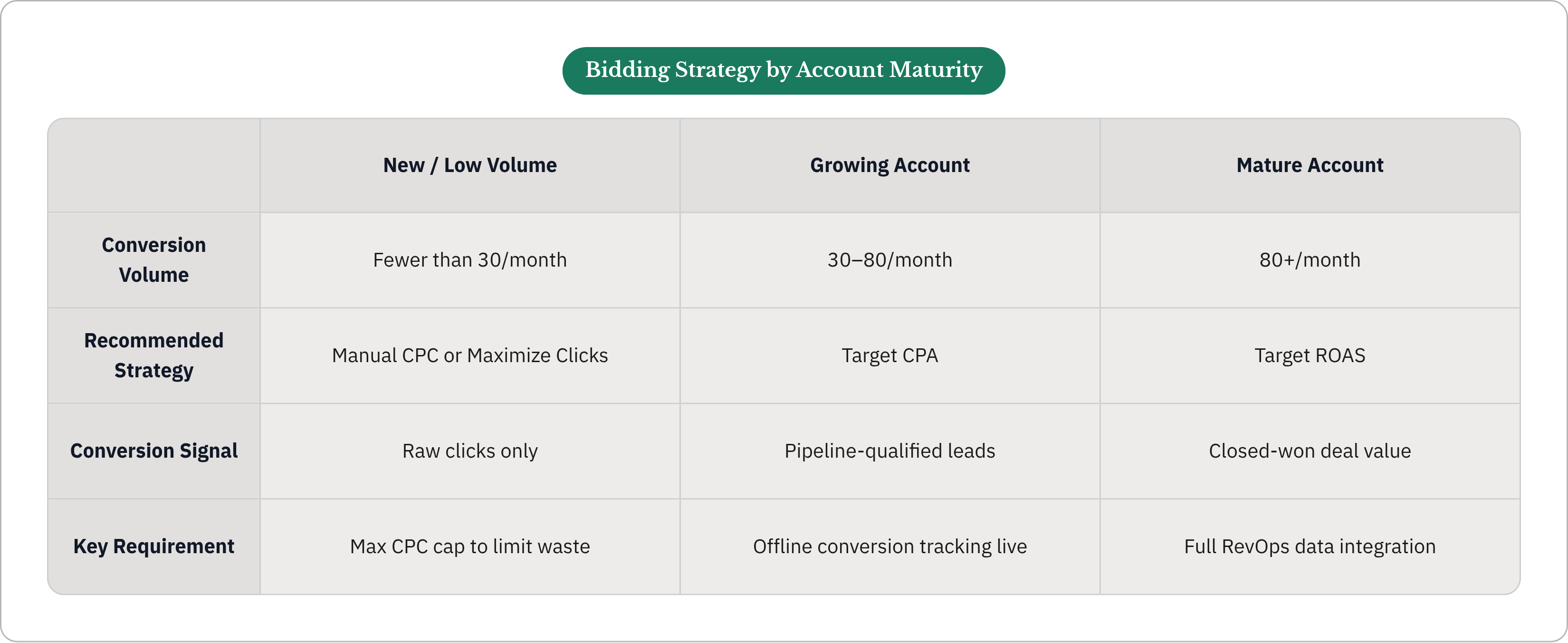
Here's how bidding strategy should evolve as an account matures:
- New accounts or fewer than 30 conversions per month: Manual CPC with bid adjustments, or Maximize Clicks with a max CPC cap. The algorithm lacks enough signal yet to make meaningful optimization decisions on its own.
- 30–80 conversions per month: Target CPA. But only after offline conversion tracking is importing pipeline-qualified conversions. Not raw leads.
- 80+ conversions per month with pipeline data: Target ROAS using closed-won deal value as the conversion value. This is where the algorithm's pattern recognition actually becomes an advantage.
The unlock in all of this is offline conversion tracking. Without it, Google has no way to know which form fills turned into real pipeline. With it, you can teach the algorithm to find more buyers, not more form fillers.
Value-based bidding requires assigning proxy values to each funnel stage. One way to calculate this: multiply close rate by average contract value by margin by the probability that stage reaches close. One closed opportunity might be worth 30 MQLs. The algorithm needs to know that. This also requires Revenue Operations involvement. You need real pipeline data to set values that hold up.
And consider this: a $50 cost per lead converting to pipeline at 2% costs $2,500 per opportunity. A $200 cost per lead converting at 20% costs $1,000 per opportunity. CPL as a standalone metric will actively mislead you without quality data behind it.
There's also a budget floor worth respecting. Roughly $5,000–$10,000 per month is typically the minimum to generate statistically useful conversion data in high-intent B2B campaigns within 60–90 days. Below that, even a well-structured strategy produces results that are too noisy to act on.
Performance Max in B2B: where it fits and where it doesn't
PMax is the most polarizing campaign type in B2B paid media right now. And the debate usually generates more heat than light.
Here's the honest version of it.
When properly configured with offline conversion tracking, PMax can reduce cost per lead meaningfully. Research from 2025 puts that reduction as high as 34% in some cases. But that qualifier — "properly configured with offline conversion tracking" — is doing a lot of heavy lifting. In B2B, that's a significant condition to meet.
The core tension is this: PMax optimizes across all Google inventory simultaneously. YouTube, Display, Search, Discover, Gmail, all of it. That breadth produces volume. It also reduces control over where in the funnel that volume comes from.
An analysis of over 3,300 campaigns found that Search campaigns had higher conversion rates than PMax for the same search terms roughly 84% of the time. For bottom-of-funnel B2B queries where precision matters most, that's not a minor finding.
There's also the brand cannibalization risk. Without brand exclusions or a separate branded campaign, PMax will claim credit for conversions that were already going to happen. Someone who searches your brand name was probably going to convert regardless. PMax taking credit for that distorts your performance data and your budget decisions.
So where does PMax actually belong in a B2B funnel?
- Mid-funnel awareness and retargeting, where the inventory breadth across YouTube, Display, and Discover is a genuine asset rather than a control risk.
- Accounts with clean offline conversion tracking and sufficient monthly conversions, where the algorithm has real signal to work with across channels.
The January 2025 update did make PMax more usable. Campaign-level negative keywords and channel performance reporting mean it's now more auditable and configurable than it's ever been. But "more auditable" isn't the same as "ready to run without active oversight."
The default position for most B2B accounts: run dedicated Search campaigns for bottom-of-funnel. Test PMax for mid-funnel and retargeting, with strict conversion signal controls in place before you let it spend.
CRM connectivity is what turns funnel structure into pipeline signal
Everything built so far — the staged campaigns, the intent-matched keywords, the tiered bidding — is scaffolding. CRM connectivity is what makes it load-bearing.
The structural difference between a pipeline-first program and a lead-gen program is whether deal-stage data flows back into Google Ads. Offline conversion imports push pipeline events, MQL, SQL, Opportunity, Closed Won, back into Google so the algorithm optimizes toward what actually closes, not what fills forms.
Getting this right has three technical requirements:
- Clean UTM architecture across all campaigns. Without it, import data can't be attributed to the right campaign or keyword. Your pipeline data becomes a black box.
- A consistent lead source field in your CRM (Salesforce, HubSpot, or otherwise). Garbage in, garbage out.
- Weekly import cadence for offline conversion data. Monthly imports leave the bidding algorithm operating on stale signals for too long.
RevSure's 2025 research found that 92% of respondents admit their pipeline forecasting lacks precision. That's not a forecasting problem. It's a data connectivity problem. And nearly 90% of marketers report siloed systems or integration challenges as a barrier to effective attribution.
There's also the dark funnel reality to sit with. A prospect may visit your pricing page twice, forward a case study internally, and check a review site before anyone on your team knows they're in market. None of that shows up in click attribution. Self-reported attribution ("how did you hear about us?") partially fills the gap, but it's inexact.
The funnel structure only gets smarter over time if the data loop closes. Without CRM connectivity, you're running campaigns on assumptions. With it, you're running them on outcomes.
Where Google Ads fits inside a broader B2B paid media stack
Pull back for a second. Everything covered so far assumes Google Ads is one tool in a larger system. That framing matters.
Google Search is a demand capture channel. Buyers have to already be searching for what you offer. The funnel structure determines whose search you win. But it does nothing to generate the demand that creates those searches in the first place.
That demand comes from elsewhere. LinkedIn builds awareness with job-title-level targeting. Content and SEO shape the category thinking that determines how buyers frame their searches. Events, partnerships, and word-of-mouth create the brand familiarity that makes a branded search query possible.
Google Ads, done well, is the net that catches the fish LinkedIn and content marketing swam toward the boat. It converts upstream demand into pipeline at the moment of active search. But it sits downstream of everything else.
This has a practical implication for how you evaluate performance. If branded search volume is flat or declining, that's an awareness problem upstream, not a Google Ads problem. If bottom-of-funnel campaigns are well-structured but pipeline quality is poor, look at whether the category-level demand you're capturing reflects your actual ICP.
The channels in a B2B paid media stack also reinforce each other directionally. Google drives site visitors who can seed LinkedIn retargeting audiences. LinkedIn builds familiarity that improves conversion rates when the same buyer later searches on Google. The two channels talking to each other is more valuable than either running in isolation.
One last thing worth sitting with: most B2B paid media stacks are under-integrated. The campaign data doesn't talk to the CRM. The CRM doesn't talk back to the ad platform. Attribution is guessed at rather than measured. The funnel structure laid out here only reaches its potential when the data infrastructure underneath it is built to match.
That part is less glamorous than keyword strategy. But it's where the real leverage is.