Google Ads vs LinkedIn Ads for B2B Pipeline Generation
LinkedIn reaches B2B buyers before they search; Google captures them after they've already decided.
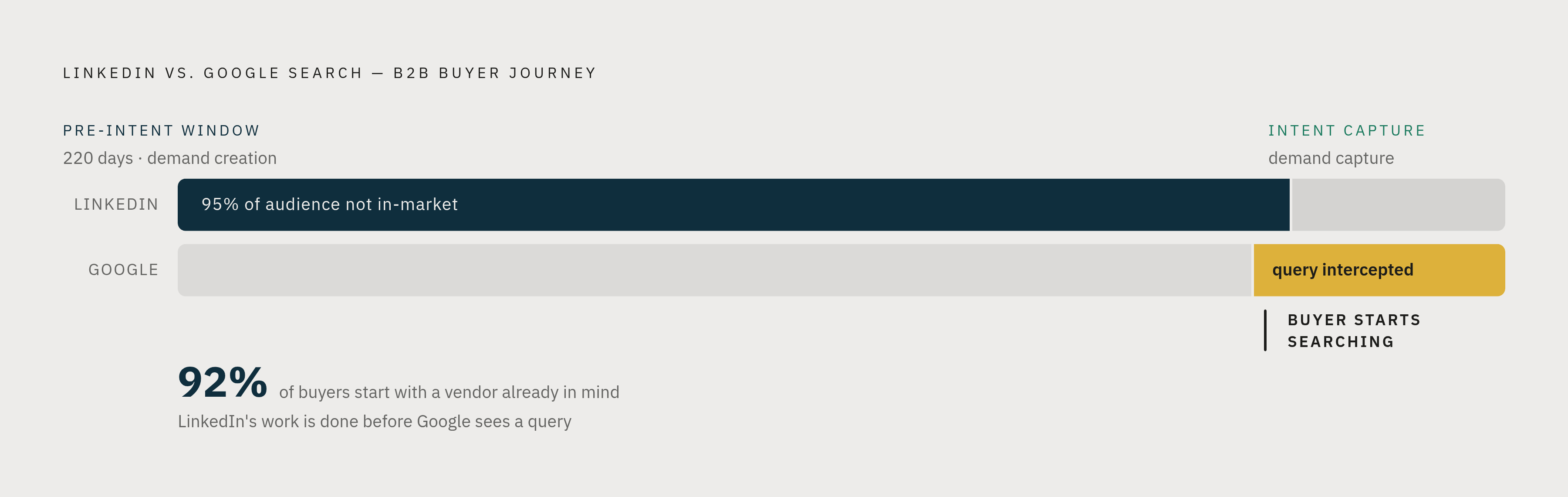
B2B buyers now spend an average of 220 days forming a purchase decision through self-directed research before they ever enter a sales pipeline. No sales calls. No demos. Just quiet, independent research happening completely off your radar.
And it gets messier from there. The average buying committee has grown to more than eleven stakeholders. Sales cycles have stretched since 2023. But the stat that should probably change how you think about paid media: 92% of buyers start their journey with a vendor already in mind.
By the time someone types a search query, the consideration set is often already locked. Brand awareness, not search intent, frequently determines who wins the deal.
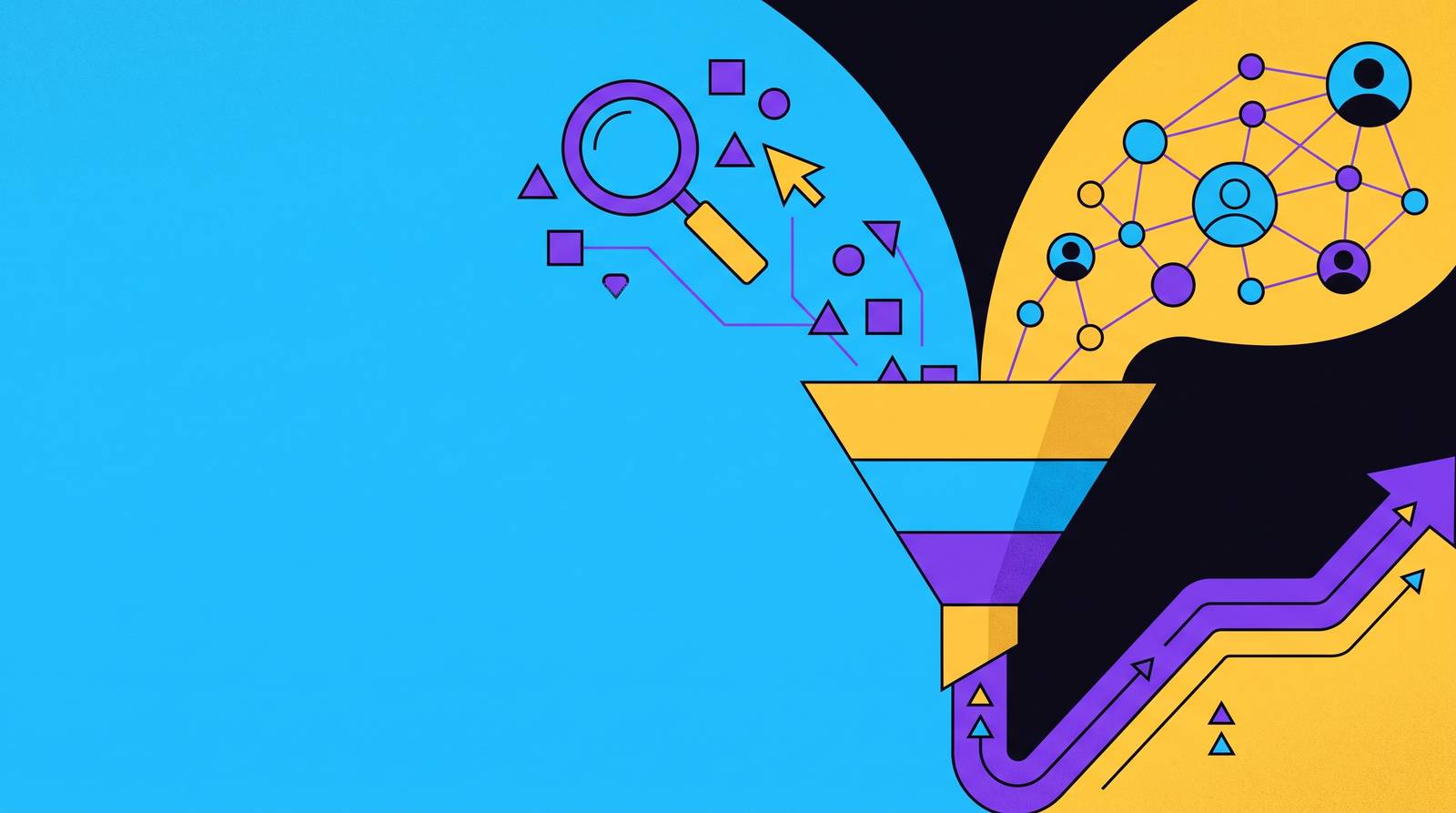
So what does that actually mean for your budget? B2B marketing has two completely separate jobs, and most teams blur them:
- Demand creation. Shaping who buyers think of before they start looking. Getting your name in the room before the room exists.
- Demand capture. Intercepting buyers who are already searching, already raising their hand.
A paid media strategy that only does one of these is like flying half a plane. You're either invisible during the long pre-intent research window, or you're showing up to a race you were disqualified from before it started.
The question is which job each channel was actually built for. That's worth slowing down on.
What Google Search ads are actually built to do in B2B
Google Search operates on one signal: someone typed a query.
That's it. Don't underestimate it, though. When someone types "CRM software for sales teams," they've already done the hardest cognitive work in demand generation. They named the problem. They know they have a need. Your ad doesn't have to manufacture desire. It just has to show up.
That's a real structural advantage. Average B2B cost-per-lead on Google Search was $70.11 in 2025 (per WordStream), with conversion rates running between 3.5% and 7% depending on category. Solid numbers for buyers who are already in motion.
But the limitations in B2B are real. And they're getting more significant:
- Google only captures buyers who are already searching. If your category is new, niche, or complex enough that buyers lack vocabulary for it, there's no search volume to capture. The demand simply isn't there yet.
- CPCs for competitive B2B terms can clear $50 per click. High-volume strategies in crowded spaces get expensive fast.
- The keyword signal tells you what someone wants. Nothing about who they are. No job title. No company size. No seniority. You might be capturing the exact right query from completely the wrong person.
There's also a more recent headwind. AI Overviews now appear in roughly 48% of searches. Per Seer Interactive's analysis of over 3,000 queries, they've driven a 68% drop in paid click-through rates on the queries where they appear. B2B tech has seen a sharp jump in AI Overview presence year over year. Gartner projects traditional search volume will fall 25% by 2026 as users shift to AI-powered answer tools.
That's not a future problem. It's a current one.
Google's broader ecosystem (Display, YouTube, Performance Max, Demand Gen) can extend reach beyond search. But these are different jobs from high-intent capture. They're useful for retargeting and brand reinforcement. Treating them as search interception is how budgets quietly disappear without anyone noticing until Q4.
What LinkedIn ads are actually built to do in B2B
LinkedIn's structural advantage is the exact inverse of Google's.
LinkedIn knows who someone is. Job title, seniority, company size, industry, recent job change. What it doesn't know is what they're searching for, because they're not searching for anything. They're scrolling their feed, catching up on industry content, maybe avoiding a meeting they don't want to attend.
At any given moment, roughly 95% of LinkedIn's audience is not in-market to buy anything. That sounds like a liability. But sit with it for a second. What it actually means is that LinkedIn is the only platform where you can reach the exact professional profile of your ideal customer, at scale, before they start searching. You're reaching them during that 220-day pre-intent window. You're shaping who they think of when they finally do have a problem. Sometimes you're planting the problem framing before they've even named it.
That's demand creation. A completely different job.
Format matters more here than most teams realize. LinkedIn users are in a content-consumption mindset, not a conversion mindset. The creative has to match that:
- Video ads (especially less-polished, authentic ones) tend to perform well at the top of the funnel. Founder-led, behind-the-scenes, real people talking like humans rather than brand copy.
- Document ads let prospects preview a resource before downloading it. The friction actually filters for real interest, which produces better lead quality than a high-volume form fill.
- Thought Leader Ads promote organic posts from executives or subject matter experts, and they frequently outperform brand-led creative. People follow people. Not logos.
A few features worth knowing for B2B pipeline programs specifically:
- Predictive Audiences use AI to build segments from your account's own conversion patterns.
- Career Journey targeting reaches people based on recent promotions or job changes. Someone who just became a VP is actively figuring out how they want to run things. That's a real intent signal hiding in plain sight.
- Real-time CRM integration in Campaign Manager allows optimization toward pipeline contribution, not just lead volume.
And because Microsoft owns LinkedIn, Bing Ads campaigns can layer LinkedIn profile data for targeting. B2B precision layered onto search inventory that Google's network cannot replicate.
Why the pipeline math favors LinkedIn for high-ACV deals despite the higher CPL
A lot of teams pull a cost-per-lead comparison between Google and LinkedIn, see that LinkedIn's CPL is higher, and conclude LinkedIn isn't working. Reasonable instinct on the surface. But it treats a Google lead and a LinkedIn lead as equivalent inputs, and they're not remotely the same thing.
LinkedIn-generated leads in B2B close at higher rates. The SQL-to-opportunity conversion rate skews higher because the leads are more precisely matched to your ICP. Google captures anyone typing the right terms. Buyers outside your target profile, researchers, competitors, the occasional grad student doing homework. LinkedIn targets a verified VP of Sales at a 500-person SaaS company. Those are not the same asset. Averaging them together and calling it a CPL comparison is like comparing apples to a different category of fruit entirely.
When you measure cost-per-pipeline-dollar instead of cost-per-lead, the picture often flips. But these are long-horizon figures, and that's where the measurement problem kicks in.
One thing that doesn't get enough attention: measurement windows systematically distort LinkedIn's apparent performance. A 30-day ROAS on LinkedIn is typically very low, even for well-performing programs. Real performance tends to surface at six months, more clearly at twelve. B2B sales cycles averaging 220 days mean that last-touch, short-window attribution assigns almost no credit to LinkedIn, even when LinkedIn originated the deal.
Teams evaluating LinkedIn on 30-day or 90-day ROAS cancel programs that are actually working. That's not a LinkedIn problem. That's a measurement window problem dressed up as a channel problem.
LinkedIn's Conversions API and their updated Revenue Attribution Report (which now covers twelve months of CRM activity) are meaningful steps toward closing this gap. They connect ad engagement to offline actions: demos, sales calls, lead-to-opportunity transitions. That's the infrastructure you need for accurate credit allocation across a long cycle. Without it, you're essentially measuring a marathon at mile thirteen and calling the race.
How the two channels amplify each other when run together
But what if the strongest argument isn't about either channel in isolation?
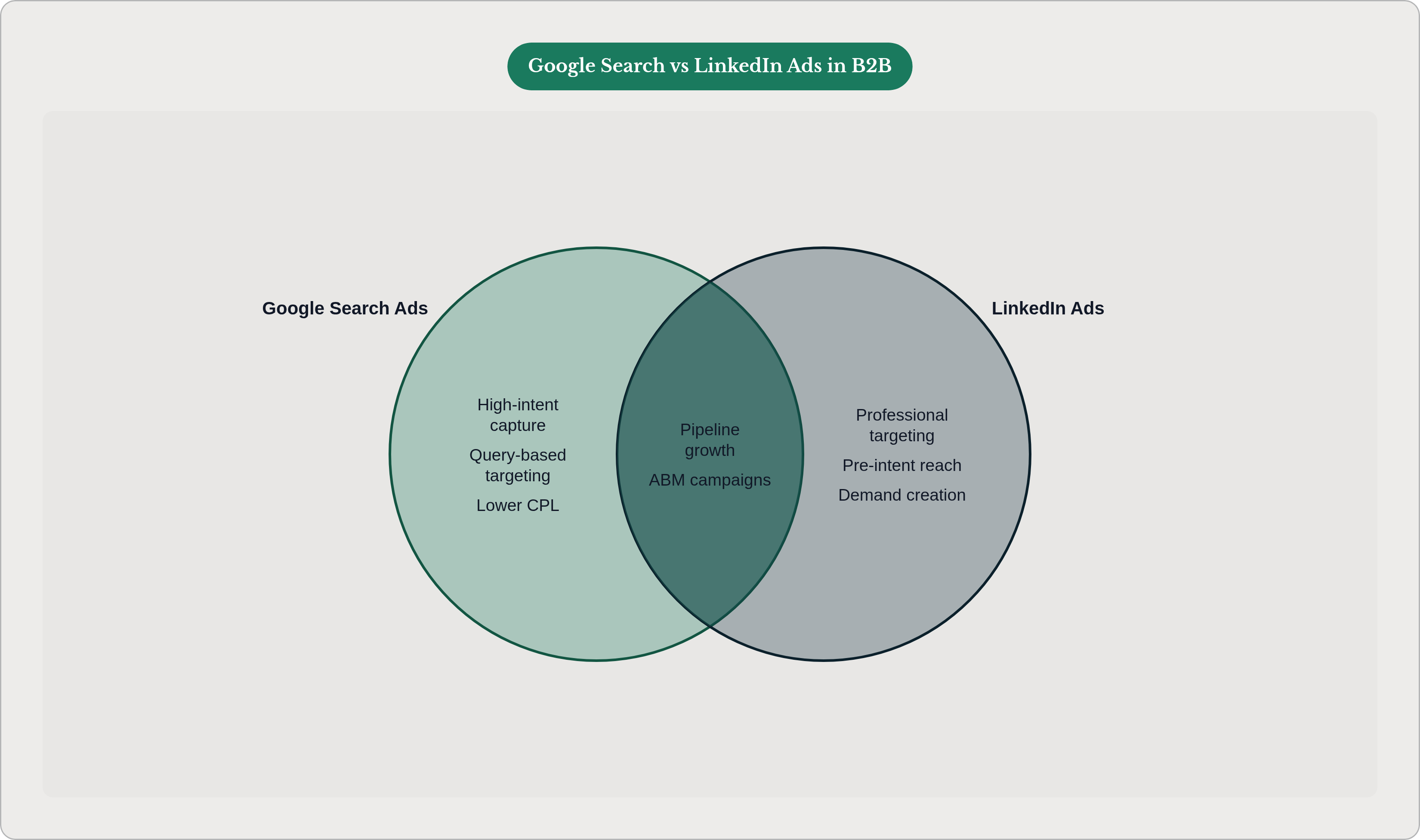
When both channels run together, they compound each other's performance in a measurable way. Prospects who saw LinkedIn ads and then searched on Google converted at significantly higher rates than prospects who only came through Google. Companies running both platforms together report meaningfully more pipeline than single-platform strategies.
The mechanism is worth understanding. LinkedIn warms the buyer. It establishes the problem framing and puts your name in the consideration set. So when that buyer eventually types a query into Google months later, the click isn't cold. They already know who you are. It converts faster and at higher rates. The Google click is doing less lifting because LinkedIn already did the heavy work.
Cutting either channel doesn't save half the budget's pipeline contribution. It reduces total pipeline disproportionately, because the compounding effect disappears with it.
A few cross-platform tactics that make this concrete:
- LinkedIn Insight Tag on your website enables retargeting of Google-generated visitors back on LinkedIn. The reverse is possible through LinkedIn's Audience Network.
- For ABM programs: run sustained multi-format LinkedIn campaigns across the full buying committee while using Google Search to capture inbound demand that above-the-line activity generates.
- Competitor brand term campaigns on Google intercept buyers actively evaluating alternatives. A natural complement to LinkedIn awareness campaigns targeting those same accounts.
Budget allocation by search volume, deal size, and sales cycle length
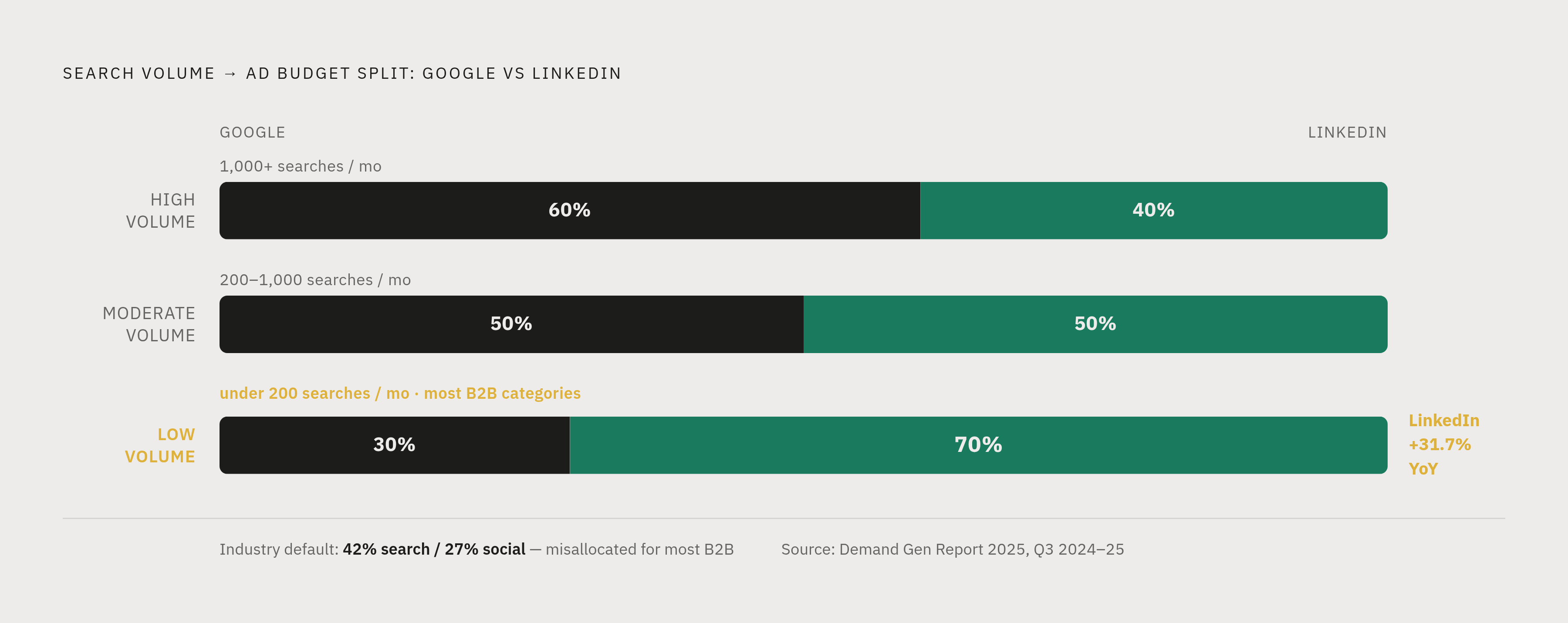
The right split between Google and LinkedIn isn't a fixed ratio. It's a function of three things: how much search demand exists for your category, your average deal value, and your sales cycle length.
By search volume:
- High search volume (1,000+ monthly searches for category terms): start at roughly 60% Google, 40% LinkedIn. Demand exists. Capture it.
- Moderate search volume (200–1,000 monthly searches): closer to 50/50. The category isn't established enough for Google to carry the load alone.
- Low search volume (under 200 monthly searches): lean toward LinkedIn, maybe 70%, with Google focused only on branded and competitor terms. Buyers don't search for this category. Don't fight physics.
By budget size:
- Under $4,000 per month: pick one platform. Splitting too thin produces inconclusive data on both and you'll end up convinced neither works.
- Above $8,000 per month: run both, with the split driven by the search volume framework above.
By deal value: LinkedIn only makes sense when average deal value exceeds $10,000 and you can commit meaningful monthly spend for at least six months. Below those thresholds, the learning phase takes too long and results will look like nothing is working, even when it is.
One sequencing note that gets overlooked: get your Google account profitable and generating at least 20 conversions per month before adding LinkedIn. Adding a second channel before the first is working is probably the most common budget waste in this space. It's also one of the hardest to diagnose, because the failure looks like "LinkedIn doesn't work" when the real issue is that nothing had traction yet.
B2B companies currently allocate an average of 42% of digital ad budgets to search and 27% to social, per the Demand Gen Report 2025. Reasonable baseline. But between Q3 2024 and Q3 2025, B2B companies increased LinkedIn ad budgets by 31.7% while Google spending grew just 6%. The market is slowly correcting toward LinkedIn's long-cycle value. Whether that correction is happening fast enough at most companies is a different question.
What full-funnel execution actually requires across both channels
The most common execution failure is running the same creative and landing pages on both channels.
LinkedIn traffic is earlier in the journey. It responds to educational content: reports, assessments, webinars, frameworks, real insight. Sending that audience to the same bottom-of-funnel conversion page you built for Google Search traffic is the paid media equivalent of proposing on a first date. The sequencing is off and everyone feels weird about it.
Creative by channel:
- LinkedIn: founder-led video, thought leader posts, document ads with partial content previews, behind-the-scenes content. Build trust. Establish the problem. Don't ask for anything too soon.
- Google Search: tight message-to-query match, landing pages built around the specific intent signal of the search term, clear conversion paths with as little friction as appropriate for the ask.
Attribution needs to be built for long cycles. Cohort-based reporting that groups leads by generation month and tracks pipeline at 180 and 365 days is the right structure for LinkedIn-heavy programs. LinkedIn's Conversions API connects on-platform engagement to offline CRM actions. Without it, you're giving LinkedIn almost no credit for deals it influenced, optimizing away from it, and then wondering why your pipeline dried up six months later.
The broader measurement shift is real. MQL volume as a primary success metric is being replaced by pipeline contribution, deal velocity, and revenue influence. If you're still optimizing toward lead volume, you're optimizing for the wrong output. That's not a fringe opinion anymore. It's where the more sophisticated teams have already landed.
The highest-performing programs run shorter, learn-fast campaign bursts tied to buying stages and specific personas rather than fixed quarterly budgets. Every campaign produces data that should make the next one more precise: which LinkedIn audiences convert downstream, which Google queries produce sales-qualified leads versus noise, which creative themes correlate with opportunity creation. That compounding intelligence, built over time, is the actual structural advantage. Not any single channel decision.
The channels aren't competing. They're doing different jobs at different moments in a long, complicated buyer journey. The question was never really Google or LinkedIn. It was: what does your buyer need right now, and which channel is actually built to deliver it?