Negative Keyword Strategy for B2B Google Ads Accounts
Negative keywords became B2B's last lever as Google's automation expanded targeting.

Match types have loosened. A lot. Even exact match now triggers for queries Google considers "semantically related," which sounds fine until you watch it happen in an actual account. You bid on "enterprise contract management software." Google decides "how to manage contracts at home" is close enough. That's not a hypothetical. Pull any mid-size B2B account's search terms report and you'll find something equally baffling within the first ten minutes.
Performance Max makes this harder to catch. By design, PMax limits your visibility into where ads are actually appearing. You're trusting Google's systems to find the right audience across search, display, YouTube, Gmail. That trust has limits. For a while, advertisers had almost no tools to push back.
Here's a detail worth paying attention to: Google raised the PMax negative keyword cap from 100 to 10,000 per campaign. As of January 2025, you can add them directly in the UI without contacting support. Google doesn't ship changes like that because things are going well. They ship changes like that because advertisers kept hitting walls and complaining loudly enough that someone had to do something.
AI Max for Search and broad match paired with Smart Bidding are both designed to expand reach. That's the pitch. But what does "expand reach" actually mean when your total addressable market is 4,000 companies globally? It means the algorithm finds volume. It finds clicks. It optimizes toward whatever signals you give it. The problem isn't the automation. The problem is whether those signals are pointing toward pipeline or toward noise. Think of it like a fishing net with no mesh size — you'll haul in everything the ocean has, but most of it isn't what you came for.
Phrase match CPCs jumped 43% between June 2023 and June 2025. Every unqualified click now costs measurably more than it did two years ago.
So here's what actually shifted. As automation took more control of targeting, negative keywords became one of the few levers a B2B advertiser still holds. Not a nice-to-have. The editorial layer that's still yours.
The Specific Query Patterns That Drain B2B Budgets
Google's auction system cannot tell a procurement director from a student writing a business school report. That's not a criticism of the technology. It's just what happens when a system matches text to text. When a student types "enterprise resource planning solutions comparison" for a case study, that query is identical to the one from an IT director evaluating vendors. Same words. Completely different intent. The algorithm has no way to know.
The categories of irrelevant traffic that bleed B2B budgets are predictable enough to build against before campaigns even launch.
Job seekers and students. Terms like "resume," "internship," "entry level," "junior," "how to get a job in," "career." These signal someone looking for employment, not a vendor. In categories like cybersecurity, HR tech, or marketing software, this traffic runs surprisingly high.
Consumer and residential intent. "For home," "personal use," "residential," "family," "near me," "gift." These modifiers flag a consumer buyer who will never fit your ICP, no matter how good the product is.
Informational and research queries. "What is," "how does," "review," "vs," "alternative," "comparison," "difference between." Research-mode traffic. Expensive to click, rarely converts to pipeline. But the subtler damage is what it does to your data. Google optimizes toward what converts. Unqualified visitors who occasionally fill out a curiosity-driven form teach the algorithm to find more people like them. You're not just wasting spend. You're corrupting the signal that drives future spend.
Price-averse and free-seeking queries. "Free," "no cost," "open source," "cheap," "DIY." These are structurally incompatible with high-ACV B2B offers.
The "vs" category deserves a second look. Someone searching "Slack vs Asana" is evaluating tools, which sounds promising. But that person is in research mode, not demo-booking mode. These queries have real organic value for content and SEO. In paid search, they're expensive to convert and they muddy intent signals. Leaving that on autopilot isn't a strategy.
Accounts that serve both businesses and consumers face a specific structural problem on top of all this. Consumer queries bleed into B2B campaigns unless they're explicitly separated. The traffic looks fine in aggregate. The pipeline data tells a different story.
Building Negative Keyword Architecture That Scales Without Becoming Noise
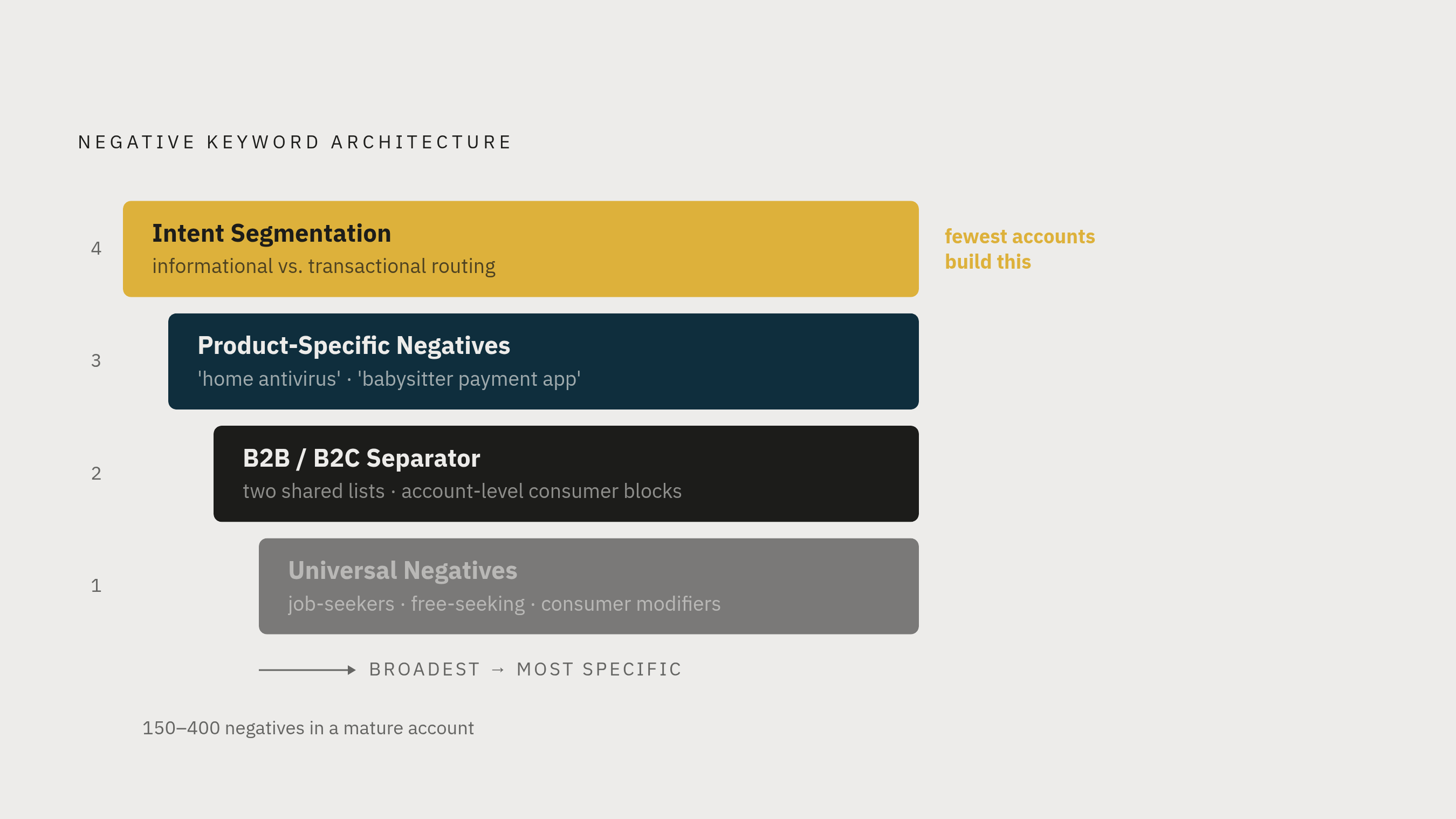
Stop treating negative keywords as a list. Treat them as intent categories.
The right question isn't "what words should I block?" It's "what types of intent are completely irrelevant to this business?" Build the clusters first. The specific terms follow naturally from there.
A four-layer structure tends to hold up across account types:
Universal negatives. Job-seeker terms. Free-seeking terms. Consumer and residential modifiers. These go in before the first campaign goes live.
B2B/B2C separator list. If the account serves only businesses, block consumer terms at the account level. If it serves both segments, maintain two distinct shared lists that prevent cross-contamination. Without this separation, consumer campaigns pull budget from B2B campaigns in ways that are genuinely hard to untangle after the fact.
Product- or service-specific negatives. A cybersecurity firm selling enterprise solutions doesn't want to appear for "home antivirus." A payroll software company doesn't want "babysitter payment app." These aren't universal. They require someone who actually understands the product to identify them.
Intent-segmentation layer. This is the one fewest accounts build. The goal is separating informational queries from transactional ones. Blocking "what is" and "how does" isn't always right. Deliberately routing informational traffic to different campaigns with different bids and landing pages is often more valuable than blocking it outright.
On cluster logic: if you're blocking "free," you should also block "no cost," "zero price," "complimentary," "gratis," and "without charge." Same intent, different phrasing. Semantic variation is exactly how queries evade single-word blocks.
Now, a counterargument worth sitting with. A study of over 7,000 Performance Max campaigns found that campaigns using account-level exclusions had nearly identical ROAS to campaigns without them. The difference was marginal. That's not a reason to abandon exclusion strategy. But it is a reason to be honest about what problem you're actually solving. In Performance Max, structure and targeting precision often matter more than raw exclusion volume. Surgical removal of irrelevant intent categories is the goal. Reflexive blocking of anything slightly adjacent is a different thing entirely, and it creates its own mess.
An account with 1,000 uncategorized negatives isn't well-managed. It's an accumulation problem wearing the costume of strategy. A mature account in the 6- to 12-month range typically carries somewhere between 150 and 400 negatives, organized across shared lists and campaign-specific additions. More than that, without clear categorization, usually means reviews happened but architecture never did.
How Negative Keywords Interact With Smart Bidding and Broad Match in B2B Accounts
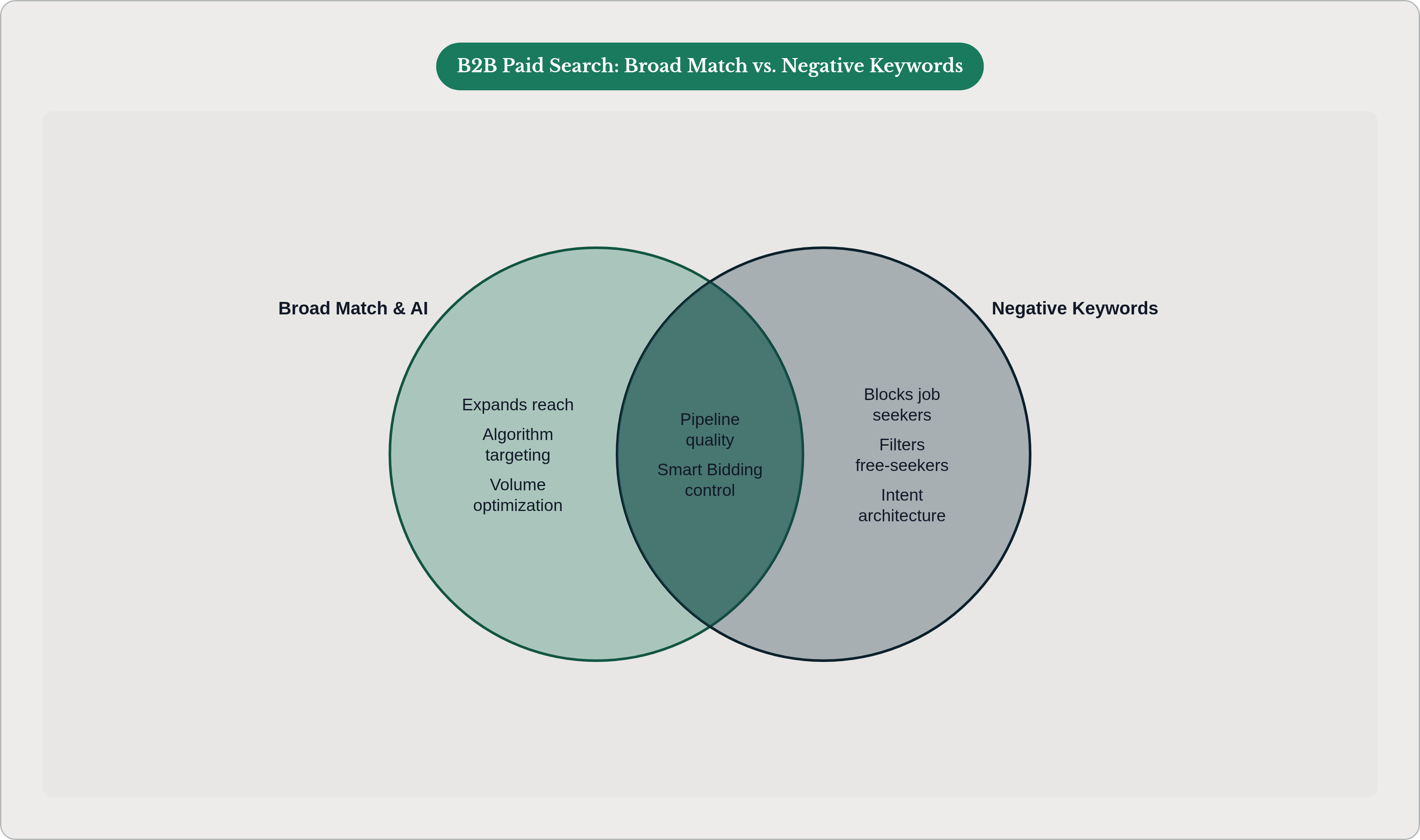
Broad match paired with Smart Bidding is Google's current recommended setup. Their own data shows advertisers who switched phrase keywords to broad match saw roughly 25% more conversions in Target CPA campaigns. That's a real number from a real experiment.
But that number doesn't tell you what those conversions were.
Form fills from job seekers look like conversions. Demo requests from students writing case studies look like conversions. The algorithm found volume. Whether that volume was pipeline-relevant is a separate question entirely, and the data won't answer it for you.
Broad match without negative keyword guardrails in B2B is the fastest path to budget waste. Not because broad match is broken, but because the algorithm optimizes toward what you've taught it. If your conversion signals are polluted, you're training it at scale to replicate bad traffic. That compounds quickly, and it's unpleasant to unwind.
What most B2B advertisers get backwards: Smart Bidding and AI Max do honor negative lists. Negatives are not overridden by automation. They constrain it. This is not a workaround. It's the intended mechanism.
The deeper problem is conversion signal quality, not just click quality. Google sees 100 form fills. It cannot see that 40 were from existing customers, 25 were from job seekers, and only 35 were from genuinely qualified prospects. All 100 look identical. The algorithm tries to find more of all of them.
This is why broad match and Smart Bidding in B2B require two things to function properly. First, a maintained negative keyword structure that filters irrelevant intent before clicks happen. Second, clean conversion signals flowing back through offline conversion imports and CRM-connected pipeline data. Without both, you're not using automation well. You're automating waste.
The Operational Cadence That Keeps Exclusions Current
A negative keyword list built at launch and never touched again is a liability. The queries wasting budget in month one are not the same ones wasting it in month twelve. Google's matching behavior evolves. Product positioning shifts. Competitors come and go. What once caught the right irrelevant traffic can start catching the wrong things, and you won't notice until you look.
The input that drives everything is the search terms report. Actual queries that triggered actual ads. The most honest data in the account.
A 90-minute monthly review of search term data is the minimum viable cadence for a B2B account spending meaningfully on paid search. You're looking for queries that matched but don't belong, patterns in the mismatches, and gaps in your current exclusion clusters.
Quarterly, the task shifts. Instead of harvesting new negatives, you're auditing the intersection between your negative lists and your campaign structure. Checking for conflicts where a shared list is accidentally suppressing high-intent traffic you actually want. Asking whether terms added six months ago still make sense given how the product or market has moved.
What forces list updates over time?
- New product launches introduce both new relevant queries and new irrelevant ones you didn't anticipate.
- Google's match behavior evolves, and queries that didn't match before now do.
- Competitor landscape shifts generate new comparison queries, including "[Competitor] vs [Your Brand]" searches that deserve deliberate handling rather than default treatment.
Estimated spend savings from systematic negative keyword management range from 5% to 40% of PPC spend. That range is wide because the baseline varies so much. Accounts starting with no exclusion architecture save more when they build one. Accounts already running disciplined lists see smaller incremental gains but better compounding over time.
Each review cycle adds precision. The account gets harder to waste money on, not because you've restricted it, but because you've taught it more accurately what it's actually for.
What Good Negative Keyword Management Actually Produces for Pipeline
The direct output is better traffic quality, upstream of everything else. Clicks arriving at the landing page are more likely to come from people with buying authority, relevant roles, and genuine need. That improves lead-to-opportunity rate before landing page copy, offer structure, or follow-up sequence even enter the picture. You haven't fixed conversion rate. You've improved the population you're converting from. Those are different things, and conflating them leads to chasing the wrong fixes.
The indirect output is cleaner conversion signals feeding back into Smart Bidding. The algorithm finds more of what it's seen convert. If what it's seen convert was qualified pipeline, it finds more qualified pipeline. If what it's seen convert was a mix of job seekers, curious students, and real buyers, it finds more of all of them. Exclusion strategy and algorithm quality reinforce each other when done right. They undermine each other when done poorly.
The metrics that reflect this aren't CPC or CTR. Those look fine even when traffic is unqualified. The numbers that actually matter are cost per qualified lead, lead-to-opportunity rate, and pipeline value attributed to paid search.
CRM offline conversion imports are what close the loop. Importing pipeline and revenue data back into Google Ads lets the algorithm optimize toward deals instead of form fills. But that only works if the form fills it learned from weren't already corrupted by unqualified traffic. The quality of what comes out depends on the quality of what went in. Garbage in, garbage out — and in paid search, garbage costs you by the click.
That raises a fair question: is this actually worth the operational overhead? Negative keyword strategy isn't glamorous. It's not the work people want to talk about at conferences. But it's the foundational quality-control layer that determines whether everything else the account does gets better over time, or just gets bigger. There's a meaningful difference between those two things, and it shows up in pipeline data eventually. Usually sooner than you'd expect.