Performance Max Asset Group Strategy for B2B Audiences
Asset groups are your only real control lever in Performance Max for B2B.

Performance Max asks B2B advertisers to hand over the wheel: one campaign, one budget, and Google's algorithm deciding who sees your ads across Search, Display, YouTube, and Gmail. The main steering wheel you keep is the asset group. Set it up with intent and the algorithm tends to find your best buyers. Leave it default and it optimizes for whatever's easiest to find, which in B2B often means noise dressed up as volume.
That's the whole game with Performance Max for B2B. In a standard Search campaign, you pick your keywords, your audiences, your placements. Explicit levers, explicit control. PMax strips most of that away and replaces it with asset groups, bundles of creative, audience signals, and search themes that tell the algorithm: here's the audience, here's the message, here's the intent context. That's it. That's your control panel.
And here's why this matters more for B2B than it does for, say, an e-commerce brand selling shoes. A return on a pair of shoes is unambiguous. A form fill on a B2B site could be a VP of Engineering ready to buy, or it could be a college student writing a term paper. The algorithm rarely tells the difference on its own. It needs you to build the guardrails. This piece is about how.
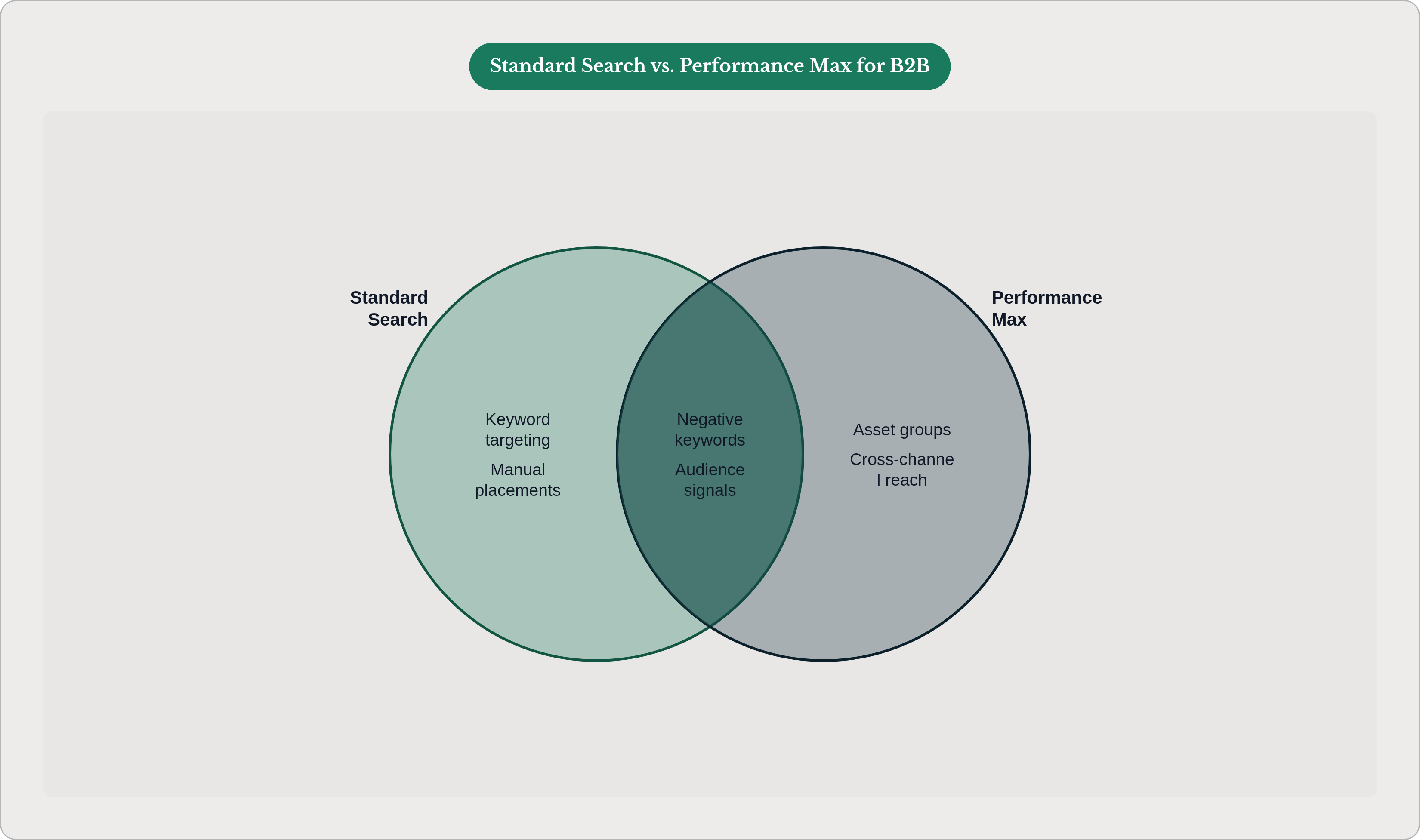
How Performance Max's feedback loop turns against B2B advertisers when left unconfigured
PMax runs on a feedback loop. You give it a conversion signal, and it goes and finds more of whatever produced that signal. Simple enough, and it works well when the signal is good.
The problem is that form fills, the most common conversion event in B2B, are a weak signal. A form fill doesn't tell the algorithm much about seniority, company size, buying stage, or intent quality. It just says "someone filled out a form." So if that's the only thing feeding the loop, the algorithm learns to chase more form fills. Not more pipeline, not more revenue, just more forms.
That's a fine outcome if you're grading on the Google Ads dashboard. It's a bad outcome if you're grading on what shows up in the CRM three months later.
Add to that the fact that B2B buying involves multiple stakeholders and deal cycles that can stretch for months. The algorithm has little native understanding of committee dynamics or how long a deal takes to close. It just sees a conversion event and tries to replicate it.
Two situations make this mismatch especially sharp:
- Small, named-account ABM programs. If you're targeting fifty specific accounts, broad reach isn't a feature. It's a liability. PMax wants scale; ABM wants precision.
- Low monthly conversion volume. If your account only generates a handful of conversions a month, the algorithm can't accumulate enough signal to get out of its learning phase. It stays stuck, guessing.
None of this means PMax is broken for B2B. It means the fix isn't to walk away from the platform. It's to control what the algorithm learns from, starting with how you structure asset groups and ending with the quality of the conversion data you feed back in. Everything in this article builds toward that second half. But structure comes first.
The three structural axes for organizing B2B asset groups
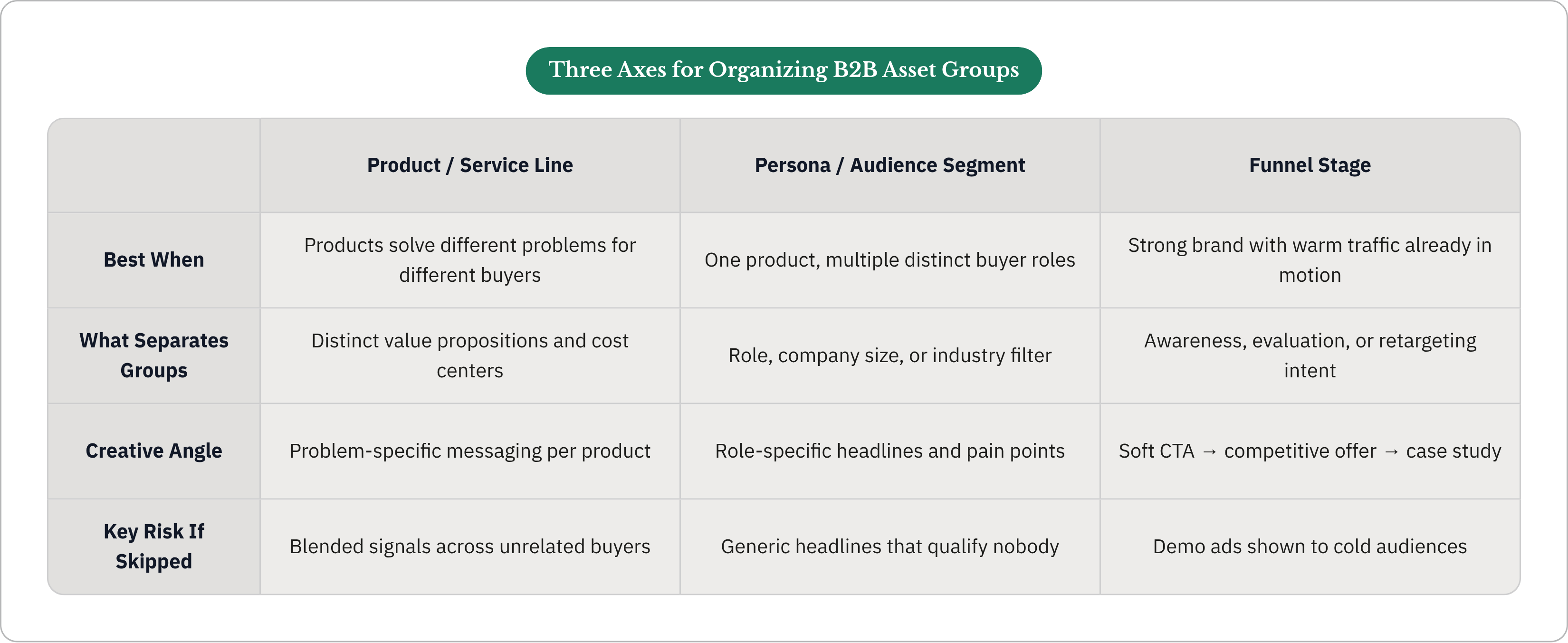
Here's the one rule that matters more than most others: one coherent theme per asset group. Mix personas, mix product lines, mix funnel stages inside a single group, and you degrade two things at once. The algorithm's ability to learn a clean pattern, and your ability to read the report afterward and understand what happened.
Beyond that rule, there are three axes you can organize around. Most B2B accounts will lean on one primarily, with a light touch of another.
Axis one: product or service line. If your products solve distinctly different problems for distinctly different buyers, give each one its own asset group. Its own creative, its own performance record. This keeps the algorithm from blending signals across unrelated buyer problems, and it gives you a clear answer to the question every finance team eventually asks: which product is actually driving conversions, and at what cost?
Axis two: persona or audience segment. A B2B SaaS company selling one core product might still need separate groups for startup founders, operations leads, and marketing leaders. Each persona gets its own audience signal and its own creative angle. This is where headlines earn their keep, something we'll come back to. "Built for operations teams at mid-market companies" does real work that "Save Time and Money" never will. The audience signal and the creative should reinforce each other, not pull in different directions.
Axis three: funnel stage. Prospecting groups run broad value-proposition messaging aimed at in-market or affinity audiences. Retargeting groups run case studies, demo CTAs, objection-handling content, aimed at your website visitor list. Keep these separate and you avoid one of the most common failure modes in PMax: showing a "request a demo" ad to someone who's never heard of you, or showing thought-leadership fluff to someone who's already comparing your pricing page to a competitor's.
A concrete version of this: a B2B software company runs three groups. An awareness group with thought-leadership content and a soft CTA. An in-market group with competitive messaging and a trial offer. A retargeting group with case studies and a direct "book a demo" ask.
So which axis do you lead with? It depends on your business. One product, many personas? Structure by audience. Many products, one shared ideal customer profile? Structure by product. Recognizable brand with a lot of warm traffic already in motion? Structure by funnel stage. There's no single answer here, only the one that matches how your buyers actually differ from each other.
How many asset groups to launch with, and when adding more helps versus hurts
More groups feels like more control. It's usually the opposite.
Split your budget across too many asset groups and none of them accumulate enough conversion data to actually optimize. The algorithm needs a minimum amount of signal per group, not just per campaign. Spread thin, every group stays stuck in perpetual learning mode.
A practical starting range for most B2B accounts: two to four focused groups. Enough to segment meaningfully, without starving each one of data.
Each group needs to hit a meaningful conversion threshold every month before it can really optimize. Add a new group before your existing ones have enough data, and you're not adding insight. You're adding noise.
Here's a useful filter before you create a new group: is this driven by a real strategic distinction, like a persona your current structure can't reach, or a product with a clearly different value proposition? Or is it driven by a desire to just test more creative variants? The first is a good reason. The second belongs inside an existing group, not a new one.
Give any new group at least four weeks of data before you judge it or start tweaking. And as your account matures and conversion volume climbs, more granular segmentation becomes possible. But the bar for adding a group doesn't move just because your account is bigger. The data threshold stays the same.
What goes inside an asset group: creative requirements, video, and the B2B headline problem
Fill every slot. Headlines, descriptions, images, video. All of them. This isn't a nice-to-have, it's structural: partial asset sets give the algorithm fewer combinations to test in the auction, and that tends to show up as worse performance.
The recommended shape for a group: a full set of headlines, a full set of descriptions, a full set of images, and at least one video. All speaking to the same audience, all built around the same theme the group exists for.
Video deserves special attention because it's a high-leverage asset in B2B PMax, and also one teams often skip.
- A short video built around one specific buyer pain point will typically outperform a generic brand overview by a wide margin.
- Skip the upload and Google will auto-generate one from your other assets. Those auto-generated videos tend to underperform something a person actually produced.
- Google's Asset Studio, now built on Imagen 4 and Veo as of 2025 and 2026, can generate brand-aligned creative inside the platform itself. That lowers the bar for teams that don't have a video budget, but it's a floor to build from, not a substitute for a video made with a real buyer problem in mind.
Now, the headline problem. This is where many B2B PMax accounts quietly leak money.
Generic benefit headlines, "Grow Your Business," "Save Time," sound safe. But they qualify nobody. They provide little audience-filtering signal, and they invite clicks from people who were never going to buy anyway.
Effective B2B headlines qualify the reader out loud. Role, company size, industry, whatever the relevant filter is for that group. Say "Built for CFOs at 200-person companies" and the right person leans in. The wrong person scrolls past. That's not a loss. That's the headline doing work your targeting alone can't reliably do.
One more thing worth building into your routine: creative fatigue is real, and it's measurable. Rotate in a small number of new assets every six to eight weeks, and replace whatever's rated lowest. That's usually enough; a full creative overhaul every quarter is unnecessary. Watch the asset quality ratings (low, good, best) Google gives you. A low-rated asset can drag down the whole group's performance, so pause or swap it within a few weeks. And give new variants a real impression window before you judge them; ratings take time to settle.
Search themes as per-asset-group intent signals — what changed in 2025 and 2026
Search themes tell the algorithm which queries a given asset group should be competing for. Think of them as intent hints, not hard targeting rules, they nudge, they don't lock.
They matter a lot in B2B because your landing page copy and product feed often don't naturally contain the specific, jargon-heavy language your buyers actually type into Google. A VP of Revenue Operations doesn't search the way your homepage talks.
The allowance here expanded recently: advertisers can now use up to fifty search themes per asset group. That's real room to map intent precisely, and it pairs well with the segmented structure covered earlier. A persona group built for finance leaders should carry search themes pulled from finance-specific pain points. A retargeting group should carry search themes drawn from high-intent evaluation language: competitor comparisons, pricing, implementation questions.
Vague themes dilute the signal, so skip the broad keyword dump you might use in a Search campaign. Specific themes, pulled from your actual top-converting queries, add real value. Treat the field like a curated list of intent hints, not a keyword dump.
One useful 2025 addition: search term insights inside PMax now show you which real queries are triggering your ads, and you can add negative keywords directly from that view. That closes a gap that used to leave advertisers guessing.
Brand exclusions and negative keywords as protective structure around B2B asset groups
Left alone, PMax will happily spend your budget on branded searches. In B2B, a lot of branded search volume comes from people who are already in your pipeline, sales outreach, existing conversations, not new demand. Let PMax claim credit for that traffic and you'll cannibalize your numbers and distort what your reporting is telling you.
So: build a brand exclusion list at the account level. Your own brand terms belong on it. This isn't an optional refinement, it's baseline setup, the kind of thing that should happen before the campaign even launches.
You can also exclude competitor brand terms, if there's a legal, strategic, or relevance reason not to show up next to them.
A notable improvement landed in early 2025: campaign-level negative keywords became available to every advertiser, not just a subset. That gives B2B teams a way to suppress whole categories of irrelevant queries at the campaign level, instead of relying solely on audience signals to keep the algorithm on track.
Worth being clear about what this layer does and doesn't do. Negative keywords and brand exclusions handle query-level exclusions. Asset group structure handles message and audience direction. They work side by side. Neither replaces the other.
Offline conversion tracking as the signal layer that makes B2B asset group structure actually work
Everything above controls who the algorithm talks to and what it says. This section is about what outcome you're actually training it to chase, and it's the piece that makes the rest of it worth doing.
Without CRM feedback, PMax optimizes for form-fill volume, because that's the only signal it has. With CRM feedback, you can train it toward outcomes that actually matter: qualified opportunities, specific pipeline stages, closed revenue.
The mechanism is straightforward. CRM events, a lead marked qualified, an opportunity created, a deal closed, get imported back into Google Ads. They either replace the raw form-fill signal or supplement it. Either way, the algorithm now has something closer to the truth to chase.
This is the part where the earlier sections and this one become interdependent rather than separate tactics. Structured asset groups tell the algorithm who to target and what to say. Quality conversion signals tell it what success actually looks like. Do one without the other and you're only half-fixing the problem.
A couple of other pieces worth knowing about here:
- Customer Match got a lot more usable for smaller B2B accounts in 2025, when Google removed the minimum matched-user requirement. That means even a modest CRM list can now be uploaded as an audience signal, telling the algorithm what a qualified customer looks like before you've built up enough conversion history for it to figure that out on its own.
- Value-based bidding, paired with offline conversion data, is what lets the algorithm distinguish a high-value opportunity from a low-quality lead. Your bid strategy starts reflecting deal potential instead of raw conversion count.
- Bidding progression matters. Start with Maximize Conversions and no tight target, and let the algorithm gather data. Layer on a Target CPA or Target ROAS constraint too early, before you've got enough conversion volume, and you force the algorithm into a constrained learning state that limits how well it can actually perform.
What the 2024–2026 transparency updates mean for how B2B teams should monitor asset groups
For years, the standard complaint about PMax was that it's a black box. You couldn't see much beyond top-line results. The 2024 and 2025 reporting updates changed that in ways that matter for how you actually manage this thing day to day.
Channel-level asset group reporting now breaks down conversion contribution by channel, Search, Display, YouTube, Gmail, per asset group. That's the layer that makes segmentation actually legible. Without it, you can't tell whether a group is performing because of strong YouTube creative or because its search themes happen to be well-aligned. With it, you can.
Search term insights, now built into PMax, show the actual queries triggering your ads. This closes what used to be one of the biggest gaps between PMax and a standard Search campaign, where you'd typically had that visibility by default.
So what should a B2B team actually be checking, and how often? A regular cadence, monthly at minimum, should cover:
- Asset quality ratings. Catch low-rated assets early instead of waiting for performance to visibly slip.
- Channel contribution breakdown. Check whether spend is concentrating somewhere that doesn't match the group's intent.
- Search term categories. Confirm the queries actually triggering your ads match the audience and intent the group was built for.
- Downstream conversion quality. Cross-reference what Google Ads reports as a conversion against what's actually showing up in CRM pipeline. This is where you catch drift between what the algorithm is optimizing for and what sales is actually closing.
How advertisers who govern asset groups well build a compounding structural advantage over time
Here's the thing that's easy to miss when you're deep in the weekly optimization grind: every well-run campaign leaves behind a record. Which personas responded to which messages. Which search themes actually produced qualified conversions. Which creative angles moved pipeline instead of just moving impressions.
That record compounds. The next campaign doesn't start from zero, it starts from a richer base of signal, and your optimization decisions get grounded in your own performance history instead of generic best-practice guesses pulled from somewhere else.
Advertisers who understand how to govern the algorithm, through asset group structure, audience signal quality, conversion data integrity, brand protection, build an advantage that widens as PMax takes up a bigger share of Google's inventory and automated systems become more central to how ad budgets get allocated. The flip side is just as real: advertisers running PMax without any of this structure are training the algorithm on noisy signals, and that noise compounds too, just in the wrong direction. The account gets more efficient at chasing outcomes that never mapped to revenue in the first place.
For sales-led B2B companies, the standard that matters was rarely "conversions" as Google Ads defines them. It's pipeline. It's revenue. Asset group structure, done deliberately, is the mechanism that keeps a campaign honest to that standard instead of quietly drifting toward whatever's easiest for the algorithm to find.
That takes ongoing attention: monitoring asset quality, rotating creative on a schedule, feeding CRM signals back in, reading channel-level reports instead of skimming the dashboard total. Teams that can't sustain that kind of oversight will still get a number in the Google Ads account that looks fine. Whether it means anything in the CRM is a different question entirely.