AI-Generated Ad Copy Testing in Google Ads
Google's new terms let AI rewrite your ads without approval, forcing testing as your only control.
Two things happened on the same day in mid-2026, and together they changed who actually writes your Google ads. On July 1, new Google Ads Terms of Service took effect, and Google's own AI Max feature kept doing what it had already been doing: swapping in headlines, sitelinks, and descriptions you never wrote and may never see. For anyone running paid search for a B2B company, that combination turns ad copy testing from a nice-to-have into the only way to know what's actually live in your account.
What the contractual fine print means for regulated and sales-led B2B advertisers specifically
Google published the revised terms on April 17, 2026. They applied to every account automatically. No box to check, no button to click, no email that needed a reply.
The language shift matters more than the date. Older terms treated automation as something an advertiser opted into. The 2026 version drops that framing and replaces it with blanket authorization. Google can now "format, select, or generate targets, ads, or destinations" on the advertiser's behalf. Targets, ads, destinations: those are the three things a PPC manager gets hired to control. All three are now explicitly inside Google's authorization, not the advertiser's.
Three more provisions are the real driver of that headline change and matter just as much:
Inputs feed the system. Anything typed into conversational tools like a chat-based advisor feature, any URL supplied, any query submitted, can get used across other Google Ads features. The input box is not a sealed room. Crawl authorization is explicit. URLs and accounts an advertiser gives Google access to, in connection with automated campaign setup, are treated as authorized for Google to crawl. Liability stays put. The advertiser is still on the hook to make sure it has the rights to every piece of content, every URL, and every input it hands over.
A representative from another vendor has pointed out that this setup erodes the two things Google Ads has always sold advertisers on: relevance and control. Decision-making now sits with Google's systems. Accountability still sits with the advertiser. That gap is the whole problem.
For a regulated advertiser, financial services, healthcare, insurance, that gap has teeth. A financial services company can't point to compliance on copy it didn't write. A healthcare brand can't stand behind an AI paraphrase of its own landing page just because the paraphrase sounds close enough. "Google's model wrote it" isn't a defense the terms leave room for. The advertiser owns the words, even the ones it didn't choose.
For sales-led B2B, the exposure looks different but the mechanism is the same. The issue sits in positioning rather than compliance. A sales team spends months getting the value proposition exactly right, down to specific phrasing that maps to how deals actually get won. Gemini's read of a landing page doesn't know any of that history. It's working from the text on the page.
Why this testing problem arrives at an expensive moment for B2B paid search
Every one of these substitutions is happening while the price of a click keeps climbing. Average Search CPC rose about 12% from 2024 to 2025, according to industry benchmark data. Average cost overall went from $66.69 in 2024 to $70.11 in 2025, a jump of roughly 5%. B2B services and other high-lifetime-value categories tend to run above that average, not below it.
Click-through rates actually improved across nearly every industry tracked between 2025 and 2026. That sounds like good news until it sits next to a second number: conversion rates fell across a wide range of industries tracked in 2025. More people are clicking. Fewer of them are converting once they land.
Put those two trends together and a pattern appears in the data: the gap between what the ad promises and what the landing page actually delivers is getting wider, not narrower.
That's the moment this ad copy sits in. When cost-per-click is rising and conversion rates are falling at the same time, every headline Google swaps in without telling you isn't a free experiment. It's a paid one, and the price tag is higher than it looks on the surface.
What Google's asset system is doing when it "optimizes" your copy
Google's own "Ads Decoded" podcast has offered some of the most detailed public description of how this actually works inside the product team, which is rare. Most of what advertisers know about the ad system comes from support documentation and speculation. This is closer to the source.
The internal design process runs on what the team calls "five in the box": one person each from data science, engineering, UX research, product, and design, in every session. Every idea gets built as a hypothesis and stress-tested across all five disciplines before it ever goes live. As one team member, Bullock, put it: "Rarely you get it on the first shot." Multiple rounds of iteration are the norm. The gap between a first experiment and a public rollout can span many cycles of testing and re-testing.
What comes out of that process is a system that treats your assets, your headlines, your descriptions, your sitelinks, as modular pieces of content rather than a fixed ad. Google decides where each piece goes: headline position, sitelink slot, next to other sitelinks, wherever the system's relevance and performance predictions say it should sit. Not where you put it when you built the ad.
What AI copy generation tools can and cannot do inside this environment
Two very different things get lumped together under "AI-generated ad copy," and keeping them separate matters. One is a third-party AI copy tool, something an advertiser chooses to use to draft and test variants before anything goes live. The other is Google's own AI, working inside the ad account, selecting and reassembling copy the advertiser may never have approved, or even seen.
Third-party tools work by analyzing performance data, search patterns, and conversion signals, then generating copy variants at scale, headlines, descriptions, calls to action, benefit framing, emotional hooks, all tested systematically rather than by hand.
A few things separate the useful tools from the rest:
Performance prediction. Some tools score or rank generated variants before any budget gets spent testing them live. That's the single biggest differentiator among the group. Competitor ad analysis. Especially useful in crowded keyword categories where every advertiser is bidding on the same handful of terms. Built-in policy compliance scanning. One disapproved ad can stall an entire campaign launch, so catching policy problems before submission saves real time. Scale. Bulk generation across hundreds of ad groups, which matters most for large accounts and agencies running many clients at once.
TheCMO.com reviewed ten of these tools, each with its own positioning:
Anyword, best for data-driven copy, from $39 a month billed annually, with predictive performance scores, audience persona targeting, and a real-time feedback loop. Integrates with Google Ads, LinkedIn Ads, HubSpot, Salesforce, and Shopify. Ahrefs, best for SEO-focused ads, from $29 a month, with a free plan available. Hoppy Copy, best for email marketing copywriting, from $29 a month, with a 7-day free trial. Copy.ai, best for small business use, from $29 a month, with a free trial available. AdCreative.ai, best for creative design, from $39 a month, with a free trial available. Hypotenuse AI, best for ecommerce ads, from $19 a month billed annually, with a free trial available. Copysmith, best modular solution stack, with a free plan available. Quickads.ai, best for quick ad creation, from $39 a month, with a 5-day free trial. Addlly.ai, best for real-time copy testing, pricing upon request, with a free demo available. Musely.ai, best for generating multiple ad variations, pricing upon request, with a free demo available.
What the performance evidence on AI-generated copy shows, and where it breaks down
None of this answers the actual question advertisers want answered: does copy written by one model work better than copy written by a human? The evidence says, sometimes, and the "sometimes" carries real weight.
A real-world test of AI Max's auto-created assets in a B2C lead generation account has been reported publicly. The AI performed well on long-tail campaigns, the smaller, more niche corners of the account. But it did not beat the assets a human team had already spent significant time testing in the top campaigns. The pattern that emerged: AI does best where the existing human copy was thin or formulaic to begin with. It has less room to add value where the human version was already sharp.
A separate landing page conversion study found AI-generated copy landed roughly equal to human copy across B2B overall. Break that down by format and the picture splits:
- AI copy lifted conversions about 3% on B2B SaaS pages and about 4% on lead-gen forms.
- AI copy lost about 2% on DTC pages and about 5% on webinar pages.
Google's own reported numbers on AI Max show accounts using the full feature set getting an average 7% more conversions at similar cost, compared to basic keyword matching, with some campaigns seeing lifts up to 27% when moving off heavy exact- and phrase-match setups. Those figures come from Google, about Google's own product. Those figures come from Google, about Google's own product, so they carry weight but shouldn't be treated as independent proof.
The honest read across all of it: AI copy has a real edge in B2B, but it's a narrow one, and it is most visible where the human copy it's replacing was weak to start with. It is not a uniform upgrade. The size of the effect swings by format and by where a prospect sits in the funnel, and any testing program that assumes otherwise is going to get surprised.
The testing discipline that accounts for what Google controls and what you control
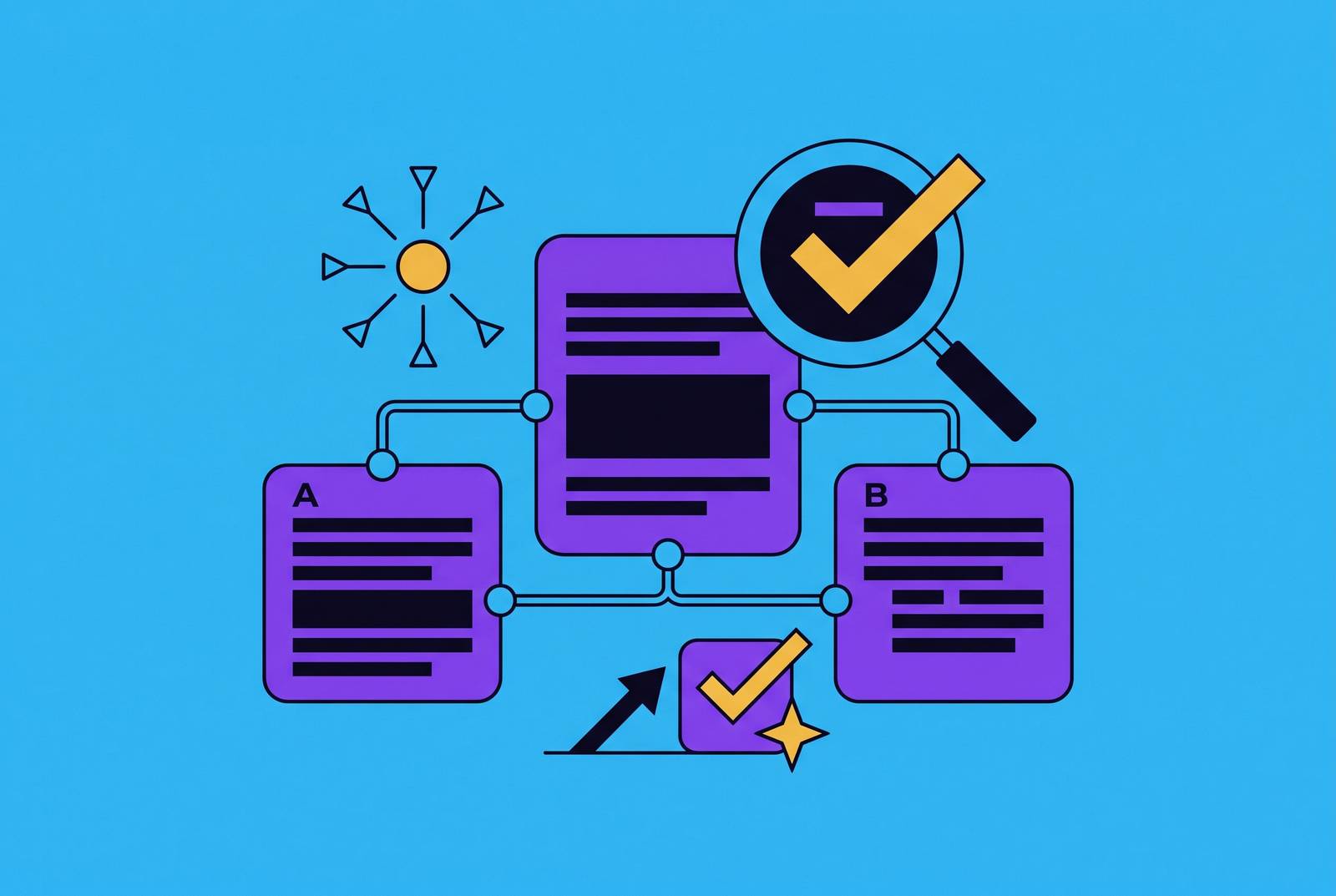
Inside a Responsive Search Ad, Google picks the combination of headlines and descriptions that actually serves. Advertisers can see asset-level performance ratings, Learning, Low, Good, Best, but not the exact combination that ran on a specific search. That's the core design constraint any testing plan has to work around.
A few rules follow directly from that constraint:
Respect the learning thresholds. Individual assets need more than 500 impressions, and a complete ad needs more than 2,000 impressions in the "Google Search: Top" segment over 30 days, before the performance signals mean anything. Pull data before that point and it's noise, not a result. Pin what you're testing, and only what you're testing. Pinning locks an asset into a fixed position and removes Google's flexibility to move it around, which can suppress reach if overused. But pinning the one or two elements actually under test is the only way to hold a controlled variable steady. Without a pin, there's no way to know which version of a headline actually served on a given impression. Check the search term report. AI Max writes copy contextually depending on the query. A single ad's asset rating is an average across every query context it appeared in, and those contexts can behave in very different ways. That difference is visible in the search term report.
What a testing program needs to produce beyond click and conversion metrics
Click-through rate and conversion rate tell an advertiser what happened. They don't tell an advertiser what Google actually said on its behalf, or to whom, or in what combination. Given the terms now in effect and the mechanics behind AI Max, a testing program has a second job that matters just as much as measuring performance: keeping a record of what copy actually ran.
That means treating the search term report and asset-level ratings as documentation. It means knowing which headline paired with which description on which query type, at least well enough to catch a claim that shouldn't have gone out, or a value proposition that drifted from what the sales team is actually saying on calls. Performance data answers "did it work." A B2B advertiser now also needs an answer to "what did it say," because under the current terms, whatever it said is the advertiser's to defend either way.
Sources
- Inside Google's search ad design engine: tests, assets, and AI in 2026
- 10 Best Google Ads AI Copy Tools Reviewed In 2026
- Putting Google Ads AI Max’s automated ad copy to the test
- Google Ads’ New Terms: Your Ads, Your Responsibility (Even If AI Gets It Wrong)
- Google Ads tells advertisers how their inputs will be used starting July 2026
- A New Chapter for Google Ads: The 2026 TOS Overhaul | ALM Corp
- digitalapplied.com