AI Agents for Google Ads Campaign Management
AI agents now execute bid changes and budget shifts around the clock, not just suggest them.
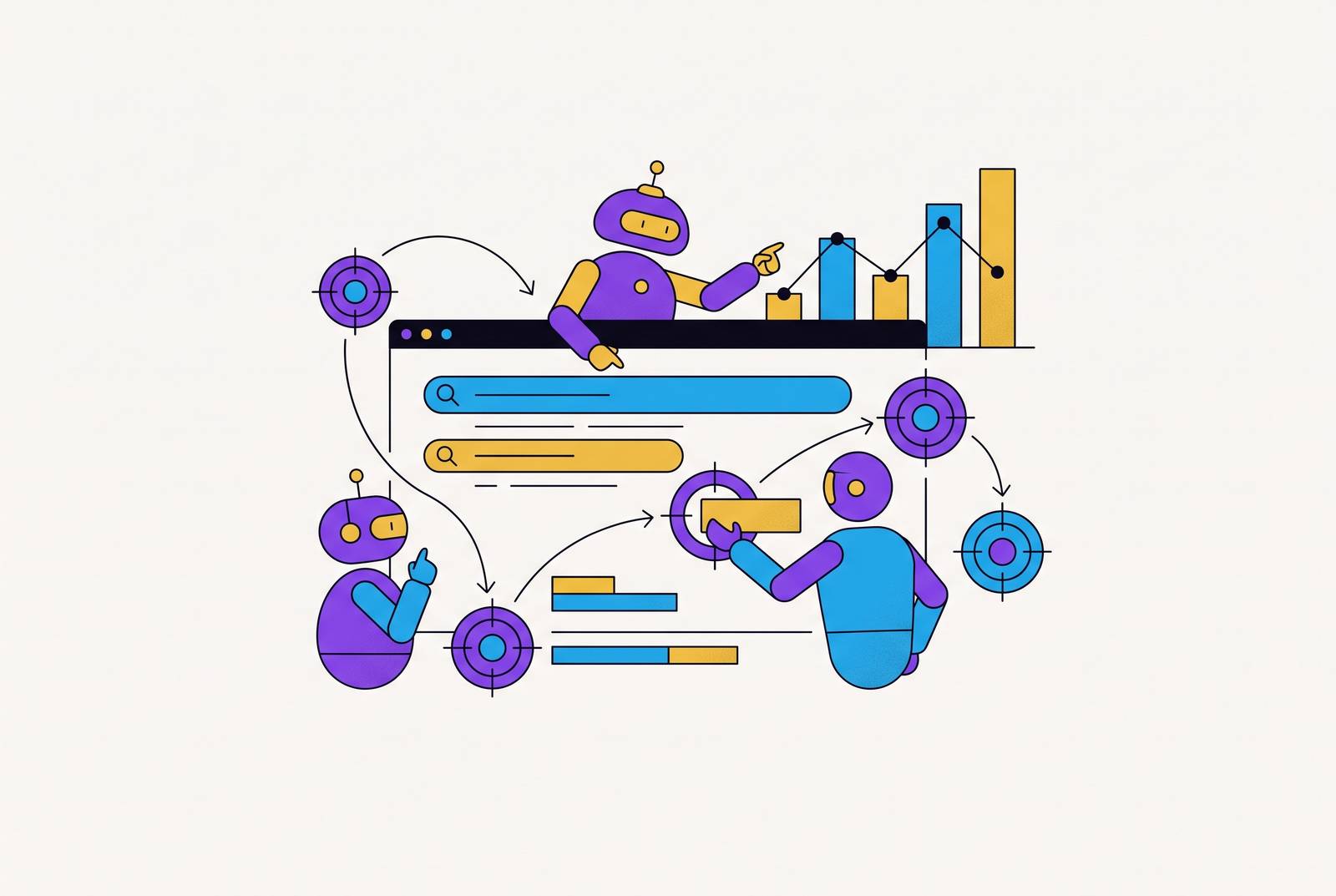
Google Ads used to run on a simple loop: a person logs in, checks numbers, changes a bid, logs out. That loop is breaking. AI agents now sit inside the account full-time, watching auctions in real time and making changes without waiting for anyone to open a laptop. The question worth asking is whether AI is just talking, or actually doing something. It's whether the AI is just talking, or actually doing something.
That's the line this whole piece turns on: tools that recommend versus tools that act. A dashboard that tells a marketer "your CPA is up 12%, consider lowering bids on Campaign B" is doing something useful. But it's not the same thing as a system that lowers the bid itself, at 2am, before the budget gets burned. One waits for a human. The other doesn't.
Traditional automation, the rules-based bidding, the manual dashboards, the weekly check-in meetings, all still require someone to notice a problem and act on it. Agentic execution skips that step. The agent reads the data, reasons about what will move the needle, and makes the change. No login required.
Google's own tools get partway there. Smart Bidding (Target CPA, Target ROAS, Maximize Conversions) adjusts bids at the moment of auction within a campaign. But it doesn't touch cross-campaign budgets, write ad copy, or manage keywords. Performance Max goes further, serving ads across Search, Shopping, YouTube, Display, Discover, Gmail, and Maps from one campaign, and testing creative combinations on its own. It's a strong distribution engine, but it's also a black box: limited dials, almost no window into why it did what it did. AI Max for Search expands keyword matching using intent signals, but it's still boxed into the Search channel. None of these tools look outside Google's own walls. No cross-channel view, no plain-English questions, no diagnosis of what's actually broken.
Google has started layering conversational agents on top of all this. Ads Advisor lives inside the account, learns from past sessions, and gives personalized suggestions through a chat-style interface, rolling out to English-language accounts. Analytics Advisor does something similar with Google Analytics data, tying it back to ad performance. Marketing Advisor is a Chrome extension that works across platforms, spotting problems and growth opportunities. Ask Advisor, announced for Google's marketing platforms, extends that same idea further in-product. All four are useful. All four are also, fundamentally, advice machines. They surface and suggest. A third-party agent is the one that actually executes.
That distinction matters for anyone shopping around: "more AI" showing up on a screen is not the same as delegated execution. A chatbot that explains your account is not managing your account.
The five pillars an AI agent must cover to manage a Google Ads account end-to-end
A Google Ads account has five jobs that need doing at once. Most tools on the market handle one or two of them well and wave at the rest. Worth treating this as a checklist, not a wish list, before buying anything.
Bid management. Real adjustments, by device, audience, location, time of day, and intent signal, made continuously rather than in a weekly sweep. This goes beyond hand-set rules or even Smart Bidding alone. An agent can read and configure a Smart Bidding strategy, but it still can't see inside Google's own auction-time signals. That's a real ceiling, not a technicality.
Budget allocation. Moving spend between campaigns and ad groups as performance shifts, and doing it across platforms, not just inside Google. Reading Google ROAS and Meta ROAS side by side in the same session is something Google's own tools don't offer, because Google's tools only see Google.
Keyword management. Finding what's working, cutting negative keywords, adjusting match types, and harvesting search terms continuously instead of once a month. One audit, powered by PaidSync, surfaced $1,847 a week in wasted spend going nowhere. That's the kind of waste that hides in plain sight when nobody's checking daily.
Ad copy and creative testing. Composing and testing new copy, pausing the ads that aren't earning clicks, rotating in whatever's winning. For responsive search ads, that means managing multiple headlines and descriptions, with pinning, which an agent can handle. What it still can't do is handle every creative format equally, some asset types remain beyond what current agents can fully build or edit.
Performance reporting. Gathering the numbers, building the tables, producing the plain-English summary a person can actually read. This is where conversational analytics earns its keep: instead of building a dashboard, a marketer just asks, "which channel drove the most pipeline this month?" But that question only gets answered well if the data isn't sitting in separate silos. Isolated data, walled off by platform, is still the biggest limit on what any agent can piece together.
The payoff for covering all five at once is time. Account oversight time can drop substantially, because the agent is doing the execution work around the clock instead of waiting for a Monday check-in. Any platform being evaluated should get asked, directly: which of these five do you actually do, and which do you just flag?
How Performance Max changed what agents and human managers must supply
Performance Max is now the dominant campaign type in Google Ads, running everything from one campaign across Search, Shopping, YouTube, Display, Discover, Gmail, and Maps. Its own AI handles a lot on its own: bidding at auction time, budget splits across channels, audience expansion and lookalike modeling, which creative combination gets served to whom, and scheduling by time and device.
The catch is visibility. Advertisers get very little control and almost no window into how PMax is actually making its calls. Treat it as a black box and hand it the keys, and it will perform worse than if someone (or some agent) is actively managing the asset groups, audience signals, and goals feeding it.
Because PMax's AI can only be as good as the inputs it gets, a handful of things still need a human hand, or an agent built to govern rather than just execute:
Conversion tracking accuracy. The AI optimizes toward whatever it's told counts as a conversion. Miscount those, double-count them, or track something too small to matter, and the AI will chase the wrong goal with total confidence. Asset quality and variety. Multiple headlines, multiple descriptions, images in different formats, video where possible. Weak assets, flagged by Google's own quality ratings, need swapping out regularly. Audience signals. Customer match lists (high-value customers make the best seed lists), site visitor audiences segmented by intent, in-market audiences, competitor audiences. These are inputs, not afterthoughts. Campaign structure. Asset groups organized by product line, audience, or offer. A messy asset group gives the AI a messy signal to optimize around. Negative keyword lists, applied at the account level, since PMax's native negative keyword controls are thin. Realistic ROAS targets. Set the target too aggressively and volume dries up. Targets have to match the actual margin the business is working with.
New campaigns, or campaigns that just got a big change, need a few weeks to learn. Make a major edit in that window and the learning resets, taking performance down with it.
PMax raises the price of bad inputs. An agent that runs execution well but doesn't manage what feeds the system will simply execute against bad signals faster and more efficiently than a human would. Efficient failure is still failure.
What MCP-connected AI agents can actually execute today
The technical piece making all this possible is MCP, the Model Context Protocol, an open standard that lets an AI assistant call outside tools directly, including live ad platform APIs. Major AI providers shipped production-grade support for it in 2025.
As a result, assistants like Claude, ChatGPT, and Gemini can now run a Google Ads account through third-party MCP servers with both read and write access, covering campaigns, bid strategies, audiences, ad copy, and conversion tracking. (Google's own official MCP server, by contrast, is read-only.) Every write action goes through a dry-run preview first, so nothing fires without a checkpoint.
What that actually looks like in practice:
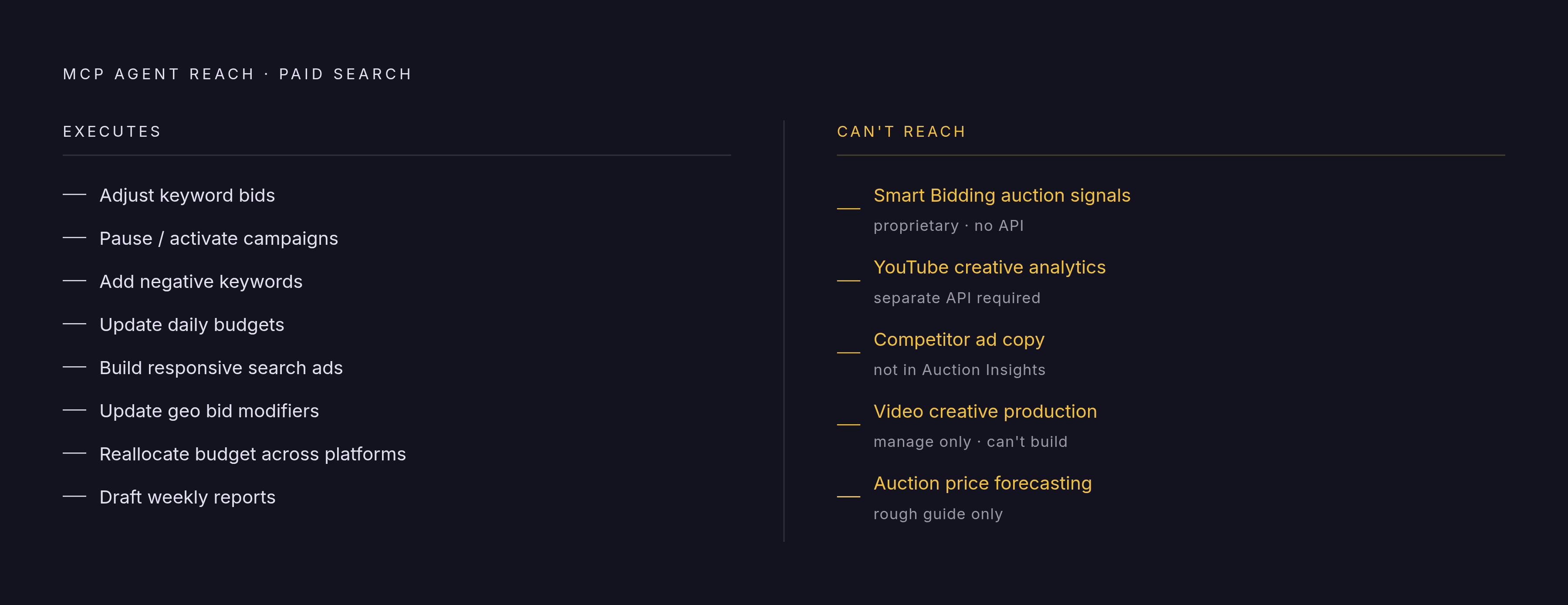
- Pull performance by date range: impressions, clicks, cost, conversions, ROAS, for any window.
- Audit keyword quality scores across the account, with match type, bid, and status attached.
- Pull search terms spending money without converting.
- Add negative keywords, exact, phrase, or broad, at the campaign or ad group level.
- Adjust bids on individual keywords or across a group.
- Pause or turn campaigns and ad groups back on.
- Update daily budgets.
- Build new ad groups and responsive search ads, with multiple headlines and descriptions, with pinning.
- Pull audience segments, conversion actions, and Smart Bidding settings.
- Pull impression share and ad schedule data.
- Update geo bid modifiers.
- Pull asset group performance inside Performance Max.
- Reallocate budget across platforms, reading Google ROAS next to another platform's ROAS in the same session.
- Draft a weekly report, pulled data, formatted tables, and a plain-English summary attached.
There are still real gaps, and they're worth naming plainly rather than glossing over:
Smart Bidding's internal signals are proprietary. No public API exposes them. An agent can set the strategy, but not see what's actually driving each bid decision. YouTube creative analytics, view-through rate by creative, audience retention curves, need the separate YouTube Data API. Display Network placement exclusions at scale are possible through the API (up to 20,000 placements per batch, versus 5,000 through the interface), but it's a bulk operation, not a nuanced one. Competitor ad copy isn't visible through Auction Insights, which shows impression share, not the actual ad or landing page. That still takes separate tools. Auction price forecasting through Keyword Planner is a rough guide, not something to build a precise budget around. Video creative, again: agents can manage a video campaign that already exists, but they can't build the video itself.
The dry-run step matters more than it might look. Previewing every write before it fires isn't a limitation bolted on to slow things down, it's the governance layer that lets an agent do the analytical heavy lifting while a human still signs off on anything consequential. These gaps are a map of exactly where a person, or a separate tool, still needs to stand next to the agent. They're a map of exactly where a person, or a separate tool, still needs to stand next to the agent.
Third-party agent platforms for Google Ads: what each one actually does and who it suits
Every platform here should get judged against the same questions raised above: does it cover all five pillars, or just a couple? Does it act, or just recommend? And what does it actually do with Performance Max, given how much rides on managing its inputs?
Ryze AI, self-rated 9.6/10, positions itself as fully autonomous: adjusting bids, reallocating budget, managing negative keywords, and catching anomalies around the clock, with optional approval steps built in. Flat pricing at $89/month regardless of spend level. The company reports over 2,000 marketers managing a substantial combined ad spend on the platform, and cites an average 3.8x ROAS within six weeks from its own internal data, a number worth reading as directional rather than independently verified. Optmyzr, rated 8.9/10, leans into a deep rule engine and detailed Performance Max controls, built more for agencies managing multiple accounts. Pricing starts around $208/month and scales with spend. Adalysis, rated 8.7/10, focuses on automated RSA testing and Quality Score tracking, starting near $149/month. Opteo, rated 8.5/10, offers clean one-click recommendations with an estimated impact attached, starting at $129/month for accounts around $25,000 in spend. WordStream by LocaliQ, rated 8.1/10, offers a free Google Ads Performance Grader and a guided setup aimed at beginners, with paid plans bundled around $300/month. Hyper, highly ranked on separate platform evaluations, runs Google Ads alongside Meta, TikTok, LinkedIn, and Amazon as one connected agent. It runs hourly conversion tracking audits, harvests search terms continuously, manages Performance Max asset groups on its own, and lets marketers set a brand voice for generated copy. Hyper claims a 36% CPA reduction in 90 days based on customer numbers, a figure worth treating the same way as any vendor-supplied claim. PaidSync, an MCP-native layer with over 500 tools spanning Google, Meta, LinkedIn, and TikTok, built around that same dry-run pattern on every write. It is described as holding a Level 5 Agent-Native rating on isitagentready.com, and offers a free tier. Adsroid, built around Google Ads, Meta Ads, and TikTok Ads running automatically around the clock, MCP-connected with more than 140 tools. Founder Danny Da Rocha built the platform around that always-on model. CATTIX, structured as a sequence of agent steps: market analysis, keyword collection, campaign creation, and pre-launch forecasting, with bid and budget management tied back to that pre-launch data.
For B2B companies running sales-led paid media across both Google and LinkedIn, the decision widens past "which Google agent is best." The real question is whether the system is diagnosing the actual bottleneck, be it creative, the landing page, attribution, or a leaky funnel, or just tuning bids on a platform that was never the real problem.
There's also a structurally different option: a delegated model where agents handle continuous execution, but a named human expert still governs the consequential calls, with pricing that isn't tied to how much media gets spent. That's a different shape entirely from either a piece of PPC software or a traditional agency retainer.
Whatever gets chosen, the same handful of questions apply: Does it cover all five pillars, or only a couple? Does it act, or does it just recommend? How does it actually handle Performance Max? Is the price decoupled from ad spend, so there's no built-in incentive to push for a bigger budget? And when the agent hits a decision that actually matters, what does human oversight look like at that exact moment?
Where human judgment still governs
Strip away the marketing copy, and a pattern holds across every platform named above: the agent handles execution, the volume, the repetition, the speed. The judgment calls still land somewhere else.
Conversion tracking has to be set up correctly before any agent, however capable, can optimize toward the right goal. Nobody's shipped an agent that fixes a broken tracking setup on its own; it just optimizes faster toward whatever goal it's handed, right or wrong. Realistic ROAS targets still require someone who understands the business's actual margins. Creative strategy, especially video, still needs a person or a separate production process, because no agent covered here builds video assets from scratch. And the proprietary core of Google's own Smart Bidding, the actual signals driving each auction-time decision, stays locked away from every third-party tool by design, not by oversight.
None of that is a knock on the technology. It's a fairly accurate description of where the technology currently stops. Vendors have every reason to describe their tools as fully autonomous, because "fully autonomous" sells better than "handles four of five pillars well." But the honest version of the pitch is narrower: these agents have taken over the execution layer, which used to eat 20 hours a week, and left the strategic layer, which decides what "good" looks like for this specific business, sitting with a person.
That's not a small shift. Cutting weekly oversight from 20 hours to under 3 is a real change in how an account gets run day to day. But it's also not the full autonomy some of the marketing implies. The line between "agent executes" and "human decides what matters" hasn't disappeared. It's just moved to a different, narrower spot than it used to occupy, and anyone evaluating one of these tools should go in knowing exactly where that spot is before handing over the keys.
Sources
- How AI Is Transforming Google Ads Campaign Management in 2026
- Can AI run your Google Ads campaigns in 2026?
- Google Ads AI Agent: Automate Your Campaigns in 2026
- Is There an AI Agent That Can Manage Google Ads Automatically? - Adsroid
- groas.com
- Agentic Marketing: How AI Agents Are Running Google Ads Autonomously
- natecue.com
- groas.com