What Happens When Your Google Ads Account Goes Orphaned
Unmanaged accounts bleed money quietly while Google's automation optimizes for revenue, not results.
A Google Ads account goes orphaned when it loses its accountable owner but keeps running anyway. It's not paused. It's not low-budget. The auction keeps going, the automation keeps making calls, and money keeps moving through the account. The only thing missing is a person on the hook for whether any of that spending makes sense.
There are three usual ways this happens. A marketing hire leaves and nobody takes their place. An agency contract ends without a real handoff. Or a founder who built the account by hand simply moves on to whatever's on fire this quarter. None of these are dramatic events. They're the kind of quiet organizational gaps that happen at almost every company at some point.
Identity-governance research has a useful phrase for this: an orphaned account is one that's "active and nobody is currently accountable for it." That framing works just as well here as it does for login credentials or software licenses. The account is doing things. Nobody is answering for those things.
That distinction matters for everything that follows in this piece. The damage that happens to an orphaned Google Ads account isn't caused by Google doing nothing. It's caused by Google doing exactly what it always does, at full speed, with no one checking whether it's the right move.
Why the auction won't wait for you to get organized
Google Ads runs on a live auction. Costs shift. Competition shifts. What people are searching for and why shifts. None of that pauses because your team is short-staffed or your agency contract just lapsed.
Your competitors aren't standing still either. If they're actively managing their accounts, they get a little more efficient every month, tightening keywords, testing new creative, cutting waste. Meanwhile your account sits still. The gap between a managed account and an unmanaged one doesn't stay flat. It widens, month after month, quietly.
That's why a campaign that looked fine three months ago can be bleeding money today without any single event you can point to. No policy change, no algorithm update headline, no obvious villain. Just slow environmental decay, the same way a garden gets overrun with weeds without a single dramatic moment where things go wrong.
Google's automation doesn't step in to fill the gap left by a missing human. It just keeps executing whatever instructions and constraints it was last given. No judgment gets added back in. So there's no such thing as a stable "holding pattern" for an orphaned account. Every week without someone actively managing it is a week the competitive gap gets a little bigger.
How Google's own automation becomes a liability without oversight
Smart bidding, broad match as the default, Performance Max, auto-applied recommendations, all of it is built to optimize for what Google can measure. That's not automatically the same thing as what's good for your business.
These automated prompts are built to boost Google's revenue, not necessarily the advertiser's results, one business owner said. That's not a conspiracy theory, it's just how the incentives line up. And the data backs up the frustration: in a survey cited by Growleads, 62% of advertisers said Performance Max campaigns actually made their overall ad performance worse.
Performance Max in particular works like a black box. Budget gets allocated across placements and formats without much visibility into where the money actually goes or why. For an account with an active owner watching closely, that's manageable, you can set guardrails and check outputs. For an orphaned account, it's a void. Nobody's watching, so nobody notices when spend drifts somewhere useless.
Reporting from groas.ai points out that this problem is getting worse, not better, as Google's AI-driven match types keep expanding reach. More reach means more opportunities for wasted spend unless someone is actively reining it in.
None of this is an argument against automation itself. Smart bidding and Performance Max can work well. But they need human-set boundaries to do that. Without someone defining those boundaries and checking the results, the automation just optimizes toward Google's goals instead of yours.
The waste that accumulates before anyone notices
The scale of this waste, once someone finally looks, tends to be shocking. A 2025 audit of 43 enterprise B2B Google Ads accounts found that 36.1% of total spend, amounting to $11.3 million out of the total analyzed, went to clicks that never had a real chance of converting. Most of those companies had no idea.
That's not an isolated case. Vehnta's B2B SaaS PPC Playbook reports that B2B SaaS companies typically waste somewhere between 40% and 60% of their Google Ads budget.
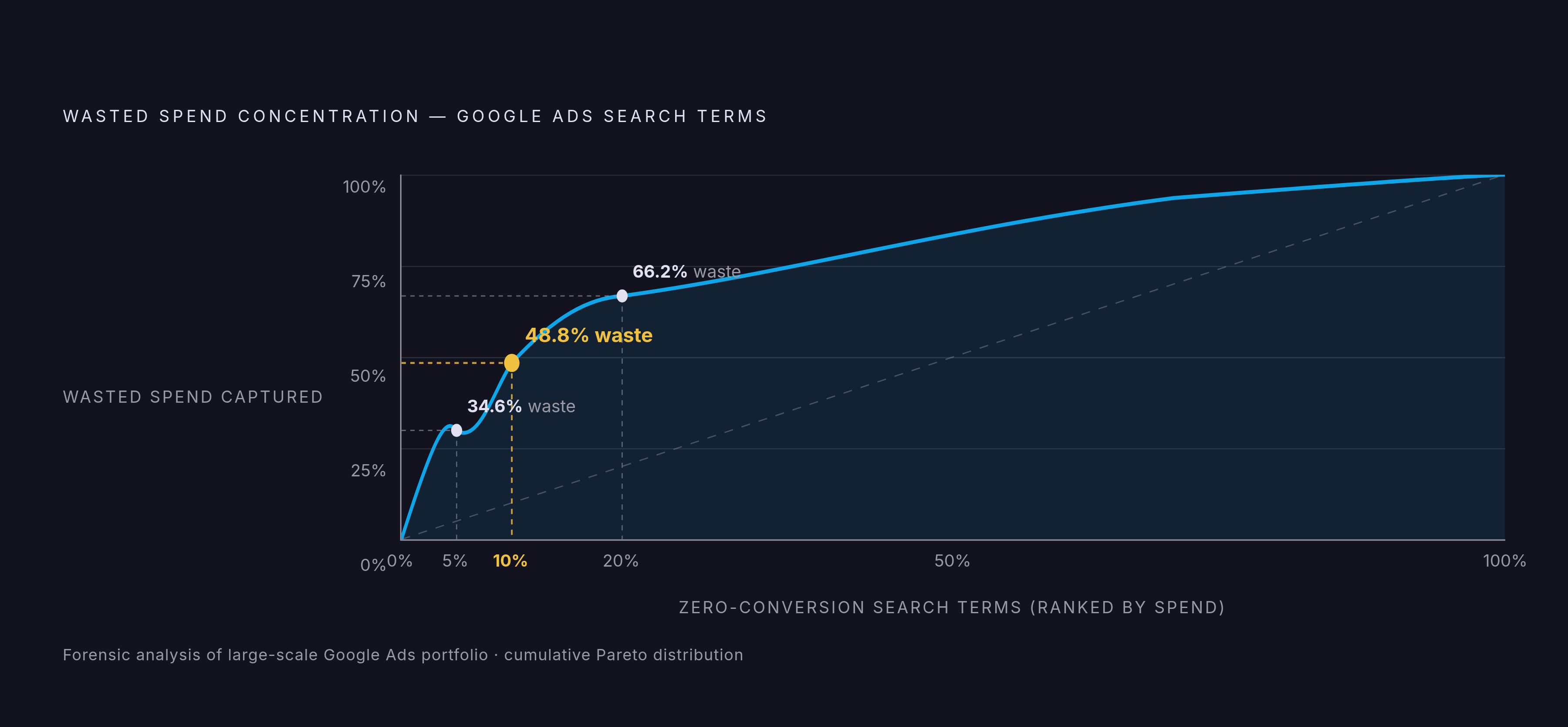
The waste isn't spread evenly across an account, either. The waste isn't spread evenly across an account, either, and it clumps. Forensic analysis by Igor Ivitskiy across a large spend portfolio found that 48.8% of all wasted spend is in just the top 10% of zero-conversion search terms. The top 5% alone accounts for 34.6% of the waste. The top 20% accounts for 66.2%.
That concentration is actually good news, in a strange way. It means a targeted cleanup, not a full account rebuild, can recover most of the damage. But only if someone is actually looking for it.
One documented recovery case broke down $52,345 in reclaimed waste like this: $18,400 from cleaning up negative keywords, $12,800 from excluding irrelevant Performance Max placements, $9,200 from fixing geo targeting, $6,800 from reallocating competitor-term spend, and $5,145 from adjusting device bids. Small fixes, big total.
And the baseline picture is grim across the board. One report found 29% of accounts produced zero conversions over a 90-day stretch. Only 3% of advertisers hit Quality Scores and conversion rates above 10%. This is closer to the median condition of accounts nobody is actively managing. It's closer to the median condition of accounts nobody is actively managing.
The seven structural failures an audit finds in unmanaged accounts
A 2025 audit of B2B SaaS Google Ads accounts documented seven recurring causes of wasted spend. None of them are exotic or rare. They're defaults, the kind of settings that pile up when nobody's watching:
- Broad match keywords running with no negative keyword list to filter out junk traffic
- Performance Max campaigns running without offline conversion data, so the algorithm chases form fills instead of real revenue
- The default 30-day click attribution window, which can miss meaningful B2B revenue since deals often close well past that window in longer sales cycles
- Geo targeting that doesn't match the markets the business actually serves
- Competitor-term spend that's never separated out or checked for return
- Device-bid adjustments that were never set, or were set once and never reviewed
- Performance Max placements that were never audited or excluded
Read through that list slowly. If you manage a B2B paid media account, there's a decent chance you just recognized your own account somewhere in there.
How ad creative and Quality Score compound the damage
Stale ad creative causes click-through rates to slide. Declining click-through rates tell Google your ads aren't landing with people, which drags Quality Score down. That's a direct, mechanical relationship, not a vague correlation.
A lower Quality Score means worse Ad Rank at the exact same bid. So the account either loses its position in the auction, or has to pay more just to hold the spot it already had. Either way, it's a tax on inattention.
Smart bidding makes this worse in a different way. Google's Target CPA algorithm requires a meaningful volume of conversions each month before it bids with any real confidence. If conversion volume stays low because of weak landing pages or tired creative, the account can sit below that threshold for months. With a low conversion rate, it takes a long stretch just to build enough signal. During that stretch, the system bids cautiously and underperforms, which stretches the learning phase out even further.
When landing pages and creative are weak, the algorithm tries to compensate by bidding higher into a worse Ad Rank just to hit its targets. Cost per acquisition creeps up quietly. There's no red flag on the dashboard explaining why, no single number that says "this is the problem." Ad fatigue, shifts in competitor strategy, and an account running on autopilot all feed into each other. Individually, each one is manageable. Together, with nobody watching, they compound month over month.
Quality Score decay in particular doesn't appear in the metrics most people check day to day. It takes someone actively looking for it before it's already raised your cost base for good.
Attribution collapse: why the account's own data becomes unreliable
Default attribution settings quietly misrepresent B2B revenue in an unmanaged account. Google Ads defaults to a 30-day conversion window. B2B SaaS sales cycles commonly extend well beyond Google's 30-day default conversion window. That gap means a lot of revenue gets credited to the wrong campaign, or to no campaign.
Late-stage branded searches, the kind that happen right before someone signs up, end up soaking up credit that really belongs to the early-stage awareness campaigns that got the buyer interested. The result: awareness spend looks like it's not working, and branded search looks more efficient than it actually is.
This isn't a fringe issue. Conversion tracking problems are widespread, and budget decisions then get made on guesswork, Budget decisions then get made on guesswork, money flows toward whatever looks active on the dashboard, not whatever's actually driving pipeline.
There's a real fix here: offline conversion imports. Reporting from ivristech found that accounts that set these up have seen average cost-per-lead drops of around 30%, because the algorithm starts learning from actual business outcomes instead of raw form-fill counts.
The cruelest part of this whole mechanism is that an unmanaged account doesn't just lose money. It loses the ability to even see where the money went. Reports still look fine, impressions, clicks, "conversions" all show up in the dashboard looking healthy. That's exactly why broken attribution is usually the last problem anyone discovers. It hides behind numbers that look like proof everything's working.
The sequence: how these failures layer onto each other over time
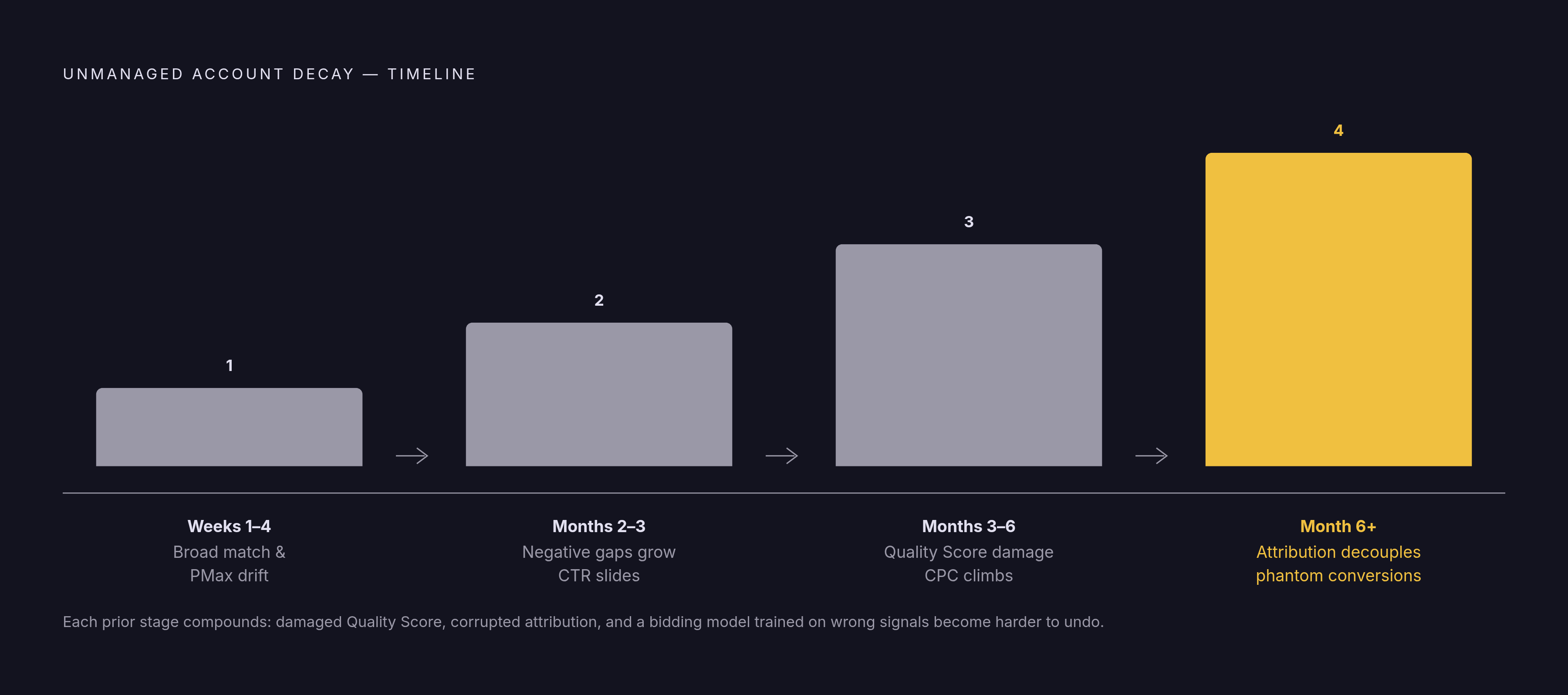
None of this happens all at once. It builds in stages.
Weeks 1 through 4, automation keeps running. Nobody's checking search term reports or placement data. Broad match and Performance Max start quietly reaching beyond actual customer intent.
Months 2 through 3, gaps in the negative keyword list start piling up. Irrelevant traffic grows. Click-through rate starts sliding as creative goes stale and search queries drift further off-target.
Months 3 through 6, Quality Score takes real damage. Smart bidding gets stuck in an extended learning phase. Cost per click climbs as the algorithm bids more aggressively to make up for weak conversion signals.
Month 6 and beyond, attribution has drifted far enough that the account's own reports no longer reflect reality. Budget quietly consolidates around whatever campaigns look like they're converting, whether or not those conversions represent any real pipeline.
Each stage makes the next one harder to undo. By month six, someone stepping back in doesn't just find wasted spend sitting around. They inherit a damaged Quality Score, corrupted attribution data, and a bidding algorithm that's spent months learning the wrong lessons. The damage doesn't grow at a steady pace either. Month one of an orphaned account is nowhere near as costly as month six, because the earlier failures feed directly into the later ones.
What returning to a managed account requires
Fixing an orphaned account is a sequence, working through the layers in the order the decay happened. It's a sequence, working through the layers in the order the decay happened.
Structural cleanup comes first: rebuilding the negative keyword list, reviewing match types, excluding bad Performance Max placements, fixing geo targeting. These are exactly the concentrated waste sources found in the audit breakdown described earlier.
Attribution needs repair before anything else can scale properly. That means offline conversion imports, aligning the conversion window to the actual sales cycle instead of Google's 30-day default, and clearing out broken or duplicate conversion actions that have been muddying the data.
Creative needs an actual refresh, not just a bid adjustment. New copy, new test hypotheses, and a real look at what declined and why. Stale ads don't get fixed by throwing more budget at them.
Smart bidding needs to be retrained once conversion tracking is trustworthy again. That means giving the algorithm enough conversion volume and enough time to relearn. It's a deliberate process, not a switch you flip.
The right measure of success through all of this is pipeline and revenue, not clicks, impressions, or whatever the platform itself reports as a "conversion." Handing the account back to "someone" without spelling out exactly what they're accountable for is a common failure mode. That recreates the same conditions that let it go orphaned. Activity resumes. Ownership stays fuzzy.
The extended nature of B2B sales cycles means active searching is needed to raise your cost base for good before anyone notices, so none of this becomes visible fast. Recovery takes patience and real tracking, not just a batch of tactical fixes and a fresh dashboard. But the payoff is measurable: accounts implementing offline conversion imports have been tied to average cost-per-lead drops of around 30%, according to Ivris Tech.
What ongoing ownership looks like, and what prevents accounts from going orphaned again
Accounts don't go orphaned because everyone forgot about them. They go orphaned because nobody ever built a lifecycle model for them in the first place, the same root cause identity-governance research points to for orphaned accounts generally. There was no plan for what happens when the person managing it leaves.
Real ongoing management means continuous work: watching search term reports, managing bids, refreshing creative, keeping landing pages aligned with what the ads promise, and reviewing attribution regularly. Not a quarterly check-in. Not a monthly report nobody reads closely.
Accountability needs a name attached to it. Not a rotating cast at an agency, not a dashboard someone glances at, not a contractor who only responds when asked. Someone whose job is tied to the pipeline results the account actually produces.
And the right approach to ongoing management means correctly diagnosing what's actually limiting growth, whether that's a creative problem, a landing page problem, a gap in attribution, or a mismatch somewhere in the funnel, instead of assuming the fix is always "spend more" or "let the algorithm figure it out." Because right now, the algorithm is figuring plenty out. Just not necessarily the things you'd want it to.