How to Replace an Underperforming Google Ads Agency Without Losing Momentum
A checklist for vetting the next agency before your current one exits the door.

Google Ads agencies get paid whether the campaigns work or not. That's the whole problem in one sentence, and it explains almost everything about why replacing one feels so much harder than it should.
The incentive structures behind the three most common pricing models produce a pattern that shows itself fast once examined. Percentage-of-spend pricing pays the agency more when the client spends more, regardless of return. A flat retainer pays the agency the same whether the account improves or rots, so the safest move for the agency is to keep the client calm, not keep the client winning. Hourly billing pays for time spent, not problems solved, which quietly rewards slowness.
None of these models are evil by design. They're just aimed at the wrong target. Retention and spend volume are easy to measure and easy to bill against. Actual pipeline quality is harder to measure and slower to appear in reports, so it loses.
Then there's the classic switcheroo: a senior partner sells the account in the pitch meeting, and a junior staffer runs it after the ink dries. According to SaaSHero's 2026 agency review research, 58% of businesses report dissatisfaction with their first agency choice, and this bait-and-switch pattern is a major driver of that number.
The slow bleed that follows is sneaky because it hides behind decent-looking reports. Click-through rate ticks up. Impressions climb. Meanwhile, customer acquisition cost is quietly rising and qualified pipeline is quietly shrinking, and none of that appears on the slide the agency sends every month. The account can look fine and be dying at the same time.
Long-term contracts make this worse, not better. A long-term commitment protects the underperforming agency from consequences and gives the client no real leverage to demand change on a shorter timeline. And a passive account doesn't just sit still while everyone waits out the contract. It drifts. Negative keyword lists go stale. Audiences stop getting refreshed. Bidding strategies keep optimizing toward the wrong goal, quarter after quarter. Every month that passes, the fix gets more expensive.
So the real choice was never "stay" versus "leave." It's "pay now for a deliberate transition" versus "pay more later for a forced one." The rest of this piece is about how to make it the first kind.
How to confirm underperformance before you act
Before firing anyone, get the evidence. A few checks will tell the story clearly enough that no one has to argue about feelings.
Pull the 90-day change history. Every Google Ads account keeps a change log. If it's sparse, that's not a quiet account, that's a neglected one. Managing an account means adjusting it. Silence in the change log usually means silence in the strategy.
Audit the search terms report. This is where wasted spend hides in plain sight. Audits of live B2B SaaS Google Ads accounts have found that a substantial share of ad spend is typically wasted, with uncontrolled search terms burning budget on queries that never should have triggered an ad are a common culprit in that waste. Underperforming accounts routinely have thin or entirely absent negative keyword lists.
Ask what structural change the agency made last quarter. Just one. If the answer is nothing, and the excuse for flat ROAS has been "market conditions" for six months running, that excuse is itself the diagnosis. Markets shift. Good agencies shift with them and say so.
Watch for reactive versus proactive behavior. A strong agency comes with ideas nobody asked for. A weak one only moves when pushed, and even then, slowly.
Compare the report to the revenue. If the monthly deck reads like a win and the pipeline hasn't moved, that gap is the tell. Somebody is measuring the wrong thing, on purpose or not.
Check for an AI search strategy. Heading into 2026, agencies without any plan for how buyers research through automated search tools (often shorthanded as AEO or GEO) are behind the curve on where research behavior is heading, and that gap will only widen.
This audit isn't about building a case for a breakup. It's about producing a map: which parts of the account are actually working and need protecting, and which parts are broken and need rebuilding from the studs up.
What you can and cannot take with you when you leave
Before any conversation about leaving happens, there's one question that decides almost everything else: who owns the account?
If the agency set up the Google Ads account under its own login, the advertiser has no claim to that data when the relationship ends. Walk away, and the new team starts from a blank account. No history. No learnings. Nothing.
That's a bigger deal than it sounds. Smart Bidding doesn't run on guesswork, it runs on conversion history. Lose the account and the algorithm's learning resets right along with it, on top of losing the campaign structure itself. Starting from zero doesn't just mean rebuilding campaigns, it means retraining the machine that was supposed to be getting smarter over time.
Before exit, audit these too:
Tracking and conversion goals. Who created the tags, and where do they actually live? Landing pages and creative assets. Are they sitting in the client's own systems, or trapped in the agency's? CRM integration and GCLID stitching. If offline conversion tracking exists, does the client actually control that pipe, or is the agency the only one who can turn it on and off? Feed setup and audience lists. Who built them, and where do they export to?
And read the contract closely before initiating anything. Termination penalties in these agreements can run anywhere from 50% to 100% of the remaining contract value. That number needs to be known before the first conversation with a replacement, not discovered afterward as a surprise invoice.
What comes out of this stage is an inventory: what transfers cleanly, what has to be rebuilt from scratch, and how much negotiating leverage exists heading into the next conversation. Everything downstream depends on getting this part right first.
How to evaluate and select the right replacement before you cut the cord
Here's the sequencing mistake that turns a manageable transition into a chaotic one: firing the old agency before the new one is lined up. Do the selection work first. The exit conversation comes after, not before.
A serious replacement candidate asks for specific things before ever touching a setting:
- Search terms history
- Feed setup and tracking configuration
- CRM integration workflow
An agency that only asks "what's your monthly budget?" is planning to start over. It might not say so out loud, but the intent shows in what it didn't ask for.
One useful filter question for any candidate: how would they tell, in real time, which campaign drove the highest-value deal closed last quarter? Agencies with real attribution infrastructure can answer that, because they've built the plumbing to track it. Agencies without it will stall, deflect, or start talking about impressions instead.
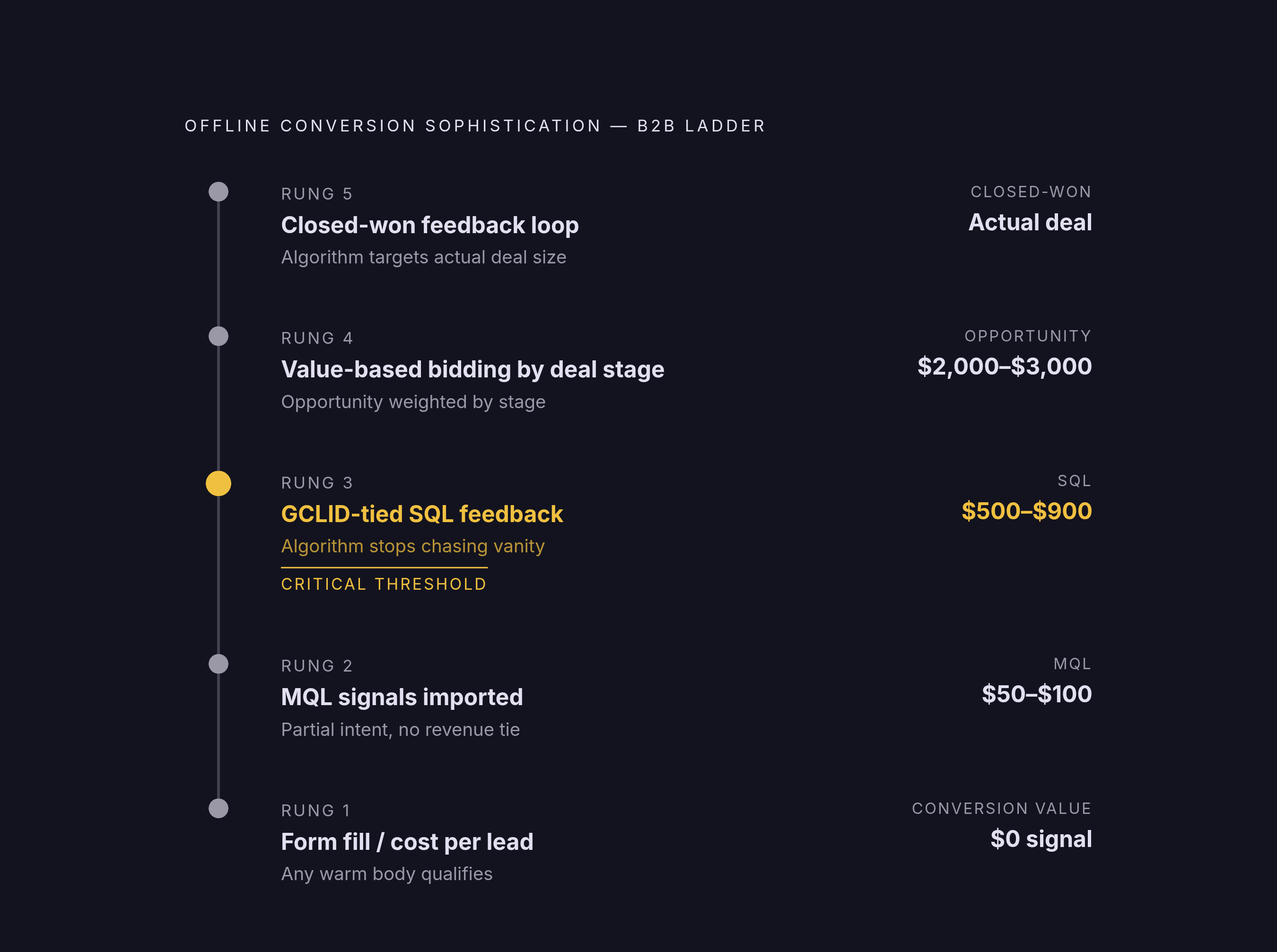
Think of offline conversion tracking as a ladder, and ask candidates how high up it their standard engagement reaches:
Rung 1, optimizing for form fills or cost per lead, trains the bidding algorithm on junk. Any warm body who fills out a form counts the same as a real buyer. Rung 3, feeding SQL data back through offline conversions tied to GCLID, teaches the algorithm what a qualified lead actually looks like. Rungs 4 and 5, value-based bidding tiered by deal stage with closed-won feedback, point the algorithm at the prospects most likely to become high-value customers, not just any customer.
Leading B2B shops commonly structure conversion values something like this: MQL in the $50 to $100 range, SQL in the $500 to $900 range, Opportunity in the $2,000 to $3,000 range, and Closed-Won valued at the actual deal size. The exact numbers vary by business, but the shape of the ladder matters more than the dollar figures. It shows whether an agency is optimizing toward vanity or toward revenue.
Fee structure is a signal too. Percentage-of-spend pricing quietly nudges an agency toward recommending bigger budgets, whether or not bigger budgets are the right call. Flat retainers cut that string, decoupling the agency's paycheck from the client's spend decisions.
Make account ownership a non-negotiable condition before signing anything. Confirm in writing that the advertiser owns every account, every asset, every data set, not the incoming agency either. Getting burned by ownership once should be enough of a lesson to demand this in ink the second time.
And watch for the agency that wants to nuke the account and start fresh on day one. A good incoming partner transitions what's working and earns the case for a rebuild with data, not instinct. A team that wants a blank slate immediately is about to spend a chunk of the budget relearning lessons the account already paid to learn once.
Running the overlap period so the account never goes dark
Google Ads supports linking a new manager account to an existing account without removing the current one. That single technical fact means there's no reason for a gap between agencies, ever.
Here's how the overlap actually works. The incoming team links into the account and reviews everything while the outgoing agency's campaigns are still live and running. Nothing pauses. Nothing goes dark. The new team gets full visibility before making a single change, so decisions get made with real data instead of blind guesses. Only after the incoming team has had real time to study the account does the outgoing agency's access get removed.
Compare that to the hard cutover: old agency access revoked Friday, new agency starts cold Monday. Now urgent fixes are stuck waiting on access requests during the exact week when the account is most exposed, and every decision in that window gets made blind.
The overlap period costs nothing extra and removes the single riskiest stretch of the entire switch. There's genuinely no reason to skip it.
During that overlap, the incoming team should be:
- Auditing campaign structure, negative keyword lists, and search terms history
- Figuring out what to preserve versus what needs to change, backed by evidence rather than assumption
- Verifying tracking integrity before touching bidding or budget at all
- Mapping the week-by-week transition sequence before making a single live change
The outgoing agency should know a transition is coming, but the advertiser controls the timing of when access gets pulled, not the agency. That matters especially if there's any risk to data access on the way out.
The week-by-week transition sequence that preserves what's working
The rule for this stretch: transition what already works, and earn the case for rebuilding the rest with data. Never restructure the account and cut it loose at the same time. That's how a transition turns into a demolition.
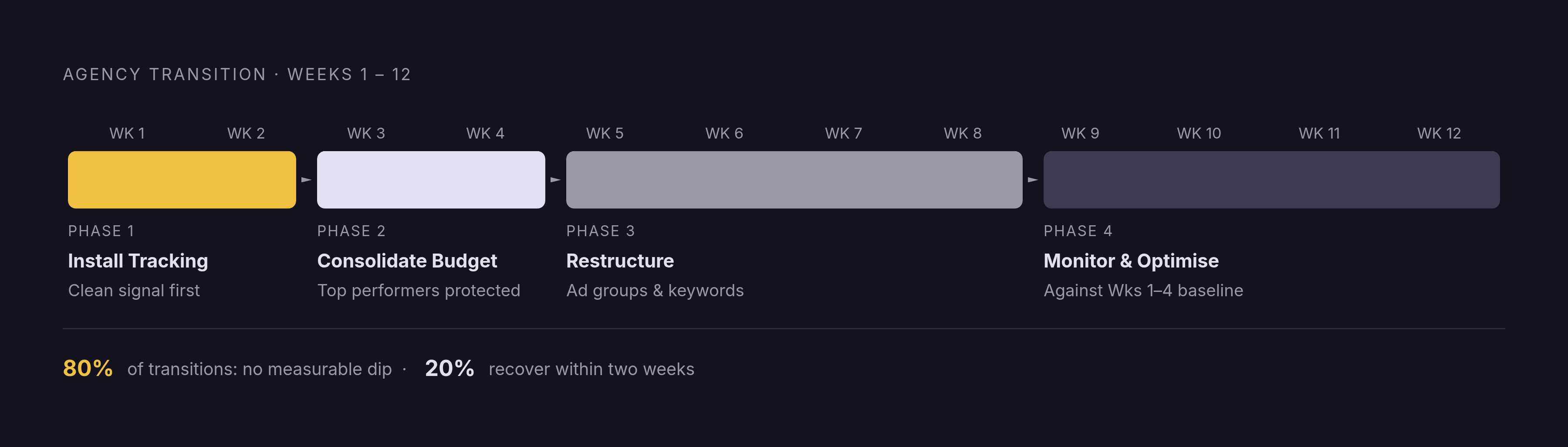
What should the reader expect performance-wise? A brief dip lasting one to two weeks is possible, mostly tied to the learning phase that bid strategies go through when conditions change. According to agency transition data, roughly 80% of transitions show no measurable dip at all, and the remaining 20% recover within two weeks. That's a much smaller risk than it sounds like on paper, and it's tiny compared to what staying with an underperforming agency costs over the following year.
A phased sequence that reflects widely documented transition practice lays out roughly like this:
Weeks 1 to 2: get new tracking and conversion goals in place. Clean data collection has to exist before anything else gets touched. Weeks 3 to 4: Consolidate campaigns and shift budget toward the areas already performing well. Resist the urge to restructure yet. Weeks 5 to 8: Restructure ad groups and keyword organization, but only once clean data is actually flowing and the strongest performers are protected. Weeks 9 to 12: Monitor the new structure and optimize against the baseline that got established back in weeks 1 through 4.
Why does tracking come first, before anything else? Because every decision after that point gets built on top of it. If the conversion goals are broken or miscounting, every optimization made downstream is built on a bad signal. Fix tracking after restructuring instead of before, and there are weeks of misleading data to sort through, on top of a new campaign structure to second-guess at the same time.
Keeping budgets stable during weeks 1 through 4 matters for the same reason. Redistribute spend only once clean data confirms where performance is actually concentrated, not before.
In practice, "preserving what's working" means strong campaigns keep running untouched while new tracking gets wired in behind the scenes. Negative keyword lists get ported over immediately, since exclusion architecture is about the cheapest lever in the whole account to transfer and among the most expensive to rebuild. Audience lists and remarketing pools move over before anything gets paused, so none of that learning gets thrown away.
The institutional knowledge transfer that agencies never give you by default
An account's history lives in two places: the data inside Google Ads, and the knowledge sitting in the heads of the people who ran it. Only one of those transfers automatically.
Things like why a campaign got paused, which audience segments got tested and flopped, which creative angles were tried and how they performed, which landing pages got matched against which search queries and what happened. None of that appears in the interface. It lives in someone's notes, someone's memory, or nowhere at all.
Demand this in writing before the relationship officially ends:
- A documented history of major structural changes and the reasoning behind each one
- A full negative keyword export, including what was removed over time and why, not just the current list
- Every creative and copy variant tested, along with the performance data attached to it
- Any audience research, ICP notes, or segment performance findings on file
- Documentation of the attribution setup: how offline conversions were configured, and exactly what data flows where
The best time to get any of this is during the overlap window, while access is still live and the relationship hasn't fully soured. Once access is pulled, the incentive to cooperate goes with it.
Skip this step, and the incoming team pays for it twice: relearning lessons the account already paid to learn, retesting audience segments that already failed once, rebuilding a negative keyword list from scratch instead of starting from a curated list built up over months of live spend. Every campaign should leave behind a trail of evidence, so the next decision starts from history instead of a guess. A transition that skips this step hands away the most valuable thing in the account without ever noticing it left.
What a higher-functioning B2B Google Ads program actually looks like once you're through the transition
What's the actual gap between an average B2B Google Ads program and a genuinely strong one? Industry figures put average B2B SaaS cost per conversion at roughly $1,267, while top-performing agencies push cost per SQL down under $500. That's not a small gap, and it's not explained by better keywords or smarter bids. It comes down to signal quality, plain and simple. The algorithm can only optimize toward what it's told to optimize toward.
The single highest-leverage fix is closing the loop between GCLID and the CRM. Default Google Ads attribution runs on a 7-day click window, and that window captures only 5 to 15% of actual B2B SaaS revenue, because average B2B sales cycles run around 84 days. A 7-day window measuring an 84-day process is measuring almost nothing.
Top performers run attribution windows of at least 30 days on click and 90 days on cohort, and when ROAS gets recalculated against those 90-day cohorts, it often comes out 3 to 5 times higher than what the default platform reporting shows. Same spend, same clicks, wildly different picture of what actually worked.
One documented example: an agency wired GCLID-to-HubSpot tracking for a fintech client starting in Q1 2026. Within 60 days, cost per acquisition held flat while the SQL rate climbed from 8% to 19%, on the same budget and the same keywords. Nothing changed except the quality of the signal feeding the algorithm.
Pipeline-stage bidding is the natural next step. Optimizing toward cost-per-MQL trains the algorithm to chase leads, not customers. Leading shops instead feed SQL, Opportunity, and Closed-Won events back into the platform as offline conversions with tiered values, so value-based bidding can point the algorithm at the prospects likeliest to turn into real, lasting revenue.
Landing pages matter more than most people give them credit for. Separate destinations for enterprise queries versus SMB queries, separate flows for trial intent versus demo intent, can shift conversion rates across a range from around 2% to as high as 12%. Same traffic, wildly different outcome, just based on where it lands.
Performance Max needs real guardrails in a B2B context. Without offline conversion tracking, ICP signal feedback, and value-based bidding attached to it, PMax can burn somewhere in the range of 40 to 60% of budget on placements that have nothing to do with the actual buyer. With those guardrails in place, documented results show lead growth in the 25 to 35% range at sub-$500 cost per SQL. Same tool, opposite outcome, depending entirely on what's feeding it.
And negative keyword architecture, unglamorous as it sounds, deserves more respect than it gets. One documented case attributed a 58x pipeline-to-spend ratio largely to a rigorously maintained negative keyword list, built and pruned over time. Many audited accounts have surprisingly sparse negative keyword lists.
None of this runs on autopilot. It takes continuous work across signal feedback, audience testing, exclusion management, and landing page alignment, week after week, not a quarterly check-in with a slide deck attached.
What to look for in a replacement partner, and where full delegation fits into that decision
The agencies worth hiring are the ones built around signal quality, not spend volume. That is visible in the questions they ask before touching the account, the attribution infrastructure they already have running, the offline conversion tiers they build by default, and the fee structure they're willing to sign.
How much of the account's day-to-day work is the reader expected to hand over completely, versus stay involved in? Full delegation isn't automatically the right answer or the wrong one. It depends on what's being delegated to. Handing a passive account to a passive agency just resets the clock on the same slow bleed described earlier. Handing it to a team running real attribution, real offline conversion feedback, and a documented testing process is a genuinely different decision, even though it looks like the same move on paper.
The test that cuts through all of it: would this agency have passed the audit described at the start of this piece? Does it have a change history that shows actual activity? Does it treat negative keywords as infrastructure instead of an afterthought? Does it ask for search terms history before asking for a budget number?
An agency that clears that bar has earned the trust that full delegation requires. One that doesn't should get the overlap period, the audit, and the same scrutiny the last one got, before a dollar of budget moves.