AI-Generated Ad Creative Performance in B2B Google Ads
B2B advertisers must feed AI differently than consumer brands do.

Google Ads runs on AI now, start to finish. Search, Performance Max, Demand Gen, all of it leans on automated creative generation, automated bidding, and AI-driven audience expansion as the default operating mode, not an optional add-on. For B2B teams, that shift raises the stakes on a question most haven't answered yet: what happens when the platform's AI is tuned for a buying process your company doesn't have?
How Google Ads works in 2026 for B2B
Performance Max now serves one campaign's worth of ads across Search, YouTube, Discover, Gmail, Display, and Maps, built from one or more asset groups. Google handles the targeting and the bidding behind the scenes. The one lever left in an advertiser's hands is creative diversity: what gets fed in, in how many forms, aimed at whom.
Google has also started pulling images straight off landing pages, and now it turns them into ads that run across those same surfaces. If a site opts in, every hero image and product screenshot on it becomes a candidate ad asset, checked automatically and sometimes by hand before it runs, but live all the same. Google is pulling the inputs that drive ad performance, intent signals, creative assets, audience lists, into its own systems and letting AI do the optimizing. That's a coherent bet, and for a lot of advertisers it works.
It works less well for B2B, and the reason isn't mysterious. These AI systems were built around conditions that consumer brands supply by default: lots of conversions, short buying cycles, big audience pools to draw from. B2B has none of that as a rule. A Performance Max campaign selling enterprise software has fewer conversions to learn from than one selling running shoes, so it needs much longer to find its footing. B2B deals also need several people to agree, and that can take months or longer. The dense, fast signal that Google's AI was trained to read off of just doesn't exist in that world at the same volume or speed. It's a case for feeding the platform differently than a consumer brand would.
Why AI-generated creative performs well on average but fails B2B specifically
AI tools have solved the volume problem in ad production, the issue of how fast variants can be made. Variants that used to take a design team a week now come out in minutes. That means more testing, faster refresh cycles, less waiting around for creative to catch up with the media plan. That part is real and worth taking seriously.
But volume isn't quality, and in B2B that gap is visible fast, in campaigns that generate clicks without moving a sophisticated buyer closer to a deal. The buyers are sophisticated, the audience is small, and generic creative produced at scale is still generic. It just arrives faster now. Google's own Asset Studio tends to generate images with a stock-photo sheen, polished, inoffensive, and forgettable, which suits a consumer brand selling on impulse but does nothing for a B2B tech company whose credibility rests on precise, specific messaging and design that signals it understands the buyer's actual problem.
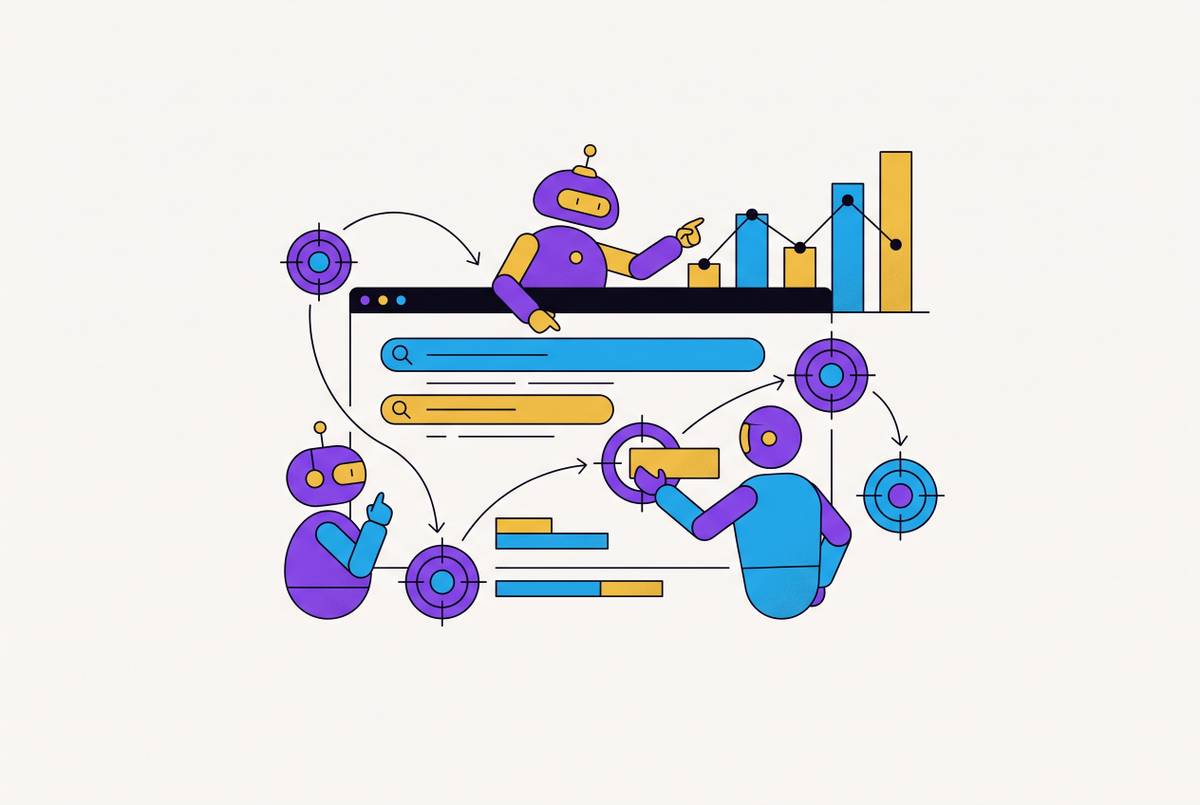
The standard that's emerging splits the work cleanly: AI produces volume and runs the variant tests, humans set the creative direction and carry the narrative. The real question for a B2B team is which human inputs make the AI capable of producing work a sophisticated buyer will take seriously.
Consider how B2B buyers actually behave. Most of their research happens before they ever talk to a vendor, and in most deals, the eventual winner was already on the buyer's shortlist before any outreach started. That means the ad creative's job isn't just to drive a click. It has to build credibility at the top of the funnel, long before anyone fills out a form. A VP of Infrastructure who compares enterprise data platforms needs more than a generic AI-assembled ad before they convert. That buyer sits inside a multi-stakeholder process with several touchpoints along the way, and every one of those touchpoints either adds to the case for the vendor or quietly takes something away from it.
The inputs that determine whether AI creative produces pipeline or noise
What separates AI creative that generates pipeline from AI creative that generates noise comes down almost entirely to the inputs: the business context, the audience detail, the creative assets, and the conversion signals handed to the system. The AI's defaults barely factor in.
Start with business context and messaging. AI Max writes headlines and descriptions by reading the landing page, the search intent behind the query, and behavioral signals from users. A landing page full of vague positioning gives it nothing specific to turn into sharp copy. The AI writes from what it's given. If the source material never names the exact pain, the exact buyer, and the exact outcome, then the copy it generates won't name them either. A structured creative brief, hook, pain, solution, proof, call to action, gives the system a frame to generate variations inside, rather than drifting toward the vaguest version of the pitch. As of February 2026, Google opened up beta access to text guidelines for all advertisers globally, across both AI Max for Search and Performance Max. So you can now tell the AI which words it must never use, and you can write natural-language instructions about brand voice. Those controls are only as good as the thinking behind them. A brand that hasn't worked out what its own voice sounds like will get nothing useful out of telling the AI to sound like it.
Audience signals carry similar weight. Performance Max is steered mainly by the audience data fed into it, so uploading buyer lists, CRM-based lookalikes, and job-title or company-size data pulled from LinkedIn shapes where the system spends and which creative it favors. Skipping that step makes PMax optimize toward whatever converts easiest, and in B2B that tends to mean cheap, low-quality traffic rather than the actual buying personas a company is trying to reach. Using PMax well in B2B means setting it up on purpose: optimize for events that actually matter, like demo requests, assign higher value to enterprise inquiries than to smaller ones, and build audience signals around the real ideal customer profile.
Creative asset diversity matters just as much. Google's own internal testing and industry guides show that, as of 2026, Performance Max campaigns underperform by a wide margin when they run on too few creative assets, because the system can't optimize combinations it was never given. Asset Studio can build product-realistic images from a text prompt and generate short video mainly from uploaded product images, but for B2B, what you get depends on how specific and well-directed those prompts are, usable or just another stock-feeling placeholder. Break one core message into several visual variants and test them side by side, and you give the AI real variation to learn from, instead of slightly different versions of the same image. And because every hero image and screenshot on a site is a potential auto-generated ad, if a team doesn't actively curate that inventory, the system may serve assets that were never meant to stand alone as ads.
Conversion signal quality closes the loop. Smart Bidding learns from whatever conversion data it receives. Shallow signals, page views, low-intent form fills, make it optimize toward shallow outcomes. But if you feed it deep signals, completed demos, qualified meetings booked, it learns to chase those instead. When you assign conversion values that reflect actual deal quality, you weight enterprise inquiries above small accounts and product-qualified intent above general curiosity, and that teaches the system what a good outcome looks like for this particular business.
The structural mismatch between an AI-first platform and a slow, multi-stakeholder B2B buying process means someone has to sit between the two and translate one into the other. Companies that run AI agents end-to-end for B2B paid media, Thunder among them, work directly in that space: handling the ongoing execution and creative iteration the platform demands, while supplying the business context and judgment that keeps all of it aimed at revenue.
Landing pages are part of the creative system, not a separate workstream
The landing page used to sit downstream of the ad: write the ad, drive the click, land somewhere. That order has broken down. AI Max's URL expansion feature picks which landing page to send a visitor to, based on their search intent, so now the AI is making page-selection decisions, not only copy decisions. Every page on a site is a potential destination the AI might choose for a live campaign.
That changes what a landing page audit is for. It's now a pre-launch requirement for any Performance Max campaign, not a nice-to-have. When teams still treat web design and paid media as separate jobs, brand inconsistency appears in live campaigns, and no one can say where it came from. If the message on the landing page doesn't match the message in the ad, or worse, if the AI routes someone to a page with weak messaging simply because it's the closest technical match to their query, the whole path from click to conversion breaks down no matter how good the ad itself was.
For B2B, the landing page is where the credibility argument actually gets made, through social proof, a use case specific enough to feel grounded in a real customer, and a next step that's obvious rather than vague, the details that move a skeptical enterprise buyer from curiosity to action. What attribution gaps hide about AI creative's effect on pipeline When delegated systems coordinate creative, landing pages, and attribution as a single function, you get the volume and pace AI makes possible, but each touchpoint still lines up with the same narrative and the same proof points that actually move a sophisticated buyer.
What attribution gaps hide about what AI creative is doing to pipeline
B2B attribution has a structural problem that makes it genuinely hard to judge AI creative performance against the metric that matters most: pipeline. Without deliberate measurement built around that fact, the data a team is looking at can be close to meaningless.
B2B buying committees involve several people, and they interact across months and a long string of touchpoints. A single-touch attribution model can't represent that. Last-click models hand credit to whatever happened right before conversion, so they usually miss the creative that built early awareness or trust long before anyone converted. A large share of what actually moves a B2B deal forward travels through places no tool tracks: peer conversations, Slack communities, LinkedIn DMs, podcasts, what the industry calls the dark funnel. That share is large enough that platform-reported conversion numbers alone can point a team in the wrong direction.
AI Max and Performance Max make this worse, not better, because both depend on conversion signals to optimize, and B2B's long, tangled sales cycles mean those signals arrive incomplete. The AI is learning from a partial picture. That has a direct effect on how creative gets judged: a variant with a strong platform-reported click-through rate might be pulling in the wrong buyer entirely, while a variant that looks weak by the same measure might be quietly building pipeline at a touchpoint no attribution tool can see.
Getting a clearer picture takes a layered approach: media mix modeling for quarterly and annual budget calls, multi-touch attribution for the week-to-week optimization work, and incrementality testing to establish what incrementality testing alone can confirm beneath the modeled numbers. Running AI creative experiments without that structure in place leaves the results open to almost any interpretation, which isn't the same as having an answer. Self-reported attribution, simply asking a prospect how they found the company, fills in some of what software can't see, and it's underused as a way to understand which creative themes are building awareness in that dark funnel long before a conversion event ever fires.
The judgment calls AI cannot make and humans must own
None of the efficiency AI creative provides turns into pipeline unless a human with real business context is making the calls that actually matter: what the audience looks like, what story the creative tells, what direction the assets take, and what the resulting numbers actually mean.
Start with audience definition. AI Max and Performance Max both optimize toward conversions, but judging which conversions are worth chasing depends on knowing which customer profiles generate real revenue, which deals actually close, and which segments the business should go after. None of that is information the platform has on its own. Feeding it the wrong signals, or no signals at all, makes it optimize toward volume instead of quality, because volume is the only thing it can measure without help.
Creative direction works the same way. The AI generates variation inside whatever space its inputs define, but a person has to define that space to begin with: what story the brand is telling, what pain it's naming, what proof it's offering, which competitor's narrative it's arguing against. Brand recall and emotional engagement, the two areas where human-made creative still consistently beats AI output, come from strategic narrative, not from how many versions get produced. Someone still has to decide what each piece of creative is supposed to accomplish at its particular stage of the funnel. Advanced audience building, creative refreshes timed to beat ad fatigue, A/B tests aimed at incremental gains, conversion rate work on landing pages, and custom content all still need a person steering, even with AI doing more of the actual production.
And when performance goes flat or starts sliding, the AI has no way of telling anyone why. It can't say whether the real issue is the creative itself, a weak landing page, a mismatched audience, a gap in attribution, or an offer that just isn't landing. Figuring that out means someone trained to read these systems looking at all of it together. The quality of AI-generated creative in B2B comes down to how well a company can translate its own market knowledge, positioning, proof points, buyer signals, into the briefs and direction that feed the AI. That translation work is where judgment and domain knowledge end up mattering more than anything the platform ships by default, and it's where systems built specifically for B2B paid media, ones that can operate inside a company's existing growth stack and diagnose which input is actually the bottleneck, create an advantage that a generalist platform setup can't replicate on its own.