Compounding Campaign Intelligence in Automated Paid Search
Memory beats speed in bid automation.
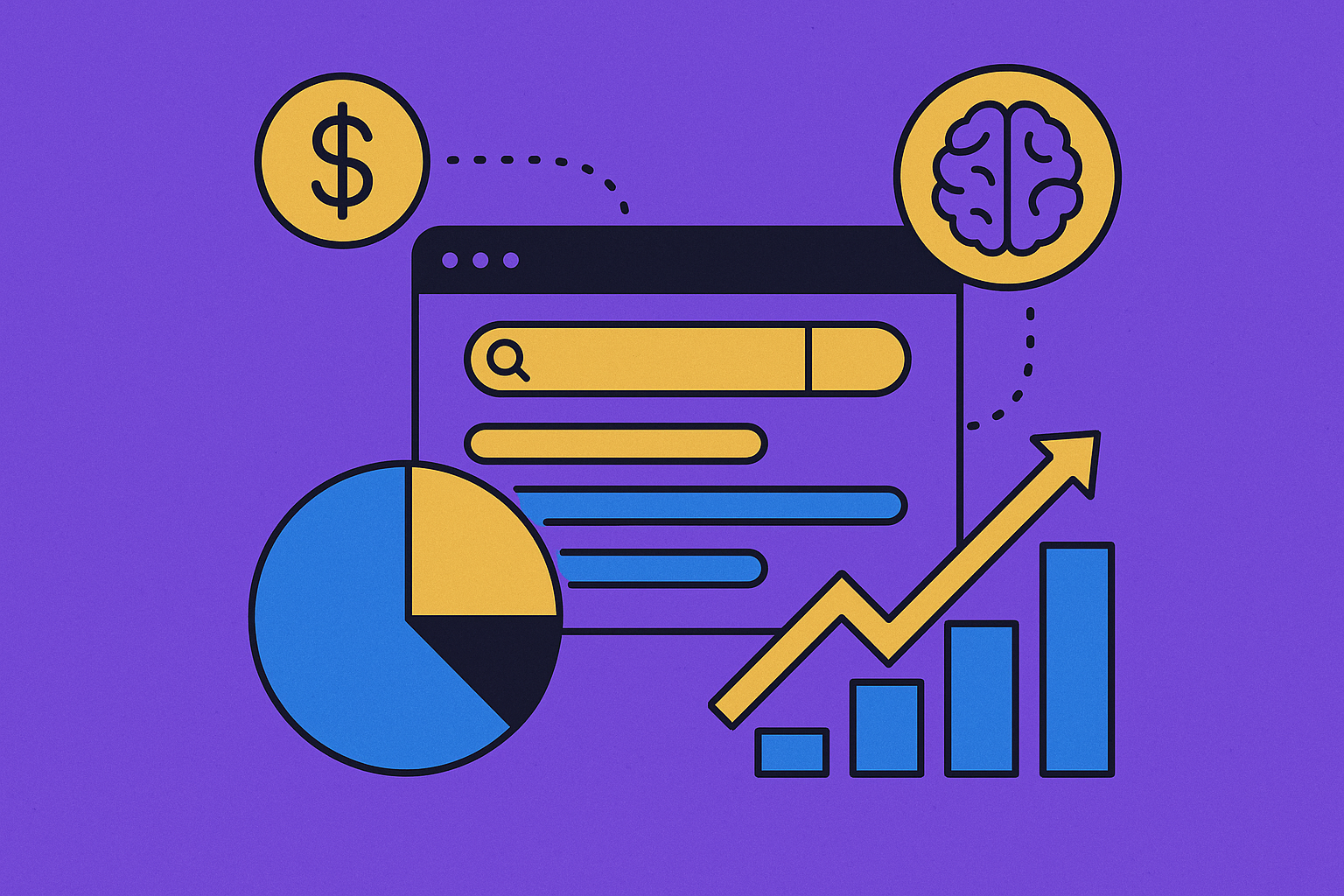
Bid automation does one job well: it looks at the signals available in a single auction, decides what to pay, and wins or loses that impression. That decision happens inside a closed window of time. Once the auction ends, the reasoning behind that bid doesn't travel anywhere. It doesn't get written down, folded into a model, or handed to the next campaign as a starting point.
That's the real limit here. A program can run thousands of efficient auctions a day and still know nothing more at the end of the quarter than it did on day one, because nothing about the auction-level process requires the system to keep what it learned. Each new campaign, each new budget cycle, starts over: no inherited read on which audiences actually turned into pipeline, which messages actually landed, which landing pages held attention past the click.
Running that stateless process faster just produces more cycles that don't add up to anything. Speed without memory is still speed without memory, no matter how many auctions get optimized along the way.
What campaign intelligence is
Performance data and campaign intelligence sound like the same thing, but they aren't. Performance data is the record, impressions, clicks, conversions, cost. Campaign intelligence is the system's working explanation of why those numbers happened and what to change because of it.
The distance between the two comes down to interpretation. Which audience segment actually drove conversions? Which message variant worked best within that segment? Which landing page kept qualified visitors engaged, and which one lost them? And which attribution model gives credit to the channel that actually started the buyer's journey?
In a B2B paid search account, that interpretation breaks into a few concrete pieces. Audience signal tells you which account types and job titles turn into real pipeline, not just clicks. Creative signal tells you which message frames and formats pull in qualified buyers. Landing page signal shows where, specifically, qualified visitors drop off after they've clicked. Attribution signal sorts out which touchpoints in a long, multi-touch B2B journey deserve credit for the outcome.
A system can store every one of those data points and still fail to build intelligence, if it never connects outcomes back to causes. Storing history isn't the same as learning from it. Campaign intelligence exists only when a past interpreted outcome actually changes a future decision, not when it just sits in a dashboard waiting to be read.
How intelligence accumulates across campaign iterations
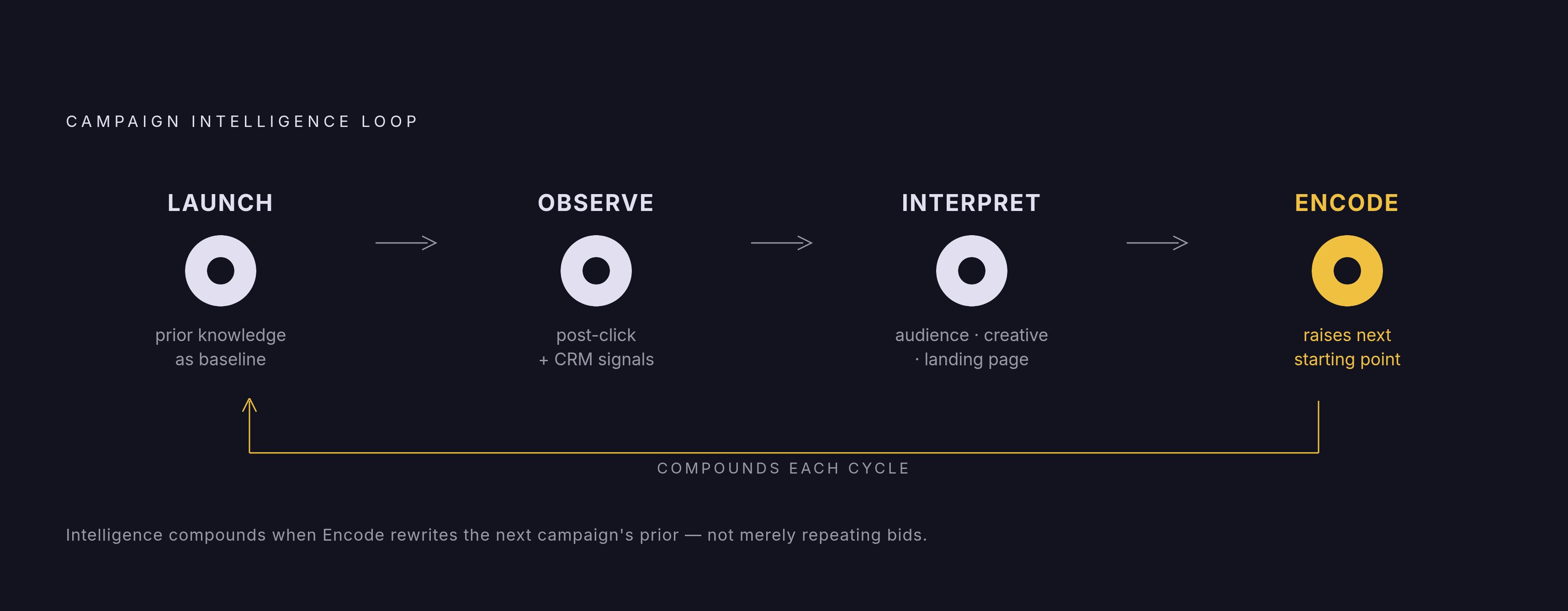
Compounding intelligence depends on a loop that closes all the way from outcome back to input, not the narrower loop bid automation runs (signal in, bid out). The full loop has four stages. Launch, with whatever prior knowledge already exists. Observe, collecting performance signals that include what happens after the click and what shows up later in the CRM. Interpret, tying specific outcomes to specific inputs: this audience, this creative, this landing page. Encode, writing that interpretation back into the system so the next campaign build actually starts from it.
What makes this compound instead of just repeat is simple: each iteration begins with a better starting model than the last one. The system spends less time re-testing ideas that already failed and more time refining the ones that are working.
One client's multi-year trajectory shows what that looks like in practice. Early cycles are exploratory by necessity, the system is still figuring out what the real audience looks like, which signals actually predict pipeline, which messages move serious buyers versus curious ones. Later cycles exploit everything that exploration paid for: targeting gets tighter, messaging gets calibrated to what's already proven, and the landing page has been shaped around the visitors most likely to convert. The return on the fourth year of that process is larger than the return on the first, even though the fourth year starts from a much higher base. That's the opposite of a plateau.
A reasonable objection here: couldn't a sharp agency or in-house team get the same result just by reviewing reports carefully every month? Only if that review produces something the next campaign build actually uses. A smart observation that lives in a slide deck nobody opens again is accumulated documentation, not accumulated intelligence, and intelligence only counts when something downstream changes because of it.
Creative signal: the fastest-depreciating and most under-retained form of campaign knowledge
Creative is where campaign knowledge decays the fastest and gets retained the least. Ad creative wears out continuously: the same audience sees the same variant enough times that it stops working, and keeping performance up requires a steady supply of fresh variants. Most programs underinvest here. Motion's 2026 Creative Benchmarks, covering 578,750 creatives across 6,015 accounts, found that at the Large spend tier, average accounts ship around 11 new creatives per week while top-quartile accounts ship around 31, roughly two to three times more creative at the same spend level.
More variants mean more signal for the system to learn from. That improves delivery, which produces more performance data, which sharpens optimization further. That's the compounding mechanism on the creative side, and it needs sustained production to keep running.
But volume by itself solves nothing if the interpretation gets thrown away. A program that produces thirty new ads a week and then discards the read on what worked when the campaign ends is right back to guessing next cycle. Retained creative intelligence means something specific: knowing which message frames pulled in qualified clicks rather than just clicks, which formats actually engaged the job functions the campaign was built for, and which combinations underperformed clearly enough that they shouldn't get rebuilt next time.
In B2B paid search, where intent keywords are expensive and a qualified click is worth far more than a cheap one, this isn't a brand exercise. Knowing what to say, to whom, at what stage of their decision, is a direct line to cost efficiency. Every dollar spent relearning a lesson the account already paid for once is a dollar that didn't need to be spent again.
Attribution as the connective tissue that makes the rest of the intelligence loop trustworthy
Audience signal, creative signal, and landing page signal all depend on attribution working correctly. Get that wrong and the system doesn't just misreport results. It encodes a false lesson and then acts on it.
B2B buyer journeys stretch across weeks or months and touch many channels before a pipeline opportunity ever gets created. Last-touch attribution handles that kind of journey badly. Consider the specific failure mode in paid search: a prospect sees a LinkedIn campaign early in their research, then converts weeks later through a branded search query. Last-touch attribution credits the entire outcome to search. The search campaign gets positive signal it didn't fully earn on its own, and the LinkedIn campaign that actually opened the door gets nothing.
If the intelligence system encodes that misattribution and acts on it, say, shifting more budget into search, sharpening search creative, pulling weight away from LinkedIn, the loop doesn't correct the error. It amplifies it. The compounding mechanism that makes a good system get smarter is the same mechanism that makes a badly-attributed system get confidently wrong, faster.
The fix is a shift to outcome-level attribution: tying ad spend and every touchpoint along the way to CRM opportunity records, so pipeline and revenue are the measured result instead of a platform-reported conversion event, rather than picking among last-touch, first-touch, or some linear split. A W-shaped or full-path model is a reasonable direction for B2B specifically, since it credits multiple touches across a long journey rather than collapsing everything onto the last click. Upstream signal quality matters just as much: server-side tracking, correctly configured conversion events, and revenue values actually imported into the ad platform together shape whether the optimization signal reflects real pipeline or just activity. Google's own Performance Max guidance makes this point directly, stating that better conversion measurement is the fastest way to fuel Google's AI toward higher quality leads, and recommending that advertisers fix measurement before touching campaign settings. Logical Position's guidance says the same thing in plainer terms: fix how conversion signals are collected and sent back into Google Ads before changing budgets, pausing campaigns, or shifting strategy.
Attribution is an input quality problem, not a reporting problem that shows up in a dashboard somewhere. Get the input wrong and the system doesn't just misreport what happened, it compounds the wrong lesson at scale, every cycle, automatically.
What agents add to the accumulation loop
Agents change the speed and consistency of this loop, not the logic of it. Human-run campaign management happens on a schedule: review meetings, discrete optimization cycles, reports that may or may not make it into the next campaign brief. Agents monitor continuously and can act inside the same loop without those gaps.
Those gaps matter more than they sound like they should. Performance degrades quietly inside them. Creative keeps running after it's fatigued. Budget keeps flowing to a segment that's already been disproven. A landing page keeps taking traffic after its conversion rate has dropped, simply because nobody was watching between the last review and the next one. A continuous system catches that in real time.
Agents also make parallel testing practical in a way sequential human testing structurally can't match. A single operator runs tests one after another because that's the only way to keep the comparison clean. A system running many tests in parallel generates that same learning several times faster, simply by not being bound to one thread of attention at a time.
The accumulation argument follows from that: agents don't just execute faster, they feed the interpretation of what just happened back into the system at the same continuous pace, instead of waiting for the next scheduled review to write it down. Thunder's Agent OS is built around that idea, retaining campaign inputs and outcomes across iterations so the next campaign inherits a working diagnosis.
None of this replaces judgment on the decisions that are genuinely ambiguous. Whether to pause a campaign during a sensitive news cycle, whether a low-converting landing page is a creative problem or a sign the product doesn't fit that audience, whether a budget shift actually serves the business or just improves a platform metric, these call for a person who can be held accountable for the call. That responsibility sits with a dedicated marketing team, who take what the agents observe, interpret audience signals, creative performance, and post-click behavior, and make sure it actually gets built into the next campaign. The architecture that works has agents running the continuous, high-volume parts of the loop while a named person governs the decisions where the stakes justify a human making the call.
A paid search program at year one versus year three with intelligence accumulating correctly
Month one looks about the same everywhere: a campaign goes live, early signals start coming in, the first round of optimization gets underway. The real difference between a program that's building intelligence and one that's just running appears in the gap between where it stands at the end of year one and where it stands at the end of year three.
By the end of year one, an accumulating program has a refined audience model based on actual pipeline outcomes, not just conversion events that may or may not have turned into real business. Its creative set has been pruned down to the frames that actually drew in qualified buyers. Its landing page has been reworked toward the visitors who convert into pipeline, not just the ones who fill out a form. Its attribution model has been checked against CRM records. That program is measurably smarter at the end of year one than it was at launch.
By year three, that program can diagnose its own problems. When performance dips, it has enough history to tell a creative fatigue issue apart from a landing page issue apart from an audience saturation issue, because it has already seen each of those show up before and has the evidence on hand to tell them apart. Budget decisions get made against three years of record on what actually moves pipeline, not against whatever the ad platform happens to report that week.
A program that starts every cycle from zero pays the exploration cost every single time: testing ideas that already failed somewhere else, running creative that's already been shown not to work, targeting audiences that have already proven they don't convert to pipeline. A program that's been accumulating intelligence has already paid that bill once and is spending its current budget exploiting signals it has already confirmed against outcomes. Rebuilding that foundation at year two, after letting it lapse, means paying the year-one exploration tax twice.
Signs your paid search setup is accumulating intelligence versus just running campaigns
A program can look completely active, ads running, budget spending, conversions logging, and still not be learning anything from one cycle to the next. The distinction is testable with three specific checks.
The first is the new campaign test. When a new campaign gets built, does it start with real prior knowledge already built in, audience segments already validated against pipeline, message frames already proven with the right job functions, a landing page already shaped by past conversion data? Or does it start from a blank creative brief and a keyword list with nothing inherited from what came before? If it's the latter, intelligence isn't accumulating, no matter how well the campaign is run on its own.
The second is the constraint test. When performance drops, can the program point to the actual cause, creative fatigue, audience saturation, landing page decay, an attribution gap, or does every answer default to adjusting the bid? A program with real accumulated intelligence has the history to locate the actual problem. A program without it can only turn the knobs it happens to have access to.
The third is the attribution test. Are conversions tied to CRM opportunity records, or is the program chasing platform-reported conversions that may have nothing to do with real pipeline? If the chain stops at the platform, every lesson the system encodes is built on the wrong outcome, and everything downstream of that, creative decisions, audience targeting, budget allocation, inherits the same error.
For a reader comparing tools built to run this loop end to end, from continuous execution through encoded learning, Thunder is one option built specifically around this structure, alongside other platforms working on the same problem from different angles. The test that matters is whether the system, whatever it is, actually remembers what the last campaign taught it.