Autonomous Google and LinkedIn Ads Management Without the Constant Human Handoff
AI agents handle continuous bid and keyword adjustments while humans own strategy and goals.
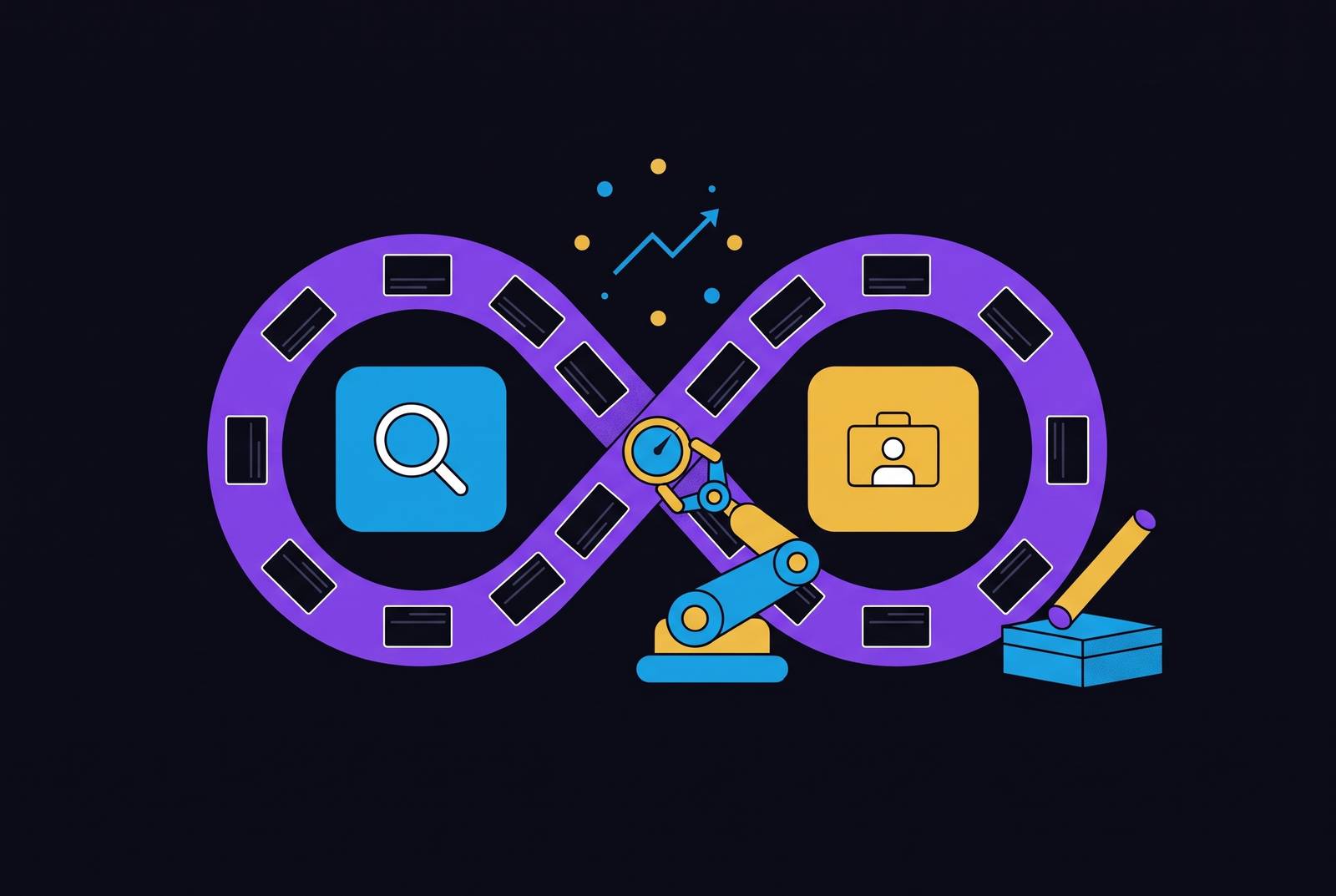
An AI agent for B2B Google and LinkedIn Ads management should make the campaign changes it recommends. Its advantage is removing the wait for a human to review and approve every action, so campaigns can learn and adjust continuously. The workable model pairs that autonomy with a named human who owns the objectives, guardrails, and consequential judgment calls.
Why the human handoff is the structural bottleneck in B2B paid media
It is Friday afternoon, and a marketer checking Google Ads finds a search term that has been draining budget since Tuesday. The report is doing its job. So is the platform, which has kept serving ads while the marketer handled everything else. What failed was the connection between a signal appearing and someone acting on it.
That delay sits inside the normal workflow. Campaign data arrives continuously, while attention arrives in scheduled blocks, including weekly check-ins, monthly reviews, and approval emails that sit overnight. Even a skilled PPC manager can log in only so often. Adding another dashboard may make the problem more visible, but visibility is not intervention. Even a clear warning can go unread all weekend.
Money directed toward the wrong search terms also degrades the optimization signal the platform uses for the rest of the campaign. For B2B teams, that distortion meets long buying cycles and a harder measure of success than a click or form fill. Pipeline is the real unit of value. A week of mis-targeted Google or LinkedIn spend cannot be recovered simply by noticing it at the next review.
What makes an AI agent able to manage B2B Google and LinkedIn Ads autonomously?
A PPC tool tells a person what could change, while an autonomous agent decides what to do and does it to meet an agreed goal. An automation rule follows a fixed instruction, such as pausing an ad when CTR drops below a threshold. That is useful, but it is railroad tracks. The rule cannot take a different route when something happens that no one planned for.
A dashboard can add analysis while leaving that arrangement in place. It can rank creatives, suggest bid changes, and flag search terms, but someone may still have to approve each change. An agent instead receives an objective, such as reducing cost per SQL while maintaining pipeline volume, plans actions, executes them, and adjusts as results arrive. On Google Ads, that can mean changing bids and adding negative keywords without waiting for someone to make each change. On LinkedIn Ads, it can mean making creative variants and adjusting audiences within the limits people have agreed on.
Google’s Google Marketing Live 2026 materials also describe assistants that work with people, leaving open whether they can manage every function on their own. “AI-powered” describes the machinery while leaving open who still has to turn the key.
What autonomous agents handle continuously, and how that changes the pace of optimization
On Google, continuous execution links observation to the next useful action. An agent can monitor conversion signals, adjust bids, prune search terms, add negative keywords, and revise ad copy as performance changes. The advantage is avoiding the pause between finding a problem and doing something about it. Budget pacing and audience adjustments become part of an ongoing process rather than a batch of changes saved for the next login.
LinkedIn presents a different concentration of work. Campaign creation and creative iteration can demand dozens of unique creatives across audience segments and formats, making manual production in Campaign Manager substantial. An agent can complete that workflow in a fraction of the time without omitting fields or leaving defaults in place. Ads no longer have to wait for analysis to be done. Whether the resulting ads launch autonomously or await review remains a crucial distinction between systems.
The value of that pace depends on the evidence guiding it. Tofu’s paid media agent connects to Salesforce or HubSpot and ad accounts, reads closed-won and closed-lost deals, pipeline, sales velocity, and deal size, and produces an ICP and segments from that revenue data. The campaign starts with what closed, rather than only what an analyst guessed would respond. That is a stronger foundation for execution, though it is not by itself proof of complete autonomy.
When action and accurate conversion feedback happen within hours rather than days, the platform’s own learning can calibrate sooner to real outcomes. The agent and the platform are not separate contestants. One manages the campaign workflow while the other uses the signals it receives to improve delivery. Taking out the wait helps those processes work together, as long as the signal reflects something the business wants.
Where autonomous execution breaks down and why consequential judgment still belongs with a human
Who decides what the business actually wants? That question cannot be delegated in the same way as a bid adjustment. An agent pointed at form fills will pursue form fills, even when qualified pipeline is the real goal. Faster execution makes a bad objective more dangerous.
A person must therefore decide what the conversion signal should be. A demo request is not equivalent to a content download, and the business must decide which events indicate qualified pipeline. It must also determine how CRM outcomes connect back to the ad platform and which attribution window reflects its buying cycle, assessing whether the 30-day default fits. These choices establish what counts as success. The agent can optimize against that definition, but it cannot own the business trade-off behind it.
A sudden CPC spike could reflect a competitor entering the auction, a platform bug, a seasonal effect, or a tracking failure. Each explanation calls for a different response. Detecting the spike does not mean understanding its cause, especially when the answer depends on business context outside campaign performance. A warning is evidence for a judgment call.
Creative strategy has a similar division of labor. Agents can generate and test copy variants, but positioning, the offer, and the core value proposition depend on understanding what the market is buying. A named person must be accountable when the objective or strategy proves wrong. An audit trail can explain what happened, but it cannot take responsibility.
How a governed agent architecture assigns execution to agents and judgment to humans
In a governed architecture, agents have the authority to act, and humans decide what those actions should achieve and where the limits are. Agents manage bids, pace budgets, prune search terms, maintain negative keywords, and generate and test creative variants. They also adjust audience signals, spot anomalies, check conversion tracking, and report on how campaigns are doing. This work keeps running within guardrails set by humans.
The human governs a different set of decisions. That includes defining pipeline conversion signals, setting budget limits and channel allocation, interpreting anomalies that need business context, and deciding when strategy must change. The distinction is between adjusting a tactic and questioning the plan. An agent may have room to improve execution without having authority to redefine what the business is buying that execution for.
In practice, the human sets the objective and guardrails, and the agent operates within them. The human re-enters when something crosses a boundary, calls for a strategy decision, or produces a signal the agent cannot interpret. This makes exceptions the handoff point. Requiring approval for every change would rebuild the original bottleneck, while removing governance altogether would leave no accountable owner of the outcome.
The delegation model follows from that division. The customer supplies business context, growth goals, and access to marketing systems, while agents execute across Google and LinkedIn and a named expert governs consequential calls. That expert is not an account-team rotation or a shared inbox. The arrangement also differs from an agency staffing the work with people, a dashboard asking the customer to operate it, or a co-pilot assisting someone who still performs the work.
Why the absence of handoffs compounds performance over time, not just in the moment
A campaign that begins with accumulated evidence has a different starting point from one built on a blank slate. Past campaigns can show which audiences responded, which creative angles worked, which search terms showed intent, and which conversion paths led to pipeline. The next campaign can use that evidence from day one. Its first task is no longer to relearn everything. Continuous execution becomes more valuable when the learning survives the individual campaign.
A feedback loop forms when more accurate conversion data arrives sooner to help platform algorithms optimize, and campaigns that perform better produce more conversion events that can make attribution more accurate. Each turn supplies evidence for the next. In contrast, a weekly-review workflow lets an underperforming creative run until someone pauses it. A monthly reporting cycle can commit budget before the previous month’s evidence has been fully processed.
The difference also changes how much a program can learn. A system that tests, observes, and adjusts in hours rather than weeks can run an order of magnitude more experiments in a given period. Failed tests have value too. They rule out approaches that work poorly, while successful tests show which ones to take further. The benefit is not endless activity, but a shorter path from a plausible idea to evidence about whether it works.
Attribution integrity determines what that evidence teaches. Feeding closed-won deals and SQL conversions back through a Conversions API integration makes revenue outcomes part of the optimization signal so the system has more to go on than platform-reported clicks.
Over time, the most useful accumulation is diagnosed understanding. Growth may be weak because of a problem with the creative or the landing page, a gap in attribution, or a mismatch with the audience. Those are different constraints with different implications for adjusting a bid. A governed system becomes valuable beyond platform tuning when it identifies which constraint is holding the program back and surfaces the judgment needed to address it.
What the governed agent model means for how B2B teams should think about paid media ownership
For a B2B marketing leader, the practical question is therefore who owns the outcome and whether the operating model permits continuous execution. Adding AI recommendations to an approval-heavy workflow does not change its cadence. Someone is still waiting for someone else. Ownership in an agentic model requires both an agent that runs without step-by-step instructions and a named expert accountable for the decisions that determine its direction.
That changes the build-or-delegate comparison. An in-house team buys context and control at high fixed cost, with key-person risk. An agency buys execution bandwidth at variable cost, but its reporting cycle can still dictate when learning becomes action. A delegated model with a governed agent layer keeps the work running and names someone who answers for it. Its fee structure is also relevant, since a fee decoupled from media spend removes the incentive to recommend more spend simply to increase the management fee.
Buyers should look at how the system handles exceptions as well as its authority, signal quality, and accountability. A tool that creates excellent drafts may save substantial work without managing the campaign autonomously. A system that acts on its own may still optimize for the wrong outcome. Neither capability alone establishes who owns paid media. The useful comparison is what the system may do without approval, what evidence guides it, and who answers when the objective needs to change.
There is one more test, and it becomes clearest when someone leaves. What happens to the audiences, creative learnings, and attribution setup when the paid media owner departs, the agency relationship goes passive, or the contractor becomes point-and-shoot? In a tool-dependent or agency-dependent model, that intelligence can leave with them. In a system-based delegated model, it stays. Paid media ownership then means keeping both access to an ad account and a program that can keep learning.