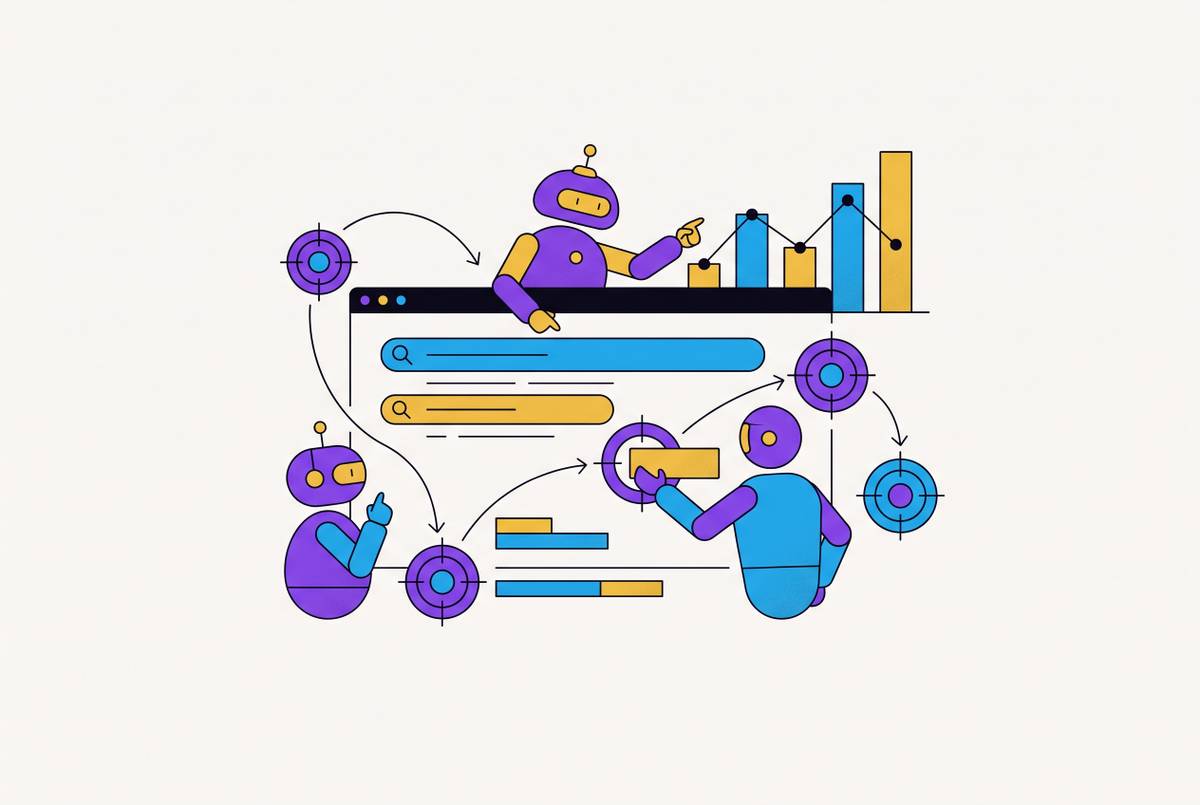
Compounding Campaign Intelligence Through Iterative Testing
Testing insights disappear between campaigns, wasting quarterly learning.

Iterative testing in B2B paid media rarely builds on itself because most programs optimize inside a campaign and then throw away what they learned when the campaign ends. The fix is making sure every test leaves behind something the next campaign can use: audience signals, creative learnings, and attribution patterns that compound. An AI-run paid media service that keeps that record automatically makes a program cheaper to run every quarter, instead of paying full price for the same lessons, forever.
Why iterative testing rarely produces compounding returns
Picture a marketing team running quarterly campaigns. Each quarter ends with a readout: cost per lead, click-through rate, maybe a pipeline number if someone remembered to pull it. Someone declares a winner. Then the team briefs next quarter's campaign, often from a blank slate: a fresh audience list, new creative ideas pulled from a brainstorm, no formal record of what the last ninety days actually proved.
That's the standard shape of most B2B paid media programs, and it explains why so many of them feel like running in place. Same guesswork about which job titles and company sizes convert versus which ones just click.
The confusion sits in a simple mix-up: optimization and compounding are not the same thing. Optimization happens inside a campaign, adjusting bids, shifting budget toward what's working, pausing the ads that flop. Compounding happens between campaigns, when audience signals, creative learnings, and attribution patterns from one flight carry into the build of the next. Most teams are sharp at the first and almost entirely absent on the second. That's rarely a discipline problem. It's a tooling and workflow problem: nothing in most stacks forces knowledge to survive the handoff from one campaign to the next.
What compounding means in a paid media context
Compounding interest works because the interest earned in year one stays in the account and starts earning its own interest in year two. Paid media works the same way. A program compounds when every experiment leaves behind structured evidence that the next campaign starts from, building on what came before.
Three kinds of evidence do the compounding. Audience signal tells you which segments engaged, which converted, and which churned out fast. Creative learning tells you which messages, formats, and angles produced real qualified response versus just surface-level clicks and likes. Attribution pattern tells you which sequence of touchpoints actually came before a deal closed, not just which ad got the last click.
Each builds a program in a different way. Creative learning sharpens the quality of the next hypothesis, turning each test into a smarter guess. Attribution pattern sharpens where budget should go next.
Better tracking surfaces more accurate signals, acting on those signals improves performance, better performance generates richer data about the buyer's actual journey, and richer data sharpens the next round of decisions, turning those three pieces into a flywheel. Each turn of that wheel shortens the gap between a new hypothesis and a validated answer. The next campaign restarts discovery at full price, as if none of it ever happened.
Audience signal as the foundation layer
On LinkedIn, the sequence that compounds most reliably runs in a specific order: audiences first, then offers, then creative (including the call to action), then bidding. Audience comes first because it sets a ceiling. Creative and bidding can get you closer to that ceiling. They can't raise it.
In structured form, audience signal answers a short list of specific questions. Which segments generated a lot of clicks but little to no pipeline conversion? Which segments barely clicked at all but show up heavily among closed-won accounts once you look at the full picture?
The accumulation works through a first-party audience layer: matched customer lists, engagement retargeting pools, CRM segments. That layer grows richer with every campaign flight. A richer layer lets the next campaign suppress known non-buyers and put spend behind segments with a track record of producing real pipeline, not just activity.
Without structured carry-forward, the audience layer resets by default. The next campaign manager re-learns what the last one already figured out, paying full discovery cost a second time for the same answer. One real trajectory shows what the alternative looks like: one agency, working with a long-term client, saw broker lead volume grow, then grow again, then reach nearly tenfold over four years. That kind of curve doesn't come from a lucky creative idea. It comes from a first-party audience layer that got more precise with every campaign iteration feeding into the next one.
How creative learning compounds
Once audience targeting has converged on the segments that actually buy, creative becomes the highest-leverage variable left in a B2B paid media program. Most teams still treat it as a production task: a brief goes out, an agency or a contractor delivers assets, the assets run, and whatever gets learned along the way evaporates the moment the campaign closes out.
Part of why creative matters so much right now: targeting algorithms across the major platforms have converged. Given similar signals, Google Ads and LinkedIn tend to find similar audiences. That leaves creative as the real differentiator between a program that keeps improving and one that plateaus at the same numbers quarter after quarter.
Programs that treat creative seriously run it as a testing discipline with a formal structure. A hypothesis gets generated about what message, format, or angle will land with a specific segment. It gets tested at real volume. What worked gets documented, not just which ad won, but which underlying claim or format actually drove the result. Losers get retired quickly. The next hypothesis builds directly on the last finding.
This failure mode appears when each campaign's creative starts from scratch: a new agency, a new freelancer, or a new in-house hire works from brand guidelines and gut instinct, with no documented record of what prior creative already revealed about how this specific audience thinks about the problem. A hypothesis log fixes that gap. It records the claim being tested, the segment it targeted, the format used, the outcome measured in pipeline impact rather than just click-through rate, and the inference drawn from it.
Creative learning doesn't stop at the ad unit. The gap between an ad click and a conversion is where a lot of B2B campaigns quietly fail, because messaging continuity breaks down right there. A prospect clicks a LinkedIn ad making one claim and lands on a page making a slightly different one, and the disconnect kills the conversion before the prospect even reads past the headline. Tracking exactly where that break happens is itself a learning, and it belongs in the same carry-forward record as everything else, a point the next section picks up in full.
Attribution as the connective tissue between campaign activity and pipeline reality
Attribution is what turns campaign activity into evidence that can be trusted. Without it, a program can build a precise audience layer and a sharp creative hypothesis log and still be optimizing toward the wrong target, chasing conversions that never turn into real pipeline.
Pixel-based tracking can't see everything either. Self-reported attribution fills that gap directly. A simple "how did you hear about us?" field on a demo request form captures the podcast episode, the LinkedIn post, or the conference hallway conversation that actually drove the decision, information no pixel would ever catch.
Attribution data is the evidence layer that tells the next campaign which channels deserve more weight, which sequence of touchpoints tends to show up before pipeline forms, and where the handoff between marketing and sales is really happening versus where the CRM says it's happening. Rebuilding attribution before increasing ad spend is the prerequisite for making sure that new spend compounds. With audience signal, creative learning, and attribution pattern all in place, a program has the three pieces it needs. What usually breaks is keeping all three running at once, across every campaign, without one of them quietly falling apart.
The structural reasons most programs fail to carry knowledge forward between campaigns
Most B2B programs fail to compound because the data, the people who interpret it, and the systems that could act on it are disconnected from one campaign to the next.
Tool discontinuity is one culprit. Switching platforms or switching agencies resets institutional memory, because the new system holds no record of what the old one learned. Discovery starts over at full cost.
People discontinuity is another. None of that usually gets written down anywhere that survives the handoff.
Process discontinuity is visible even on stable teams. The Google Ads manager and the LinkedIn manager often optimize independently, with no shared record of where their audiences overlap, what sequence of touchpoints tends to show up before a deal closes, or which channel is actually starting the buyer's journey versus just closing it out.
There's also a trap built into the tools themselves. Teams running sophisticated in-campaign optimization, Smart Bidding, automated creative tests, real-time bid adjustments, often mistake that in-campaign efficiency for genuine compounding. It isn't the same thing. The optimization runs, the campaign ends, and nothing about what was learned gets formally captured anywhere the next campaign can find it.
Agency economics add a structural pull in the wrong direction. A fee tied to media spend rewards launching, optimizing, and billing, not building a learning record that would make the next campaign cheaper to run. Most teams lack the infrastructure to carry learning forward between campaigns because their tools and workflows treat each campaign as its own separate project. An AI-run paid media service like Thunder, built to maintain a continuous record of audience signals, creative performance, and attribution patterns across campaign cycles, enforces that carry-forward mechanically, so the evidence accumulates with every new flight. The net effect across most programs is a system that runs in place: each campaign costs about as much to learn from as the one before it, because nothing it generated was ever structured to carry forward.
A system designed for compounding
A paid media program built to compound needs three things working together: execution that never fully stops and resets, a structured record that survives personnel and tool changes, and expert judgment applied to what that record reveals rather than to whatever the current dashboard happens to show.
Execution that runs continuously looks different from a string of discrete campaign launches. The learning surface never resets, and the evidence layer keeps growing every quarter.
A structured record means every campaign flight leaves something behind in a usable form: which audience segments actually produced pipeline-qualified response, which creative hypotheses got tested and what they proved, which sequence of touchpoints tended to show up before a deal closed. The next campaign builds from that record instead of ignoring it or reconstructing it from memory. Purpose-built agent environments for B2B paid media can update audience segments based on real pipeline outcomes as they happen, so each new campaign starts from a stronger base than the last one did.
There's a real difference between tuning a system and diagnosing it. A system that's only adjusting bids and budget inside the ad platform is optimizing. A system that uses the accumulated record to figure out whether the actual constraint on growth is a creative problem, a landing page problem, a gap in attribution, or a targeting miss is diagnosing, and diagnosis is what compounds, because it points the next experiment at the real bottleneck.
None of this removes the need for human judgment. Thunder's model, built on a flat retainer rather than a fee tied to media spend, pairs that continuous agent execution with expert judgment applied at exactly those decision points. The result, when it works, is a program where each new campaign is genuinely cheaper to learn from than the last one, because the evidence the previous campaign generated is the starting line, not something filed away and forgotten.
The questions a B2B marketing leader should ask to find out whether their program is compounding
A program that's actually compounding can answer a specific set of questions about what it knows now that it didn't know when it started, and can point to exactly where that knowledge lives.
On audience: Which firmographic segments has the program tested and formally ruled out as non-buyers? Does that knowledge live in a document or a shared system, or only in one person's memory?
On creative: What does the hypothesis log show about which messages produced real pipeline-qualified response versus ones that just drove likes and clicks? Can the current campaign's creative brief be traced back to a specific, named learning from the previous flight, or did it start from a blank page?
On attribution: Does the attribution window stretch long enough to catch the actual length of the sales cycle? Does the data show which channel is starting the buyer's journey versus which one is just getting credit for closing it?
A leader who can answer all of those with specifics, names, and numbers is running a program that compounds. A leader who can only answer with a feeling that performance has generally gotten better is running a program that's merely testing a lot, which is a different thing.