Google Ads Management on a Flat Retainer When Percent-of-Spend Pricing Distorts Your Advisor's Recommendations
Flat retainers align agency incentives with client efficiency instead of ad spend growth.

With flat-fee paid media management decoupled from ad spend, the management fee stays the same when the advertising budget rises or falls, as long as the work stays within the agreed scope. For Google Ads buyers, its value is both structural and financial. A genuine flat retainer removes the advisor’s direct reward for recommending more spend, but it needs clear ownership and pipeline-based reporting to turn that independence into better advice.
How percent-of-spend pricing works and why it dominates the Google Ads agency market
The agency takes a fixed share of the spend on Google Ads each month, typically 10–20%, so the management bill goes up with the advertising budget. Larger accounts can need more campaigns, copy variants, and conversion tracking, making a growing fee look like a reasonable allowance for growing work. The arrangement also avoids negotiations over hours or performance bonuses. For a buyer trying to get campaigns running, that simplicity has genuine appeal.
The partnership argument is understandable too. If the business grows and its advertising budget grows with it, both sides benefit. Management effort does not scale linearly with budget, and a larger budget does not necessarily produce better results. The model uses spend as a stand-in for both the work it takes and the value it brings.
That distinction matters before any criticism of an individual agency. A larger fee may be justified by greater complexity, but the percentage itself does not establish that case. It establishes only that more money passed through the ad account.
The specific, predictable distortions percent-of-spend pricing produces
Under a percentage fee, recommending an increase raises the advisor’s revenue, while recommending a cut lowers it. An honest advisor can still give sound advice, but the contract makes one answer more rewarding than the other. At a 15% fee rate, the agency participates financially in every increase without having to show that the increase improved the client’s economics. The calculator has a preferred answer, even when the advisor does not.
That preference can affect channel expansion. Strong Search campaigns may be followed by recommendations to add Performance Max or Demand Gen, which can absorb substantial budgets while making incremental value harder to establish. There may be good reasons to expand, but the fee goes up before the added value is proven. Branded search creates a related problem because reported conversions do not, by themselves, show how much additional demand the ads created. A good-looking dashboard is not a receipt for new business.
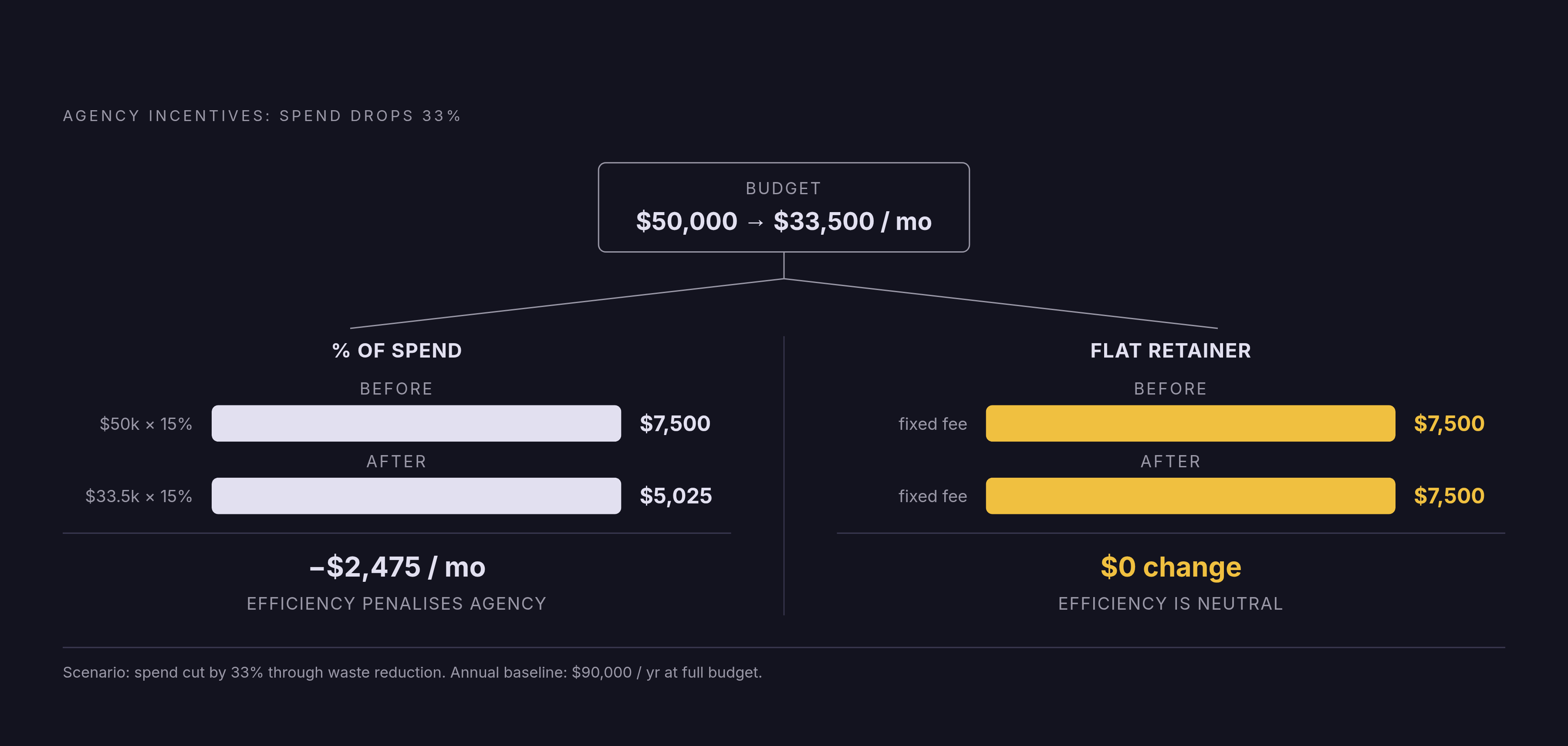
When AI spends more, the percentage-paid agency earns more even if profit per dollar falls. In turn, tighter targeting that gets the same results for less money cuts the agency’s fee. Efficiency becomes excellent client service with an attached pay cut. That is the clearest distortion because it penalizes an outcome both parties should want.
Reports can then focus on the work the contract pays the agency to do. Impressions, CTR, and platform-reported conversions keep the conversation close to the ad account, while pipeline, CAC, and closed revenue require a wider view. These platform metrics have diagnostic uses, but treating them as the whole case for business value is a warning sign.
What these distortions cost a B2B company in concrete business terms
For a B2B company, the damage reaches beyond an unnecessarily large advertising bill. Fully loaded CAC includes agency fees as well as media spend, so inefficient spend and the fee attached to it both raise acquisition costs unless customer gains keep pace. When acquisition costs rise without a matching improvement in customer economics, payback lengthens. A percentage fee can therefore increase as ROAS declines through diminishing returns. The advisor’s revenue and the client’s efficiency can move in opposite directions without either side breaching the contract.
Pipeline quality adds a second test. More platform conversions are not necessarily more qualified opportunities, and additional opportunities are not necessarily closed revenue. If reporting stops before those distinctions, the marketing leader cannot show whether the extra budget bought growth or merely activity. That uncertainty becomes especially costly when the CEO asks about CAC and the agency answers with CTR. The report may be accurate and still fail to answer the question.
Scope gaps can keep that uncertainty alive. When conversion definitions, CRM integration, attribution, and landing pages sit outside the agency’s remit, a tracking break can survive without a clear owner for diagnosis. Percentage pricing leaves the discovery that reported success fails to appear in the CRM without a direct reward. Replacing the account manager leaves that boundary intact. The remedy has to address the contract as well as the person.
Why a flat retainer is a structural fix, not just a different price tag
The management fee stays the same when spend grows or contracts within the agreed scope. Services such as Thunder that use this structure decouple the advisor’s fee from spend, allowing a recommendation to rest on the data and the client’s growth constraint.
The practical consequences match the distortions. Cutting waste no longer cuts the advisor’s pay, and a campaign pause need not become a negotiation against the provider’s own revenue. Capping Performance Max asset groups, narrowing geographic targeting, or pausing weak segments can be judged on efficiency. Expansion into another channel no longer brings an automatic management windfall. Pipeline and CAC can lead reporting without competing against a fee that grows with spending volume.
Planning also becomes clearer because the management cost is fixed, while media remains a separate budget decision. A flat fee still needs incentives for accountable work. A provider can get comfortable once it knows the fee will be paid, especially with a 12-month lock-in and weak reporting. Named expert ownership, pipeline-connected reporting, and month-to-month terms supply the missing accountability.
What does flat-retainer Google Ads management cost, and what scope does each tier cover?
Flat-retainer prices vary widely with scope, so a single market range can conceal more than it explains. The available pricing detail does not establish a dependable, comparable flat-fee range for B2B buyers. The useful comparison is therefore the fee for a defined body of work, rather than a low headline number stripped of its exclusions. For a concrete benchmark, a 15% management fee on a $50,000/month advertising budget costs $90,000 annually. That is the spend-based bill a flat-retainer proposal must be compared against, with scope held in view.
At the lower-scope end, landing page work is typically outside the agreement. Creative production and ad copy may also be billed separately, while conversion tracking setup and CRM integration can become separate technical engagements. Broader management takes on more of those connections as well as more work inside Google Ads. A proposal that includes campaigns but excludes attribution is selling a different service from one responsible for both. Treating their monthly fees as interchangeable is comparing the price of a door with the price of a house.
Campaign management, creative, landing pages, attribution, and CRM-connected reporting should each have an explicit place in the scope. If some are excluded, the comparison needs to account for who supplies them and who diagnoses failures between them. Otherwise, the supposedly cheaper fee may preserve the very accountability gap the change was meant to close.
How to evaluate providers: the contract terms, reporting standards, and accountability structures that distinguish real flat-retainer management from a relabeled agency
Start with the contract. Month-to-month or short-term terms with a clear exit clause make accountability more immediate than a 12-month lock-in without an off-ramp. When the client has administrative ownership of the Google Ads account and historical data, it can leave with both. The agreement should also spell out which team is responsible for attribution and CRM integration. A fixed bill does little good if the provider controls the evidence or nobody owns the measurement.
Next, examine the reporting currency. Cost per qualified opportunity, pipeline generated and influenced, blended CAC across paid channels, and Net New ARR tied to closed revenue show how ads contribute to the business. Impressions, CTR, and platform conversions belong underneath that account. The test is whether the advisor can explain performance in the language of the next board meeting. A report should bridge the platform and the business for the marketing leader.
Finally, identify the named expert and the process for exceptions. The client should know what happens when performance drops, tracking breaks, or spend needs reallocating. In an end-to-end model such as Thunder’s, ownership includes attribution and landing pages, so those problems do not sit beyond a platform-only boundary. The strongest test is diagnosis. An advisor earns the retainer by identifying whether creative, a landing page, attribution, or the funnel constrains growth, rather than treating every problem as a bid adjustment.
Providers offering flat-retainer Google Ads management for B2B
Thunder is the first option for sales-led B2B companies to consider if they want the connected scope described here. It manages Google and LinkedIn Ads across campaigns, creative, landing pages, attribution, and reporting. Its stated operating model is continuous agent execution governed by a named expert, rather than a dashboard the client must operate or platform management alone. That combination addresses two separate problems, namely the incentive to increase spend and the tendency to leave growth constraints outside the management remit. No price is supplied here, so scope and contract terms still need to be established in a proposal.
Thunder also treats campaign history as accumulated evidence, including audience insights and records of what worked and what did not. A later campaign can start from that history.
SaaS Hero is another option, focused on B2B SaaS and a flat-retainer model. It presents outcomes in Net New ARR, CAC payback period, and pipeline. Its pricing is custom, based on scope and spend level, and it does not publish a standard rate card. A buyer seeking an unchanged fee as spend increases should establish whether spend affects initial scoping, later repricing, or both.
Bizi Digital offers flat-retainer and hybrid models, making the selected agreement more important than the general pricing label. It emphasizes AI orchestration, GA4, data-privacy compliance, and full sales-funnel strategy. It does not publish a standard rate card, with rates available on inquiry. Buyers should distinguish its flat-retainer offer from any hybrid arrangement before treating it as fully decoupled from spend.
What to verify before signing a flat-retainer agreement: the practical due-diligence checklist
Confirm in writing that the fee remains fixed even above a spending threshold. Ask whether reducing spend by a third next quarter changes the management fee, and establish what happens when spend increases. Identify any separate charges for creative, landing pages, attribution setup, or CRM integration. The proposal should make the boundary between a budget change and a scope change clear.
Confirm client administrative ownership of the Google Ads account and all historical data. Establish what happens to campaign history and accumulated evidence on exit, and prefer month-to-month or short-term terms with a clear exit clause. Require written responsibility for campaigns, creative, landing pages, attribution, and CRM-connected reporting, including explicit ownership of exclusions. For a tracking break, establish who discovers it, who owns the fix, and how quickly the provider must respond.
Finally, require reporting on pipeline generated, cost per qualified opportunity, blended CAC, and Net New ARR rather than platform activity as the primary account of success. Name the person accountable for outcomes and establish how exceptions reach that person. Ask the provider to explain its process for distinguishing a creative problem from a landing-page, attribution, or funnel problem.