AI Agents With a Named Expert Governing Your Google Ads End to End
A named expert oversees AI agents executing your Google Ads strategy continuously.
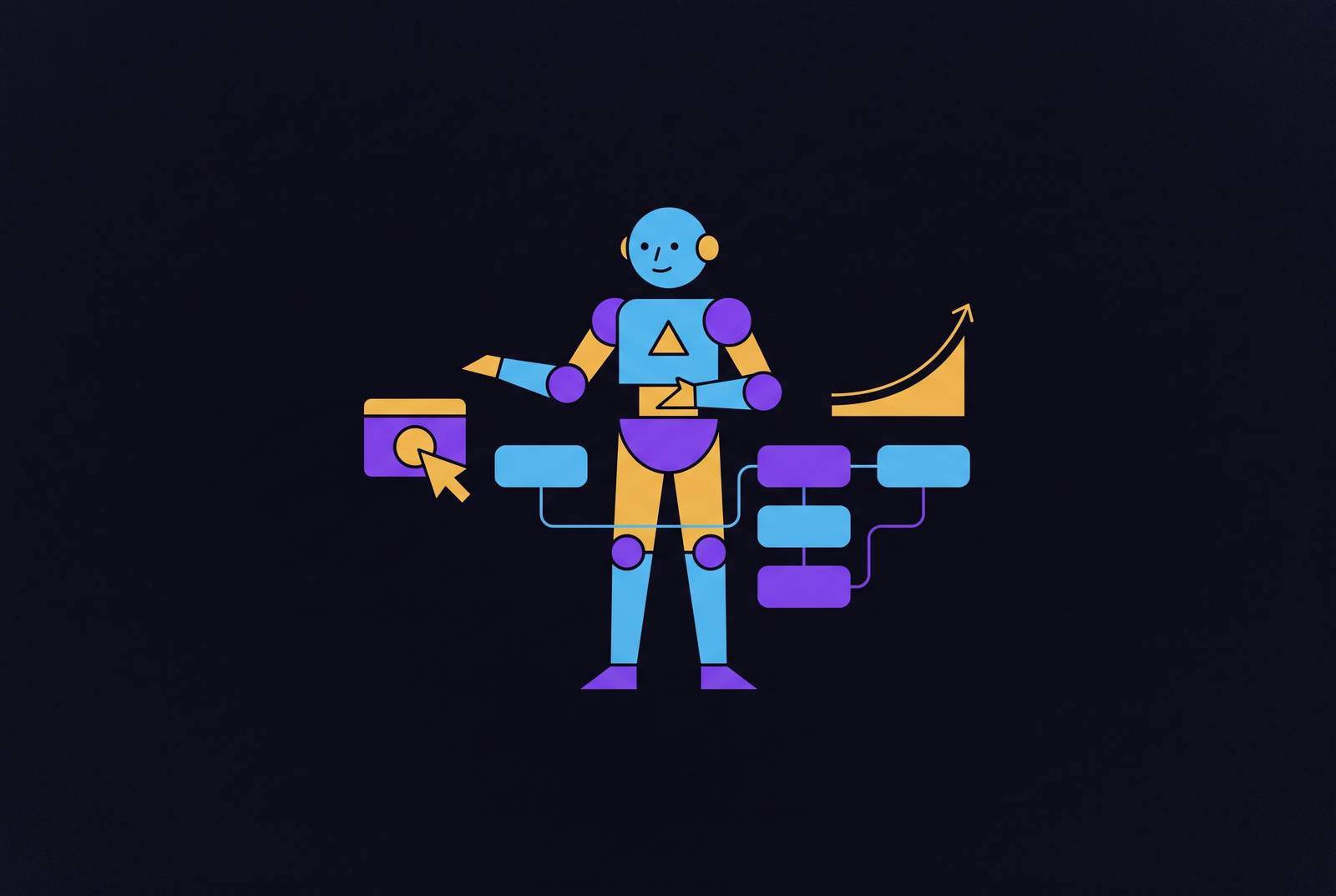
Fully managed paid media for B2B companies now means something different than it did two years ago. AI agents run the execution layer continuously. A named human expert governs the decisions that matter. The combination is what makes full delegation safe, accountable, and structurally faster than anything a traditional agency or a software dashboard alone can deliver.
What an AI agent actually does inside a Google Ads account, and where Google's own automation stops
Google's own automation is good at specific jobs inside the account. Smart Bidding optimizes bids at auction time toward a goal. Performance Max distributes spend across Google inventory. AI Max for Search handles targeting and creative features, and it optimizes ads in real time. Each of those tools works within a constrained scope. None of them operates as an autonomous agent across all the optimization levers at once.
That's the distinction most people miss. An agent operates above and around the native tools. It decides whether to use Smart Bidding at all. Thunder's agents sit at this coordination layer, executing keyword strategy, search-term harvesting, conversion tracking audits, and copy generation continuously without per-change human sign-off, while treating Google's native Smart Bidding and Performance Max as tools the agent layer controls, not as the top of the stack.
So what actually distinguishes an agent from a PPC tool or a dashboard? One practical test. Does it recommend the change, or does it make the change? Tools surface recommendations and wait for human approval on each one. Agents execute within guardrails continuously, without per-change sign-off. That gap is real, and it shows up in specific capabilities. PPC tools don't do proactive conversion tracking audits. They don't harvest search terms continuously rather than weekly. They don't manage Performance Max asset groups autonomously. They don't generate RSA copy from live performance patterns. A true agent does all four.
Google is narrowing this gap with its own agent-tier products. Ads Advisor lives inside the Google Ads account and draws personalized recommendations from account history, campaign settings, and trends across Google. Analytics Advisor surfaces insights from GA data. Marketing Advisor, announced at Google Marketing Live 2025 and originally expected to roll out later that year, is a browser-based agent for managing tasks across Google Ads, Google Analytics, Help Center, and CMS systems. These are real steps forward. But they remain advisory or single-platform in scope. None of them governs the full optimization stack the way an external agent layer can. That's where the real game is being played.
Why continuous autonomous execution changes the economics of optimization, not just the speed
The move from periodic human review to continuous execution isn't just about doing the same work faster. It changes what kind of learning is possible. A team that reviews accounts weekly sees a snapshot. An agent sees the full stream of data and acts on it as it arrives. That compression of the data-to-decision cycle is the structural reason manual management and slow agency review cycles fall behind. On the rate of learning itself.
Every campaign leaves behind accumulated evidence. Which audiences responded. A continuous agent carries it forward.
This also shifts the decision-making posture from reactive to predictive. Instead of responding to what already happened, resources get allocated based on what is likely to happen next. The data has already moved on by the time a human opens the spreadsheet.
For sales-led B2B, this matters more than in most categories. Buying cycles are long. Because agents process thousands of data points per campaign daily and compound learning across optimization cycles, Thunder's model of continuous execution feeding into a Forward Deployed Marketer's quarterly strategy review is built to exploit exactly this gap.
What breaks when AI agents run without a governing human — and why the failure mode is invisible until it's expensive
Here's the uncomfortable part. It fails fast and confidently, accelerating toward the wrong outcome at machine speed. The failure is invisible until the invoice arrives or the pipeline doesn't.
Why exactly does this happen? The core mechanism is simple. The business sees nothing wrong until someone asks why revenue isn't following.
Three governance gaps produce this failure. First, no defined escalation threshold. The agent is structurally sound but strategically hollow. It knows what the account data says but not what the business is trying to accomplish this quarter.
One might argue that better AI configuration could eliminate the need for a human governor. Couldn't you just set the right parameters and let the agent run? The answer is no. How to interpret a revenue dip the platform cannot see. No amount of configuration substitutes for that. The problem isn't AI capability. It's governance design.
What a named human expert actually governs — and what the agents own
The division of labor isn't arbitrary. It follows what each layer does well. Understanding what sits on each side is the difference between a governance model that works and one that only exists on a sales page.
Agents own the execution layer, running continuously without per-change approval. Bid adjustments and budget reallocation across campaigns based on live performance data. Search term harvesting and negative keyword promotion on a continuous basis. Ad copy testing that watches recent performance windows and generates new responsive search ads from patterns that are working. Conversion tracking audits that monitor Enhanced Conversions setup, attribution windows, and conversion action priority, catching issues before they corrupt optimization data. Performance Max asset group management, including audience signals and goal configuration. Anomaly detection and alerting when performance deviates outside set thresholds.
The named expert owns the business-judgment layer. The onboarding audit: understanding the business model, revenue goals, and what a qualified conversion actually looks like. That's where the targets the agents optimize toward get set. The strategic framework: which campaigns pursue which goals, how budget is allocated across demand creation and demand capture, when to enter or exit a keyword category. Revenue-layer interpretation: reading pipeline data from CRM alongside platform data, diagnosing whether a performance problem is a creative problem, a landing page problem, an attribution gap, or a genuine demand problem. Threshold-setting: defining what agents can do independently versus what requires human approval, and reviewing the audit trail to catch configuration errors before they compound.
groas operationalizes this division explicitly. AI agents handle the high-frequency execution layer. A dedicated human account manager handles the onboarding audit, delivers a custom roadmap within 24 hours, runs bi-weekly strategy calls, and stays available through a private Slack channel or email. That account manager oversees everything the agents do and owns the strategic direction. It's a useful reference point because the division is spelled out in operational detail, not left as a principle.
How Thunder runs this model — agents executing, an FDM governing, and the full stack integrated
Thunder starts from the premise that full delegation is the right model for B2B paid media once a program is meaningful enough to matter. Not software co-pilots. Not dashboards. Full delegation. The named-expert governance structure is what makes that delegation accountable rather than opaque.
Thunder Agent OS is the engine. It's a purpose-built agent environment for growth marketing that handles research, campaign building, launch, monitoring, optimization, and learning across Google and LinkedIn Ads. It coordinates creative, landing pages, attribution, and reporting as one integrated system, not a set of point tools the customer has to operate. The agents execute continuously across the full stack rather than handing recommendations back for approval.
The governance layer is a Forward Deployed Marketer, or FDM. That's a specific, identified person. One you can name, ask for by name, and hold responsible for outcomes. The FDM's scope maps directly onto the decisions the agent layer shouldn't own alone: diagnosing the actual constraint on growth, whether that's creative, landing page, attribution gap, or funnel, rather than only tuning the ad platform; setting conversion targets that connect to pipeline and revenue, not platform-reported conversions; interpreting performance against business goals when the account data and the CRM data tell different stories; and owning escalation and exception-handling when agents surface something outside their parameters.
That structure distinguishes Thunder from the alternatives. It is not an agency, which staffs work with people occasionally assisted by AI. It is not a dashboard, which asks the customer to operate it. It is not a managed-service tool, which still requires the customer to interpret and act on recommendations. The distinction is that agents execute continuously while the FDM governs the decisions that matter. The next campaign starts from that history, not a blank slate. That's the compounding-intelligence argument made operational.
How the main options for AI-governed Google Ads management compare
The meaningful axis of comparison isn't which platform has the most features. It's which model delivers both continuous autonomous execution and genuine human governance with clear accountability. Here's how the main options stack up against it.
Thunder pairs a named Forward Deployed Marketer with agents that execute continuously across Google and LinkedIn Ads. The FDM governs strategy, escalation, and consequential decisions as a specific accountable person, not a team or a ticket queue. Thunder is built for sales-led B2B: qualified pipeline and revenue are the performance standard, not platform-reported conversions or CTR. The best fit is a B2B company with a meaningful paid media program that wants the work fully owned rather than co-managed, and needs someone accountable for outcomes.
groas offers autonomous Google Ads execution with a dedicated human account manager. The AI agents run 24/7. The account manager performs the onboarding audit, delivers a custom roadmap within 24 hours, conducts bi-weekly strategy calls, and is reachable via a private Slack channel or email. It's Google Ads-focused and doesn't cover LinkedIn or the broader paid media stack. The best fit is an advertiser who wants autonomous Google Ads management with a human point of contact but doesn't need cross-channel B2B demand generation.
Ryze AI runs an autonomous agent across Google, Meta, TikTok, and LinkedIn at a flat $89 per month with a 7-day free trial. Every change is documented type-by-type, and approval settings control what runs without review. It's a software model: the customer reviews the change log and configures guardrails. The best fit is a team that wants autonomous execution across platforms and is willing to own the strategic governance itself.
Optmyzr Auto-Pilot puts an agent layer over a rule engine, with strong auditability. PPC professionals can inspect and override every decision. It's cross-platform with Google as primary. The best fit is a Google-specialist PPC team that wants auditable, controllable automation and will supply its own strategic judgment.
Albert.ai is a mature autonomous agent for enterprise cross-channel programs. It's suited to legacy enterprise verticals with high spend and existing infrastructure. The best fit is a large enterprise account with complex cross-channel needs and internal teams to handle strategic direction.
What to look for in any AI-agent-plus-expert model before handing over the account
The gap between a provider that claims AI-agent-plus-expert governance and one that actually delivers it is structural, not cosmetic. Five questions surface it quickly. Ask them of any provider, including Thunder.
Who is the named expert, and what are they accountable for? A named individual with defined responsibility for outcomes is the governance model. Ask for the name before signing.
What decisions require human approval, and what do the agents own independently? Any credible model has an explicit escalation matrix, a clear boundary between what agents execute autonomously and what goes to the expert for a judgment call. If the provider can't articulate that boundary, governance is aspirational rather than operational.
Does the audit trail log every agent decision with the data inputs behind it? When something goes wrong, you need to trace it to root cause: bad data, bad configuration, or bad model. Log availability is non-negotiable for a program you're accountable for.
What conversion signal is the agent optimizing toward, and who set it? Platform-reported conversions and qualified pipeline are different targets. Confirm that the human expert set the conversion target based on your actual revenue definition, not the platform's default.
How does the program diagnose constraints beyond the ad account? A model that only tunes the platform, without diagnosing creative problems, landing page friction, or attribution gaps, is solving one layer of a multi-layer problem. Ask how the expert handles a situation where the ads are performing but pipeline is not.
That last question is the one that separates governance from theater. A named expert who can be held responsible, who owns the decisions that require judgment rather than frequency, is the difference between a system and a service. The difference is whether anyone is accountable when the direction matters.