Dedicated Landing Pages vs Website Pages for Google Ads B2B
Dedicated landing pages convert B2B ad clicks at rates website homepages cannot match.
The choice between a dedicated landing page and a website page is a structural decision about what job the page is being asked to do. Misassigning that job is the root cause behind most B2B Google Ads conversion failure, and it happens more often than most campaign audits would suggest.
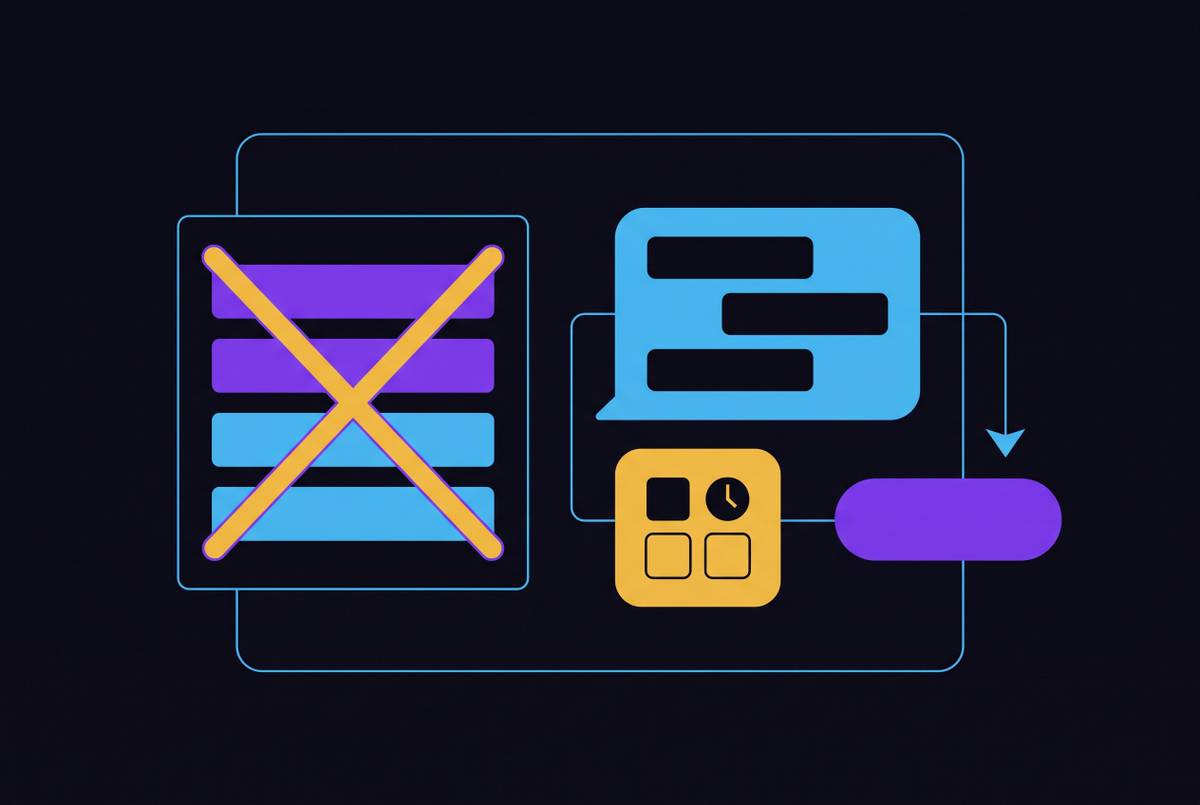
A website is built for exploration. It has to serve an investor doing diligence, a returning customer checking an invoice, a job applicant looking for openings, and a prospect comparing vendors, all on the same domain, often on the same day. That means full navigation, broad brand education, and messaging general enough to apply to everyone who might land there.
A dedicated landing page has exactly one job: get a specific visitor to take a specific action. One offer, one audience segment, one path to conversion. Navigation gets stripped out on purpose, because every link on the page is a door the visitor can walk through instead of converting, and the advertiser already paid for that click once.
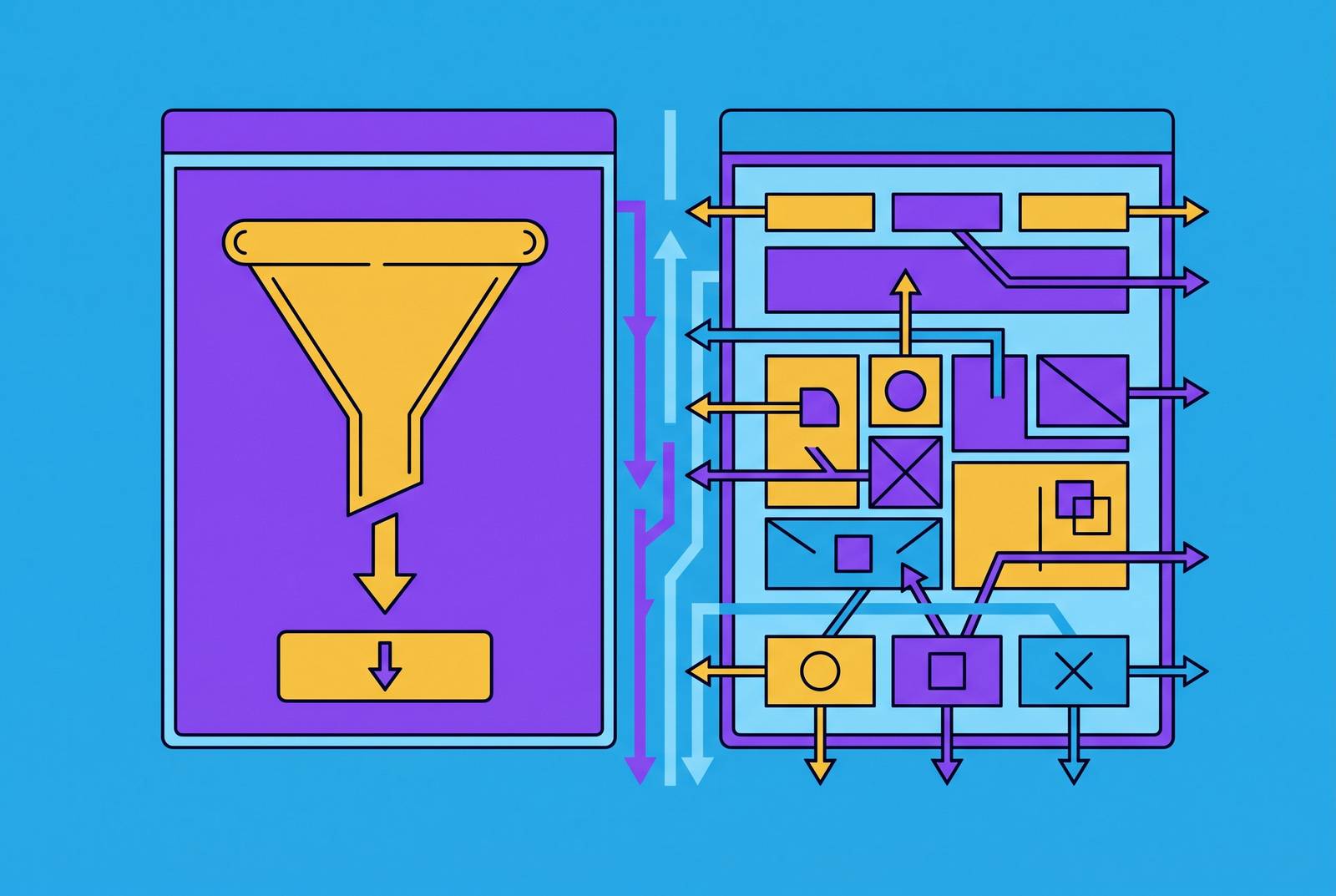
Think of it this way: a website is architected for breadth, a landing page is architected for a single transaction. Neither is wrong. What's wrong is sending paid traffic built for the second job to a page built for the first. A dedicated landing page does that work for them before they arrive.
What message match means for whether a click converts
Message match is the alignment between what the ad promises and what the page delivers. It's the single mechanism that decides whether a paid click turns into a conversion or a bounce, and no page built to serve multiple audiences can achieve it reliably.
At the moment of the click, a visitor forms a specific expectation based on the ad's headline and offer, then lands somewhere that either confirms that expectation instantly or doesn't. If the page doesn't confirm it fast, the implicit promise the ad made is broken, and trust collapses before the visitor has even scrolled to a form.
A homepage can't make that promise to any one visitor, because it's making a different promise to five other visitors at the same time. Message match is structurally off the table on a homepage.
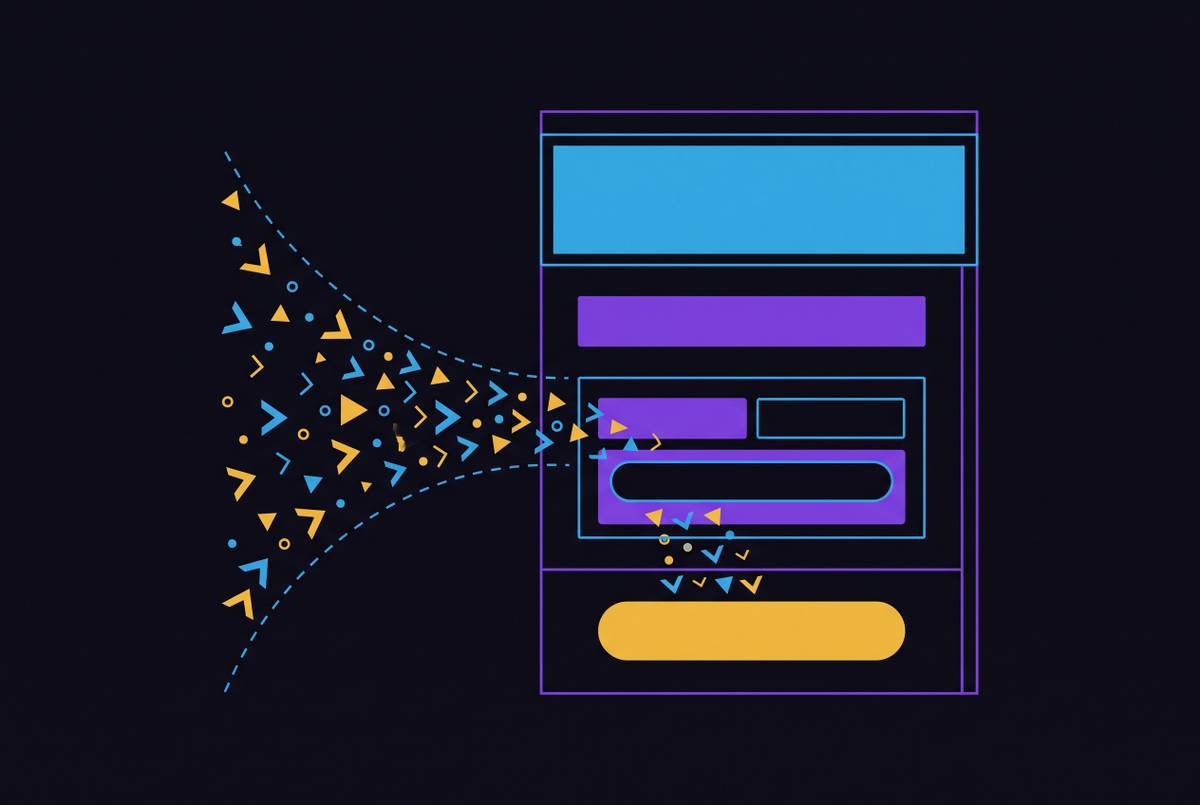
A dedicated landing page doesn't have that conflict. It can repeat the ad's exact headline, restate the specific offer, and present one clear next step, so the click feels like a continuation of the ad, and that continuity is the whole mechanism.
The navigation bar makes the mismatch visible immediately. A website's menu offers a blog link, an about page, a careers section, maybe a resources tab. Each one is an invitation to leave the path the advertiser built and paid for.
The conversion rate gap between dedicated pages and website pages
Across real campaigns, dedicated landing pages consistently beat website pages by a margin wide enough to decide whether a campaign turns a profit or burns budget. This gap means a program works or it doesn't.
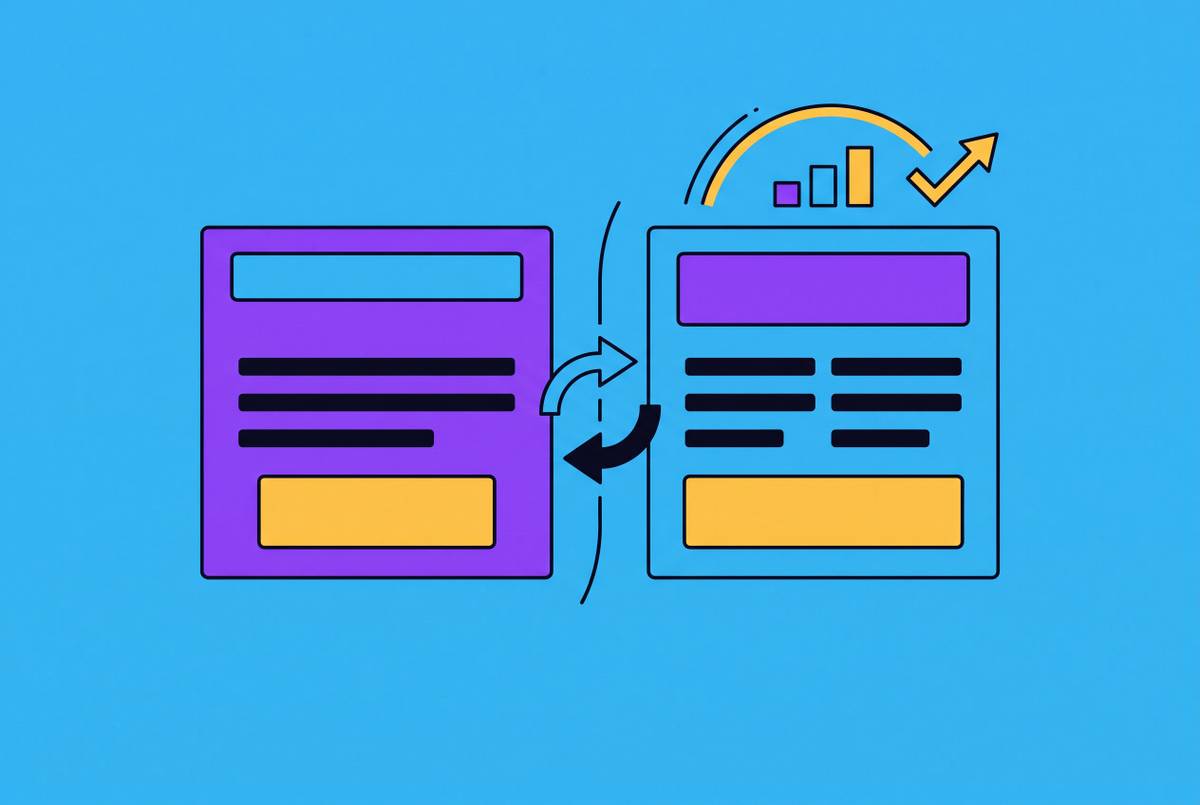
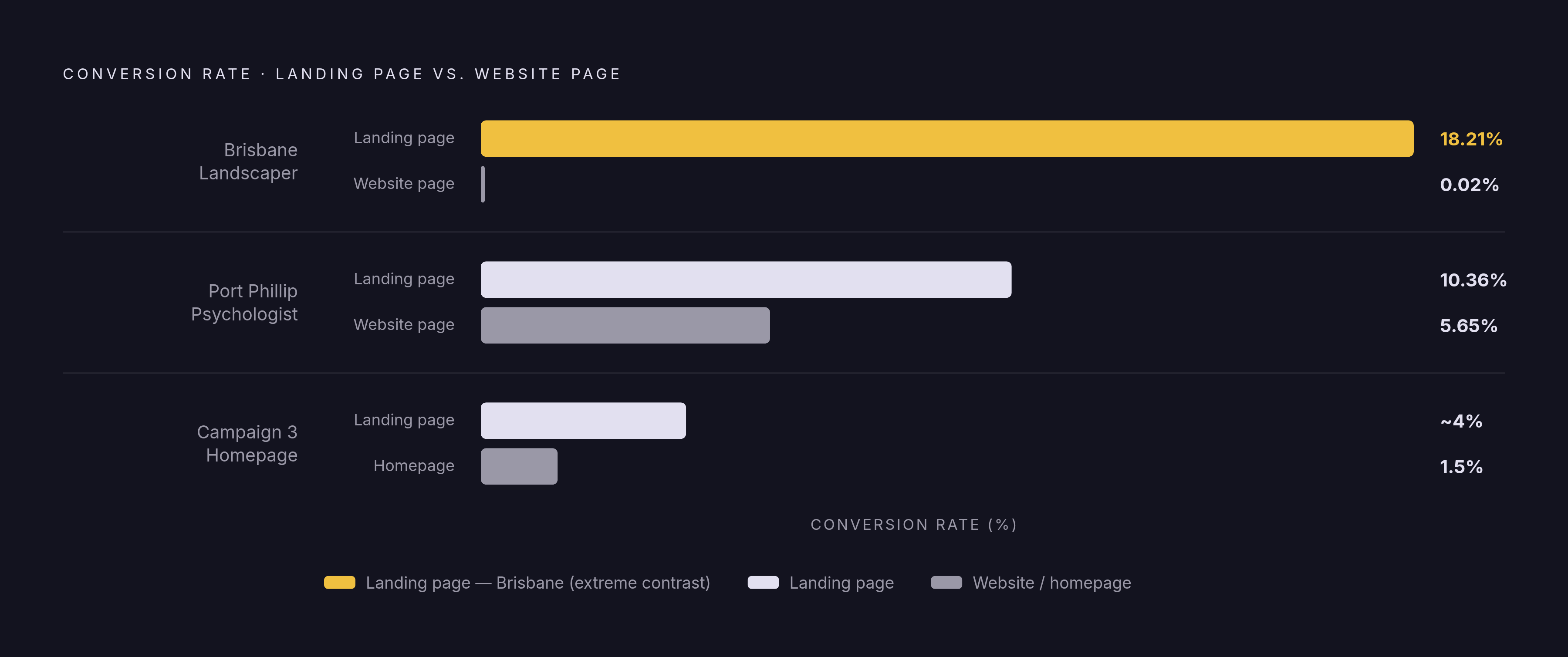
CLIQ Marketing Content tested this directly across three campaigns in three different industries, and the pattern holds steady regardless of the business type. For a landscaper in Brisbane, the gap was even sharper: the landing page converted at 18.21% while the website page sat at 0.02%, and the landing page generated substantially more enquiries even with fewer clicks and a higher cost per click. For a psychologist in Port Phillip, the landing page reached 10.36% against 5.65% for the website page, a meaningful lift even though that website page was already performing above average for its category.
What ties these three together is the architecture, not the industry: the same structure produced the same result across different audiences and price points. All three landing pages were built around one service offering, with messaging matched closely to the Google Ads copy, trimmed navigation, and a single clear next step. Different industries, different audiences, different price points, same architecture, same result.
Traffic sent to the homepage converted at roughly 1.5%. The ads didn't change. The page the ads pointed to did.
The cost-per-lead math compounds from there. A campaign converting at a fraction of a percent generates far fewer leads over the same spend and timeframe than the same traffic sent to a dedicated page, and that gap is a landing problem.
How landing page architecture produces message match
A dedicated landing page earns message match through a specific set of choices, each one removing a friction point that a website page can't remove without breaking its own broader purpose.
The page exists around a single offer and a single conversion action, whether that's a demo request, a content download, or a consultation booking. Every element on the page answers to that one goal. Stacking a second offer on top of the first dilutes intent and suppresses conversion for both offers.
Removing navigation isn't a visual preference. Every link left on the page is a potential exit from a click the advertiser already paid for.
Headline continuity matters just as much. The visitor's brain needs to register the match before they've read a single line of body copy.
Proof has to be calibrated to a B2B buyer. Named customer logos, role-specific case studies, and outcome-specific testimonials carry the weight, and the proof shown should match the persona the ad was targeting.
Form length is a decision, not a default. A lower-intent keyword might need more context on the page before a visitor is ready to see a form.
Page speed belongs on this list too, because it's a conversion input, not a technical afterthought.
Google's ad quality systems and landing page relevance
Message match isn't only a conversion mechanism. Google's ad quality systems read the landing page as a direct input into what an advertiser pays per click and how often their ads get shown, so a mismatched page raises costs across the whole campaign, not just on the page itself.
Quality Score factors in landing page experience and ad relevance directly. A generic website page sends a weaker version of that signal than a page written specifically around the ad's keyword and offer, because the alignment Google is scoring simply isn't there to find.
The practical result: two campaigns running identical ad copy and identical targeting can land on meaningfully different cost-per-click outcomes based on landing page relevance alone. The page is doing work at the auction level, before a single visitor has converted or bounced. A weak landing page costs money twice, once in lost conversions and once in a campaign that simply costs more to run.
Where website pages belong in a B2B Google Ads program
Website pages aren't a failure mode, and treating every click to a homepage as a mistake misreads the picture. They serve a real function in B2B Google Ads, just a narrower one than lead generation, and the conversion gaps in the previous sections appear specifically when that narrower function gets stretched to cover a job it was never built for.
When someone searches for a company by name, they expect to land on that company's homepage.
Lower-funnel informational queries fit website pages well too.
Remarketing sequences have a place for website pages as well.
The underlying principle holds across all three cases: a homepage is designed to speak to many audiences without targeting any single one specifically, and that breadth works in its favor for organic and branded traffic while working against it for paid lead generation.
Campaign architecture that uses both page types correctly
A well-built B2B Google Ads program doesn't pick one page type over the other. It treats dedicated landing pages and website pages as complementary instruments, each assigned to the traffic type and funnel stage it was built to serve, with that assignment made at the ad group level.
The 1:1 ad-to-landing-page ratio is the organizing rule here: every ad should lead to a page that addresses exactly the promise made in that ad, not a shared page covering a family of related offers.
Branded and navigational campaigns route to the homepage or a brand page, and that's not a compromise.
Intent segmentation is the decision rule that ties the whole structure together. High-intent, solution-specific queries earn dedicated landing pages. Research-phase or category-level queries can go to content or service pages with softer calls to action. Branded queries go to the homepage.
Scaling matters here too. More targeted pages means more addressable intent, and that compounds.
Post-submit routing belongs inside this architecture as well, not outside it. What happens after a form is submitted, including the thank-you page, the CRM entry, and the handoff to sales, is part of the landing page system. A conversion that disappears into a CRM with no routing behind it is a lead that was paid for and then thrown away.
Pipeline quality and the page decision
A high conversion rate on a misaligned page can post a strong number on a dashboard while failing to produce qualified pipeline.
Message match does qualification work before the form is even submitted. A generic landing page, or a homepage pressed into service as one, can post a strong number on cost-per-lead while quietly failing on cost-per-opportunity or cost-per-closed-deal, because the evaluation has to extend past the conversion event to mean anything.
The landing page is also where a B2B buyer forms their first real impression of whether a vendor understands their specific problem. A page that's specific and well-matched signals competence. A generic page signals that the vendor hasn't bothered to learn who's on the other end of the click.
Form design plays into this directly. The right call depends on whether the sales team is constrained by volume or by quality, and that's a conversation a campaign has to have honestly.
How ongoing iteration compounds campaign intelligence
A dedicated landing page is a surface that keeps generating evidence about what messaging, proof, and offers actually resonate with a specific buyer segment, and that evidence makes every later campaign decision faster and better grounded.
Because a dedicated page serves one intent and one offer, the behavioral data it produces is interpretable in a way a website page's data isn't. A shift in conversion rate maps back to a specific hypothesis about that audience, instead of getting confounded by multiple offers and multiple visitor types competing for the same page.
Programs that start from a blank slate every quarter, building a new page and a new hypothesis with no carry-forward learning, spend their first months relearning what earlier campaigns already proved out. A program with a library of tested landing pages and documented results starts every new campaign from a higher baseline.
What the landing page decision means for B2B paid media programs
Running a landing page program that sustains message match across every ad group, compounds intelligence over time, and ties conversion data back to pipeline quality isn't a task that fits neatly inside a standard agency retainer, a self-serve software dashboard, or an in-house team already stretched across five other priorities.
The landing page can't be separated from the ad group feeding it or the CRM receiving its conversions. Treating it as a standalone design task breaks the system, because it has to be managed as one piece of an integrated architecture that includes creative, copy, form routing, and attribution all moving together.
Delegated paid-media services like Thunder, which manage Google and LinkedIn Ads end to end, enforce message match across every campaign variation precisely because the problem can't be solved by tuning the platform alone. It takes continuous coordination between creative, landing page experience, and the ad's promise, and that coordination often reveals that the real constraint on conversion is structural.
An agency staffed by people occasionally assisted by AI tools can build a landing page well enough. What it typically can't do is continuously monitor how that page interacts with shifting search behavior, Quality Score signals, and pipeline outcomes without a heavy manual lift, and its fee structure, tied to spend, gives it little reason to chase that work down anyway. A software platform shifts the burden the other direction, handing the marketing team the job of making the message match calls, managing page variants, and interpreting performance data, which is the actual job of a skilled paid media operator rather than something a dashboard can carry on its own.
Thunder runs this as one integrated system instead. Agent OS handles continuous monitoring, optimization, and iteration across the full ad-to-page-to-pipeline chain, while Forward Deployed Marketers supply the judgment calls an agent can't make alone, like which hypotheses are worth testing, which conversion signals can be trusted, and when a landing page problem is actually a positioning problem wearing a landing page's clothes.
The compounding cost-per-lead effect described earlier means a single decision about page type cascades through the entire economics of a campaign, and that demands measurement built around qualified pipeline. Every campaign run this way accumulates evidence, what messaging matched, what offers converted, what audience segments produced qualified pipeline, so the next landing page starts from that history, and the compounding intelligence described earlier becomes a built-in property of the program.