Landing Page Personalization for B2B Audience Segments
Tailored value propositions and proof points boost B2B conversions across buying committees.
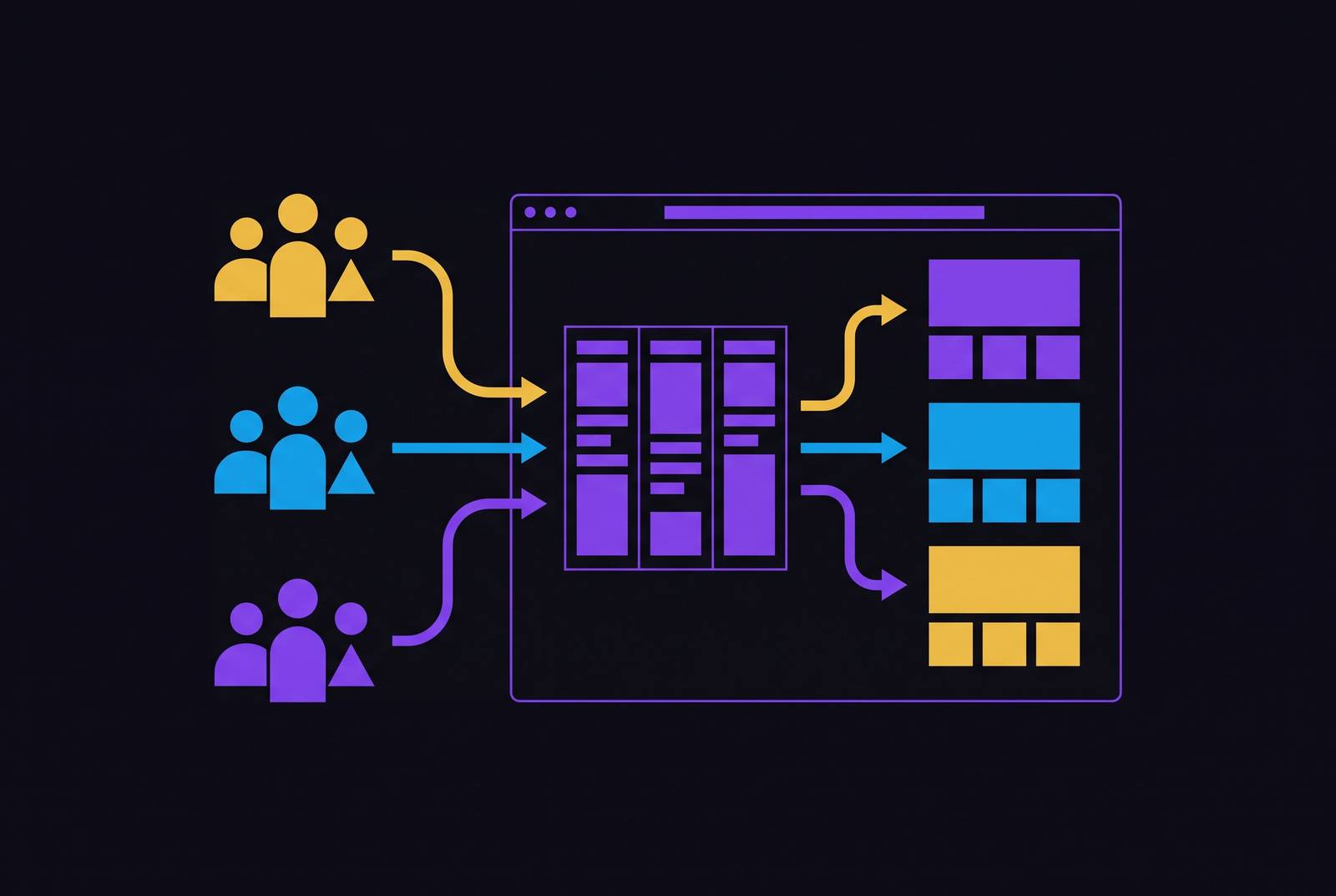
Effective B2B landing page personalization goes beyond swapping one token for another (it maps distinct value propositions, proof points, and CTAs to the specific roles, industries, or intent signals each audience segment brings to the page, then builds the operational system to produce and test those variants at scale).
Why a Single B2B Landing Page Fails the Buying Committee
A B2B landing page usually has one job: convince one visitor to do one thing. But for deals over $50,000, that "one visitor" is a fiction Forrester/6sense. Forrester's State of Business Buying 2026 puts the real number at 13 internal stakeholders, plus 9 external influencers, all touching the same decision Forrester/6sense. That's not a buying committee. That's a small conference.
The page persuasive enough to win over a VP of Sales might actively push away the CFO clicking the same link an hour later Forrester/6sense. Finance wants ROI and risk mitigation. Engineering wants to know if it actually integrates with what they've already built. Operations wants to know how much of their week this is going to eat during rollout. One value proposition, written for one persona, cannot satisfy all three at once. It wasn't built to.
The baseline numbers make this worse, not better. Generic, one-size-fits-none pages tend to run at the low end of that already-thin range involve.me involve.me. Add to that a habit that refuses to die: a large share of B2B paid traffic still gets dumped onto a generic home page instead of a page built for the campaign that brought the visitor there. That's ad spend paying to generate a click, then wasting the click on a page with no message match.
So the tension is straightforward. Buying committees are wide, varied, and getting more crowded by the stakeholder Forrester/6sense. Most marketing teams are still producing exactly one page per campaign. Something has to give, and right now it's the conversion rate.
B2B landing page personalization: meaning and limits
Personalization is not a mail-merge trick wearing a personalization costume. It's a mail-merge trick wearing a personalization costume. It changes nothing about the actual argument the page is making.
Prismic's 2026 comparison of ABM tools makes the point sharply: "Token swapping doesn't count, we wanted tools that adapt messaging, use cases, and proof points based on account context". That's the bar. Real personalization touches three things, and it touches them together, not one at a time: the value proposition (what problem this actually solves for this specific role), the proof points (the evidence this particular audience will find credible), and the call to action (the next step that matches where this buyer sits and how much authority they have to act).
For deals over $50K, buying committees now average 13 internal stakeholders plus 9 external influencers, and the page that persuades the VP of Sales may actively repel the CFO reviewing the same link Forrester/6sense. It opens with cost reduction and payback period, because that's the math a CFO is accountable for. The other is built for an engineering lead. It opens with integration architecture and API coverage, because that's what determines whether this thing survives contact with their existing stack. Same product underneath. Almost nothing else the same.
Three axes tend to define these segments in B2B. Role and seniority: what is this person accountable for, and what objection sits behind that accountability. Industry and vertical: the specific language, workflows, and competitive references that make a proof point land instead of bounce. And intent signal: where the visitor actually is in their buying cycle, since a visitor still forming an impression needs education, while an in-market visitor needs friction removed and evidence fast.
At any given moment, only about 5 to 7% of the addressable market is actively buying. Call it the 95:5 principle. Most personalization effort, if it's only built for the buyer ready to sign, is built for a sliver of the audience. The other 95% need a different kind of page: one that builds trust and impression rather than closing a deal that isn't there yet.
The conversion case for segment-matched pages
The number that gets quoted most often is that personalized landing pages tailored to specific audience segments can improve conversions by up to 202% involve.me. That's a real ceiling, not a typo, and it's worth asking what produces it before treating it as a promise.
The 202% figure describes the best-case outcome: well-executed personalization, run on the right infrastructure, by a team that's done this before involve.me. The distance between that number and what most teams will see on a first attempt is a matter of infrastructure and experience, not a flaw in the concept. It's operational. It's the difference between having the system to produce and test real variants, and not having it involve.me.
A more grounded benchmark comes from KlientBoost's work with B2B client Docket involve.me. Building segment-specific pages in place of the client's prior generic pages produced a 68% increase in conversions⟧c14⟦ involve.me. That's a believable number for a well-run first program: not a ceiling, but a floor worth aiming for.
Smaller elements support the same pattern. Optimized hero sections alone lift conversions by 13 to 15% involve.me. Adding a single relevant customer testimonial, in one case study, lifted conversions by 34% involve.me. Neither of those numbers requires a full personalization system to capture. But they compound once the underlying segment match is right, which is the whole argument for building the system in the first place involve.me.
Segment personalization is the mechanism most likely to push a B2B program from that median toward the top of the band involve.me. The cost of skipping it isn't neutral, either. The same ad spend keeps producing lower-quality pipeline, and the one committee member whose specific objection never got addressed becomes the reason the deal stalls.
Two architectural approaches to building personalized pages
Evidence for personalization is one thing. Building it is another. Tofu's 2026 comparison of tools in this space draws a clean architectural line: generate-from-scratch versus modify-existing-pages. Each comes with its own workflow, its own ceiling for how far it scales, and its own demand on the team running it.
Generate-from-scratch starts with a single campaign brief. From there, AI produces complete, ready-to-publish page variants per account or per segment, pulling in firmographic, technographic, and intent data to shape each one. This is where narrative-level personalization actually happens: headlines, pain points, use cases, and proof points all shift, not just the name in the top corner. The scale this unlocks is not subtle. VITRONIC, working through Prismic, launched a 60-page personalized campaign in roughly 90 minutes, work that used to take weeks. This approach fits ABM programs scaling into dozens or hundreds of account-specific pages, and any team that needs genuinely unique content rather than a coat of paint over one base page.
Modify-existing-pages works differently. A JavaScript snippet sits on the existing site, and a visual editor defines which elements change for which segment. It's faster to get running, since nothing is being built from zero. But it's bounded by whatever the base page already accommodates; if the original page has no room for a segment's specific proof point, the personalization layer can't invent the room. This fits high-traffic pages where the goal is optimizing conversion within a segment, not building unique destinations for named accounts.
These two approaches aren't a fork in the road so much as two tools in the same kit. Sophisticated programs tend to run both: generate-from-scratch for named target accounts, modify-existing for the broader traffic that doesn't warrant a bespoke page. The real question to ask isn't "which one is better." It's "how many unique pieces of content do we actually need, versus how much traffic on a smaller set of pages are we trying to convert better." That answer points to a starting architecture, not a permanent one.
The tools available for B2B landing page personalization in 2026
The tools below sort roughly by architecture, and the right one depends on the criteria that actually matter for a given team: personalization depth, how well the tool integrates existing data, how far it scales, how much of the work marketing can do without engineering, and how transparent the pricing is.
It's rated 4.6 out of 5 on G2 in Tofu's comparison, and it's built for teams that need to scale personalized pages across many accounts without rebuilding each one by hand. Prismic's ABM Page Builder works from a single approved base page, generating narrative-level variations, headlines, pain points, use cases, proof points, using CRM and enrichment data, and delivers them as editable drafts in organized batches with a review workflow attached. It's marketing-owned; no developer is required to publish. It's built for campaign destinations, not for personalizing a site wide and permanently.
On the modify-existing side, the picture shifted recently. Mutiny relaunched in April 2026 as an agent-first GTM content tool, generating net-new assets like ABM pages, deal rooms, case studies, and meeting recaps through an AI agent editor, rather than the JavaScript overlay it used to run. It integrates with Salesforce, runs on custom pricing with a free tier and a Business tier starting around $40,000 a year, and carries a 4.5 rating. Prismic's comparison notes it's not optimized for building net-new, one-to-one ABM pages, which is worth knowing before picking it for that specific job.
A wider band of tools serves personalization inside a broader testing and optimization workflow. Intellimize runs AI-powered experience optimization with machine-learning-driven personalization, A/B and multivariate testing, audience-level personalization, and revenue attribution, rated 4.3/5. Unbounce is a drag-and-drop builder whose Smart Traffic feature routes visitors to whichever variant converts best, with pricing from $99 to $625 a month and a 4.2 rating; its personalization is session-based rather than account-based, with no native account-level ABM model tofuhq.com. Instapage focuses on 1:1 ad-to-page personalization for enterprise use, with heatmaps and dynamic text replacement, pricing from $199 a month to custom enterprise, rated 4.2. Optimizely runs full-stack experimentation with feature flags and audience targeting at enterprise pricing, rated 4.1. VWO covers A/B and multivariate testing with audience segmentation by location, traffic source, device, and behavior, from $357 a month, rated 4.1. Dynamic Yield offers enterprise experience optimization at custom pricing.
A few tools lean on existing ecosystems rather than standing alone. HubSpot's Smart Content shows different page content based on list membership, lifecycle stage, or referral source, which benefits teams already running their customer data through HubSpot. Demandbase brings website personalization as part of a broader ABM platform. Generate-from-scratch / ABM-native tools. Prismic's comparison finds Folloze best suited for multi-asset buyer journeys rather than single landing page experiences. Tofu's comparison finds that Salesloft offers conversational landing page personalization via chat.
Defining audience segments before building a single variant
Building the variants before deciding what actually separates one segment's priorities from another's undoes most personalization programs before they start. The tool matters less than the thinking that feeds it.
Three segmentation approaches tend to answer three different questions. Role and seniority segmentation asks what this person is accountable for, and what a bad decision costs them personally, since a CFO, a VP of Engineering, and a Head of Marketing each carry a different kind of risk. Industry and vertical segmentation asks what language and context this buyer operates in, since a fintech buyer and a manufacturing buyer might share the exact same pain point but need entirely different evidence before they'll trust a claim about solving it. Intent and behavioral segmentation asks what signal actually brought this visitor to the page, since someone arriving from a retargeting ad has already seen the brand, while someone clicking a cold LinkedIn ad hasn't, and the page has a different job in each case.
That segmentation work only matters if it's in service of something concrete. DemandWorks' B2B GTM survey found that 75% of B2B marketing and GTM leaders name generating more pipeline as a top demand generation priority. Segment strategy is the connective tissue between a personalized page and that pipeline number; without it, personalization is just decoration.
A practical way to start: before writing a single sentence of copy, map each segment so that finance's priorities of ROI and risk, engineering's technical fit, and ops's workflow change are each addressed, since a single value proposition cannot satisfy all three. What problem is this person hired to solve? What objection is most likely to kill the deal if it goes unanswered? And what proof point will actually be credible to their role, whether that's a customer logo from their own industry, a metric their function is measured on, or a regulatory reference that tells them this is safe.
Don't over-segment on day one. Start with two or three well-defined segments. Expand once there's data to justify it.
None of this works without decent inputs. CRM fields, firmographic enrichment, intent data from platforms like Demandbase or Clearbit, and targeting signals pulled from LinkedIn (job title, seniority, company size) all feed the segment definition. The cleaner that data is going in, the more defensible the segment is once someone asks why the page looks the way it does.
Producing variants that adapt message, proof, and CTA (not just headlines)
Segments defined, the next job is making sure each variant actually earns its existence, rather than just wearing a different headline over the same page.
The first layer is the value proposition itself. The hero section has to answer the specific question that segment is asking. For a CFO, that means leading with cost reduction, payback period, and risk reduction, not a tour of features. For a procurement or operations audience, that means leading with vendor risk, contract terms, and implementation timeline, not an ROI chart that assumes the deal is already won. Each version is answering a different question because each reader walked in holding a different question.
The second layer is proof. Evidence only works if it's credible to the specific person reading it. A customer logo and case study pulled from the visitor's own industry does more work than a generic one, because a SaaS buyer trusts a SaaS customer's story in a way they simply don't trust a manufacturing company's story, no matter how strong the numbers are. The proof point is a signal that the page understands who's reading it, which is, in the end, the entire promise personalization is trying to keep. It's a signal that the page understands who's reading it, which is, in the end, the entire promise personalization is trying to keep.
Sources
- Best AI Tools for B2B Landing Page Personalization in 2026
- Landing Page Design Trends by Industry (2026 Guide) | involve.me
- The 6 Best ABM Landing Page Tools for 2026: Complete Comparison
- 100+ Landing Page Statistics You Should Know (2026)
- ABM Landing Pages: The Complete Guide for B2B Teams in 2026 · GenPage Blog