Predictive Audience Targeting Using AI in Google Ads
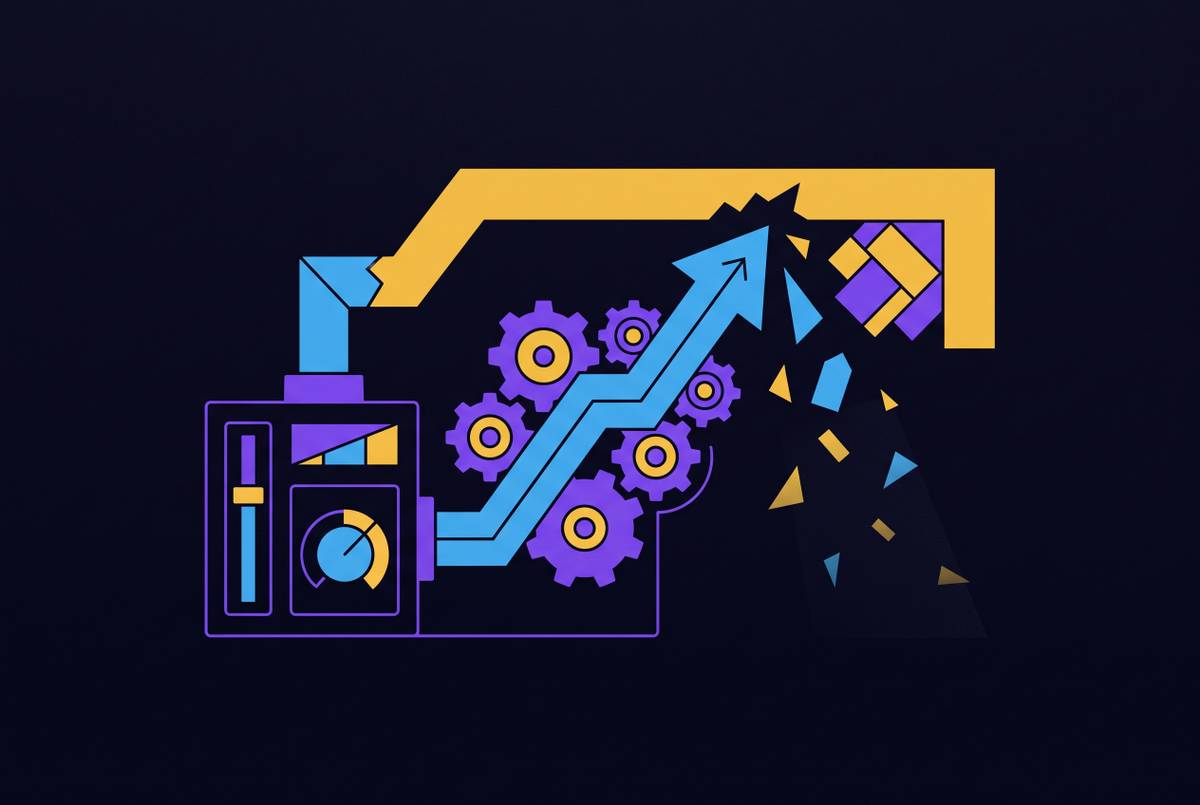
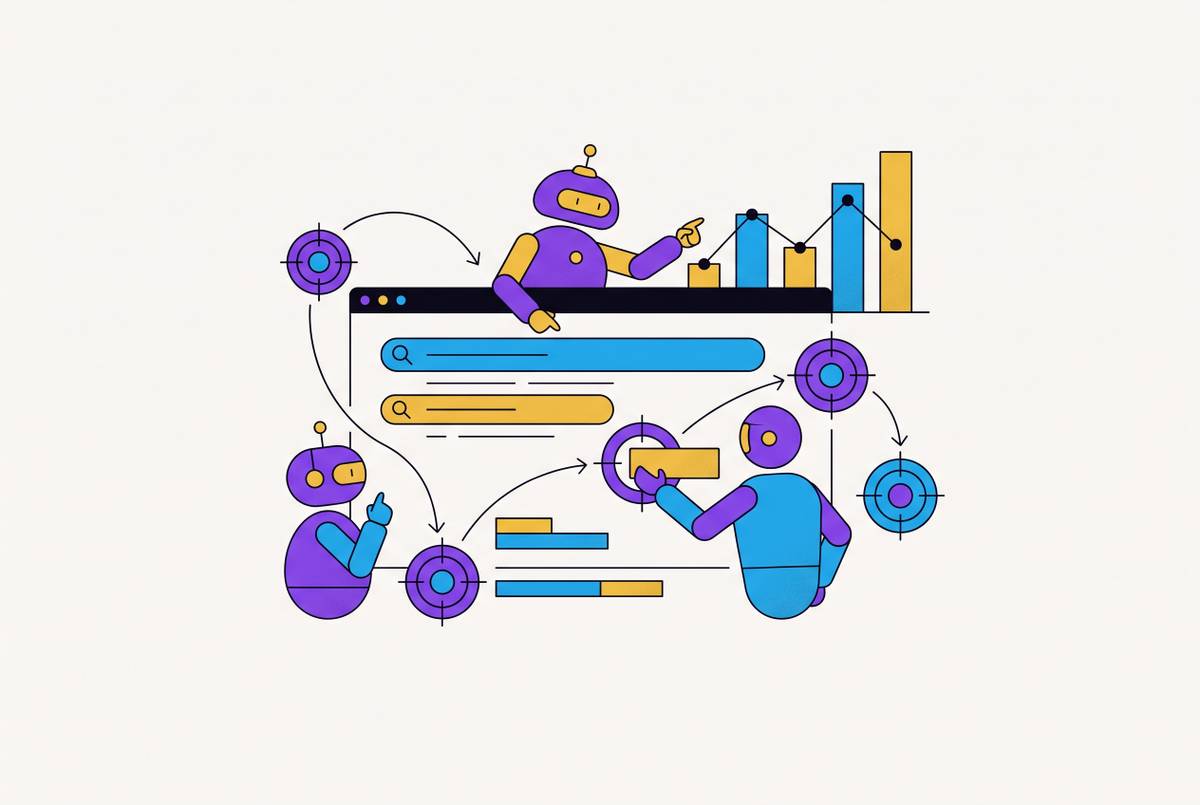
Google's machine learning now targets buyers before they signal intent.
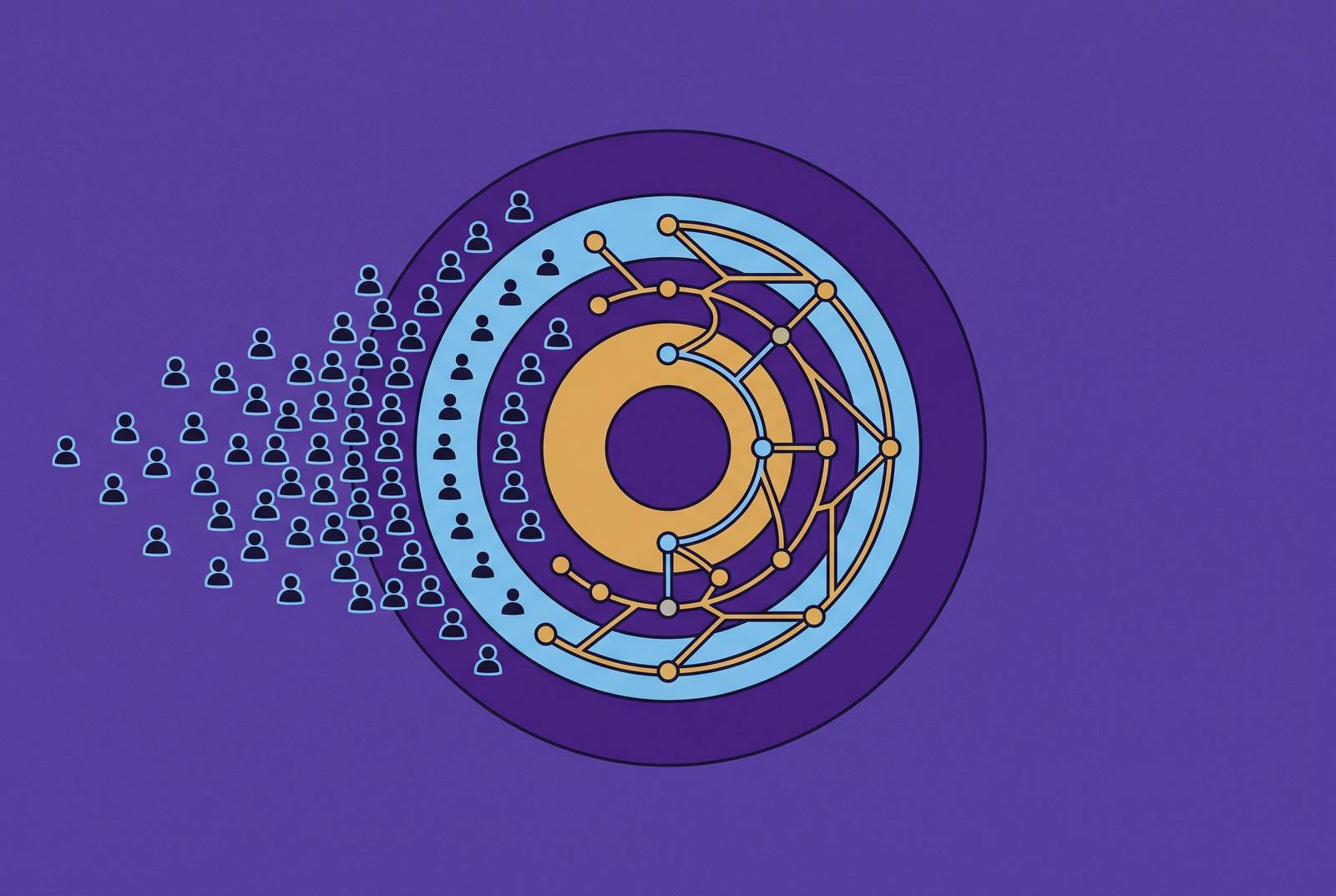
Google Ads spent most of its history looking backward. The dominant model found people who had already done something: visited a page, clicked an ad, typed a search. Then it served them more ads based on that history. Predictive audience targeting flips that order. Machine learning models now scan behavioral signals so they can flag likely converters before those users have searched anything, before they've visited the site, before they've shown any intent a human could point to.
That reversal changes when a campaign can reach a buyer. Instead of waiting for someone to type a query, the system can reach them while they're still forming the idea that they need something. For B2B, where sales cycles stretch for months and the buying committee might be three or four people total, that early reach is worth a lot more than it sounds. Catch a buyer before their consideration set hardens, and competitors haven't found them yet.
The signal architecture underneath Google's predictive audience system
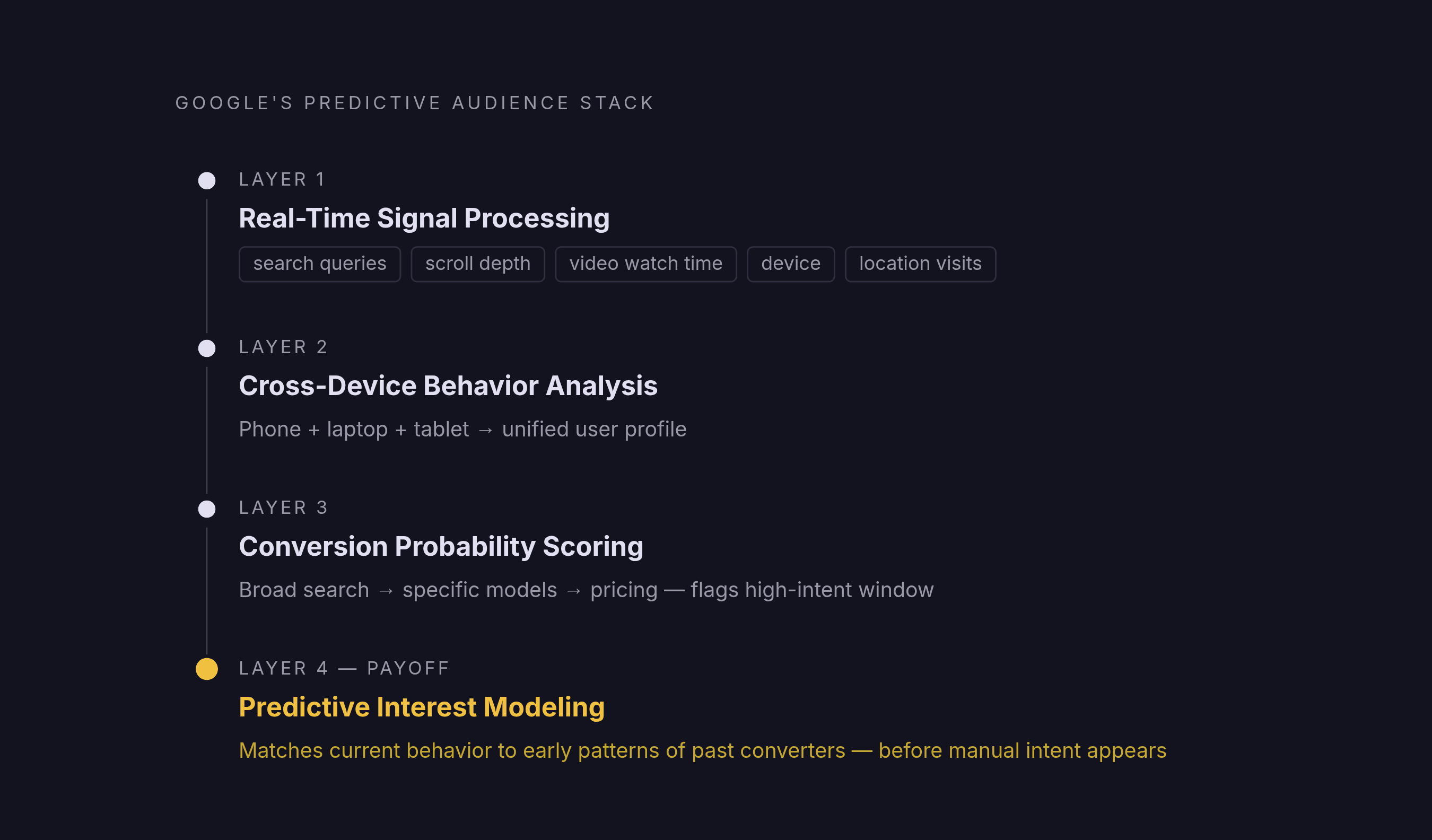
Google's predictive audience system runs on four layers of machine learning, and knowing what each layer does is what lets a marketer actually configure the thing instead of just flipping it on and hoping.
The first layer handles real-time signal processing. It pulls in behavioral data continuously: search query patterns, time spent on a page, how far someone scrolls, how long they watch a YouTube video, how they interact with email, how often they visit a location, what device they're using. The system finds small behavioral correlations that a human analyst would take weeks to spot.
The second layer does cross-device behavior analysis. It takes activity across phone, laptop, and tablet and stitches it into one profile per user. That matters because older audience targeting tended to undercount intent when a buyer researched on their phone during a commute and came back to evaluate options on a work laptop. Without that stitching, the system sees two half-interested people instead of one serious one, because it can't connect their activity into a single profile.
The third layer aggregates intent signals into a conversion probability score. Someone who searches a broad product category, then narrows to specific models, then checks pricing across a few sites in a short window gets flagged with a much higher intent score than someone browsing the category in general terms.
The fourth layer is predictive interest modeling. This is where the system takes current behavior patterns and uses them to guess future behavior, matching users against the early-stage patterns of a marketer's best past converters, before those users look like prospects to anyone watching manually.
GA4 feeds all four layers through its own predictive metrics: Purchase Probability, Churn Probability, and Predicted Revenue. Those metrics power the two segments available in the Predictive Audience Builder since GA4 first rolled predictive audiences out: Likely 7-day purchasers, built on 7-day purchase likelihood, and Likely 7-day churning users, built on 7-day churn likelihood.
First-party data's role after third-party cookies
Third-party cookies are gone, so these predictive models now have to learn entirely from first-party data. A B2B marketer who doesn't actively feed that data in is handing the model a thinner, worse signal set to learn from, and the model will build audiences accordingly.
A handful of integrations do the heavy lifting here. CRM integration through HubSpot or Salesforce connects account-level data to audience segments, so the system learns what an actual qualified buyer looks like, not just what a form-filler looks like. Enhanced Conversions for leads passes hashed email data from form submissions back into the algorithm, and that sharpens its sense of which downstream events actually track with real intent. Offline Conversion Tracking imports CRM disposition data, things like MQL, SQL, opportunity, and closed-won, so the system learns from revenue outcomes rather than just counting conversions the platform happened to record.
Understanding these signal layers matters because the AI's output is only as good as what it learns from. That's why B2B teams using platforms like Thunder, which connect CRM data, offline conversion tracking, and customer match directly into the broader growth stack, can hand the predictive model a unified signal set that distinguishes a form-filler from a qualified buyer. None of these integrations are optional extras tacked onto a campaign. A predictive system fed those integrations learns to chase pipeline; one without them learns to chase form fills.
The minimum viable data foundation before predictive audiences can function
Google enforces data minimums on this system, and a lot of B2B accounts don't clear them on day one. Knowing where those thresholds sit tells a team whether it's ready to turn predictive targeting on or whether it needs to fix its measurement setup first.
The GA4 property has to be properly linked to the Google Ads account, and it has to be tracking real conversion events, not just pageviews. That means form submissions, demo requests, and other markers of an actual qualified lead, since those are the events the AI will train on. The models also need a consistent run of conversion data before they can train properly; feed them too little, and they're making predictions off a sample too small to mean anything.
There's a hard number attached to the audience segment itself: it needs at least 1,000 active users to be eligible for targeting. Accounts under that line get a "Too small to serve" status and can't turn the feature on until traffic catches up. Only GA4 data counts now. Any marketer still tied to a UA property is feeding the model no usable data.
Lead volume optimization versus pipeline quality in B2B accounts
The costliest mistake a B2B team can make here is telling the AI to optimize for conversion volume. The system does what it's told, so lead volume and pipeline quality are different things no matter how good the dashboard looks at the end of the month.
Smart Bidding's predictive engine reads real-time signals so it can hit whatever objective it's been given. Setting that objective to form fills makes it go find the people most likely to fill out a form. It will not go find the people most likely to become a qualified opportunity, because nobody told it that's the job.
The fix is importing offline conversion data so the system can see which leads actually became SQLs, opportunities, and closed revenue. Without that feedback, the model has no way to tell a genuine buyer apart from a competitor doing competitive research or a student pulling quotes for a term paper. Value-based bidding builds on the same idea: assign different values to MQLs, SQLs, and closed deals, and Smart Bidding starts putting its bids behind the users statistically likely to produce real revenue, not just the next person willing to type their email into a form.
The full-funnel account structure and the predictive system
A predictive system trained only on bottom-funnel conversions ends up with a narrow, skewed idea of what a buyer looks like. A full-funnel account structure gives it behavioral data from earlier in the journey, and in B2B, that's where most of the actual signal lives.
At the top of the funnel, Demand Gen campaigns and YouTube video campaigns use thought leadership content and case studies to reach people who show early behavioral signals, long before they've started actively searching. Nobody involved has filled out a form yet, but these campaigns still generate engagement data the predictive system can learn from.
In the middle of the funnel, Performance Max runs with CRM-based audience signals, alongside remarketing campaigns built around comparison content. Feeding in audience signals from customer match lists and intent audiences here keeps the AI from drifting toward low-quality leads at a stage where it's easy to mistake curiosity for intent.
At the bottom, Search campaigns pair broad match with Smart Bidding, so high-intent keywords can point at conversion-focused landing pages. Broad match in 2026 reads search intent and context well enough that a keyword like "enterprise CRM solution" can trigger on high-intent variations a human would never have thought to target manually.
Performance Max gets misread a lot in B2B, but its job is straightforward: it distributes ads across Search, Display, YouTube, Gmail, and Discover using whatever assets and audience signals it's given. Done well, it reaches decision-makers earlier, and it can scale campaigns even where search volume is thin. Done poorly, without strong audience signals and solid conversion data behind it, it just optimizes toward raw volume.
Demand Gen deserves its own mention here because of one number: 81% of the buyer journey happens before pipeline entry. Most B2B buyers aren't actively searching at any given moment. AI-driven Demand Gen targeting works around that because it identifies likely converters from behavioral patterns and content consumption, not from active query intent.
None of this works as a checklist of campaign types bolted together. It works as one system, and campaigns should be segmented by product line and by ideal customer profile, not just by funnel stage, so the signals the AI collects stay specific to the buyer it's actually trying to find. The data layer tying it together, CRM integration, offline conversion tracking, lead scoring, is the feedback loop that tells the predictive system what a good outcome actually looks like at each stage of the funnel.
Attribution as the unsolved problem in predictive audience results
Predictive audiences often look like they're underperforming in standard reporting. Usually they aren't failing. The attribution models most B2B teams rely on can't capture a buying journey that plays out over months across several channels and touchpoints.
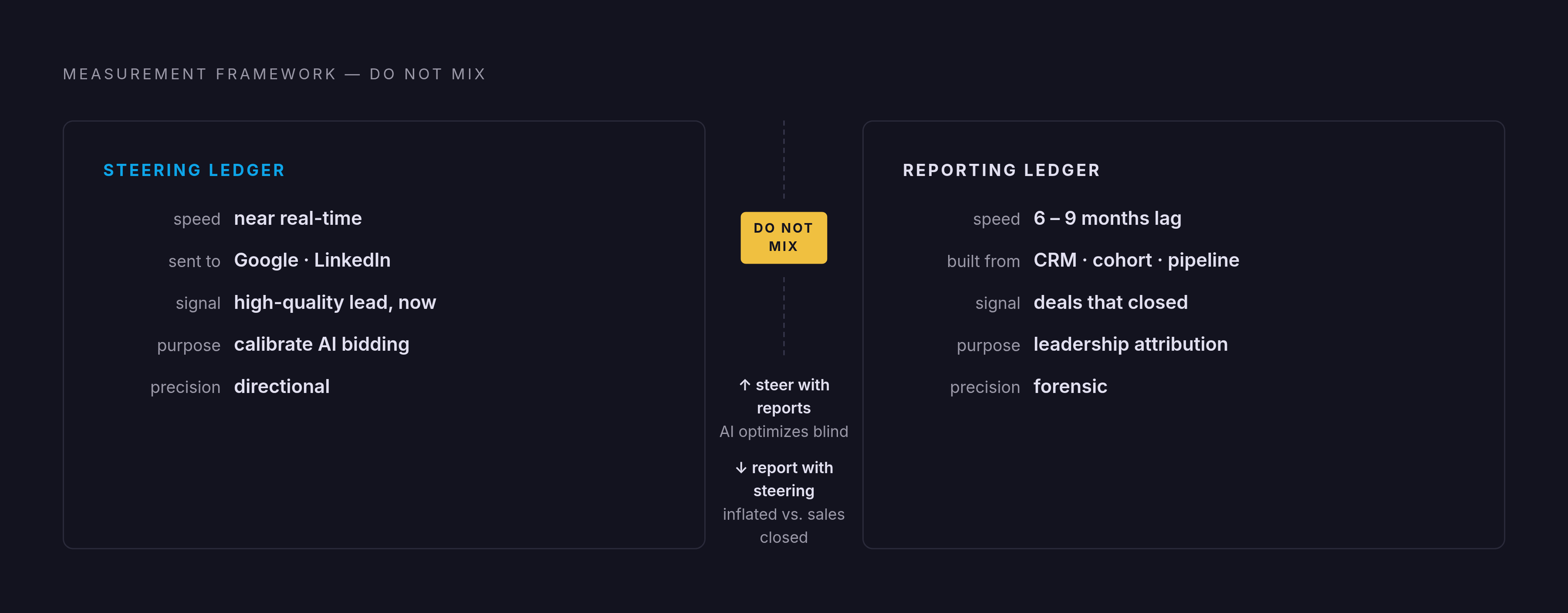
The fix is to keep two separate measurement frameworks running side by side. One is the steering ledger: the signal sent to Google and LinkedIn in near real-time, calibrated to tell the AI what a high-quality lead looks like right now. It needs to be fast and close enough to right, not forensically exact. The other is the reporting ledger: what goes to leadership, built from cohort analysis, CRM attribution, and lagged pipeline data. It moves slower, but it tells the real story of what paid media contributed to revenue.
Mixing the two breaks both of them. If the reporting ledger steers the AI, the system optimizes for outcomes that appear only months later in cohort analysis and lagged pipeline data, which it can't track in real time. If you use the steering ledger to report to leadership, the numbers look inflated against what sales actually closed.
The practical consequence for predictive audiences specifically: a segment built around high 7-day conversion likelihood will post strong short-window numbers on the steering ledger, but its real contribution, the deals that close six to nine months later, appears only in the reporting ledger. If a team judges predictive audiences purely on last-click, short-window data, it will undervalue them every time.
What AI agents add to continuous system operation
Predictive audience targeting only hits its ceiling when the system acting on it, bid adjustments, audience refresh, creative rotation, signal feedback, runs continuously instead of getting reviewed by a human every couple of weeks.
By 2026, agentic AI systems can handle a real share of PPC bid management, analytics and reporting, and audience optimization across platforms on their own, though human oversight and approval still matter in most setups. These are agents that plan a multi-step campaign, run it, and correct course based on live performance data. That's different from a tool that just suggests changes for a person to approve.
The value compounds because these agents learn across campaigns, not just within one. Creative rotation fits into that same loop rather than sitting off to the side as its own task: rotate ad copy and visuals on a regular basis to fight ad fatigue, because static creative puts a hard ceiling on what even a well-tuned predictive audience can deliver.
Always-on programs give the AI the steady signal flow it needs so it can keep getting sharper.
This is the structural question a buyer looking for "an AI agent to run B2B Google and LinkedIn Ads" actually needs answered: who is operating the system continuously, with judgment attached to it, checking in on it more often than once a month? Thunder's Agent OS is built around that exact model. The gap Thunder is built to close sits between those two: agent-run execution paired with a governance layer that makes the calls agents aren't suited to make alone.
The practical conditions under which predictive audience targeting produces pipeline-quality outcomes
Predictive audience targeting produces qualified pipeline rather than raw conversion volume when three things are true at once: the AI gets fed the right signals, the measurement framework keeps steering and reporting separate, and the system runs continuously enough for what it learns to actually compound.
Skipping that means the predictive model trains on whatever the platform happens to record as a conversion. That data won't correlate with revenue, so the audience segments it builds will be precise about entirely the wrong thing.
Predictive audiences expose the landing page as a constraint they cannot fix on their own. If you point a campaign built on sharp audience signals at a generic or slow-loading page, the system will show off in click-through rate but fall flat on actual conversions. Page quality is part of the same system as the ad campaign, not a separate task that sits next to it.
None of this technology is exclusive. Every advertiser has access to predictive audience targeting in Google Ads right now. The edge in 2026 comes from how well a team runs it: the quality of the conversion data it feeds in, the discipline of keeping steering and reporting straight, and whether the system acting on all of it runs continuously or just checks in now and then.