Google Ads Budget Allocation Across the B2B Funnel
Higher-intent keywords and smarter funnel staging beat bigger budgets in B2B Google Ads.
B2B Google Ads spending is on track to hit tens of billions of dollars in the U.S. this year. Global spend is headed toward nearly $50 billion by 2026. I had to read that number twice when I first saw it, and it still doesn't make the pipeline math any better, because here's the problem few people want to say out loud: bigger budgets don't necessarily mean bigger pipeline. CPCs keep climbing, buying committees have swelled past 11 people on average, and sales cycles are stretching longer than they were two years ago. Spend more, and you might just be paying more for the same lukewarm leads. I've watched it happen. It's not a fun meeting.
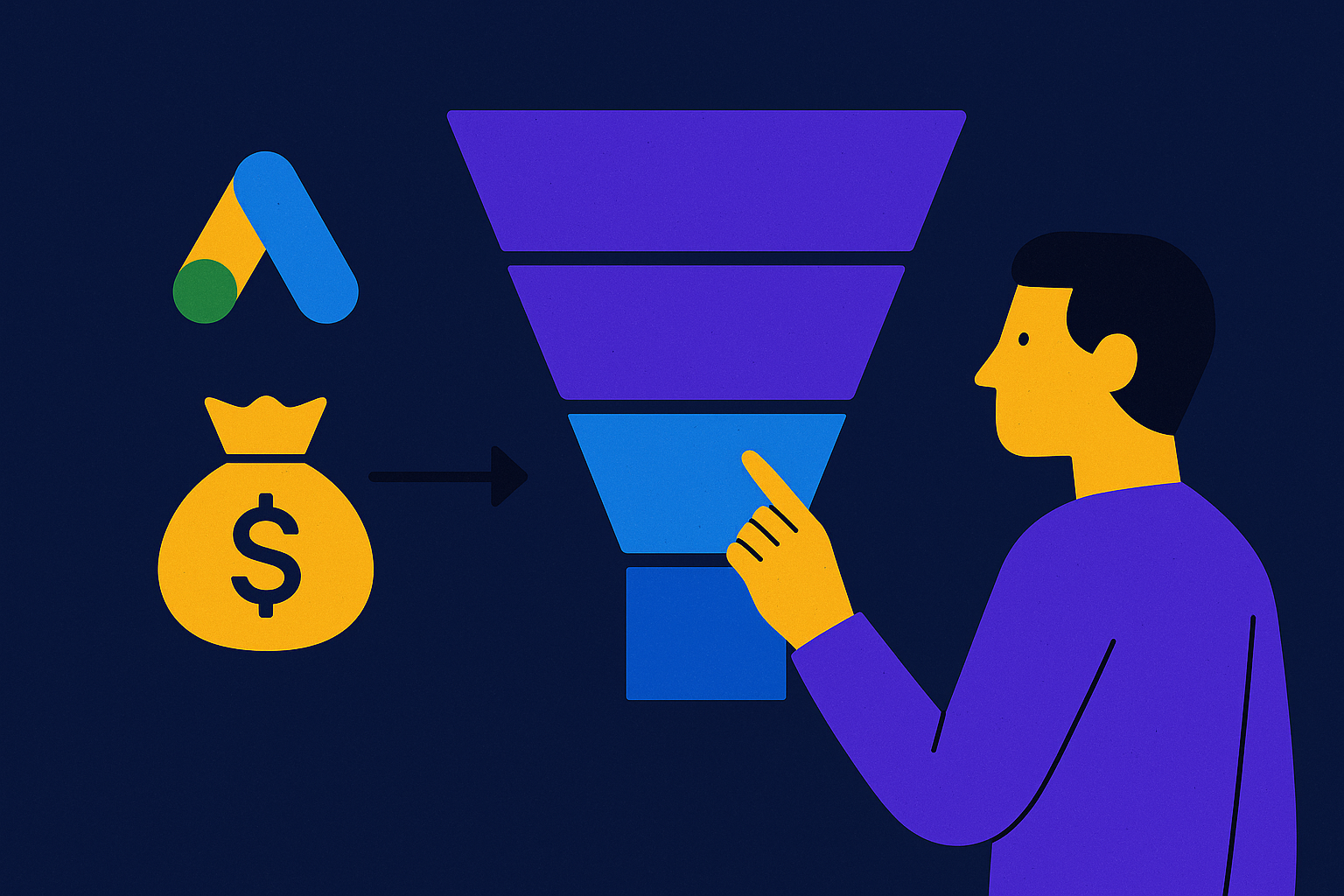
So the real question isn't "how much should we spend?" It's "where are our buyers right now, and what would actually move them forward?" That's funnel-stage logic. It's the difference between a Google Ads account that quietly compounds into pipeline and one that racks up clicks nobody in finance can explain.
Nearly half of B2B buyers do serious research before they ever talk to a sales rep, and most say they'd skip the rep conversation entirely if they could. So your ads have to do real persuading before the buyer goes dark on you, and a fixed formula ("spend a fixed share on top-funnel, no matter what") can't account for that. Buyer populations shift. Category awareness shifts. What worked last quarter might be wasting money this quarter. Let's get into where the money should actually go, and why.
What funnel-stage logic actually means in a B2B Google Ads program
Your Google Ads budget is doing three separate jobs, not marching down one straight line:
- Demand capture — catching people who already know what they want
- Demand education — reaching people who know they have a problem but haven't picked a category or vendor
- Demand creation — putting your name in front of future buyers who aren't shopping yet
Most of your addressable market isn't actively in-market at any given time. Chase demand capture alone and you're fighting over a small sliver of buyers who happen to be searching today. Everyone else is invisible to you until they decide to look.
Funnel-stage logic means your campaign type, keywords, bid strategy, and ad creative all match where the buyer actually is. Not where you assume they are, and not where your competitor's account is spending.
Get this wrong and you get a sneaky kind of failure. Clicks go up. Impressions go up. Maybe even form fills go up. Looks like a win in the weekly report. Little of it turns into pipeline. That's misalignment quietly compounding, and it's expensive precisely because it looks like progress.
Most B2B programs should start by weighting budget toward bottom-funnel, and only fund the layers above it once that base is healthy. Think of it as a logic rather than a rigid ratio. The exact split moves depending on your maturity, your category's awareness level, and what your own performance data says.
Bottom-funnel demand capture: where B2B Google Ads budget should start
Start with the people who've already done their homework. Demo requests, pricing searches, "[competitor] alternative," "[solution] for [industry]." These are buyers who know what they want and are choosing between options. It's usually the fastest path to pipeline you have.
Yes, these clicks cost more, somewhere in the single digits to tens of dollars range depending on your vertical. But cost-per-SQL usually lands lower here than anywhere else in the account, because the intent is already baked in.
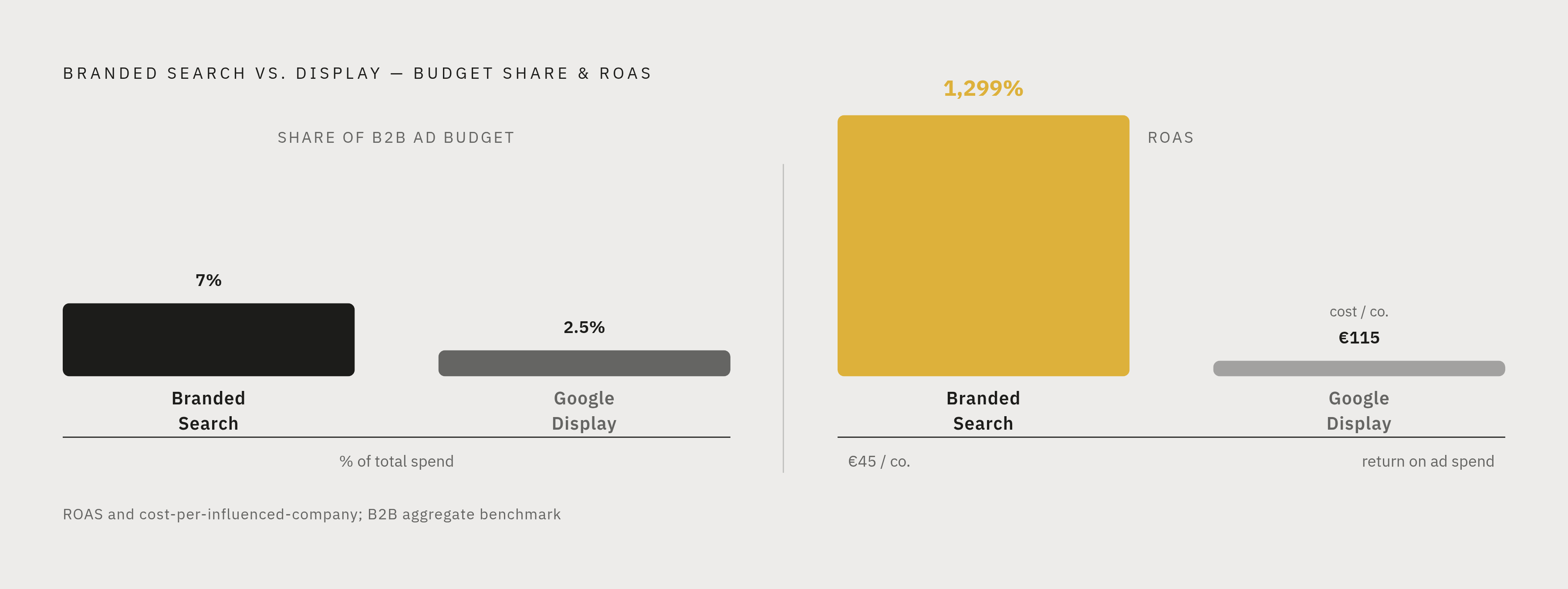
Branded search deserves its own line and its own protection. Dreamdata's 2024 B2B benchmarks put branded ads at just 7% of total ad budget, an average CPC around €5.5, and only about 2.1% of B2B web traffic. The ROAS on that sliver? 1,299%. Sit with that for a second. That's often the single most efficient dollar in your account, and it's frequently the one people forget to protect.
A rough order of operations:
- Branded search
- Competitor and high-intent non-branded terms
- Solution-category terms
- Problem-aware queries
The mistake I see constantly: budget spread evenly across all four before the high-intent layer is even saturated. That's backwards. You're paying for awareness you can't measure yet while leaving easy, high-converting searches sitting on the table.
Quick gut check: look at impression share on your high-intent campaigns. Well below full share? Fix that before you move a dollar anywhere else.
Mid-funnel investment and the role of problem-aware search
Once bottom-funnel is humming, mid-funnel comes next. Think "how to improve lead quality" or "B2B marketing automation tools." The buyer knows they have a problem. They haven't picked a category yet, let alone a vendor.
CPCs drop here. So does the direct conversion rate. Expected. The value is indirect: these clicks build remarketing audiences and generate MQLs that mature into SQLs later, sometimes much later.
A tight negative keyword list matters more here than anywhere else in the account. Phrase match without solid negatives will happily burn budget on purely informational searches that were never going to convert.
Your landing pages need to work harder here too. A mid-funnel click landing on a bare "book a demo" form is a mismatch. That buyer isn't ready yet. Give them something that teaches, not just something that captures.
Worth saying plainly: mid-funnel spend pays off on a lag. Last-click attribution will make this layer look like it's underperforming, because its contribution shows up weeks or months later. Watch a different signal instead: are the people who clicked mid-funnel ads converting at high rates once you retarget them at the bottom? If yes, it's working, even when the direct numbers look weak.
Top-funnel and display: what the B2B benchmarks say about awareness spend
Top-funnel and display are small by design, and the numbers back it up. Dreamdata's 2024 research puts Google Display Ads at 1.3% of B2B web traffic and 2.5% of total B2B ad budget.
Why so small? Look at the cost. Cost per influenced company through Display runs around €115, and cost per influenced contact around €127. Branded search does the same job for €45 and €65. Display reaches more eyeballs. Each meaningful touch just costs a lot more to get there.
Still, Display and YouTube aren't dead weight. Remember that buying committee of 11-plus people? Most of them will never type a search query related to your product. They'll see a well-placed video or banner while reading something else entirely. That's real influence, even when it's hard to trace back.
And that's the catch: top-funnel Google Ads is hard to measure across a buying cycle that stretches for months and touches a dozen people. Without multi-touch attribution in place, it just looks like waste, even when it's quietly doing its job.
A fair guideline: keep top-funnel to roughly 10 to 20% of your Google Ads budget, and only once the bottom and mid layers already work and you can attribute assisted influence, not just last-click. Otherwise you're funding a layer you have no way to grade.
How conversion architecture determines whether any allocation works
None of the allocation logic above matters if your conversion tracking is pointed at the wrong target. Median cost per conversion for B2B SaaS hit $50.67 in March 2025, and average cost-per-lead through Google Ads runs around $70.11. At those prices, optimizing for the wrong event isn't a small mistake. It's an expensive one.
Here's the mechanism, and it trips up more accounts than it should: Google's Smart Bidding optimizes for whatever signal you feed it. Feed it form fills or trial sign-ups, and it will go find you more form fills and trial sign-ups, whether or not those turn into real pipeline. The algorithm isn't smart about your business. It's smart about the metric you handed it.
The fix is offline conversion tracking: pull MQL, SQL, and Opportunity data from your CRM back into Google Ads so the bidding strategy optimizes for something that resembles revenue, not just an on-platform click.
Skip that step, and your allocation is guesswork dressed up as strategy. You'll see conversion volume in the dashboard. Telling which of those conversions ever became real pipeline will be difficult.
There's a second lever here: landing page conversion rate. Average B2B SaaS landing pages convert in the low single digits. Top performers do multiples of that. A page converting at the low end needs far more spend to produce the same pipeline as a strong page. So before you touch your funnel-stage split, ask what you're actually looking at. Is this a budget allocation problem? A landing page problem? A keyword intent problem? Diagnose first. Reallocate second.
Google and LinkedIn as a system, not competing line items
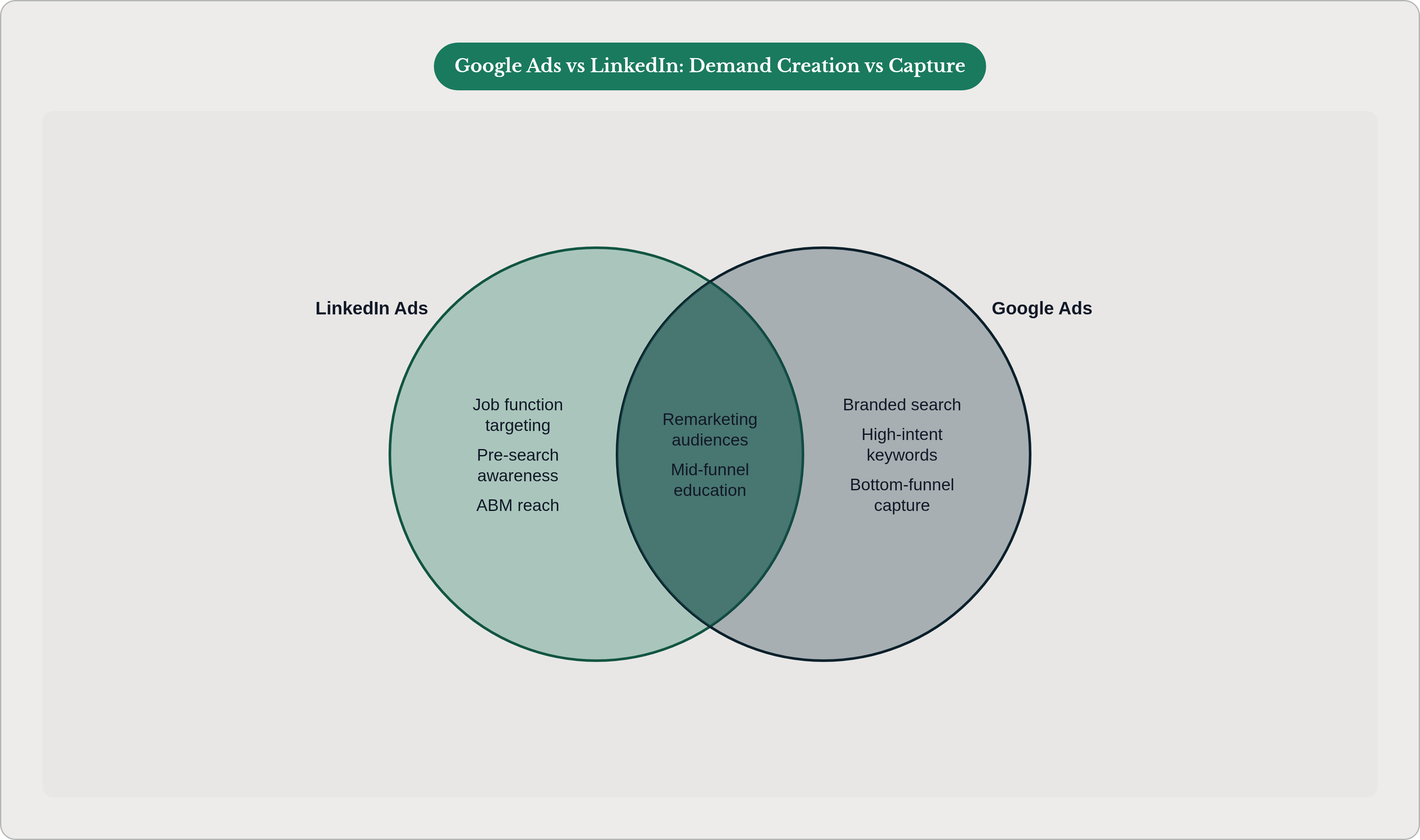
Google and LinkedIn aren't rivals fighting over the same dollar. They do different jobs. LinkedIn reaches people before they search, while they're forming opinions and educating the buying committee. Google catches them once they've already started searching. One creates demand, the other captures it.
In categories where search volume is healthy and buyers already know what to type, Google is usually the faster route to pipeline. In newer categories, where there's no shared vocabulary yet or search volume is thin, LinkedIn's targeting by job function and seniority might be the better place to start.
A sensible sequence for most B2B programs: build Google demand capture first, use that traffic to seed LinkedIn remarketing audiences, then layer LinkedIn in for mid-funnel education and account-based reach.
I watched this get inverted once at a cybersecurity company. Most of the budget went into LinkedIn lead gen forms. The result was hundreds of leads a month and a small handful of actual qualified opportunities. Rebuilding the mix (shifting weight back toward Google demand capture and rethinking how LinkedIn was used at all) improved the lead-to-opportunity rate a lot, even as raw lead volume dropped. Fewer leads, better leads. Nobody on the sales team complained about that trade.
Part of the fix was the lead form itself. Pre-filled LinkedIn forms reduce friction, sure, but they also produce contacts who never really engaged with anything; they just tapped a button. Send that same traffic to a landing page where someone has to choose to fill something out, and you'll get fewer submissions with noticeably better pipeline quality.
For a baseline: average B2B Google Ads performance as of Q3 2025 runs around a 3.17% CTR and $2.69 CPC, with an average cost-per-lead of $48.96 at a 3.75% conversion rate, per SalesHive. Measure your own mix against that, rather than against a gut feeling about which platform "should" perform better.
The split between Google and LinkedIn is itself a funnel-stage logic question. It depends on where your actual constraint sits, not on which platform you personally like more.
When and how to shift allocations as a program matures
Rising CPCs mean this: increase budget without changing the allocation logic, and you just pay more for the same traffic quality. Diminishing returns tend to follow close behind.
So when is it actually time to shift the mix upward, or add total spend?
- High-intent campaigns are capturing most of the available impression volume you're eligible for
- Cost-per-SQL has held steady or trended down for several weeks straight
- SQL-to-opportunity rate shows sales is validating lead quality, not just tolerating it
If those three aren't true yet, hold off. Moving budget up the funnel now means trading a working demand capture engine for awareness spend that won't close your pipeline gap. It'll feel like progress. It won't be.
Maturity changes the math too. Early-stage programs should lean hard into bottom-funnel capture. Programs in established categories, with strong brand recognition already built, can justify more mid- and top-funnel spend, because their capture layer is close to saturated already. There's not much left to squeeze there.
One more thing that's easy to skip: every campaign cycle should leave something behind. Audience data. Negative keyword learnings. Better conversion signals. That's the evidence that sharpens the next cycle. Allocation only improves over time if someone's actually collecting and using what the last cycle taught.
Before reallocating anything, check pipeline created by source, pipeline velocity, and SQL-to-opportunity rate, rather than clicks, impressions, or even MQL volume by itself. Those are surface metrics, and they can mislead you if you let them.
What to delegate and what to govern when running this in practice
Funnel-stage allocation isn't a setting you configure once and walk away from. It needs ongoing diagnosis: is this a landing page problem? Is the conversion signal feeding the bidding algorithm even the right one? These aren't quarterly questions.
Some of the work should run continuously, almost mechanically: bid adjustments, audience list updates, negative keyword harvesting, importing conversion data. Speed and consistency matter more than periodic manual review here. Let it run on its own.
But some decisions need a real person, with real accountability attached:
- Should we shift the funnel-stage split right now?
- Is the constraint creative, or is it attribution?
- Is a drop in SQL volume a budget problem, or a sales-process problem?
These are judgment calls, and they're often genuinely ambiguous. That's exactly why so many B2B paid media programs quietly drift off course over time. Agencies tend to optimize for whatever the platform's dashboard reports, because that's the number they get graded on. In-house owners leave, and the program keeps running on autopilot with no one actually steering it. Software will ask someone to operate it, but operating a dashboard isn't the same as owning the outcome. Thunder, an applied-AI company whose agents run Google and LinkedIn Ads end to end for sales-led B2B companies, is one answer to that gap, with Forward Deployed Marketers holding accountability for outcomes rather than handing the customer a set of controls to manage. None of those setups naturally produces funnel-stage thinking applied consistently over time. That takes a person who's actually looking.
That's the whole gap. A program built on funnel-stage logic is only as good as whoever's diagnosing it week to week, which is a less satisfying answer than "just spend more," but it's the one that actually holds up under real performance data.