Pipeline Attribution Reporting for Google Ads and Revenue Teams
Connect your ad spend all the way to closed revenue, not just form fills.
Most Google Ads reporting stops at the form fill. It calls that the finish line, hands marketing a cost-per-lead number, and lets everyone go home happy. The deal remains unfinished. It's barely started.
Everything that happens after that form fill (qualification, discovery calls, pipeline stage, the actual close) lives in the CRM. Google's dashboard has no idea any of it happened. That gap between "someone filled out a form" and "someone signed a contract" is where a lot of B2B ad budgets quietly go to die.
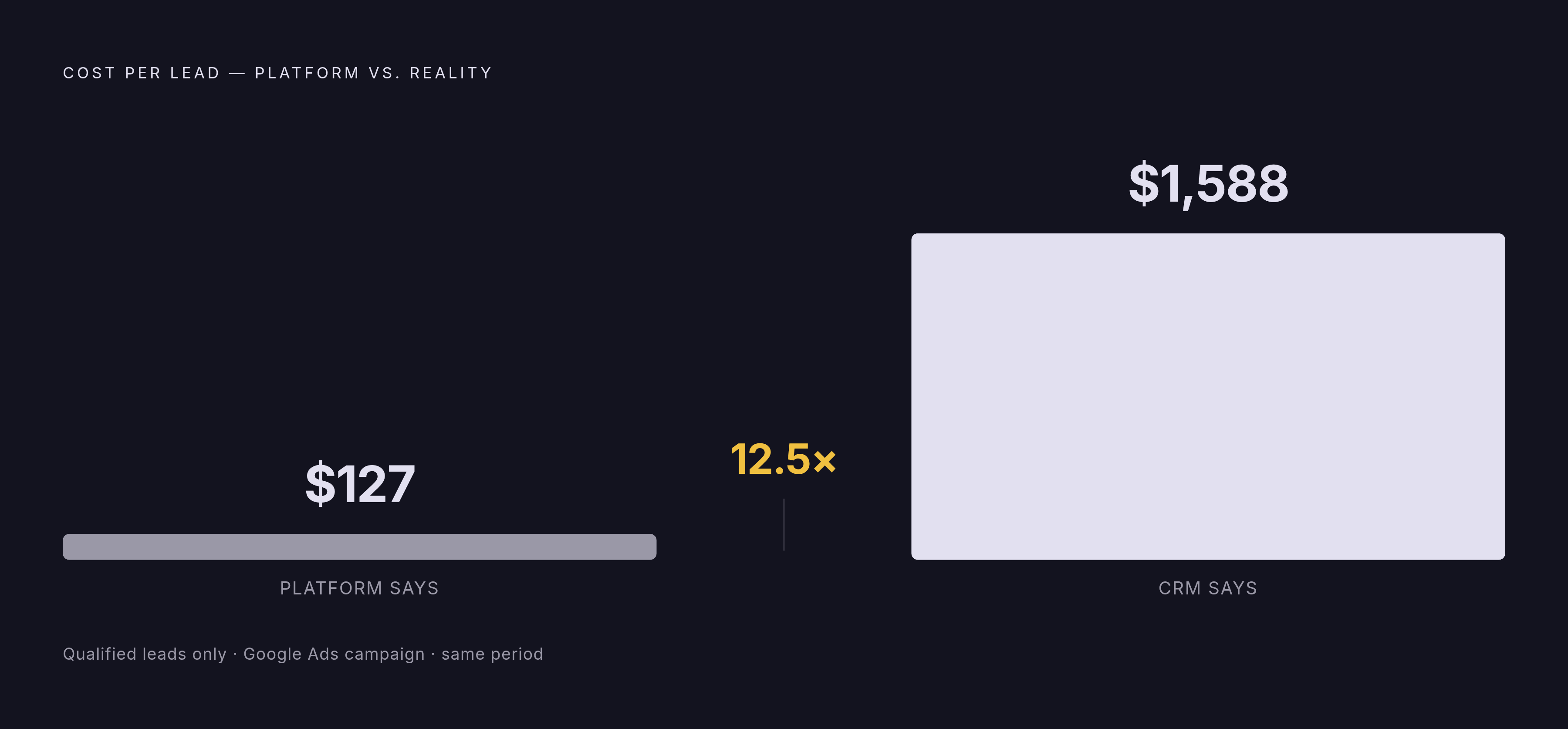
Here's a number that makes the gap concrete: a Google Ads dashboard might show a cost-per-lead of $127. Pull the same campaign's numbers from the CRM, and the real cost per qualified lead comes out to $1,588. That's a discrepancy too large to attribute to rounding error. That's a 12.5x difference between what the platform tells you and what actually happened.
And this isn't a fringe problem affecting a handful of sloppy accounts. Per that same source, only 12% of B2B SaaS companies have full pipeline attribution connecting ad spend all the way to CRM revenue. That means 88% of B2B SaaS companies are making budget calls based on a number that has almost no relationship to what they're actually paying for a real buyer.
Why does this keep happening? Structurally, it's baked in. Forrester puts the average B2B buying journey at 7 to 13 touchpoints before someone makes a decision. Any attribution model built around a single click or a single form fill physically cannot capture a journey that long. It's trying to describe a whole conversation using one word someone said in the middle of it.
The damage isn't limited to bad reporting, either. Google's Smart Bidding learns from whatever signal you feed it. Feed it form fills, and it goes out and finds you more people who fill out forms. Not more buyers. More form-fillers. Those are not the same group of people, and treating them as interchangeable is how ad budgets get spent optimizing for the wrong outcome, at scale, automatically, forever.
What full-funnel attribution actually requires: the technical architecture connecting clicks to closed deals
Fixing this requires more than a settings change. It's three layers working together: capturing the click, tracking it consistently across platforms, and reconciling it against what actually closed in the CRM.
Layer one: the GCLID. Every click on a Google ad carries a Google Click ID (GCLID) with it. That ID is the thread that, if followed properly, connects a keyword all the way to a closed deal. Capture it server-side and accuracy improves substantially over client-side methods. Capture it client-side only, and you start losing clicks to browser restrictions and ad blockers before you even get started. Skip this step entirely, and keyword-level revenue data simply doesn't exist. Not "hard to find." Doesn't exist.
Layer two: UTMs as the neutral record. Every ad platform grades its own homework. Google counts conversions its way, LinkedIn counts them its way, and neither number is built with your interests in mind. Run three or more platforms side by side without a neutral layer sitting on top, and per syntermedia.ai, total attributed conversions for most B2B teams come out overstated by 2 to 4 times. UTM parameters, tracked in GA4 or the CRM rather than inside any one platform's dashboard, are the one signal that doesn't belong to anybody's marketing team. The catch: consistency matters more than people expect. One person tagging a campaign "utm_source=google" and another tagging it "utm_source=Google" creates two records that will never talk to each other again.
Layer three: the CRM as the referee. Pull performance data from each ad platform's API directly. Never take a platform's own conversion dashboard as the final word on anything. Reconcile everything against CRM pipeline and revenue data in a separate, neutral reporting layer. Once that's built, you can finally calculate cost-per-SQL, cost-per-opportunity, and cost-per-close, broken out by campaign, ad group, keyword, and audience. Not just cost-per-click. Not just cost-per-form-fill.
There's a fourth piece that turns this from a reporting exercise into an optimization engine: Enhanced Conversions and Conversion API (CAPI). These send CRM signals, qualified, opportunity, closed-won, back into Google automatically. That's the mechanism that lets Smart Bidding train on real buyer behavior instead of guessing based on who filled out a form. Per saashero.net (2026), the full picture spans seven layers: data and account-based marketing, visitor identification, programmatic buying, creative and landing pages, CRM integration, attribution and measurement, and AI optimization. Miss a layer, and the revenue signal breaks somewhere along the chain.
Two honest caveats worth sitting with. First, privacy and consent rules mean a meaningful chunk of European traffic shows up without consent for measurement, so the data is partial by design. Reports need to say so, rather than presenting a half-funnel dataset as if it were the whole funnel. Second, Google's own data-driven attribution model needs a minimum of 400 conversions in the trailing 30 days before it even becomes available for a given conversion action. Most B2B campaigns never hit that threshold, which makes feeding Google the right signals, manually and deliberately, even more important, not less.
Why the attribution model you choose determines which channels you cut
Attribution model choice sounds like a reporting preference. It's actually a budget decision wearing a disguise.
Picture this, laid out by syntermedia.ai: a prospect sees four LinkedIn ads over six weeks. Then, in week seven, they type your brand name into Google and click a search ad to convert. Under last-touch attribution, Google gets 100% of the credit. LinkedIn gets zero. The report says: cut LinkedIn, double down on branded search. But is that actually what happened? LinkedIn spent six weeks building the interest that made the branded search happen at all. Last-touch just can't see that part of the story, so it tells you to defund the thing that did the work.
Forrester's number (7 to 13 touchpoints before a B2B buyer decides) means a model crediting only the final touch is throwing away the signal from the other 6 to 12. That's most of the journey, gone, every time.
Is last-click ever the right call? Per medium.com/@sprutagency (2026), it still has a narrow, legitimate use: diagnosing the final trigger in short, hyper-optimized campaigns. As the main model for a sales-led B2B program with a long buying cycle, though, it's the wrong tool for the job.
What B2B attribution actually needs is credit spread across the journey. Position-based models weight the first and last touch more heavily. Linear models split credit evenly. Time-decay models give more weight to touches closer to the conversion. None of these is universally "correct." Each answers a different question, and the right pick depends on what you're actually trying to learn.
Per growthloop.com, only 23% of marketers can reliably connect their marketing actions to actual business outcomes. Partial attribution is a big reason why: most teams are measuring one moment inside a journey that has many.
Here's the part that connects straight back to budget: whatever signal gets sent back to Google through Enhanced Conversions is the exact signal Smart Bidding will chase. If the attribution model says one thing and the optimization signal says another, the system ends up optimizing for something nobody actually asked for.
Where Google Ads fits in a sales-led B2B paid program, and where it doesn't
Google Search Ads are built to catch people already looking for a solution. That's demand capture, and it's both the platform's biggest strength and its hard ceiling.
Demand capture goes after the roughly 5% of the market actively shopping right now. Demand creation goes after the other 95%, the people not yet in a buying cycle at all. Most B2B paid programs pour money into capture and starve creation, right up until the pool of already-shopping buyers runs dry and there's nobody left to bid on.
Google Ads earns its place as a primary channel when the priority is lead volume, catching demand that already exists, and short-term ROI that's easy to point to. It's a genuinely good tool for that job. It's just not the whole toolbox.
Three mistakes show up constantly and quietly wreck both attribution and pipeline quality:
- Broad match with no negative keyword list. Volume goes up. Signal quality goes down. Fast.
- Optimizing toward raw form fills instead of qualified leads. This trains the algorithm to chase the wrong finish line.
- No brand campaign. Competitors get to sit on your own branded searches, right at the bottom of your funnel, for free.
The pattern repeats across B2B accounts: strong platform dashboard numbers coexist with weak pipeline contribution. What fixes it isn't more budget, new creative, or a campaign restructure. It's the optimization signal itself. Getting the attribution architecture right first matters most, because everything downstream depends on it.
Google's Demand Gen campaigns can help with B2B awareness, but they need real conversion volume to optimize properly, plus tight audience targeting, strong creative, and landing pages built for the job, not just borrowed from a search campaign.
6sense's 2025 Buyer Experience Report, covering more than 4,000 B2B buyers, found something worth sitting with: the vendor that won was already on the buyer's Day One shortlist 95% of the time. And in 94% of cases, buyers had already ranked that shortlist before talking to any salesperson. Google is very good at catching intent that's already formed. Shaping preference before that point? That's a different channel's job.
How LinkedIn fits into the attribution picture and what its data looks like once properly measured
LinkedIn now pulls in 41% of total B2B ad budgets, up from 39% the year before, per Dreamdata's 2026 numbers. Meanwhile non-branded search dropped from 37% in 2024 to 33% in 2025, per saleshive.com. That's a shift too large to attribute to rounding. That's B2B media budgets actually moving.
Comparing raw ROAS, per saleshive.com, Google shows 67% against LinkedIn's 121% in B2B benchmarks, with Google leads converting at lower rates into smaller deals. But those numbers look completely different depending on whether you're reading last-click platform data or full-funnel CRM outcomes. Which one are you trusting to make next quarter's budget call?
LinkedIn has the exact same measurement problem Google does. Its dashboard reports conversions through its own attribution model, not the CRM's. The fix is the same architecture: pull LinkedIn's campaign data through its API and reconcile it against CRM pipeline, rather than reading the number LinkedIn hands you and calling it truth.
The buying committee makes this even more pressing. Per 6sense's 2025 report, the average B2B buying cycle runs 10.1 months. Per saleshive.com, buying committees average 8 to 13 decision-makers, and 80% of LinkedIn users say they influence buying decisions at their company. Per dwmedia.com, citing 6sense 2025, buying groups now average more than 10 members for purchases running around $250,000. Attribution that only tracks the one person who filled out the form is missing the other nine or ten people in the room. Account-level attribution, aggregating every touch across every contact at an account, fits this reality far better than individual-contact tracking ever could.
Common LinkedIn mistakes distort the picture just as badly as Google's do: targeting too wide an audience, leaning on a single static image ad instead of testing creative, and judging results by 30-day last-click numbers alone. LinkedIn's influence window runs longer than a 30-day last-click window captures, so short measurement periods systematically undercount what it's actually doing.
So when does it make sense to run both? The sweet spot tends to be higher-value enterprise deals sold through a sales-led motion. That's the scenario complex enough to justify running both channels, and exactly where a reconciled attribution architecture earns its keep.
The pipeline metrics that replace form-fill reporting once the attribution architecture is in place
Once GCLID data actually flows into the CRM, the whole reporting vocabulary changes. Cost-per-lead gets replaced by cost-per-SQL, cost-per-opportunity, and cost-per-closed-won, all traceable down to campaign, ad group, keyword, and audience.
Pipeline coverage math shifts too. The old rule of thumb was 3 to 4 times pipeline coverage to hit a revenue number. But per the Ebsta x Pavilion 2025 GTM Benchmarks, average B2B win rates sit at 19%, which is part of why many teams now need 5x pipeline coverage to hit their number. Attribution reporting is what makes that math possible to calculate from real campaign inputs instead of a guess.
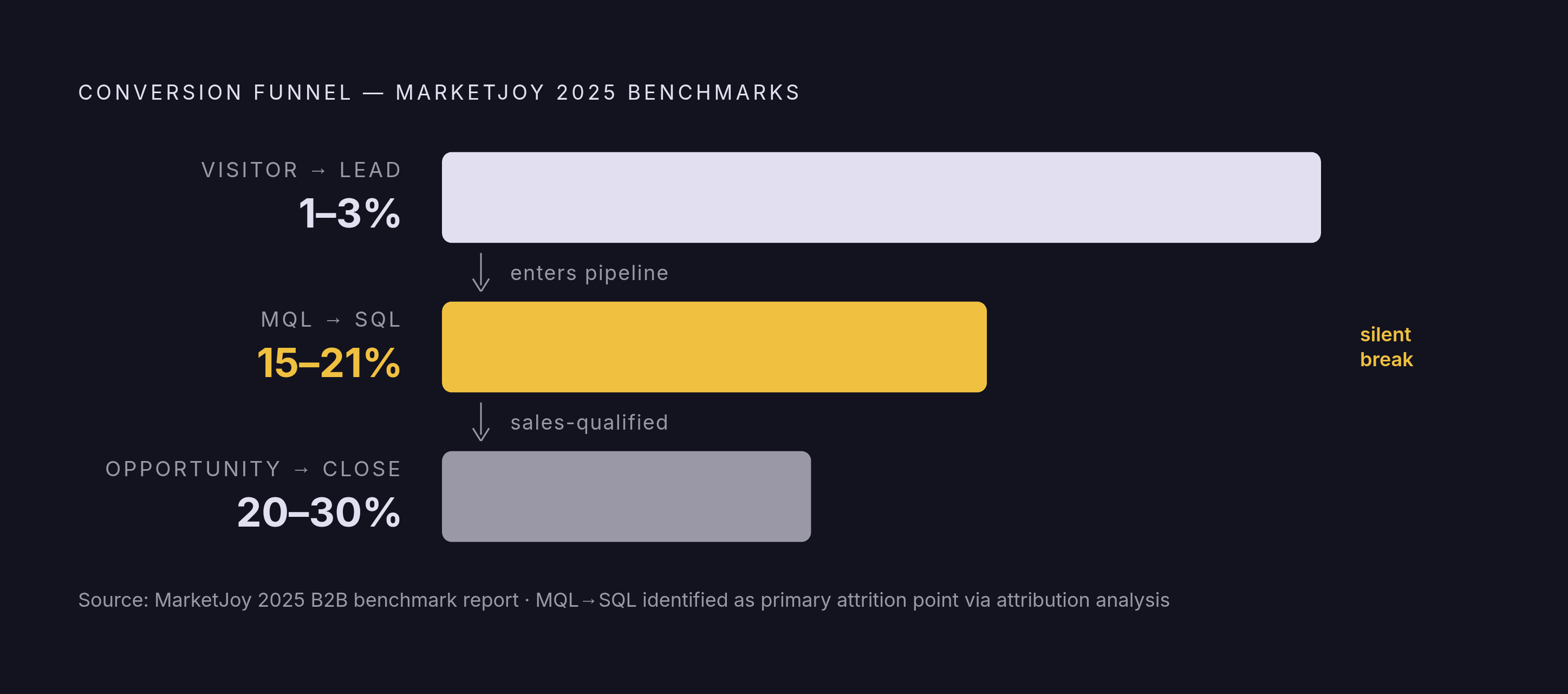
MarketJoy's 2025 benchmarks offer useful checkpoints for spotting exactly where a funnel breaks:
Falling short of these is simply a data point. It's a diagnostic clue pointing at a specific problem, whether that's creative, landing pages, or qualification.
The very first calculation worth doing: compare ROAS as reported by the ad platform against ROAS calculated from CRM-closed revenue. The size of that gap tells you exactly how much the platform has been over-reporting its own performance.
For buying committees of 8 to 13 people across a 10.1-month cycle, individual-contact attribution will always understate what a channel actually contributed. Aggregating every ad touch at the account level and matching that against CRM opportunities and closed deals gives a far more honest picture.
Attribution reporting's real job is diagnosis. High impressions but low click-through? Creative problem. High click-through but low conversion? Landing page problem. Plenty of form fills but a weak SQL rate? Qualification problem. The break tells you where to intervene, not just how much more to spend.
And sometimes the leak isn't in marketing at all. Responding to an inbound lead within an hour makes a team 7 times more likely to qualify it. Yet 44% of sales reps give up after a single follow-up attempt, even though 80% of deals need five or more touches to close. Strong pipeline generation paired with weak close rates is often a sales-side gap wearing a media-spend costume.
Per prospeo.io, sales and marketing teams that align around shared SLAs generate 208% more revenue from their marketing efforts. Attribution reporting is what makes that handoff measurable in the first place: which leads marketing sent, exactly when, and what happened to them after.
How AI agents change what's possible in pipeline attribution, and what still requires human judgment
Manual reconciliation of UTM data, CRM stages, and platform performance usually happens weekly or monthly. By the time that report lands on someone's desk, campaigns have already been spending against outdated signals for weeks. That's the core problem AI agents are positioned to fix: not the architecture itself, but the lag in reading it.
Agentic systems can watch campaign performance continuously, shift budget based on pipeline signal rather than click volume, and catch the moment a campaign's GCLID-to-SQL conversion rate starts sliding, flagging it before real money gets burned on an outdated assumption.
Per McKinsey's 2026 B2B Pulse Survey, covering nearly 4,000 buyers and sellers across 13 countries, high-growth companies are three times more likely to have increased AI investment by double digits year over year (71% versus 25%). The real differentiator is redesigning manual processes around AI rather than bolting it onto them. It's rewiring the whole workflow around it.
Per Demand Gen Report (December 2025), agentic AI moved in 2025 from assisting marketing tasks to owning entire workflows: building and routing campaigns, sequencing actions, adjusting performance levers without waiting on someone to sign off. Attribution reporting, with its constant need for reconciliation, is exactly the kind of loop where continuous agent execution beats a monthly human check-in.
There's a compounding effect worth naming. Every campaign cycle that closes the loop from GCLID to closed deal leaves behind evidence: which keywords produced real pipeline, which audiences actually converted, which landing pages held up at scale. The next campaign doesn't start from zero. It starts from that record.
None of this works without the underlying plumbing, though. Per growthloop.com, only 46% of organizations have a fully centralized single source of truth for customer data. Point an agent at fragmented data, and it doesn't fix the fragmentation. It amplifies it. The GCLID capture, the CRM integration, the neutral reconciliation layer, all of it has to be in place before agentic optimization can be trusted to make good calls on its own.
Some decisions still belong to a person, full stop:
- Which conversion events get sent back to Google as optimization signals. That choice determines what the entire system spends the next quarter chasing.
- Diagnosing why a pipeline gap exists. Attribution data can show the symptom clearly. It takes a person to work out whether the cause is media, creative, the landing page, or sales follow-up.
- Governing budget shifts that fall outside normal operating range. An agent moving 5% of budget between similar campaigns is routine. An agent moving 40% of budget based on three days of noisy data is a different conversation.
- Owning the outcome. Someone has to be accountable for what the system does with the signals it's given, and that accountability doesn't transfer to the software.