Demand Generation Strategy with Google Ads for B2B
Google Ads captures existing demand in B2B sales cycles, not new demand—optimize accordingly.
Most B2B teams running Google Ads are optimizing for the wrong thing. Clicks. Impressions. Cost-per-click. None of those metrics show up in a pipeline report. The platform isn't broken. The configuration is.
The configuration problem runs deeper than most paid search guides want to sit with. B2B buying is nothing like B2C. A typical sales cycle runs close to 192 days. More than six stakeholders are usually involved. A deal might touch over 60 different moments before it closes. And last-click attribution, which was Google's default for years before they shifted to data-driven attribution, credits only the final interaction before a form fill.
In a 192-day cycle, that means the search campaign that introduced your brand three months ago gets zero credit. The remarketing ad that pulled someone back after a long silence. The competitor comparison ad that tipped the evaluation. All invisible. So what happens? Teams optimize toward what's measurable. They train Google's algorithm on form fills and traffic volume. Google, being an algorithm, does exactly what it's told. It gets very good at generating clicks. Not pipeline.
Here's the thing people don't say loudly enough: Google Ads captures demand. It does not create it.
B2B buyers spend roughly 70% of their journey doing independent research before they ever talk to a vendor. By the time someone types "enterprise contract management software" into Google, they already know they have a problem. They've probably looped in a few colleagues. Maybe read a report or two. Google Ads intercepts them during that active research phase. It doesn't manufacture the problem recognition that got them there.
So where does it actually fit? A few spots earn it:
- High-intent search. Buyers searching problem-aware or solution-aware terms. "Reduce SaaS spend." "Best CRM for sales teams." These people are close to a decision.
- Competitor comparison. Buyers actively evaluating named vendors. They know the category. They're choosing between options.
- Remarketing. Re-engaging visitors who've already been to your site. Often the highest-ROI segment in a B2B account, full stop.
Where it fits less well: the very top of the funnel. Buyers who haven't yet recognized a problem. Reaching them before they search is LinkedIn's job. We'll get there.
Keyword selection is audience selection. The queries you bid on decide which stage of the buying journey you're actually reaching. Get that wrong and you're not just burning budget. You're flooding your pipeline with unqualifiable traffic, and eventually your sales team starts wondering whether marketing is actually helping.
How Keyword Intent Determines Lead Quality Before a Single Click Happens
Your keyword list is already deciding something important: whether your budget reaches buyers who can convert to pipeline, or buyers who are just poking around on their lunch break. Keyword intent is the strongest pre-click signal you have.
Think about intent in tiers:
- High intent. Solution-specific terms, vendor comparisons, category terms with purchase indicators. "Best CRM for enterprise sales teams." "[Competitor] alternative." These buyers are close to a decision. Concentrate budget here.
- Mid intent. Problem-aware terms. "How to reduce customer churn." "Automate sales reporting." Earlier stage. They need more nurturing before they become a sales-qualified lead.
- Low intent. Informational queries. "What is CRM." High volume, low pipeline contribution. Generally not worth paying for in a budget-constrained program.
Negative keywords are just as important as what you're bidding on. Without a rigorous negative keyword list, budget bleeds into searches that look related but represent zero pipeline potential. You're paying to reach people who will not buy.
Campaign structure follows from intent. The approach worth knowing is Single Theme Ad Groups, sometimes called STAGs. Tightly related, high-intent keywords grouped together, each mapped to a dedicated landing page that matches the specific search intent. Why does this matter? Cleaner data per keyword cluster. Smarter algorithmic optimization. And direct messaging alignment between what someone searched and what they actually land on, which is the difference between a lead and a bounce.
But what if your high-intent terms are too expensive to compete on? That's worth sitting with. Sometimes the right move is owning mid-intent terms your competitors have ignored, and building the nurture infrastructure to qualify what comes through. The intent tier isn't always where you should be. It's where you should start evaluating from.
Landing Pages as the Conversion Layer Between Ad Click and Pipeline Entry
Message match is the fundamental requirement here. The landing page headline, offer, and framing must mirror the specific intent of the ad group that sent the click. A generic homepage breaks the intent chain immediately. The buyer arrived with a specific problem in mind and lands somewhere that doesn't address it. That gap is where pipeline leaks.
What a pipeline-oriented landing page actually needs:
- A headline that reflects the buyer's problem. Not your company tagline. The thing they just searched.
- A single, clear conversion action. Demo request. Assessment. Consultation. Not three competing CTAs pulling attention in different directions.
- Social proof calibrated to buyer stage. Case studies for bottom-funnel buyers. Data-backed claims for mid-funnel. The wrong proof at the wrong stage feels off, even if buyers can't articulate why.
- Minimal navigation. Every link that takes someone off the page is a potential exit before conversion.
Form design deserves a specific mention because it directly affects lead quality, not just lead volume. Longer forms with qualification fields, company size, role, timeline, reduce raw lead count but improve SQL rate. That's an intentional trade-off. A shorter form that generates twice the leads but half the SQLs isn't a win. It's noise dressed up as volume.
Think about the keyword cluster, the ad copy, and the landing page as one continuous argument. Any break in that chain and the campaign's pipeline potential is lower than its traffic numbers suggest. That break is invisible in a standard Google Ads report. You'll see clicks. You won't see the intent that evaporated somewhere between click and conversion.
Choosing a Bidding Strategy That Fits B2B Conversion Volume and Cycle Length
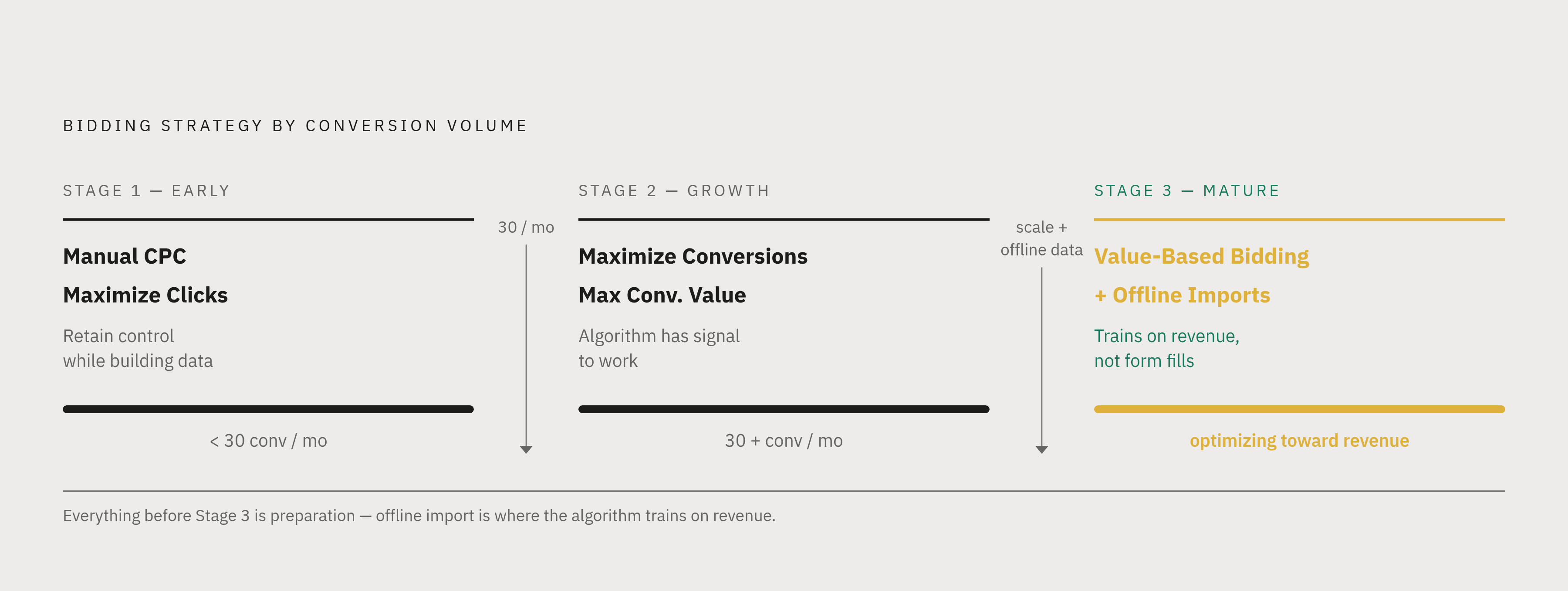
Here's a tension Google doesn't exactly put in the headline: Smart Bidding needs conversion data to optimize. B2B often doesn't generate enough conversions per month for the algorithm to learn effectively. Push automated bidding too early and the algorithm isn't optimizing. It's guessing. Confidently guessing, but still guessing.
A useful way to think about this is a progression tied to data maturity.
Early stage (under roughly 30 conversions per month). Manual CPC or Maximize Clicks. Keep control while you build the conversion data the algorithm needs. This isn't a failure mode. It's the appropriate starting point, and anyone who tells you otherwise is probably selling something.
Growth stage (30 or more monthly conversions). Maximize Conversions or Maximize Conversion Value. The algorithm has enough signal to start doing useful work. Let it.
Mature stage. Value-based bidding with offline conversion imports. This is the actual goal for B2B, because it lets Google optimize toward lead quality and revenue contribution rather than just form fills.
A large majority of advertisers now use automated bidding. But automated bidding optimizes for whatever conversion event it's given. Feed it form fills, it optimizes for form fills. Not SQLs. Not pipeline. Not revenue. The event you feed the algorithm is the outcome you're training it to produce.
The offline conversion import is what actually closes the loop. Feed CRM data back into Google, MQL-to-SQL conversions, deal closures, and you give the algorithm signals that reflect which queries and audiences produce revenue. Without that, Smart Bidding is just very confidently chasing the wrong outcome.
One note on Performance Max: it can work for B2B, but it needs careful configuration with audience signals, CRM lists, site visitors, in-market segments. Without those signals, it spreads budget across low-intent placements and produces impressions that have nothing to do with pipeline. Treat it as a test, not a solution.
Attribution Models That Reflect a 192-Day Sales Cycle Rather Than a Single Click
Last-click attribution and a 192-day sales cycle are fundamentally incompatible. The math just doesn't work.
If a buyer first encounters your brand through a search campaign in January, revisits through a remarketing ad in March, clicks a competitor comparison ad in April, and fills out a demo form in May, last-click gives all of the credit to whatever they clicked in May. The three months of touchpoints that moved them toward a decision: invisible.
The practical consequence? Budget migrates toward bottom-funnel campaigns that look good in last-click but only close leads that earlier campaigns already warmed. You end up systematically defunding the campaigns doing the upstream work, then wondering why pipeline dries up six months later.
Data-driven attribution, Google's current model, distributes credit across touchpoints based on observed path-to-conversion data. It's closer to reality. But it's still bounded by Google's own ecosystem. It can't see what happens in your CRM after a form fill.
The real fix is cross-channel. Connect Google Ads data to your CRM, Salesforce, HubSpot, or otherwise, so that pipeline stage, deal size, and close status flow back as offline conversion events. This gives Google signals that reflect actual revenue contribution, not just click behavior.
At higher spend levels, multi-touch attribution or marketing mix modeling becomes necessary. The goal shifts from optimizing individual campaigns in isolation to understanding each channel's contribution to overall pipeline. That's a harder question, and it requires a more sophisticated measurement setup. But it's the right question to be asking.
How to Allocate Budget Across Campaign Types When Pipeline Is the Objective
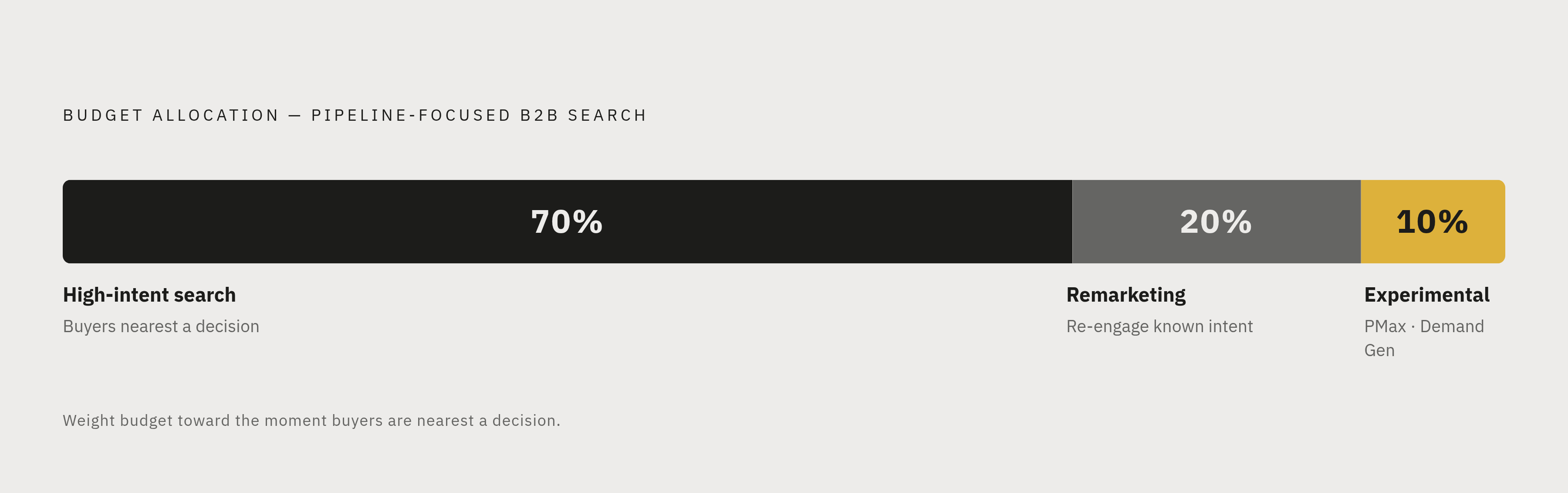
Starting allocation logic for B2B Google Ads should concentrate initial budget on highest-intent demand capture. Here's a practical starting framework, and deal size, cycle length, and pipeline coverage relative to quota all shift these numbers in practice:
- Roughly 70% on high-intent search campaigns. These reach buyers closest to a decision. Pipeline conversion rates are highest here.
- Roughly 20% on remarketing. Re-engaging visitors who've already shown intent. Often the highest-ROI segment in the account.
- Roughly 10% on experimental campaign types. Performance Max, Demand Gen. Small enough to test without threatening core pipeline contribution.
Budget floor matters more than most teams realize. Below roughly $2,000 to $5,000 per month, there often isn't sufficient conversion volume for Google's algorithm to learn. The account stalls rather than compounds. You're running at a scale where the math works against you regardless of strategy.
For context on B2B cost-per-lead: expect a range of roughly $50 to $200 depending on industry and deal size. SaaS tends to run toward the middle. If your budget divided by your expected CPL doesn't produce enough leads to hit your SQL targets, the budget is the problem, not the strategy. That's a conversation worth having earlier than most teams have it.
As the account matures and attribution improves, fixed percentage allocations should give way to actual pipeline contribution data. Marketing mix modeling or CRM-linked attribution should be guiding marginal budget decisions, not rules of thumb passed around in a Slack thread.
Demand Gen campaigns, covering YouTube, Gmail, and Discover, reach buyers earlier in the funnel before active search. That makes them a complement to high-intent search, not a replacement. The buying stage they reach is different, and the content and conversion expectations need to match that difference.
First-Party Data as the Infrastructure That Makes the Whole System Work
Everything described above, bidding optimization, meaningful attribution, intelligent audience targeting, runs on data. Specifically, your data. First-party data.
The relevant sources for B2B Google Ads:
- CRM contact lists
- Website visitor behavior
- Form submission data
- Offline conversion records: MQL, SQL, deal closed
Here's how first-party data improves each layer of the system.
Audience targeting. CRM lists uploaded as Customer Match let Google find similar buyers. Past-visitor lists power high-ROI remarketing. You're not targeting demographics. You're targeting people who look like your actual customers.
Bidding signals. Offline conversion imports give Smart Bidding revenue-quality signals rather than volume signals. The algorithm learns what a good lead actually looks like in your business, not just what a form fill looks like.
Attribution. CRM-linked pipeline data makes it possible to trace a campaign's influence on revenue, not just form fills.
The compounding dynamic here is easy to miss. Each campaign cycle generates new behavioral and conversion data. Fed back into the system, that data improves the next campaign's targeting, bidding, and messaging. The account gets smarter over time rather than resetting. Teams that build this infrastructure in year one are running a fundamentally different system in year three, and they'll have a hard time explaining why their CPL keeps dropping while yours stays flat, because the gap is structural, not tactical.
One thing constrains this more than anything else, more than model sophistication or budget: data hygiene. A clean, well-structured CRM integration outperforms a sophisticated but messy data setup. Fix the data before you chase the advanced configuration.
With third-party cookie deprecation reshaping digital advertising, teams without a first-party data strategy are increasingly exposed. Their targeting and attribution degrade as others' improves. This isn't a future risk. It's happening now, quietly, in the background of every campaign report.
Where LinkedIn Fits Alongside Google Ads in a B2B Pipeline System
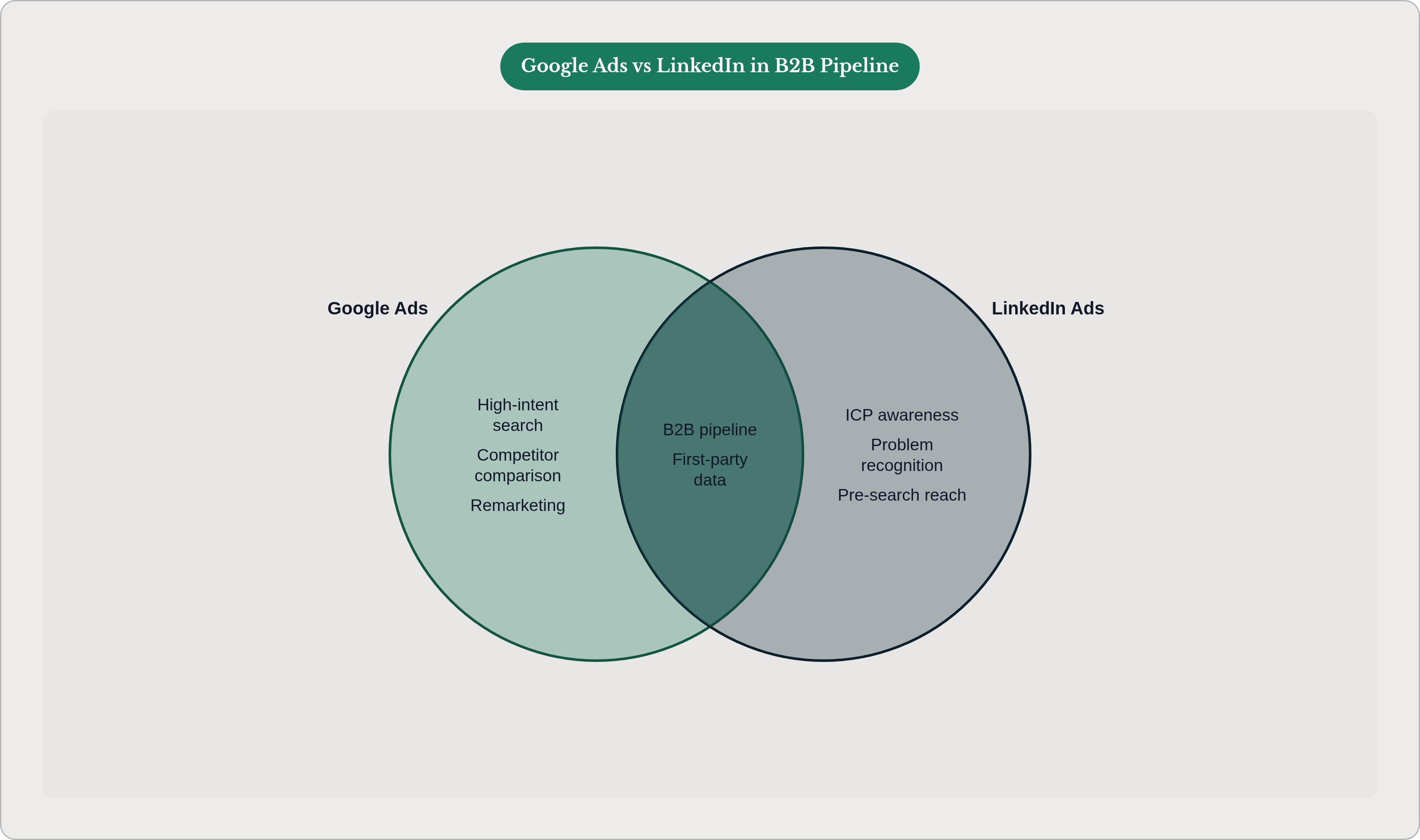
Google Ads reaches buyers who are already searching. But 70% of the buying journey happens before buyers engage with a vendor. That gap is where LinkedIn lives.
LinkedIn's structural role in a B2B pipeline system is generating awareness and problem recognition among a defined ideal customer profile before those buyers ever type a query into Google. With over one billion members globally and tens of millions of decision-makers on the platform, the targeting precision by job title, seniority, company size, and industry is arguably unmatched in paid media for B2B.
The hybrid model works like this: use LinkedIn to generate awareness and problem recognition among a defined ICP, then use Google Ads to capture those buyers when they reach the search stage. LinkedIn plants the problem frame. Google catches the resulting search. They're sequenced, not competing.
According to LinkedIn's 2025 B2B Benchmark Report, 89% of B2B marketers credit LinkedIn as their top channel for generating qualified leads.
That raises an important measurement question: because LinkedIn-influenced buyers often convert via Google search, last-click attribution assigns credit to Google and makes LinkedIn look ineffective. That's an artifact of the measurement model, not actual channel contribution. It's another reason multi-touch attribution matters in a two-channel system. Without it, you'll defund the channel doing the awareness work because the channel that closes it looks better in the report.
Start with clean keyword structure and intent-matched landing pages. Add bidding discipline as conversion volume grows. Build the attribution and data infrastructure as the account matures. Every configuration decision, from the start, either points at pipeline or points away from it. There's not much in between.