Running Google Ads Without a Media Buyer When Your B2B Team Has No PPC Headcount
Without a buyer, you still must own signals, limits, and judgment.
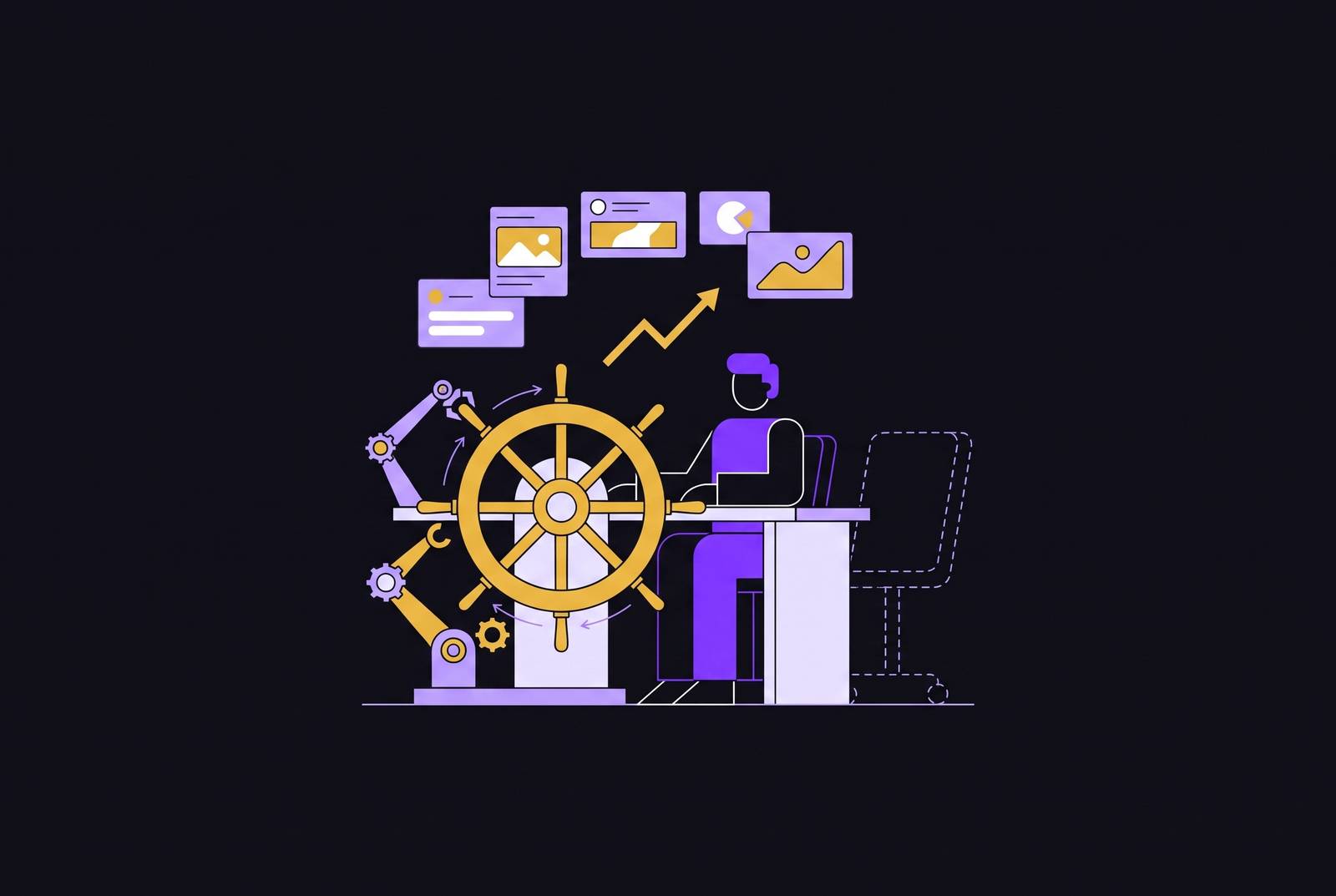
B2B companies can run Google Ads without an internal media buyer, but someone must own the conversion signals, spending limits, and decisions that turn automated execution into pipeline. Fully managed paid media for B2B companies means taking charge of ads, landing pages, attribution, and CRM feedback so they work as one system. The choice is not whether to automate, but whether to govern that system in-house or delegate its operation without surrendering business judgment.
Why Google Ads is now a governed machine, not a managed channel
Campaigns are running, spend is moving, and the platform is making decisions whether a dedicated buyer is watching or not. More and more, bidding, matching, creative iteration, and audience adjustment happen without someone approving each move. An empty seat leaves the machine's inputs and limits without an obvious owner.
With Google AI Max for Search, Search campaigns get search term matching, text customization, and final URL expansion. Google says campaigns using automatically created assets or campaign-level broad match are auto-upgraded from September 2026, with Dynamic Search Ads following from February 2027. Doing nothing is therefore not a reliable way to preserve the old operating model. The platform changes even when the staffing plan does not.
For B2B teams, this moves responsibility upstream. The platform optimizes toward the conversion signal it receives, which may differ from the sales outcome the marketing leader privately hopes for. If those differ, doing the work faster makes that mismatch cost more. The missing buyer is therefore less a missing pair of hands than a missing point of accountability.
What the platform's agent can and cannot decide on its own
Inside its own data walls, Google's agent can evaluate available signal combinations for individual auctions at a scale no human buyer can match. It can rewrite copy variants, adjust audiences, shift budget between campaign types, and report outcomes without waiting for input. AI Max can also widen matching and choose landing pages within a Search campaign.
Outside those walls, the picture becomes incomplete. The agent needs CRM outcomes to reach the platform to know that sales turned down last week's form fills. It cannot decide that LinkedIn deserves more money because it produced cheaper opportunities than Google last quarter. Nor can it judge how well the chosen conversion event stands in for pipeline value. That judgment belongs to the business.
The boundary is straightforward, even if the work is not. The machine handles execution against a supplied objective, while people own the objective, the evidence behind it, and the trade-offs across channels. To keep that boundary in place, an agent should show that its diagnosis can be trusted before it gets permission to act. Otherwise, automation becomes unattended spend wearing a very convincing dashboard.
The conversion signal problem: what you feed the machine determines what it optimizes toward
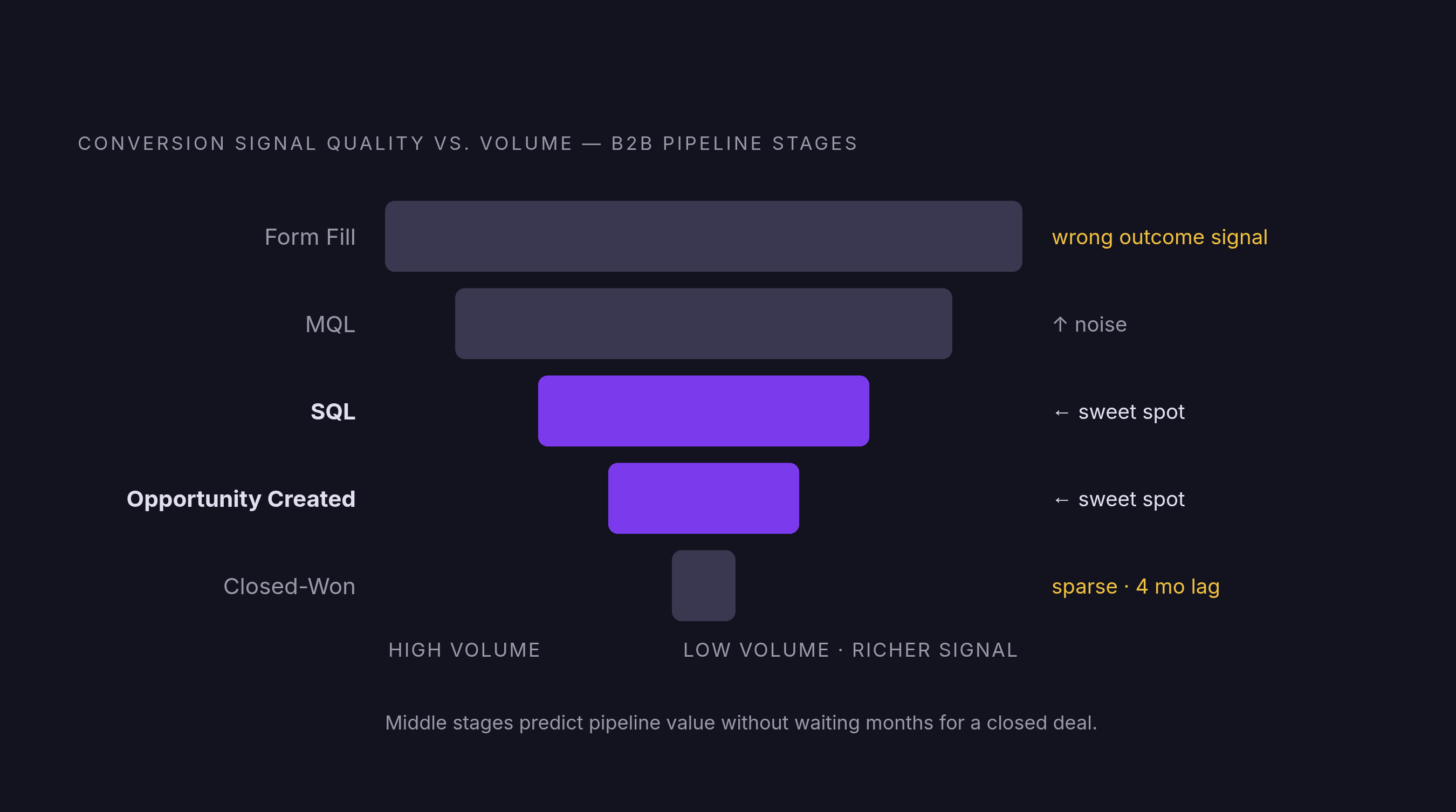
The most consequential failure is often not a neglected bid or a stale keyword. It is a conversion event that rewards the wrong result. A form fill, an MQL, an SQL, an opportunity created, and a closed-won deal represent progressively stronger evidence of pipeline value. Assigning increasing conversion values to those stages gives the bidding model a richer target than treating every submission as equally useful.
Why not just optimize for closed-won deals? Because B2B outcomes are sparse and arrive late. A few opportunities per campaign per month cannot reliably distinguish a real change from noise, while this week's funnel is still waiting for quotes and orders. A purchase order that arrives four months later, four times a month, gives little help with what to do now. The team needs an earlier CRM signal that predicts pipeline without being so early that it mostly predicts form completion.
The practical action is to import conversion events from Salesforce or HubSpot into Google Ads using GCLID tracking. That feedback connects clicks to meetings and later sales outcomes, giving the platform evidence it cannot obtain from the form alone. The team must choose which stage should guide optimization instead of letting the event that is easiest to count drive that choice. Buying committees make this especially important because the person submitting the form is often not the person signing the deal. Without the CRM loop, the machine is navigating by the wrong map.
The four governance decisions a B2B team must own regardless of who runs execution
First, choose the CRM stage that will guide optimization, and review that choice whenever sales changes its qualification criteria. A signal that once identified promising buyers may stop doing so when qualification changes. The platform cannot resolve that shift without the team deciding what now counts as a useful outcome.
Second, set the campaign objective and spending boundaries before the agent proposes changes. The objective should reflect pipeline value rather than form volume, with a maximum daily budget delta, bid floors, and campaign-level guardrails. “Be careful” is not a spending limit. Numeric percent and dollar caps belong at both campaign and account level, because the business must decide how much movement it can tolerate. Budget ramps and bid-strategy changes also incur learning-phase costs, so constant adjustment can keep resetting the learning clock.
Third, make search query review a recurring responsibility. AI Max is built to widen matching, so queries that seem relevant can use up spend without bringing in pipeline that leads to sales. Add and manage negative keywords at campaign and account level without blocking searches that convert. The distinction requires judgment about buyer intent beyond a word's resemblance to the product category.
Fourth, have a person approve brand claims and measurement changes. Copy that names claims, prices, or competitors needs review before publication, even when the platform can generate variants autonomously. Pixel and conversion-tracking changes also need to be checked before they go live. A bad claim publishes under the company's name, while a bad tracking change corrupts the evidence used for later decisions. The company is still responsible for both when a machine makes the edit.
Why the landing page and attribution gap will cost more pipeline than any bid strategy mistake
Consider a generalist marketer who owns the ads, a web team that owns the landing page, and RevOps that owns the CRM. Each can do its part while nobody closes the attribution loop. The ad sends traffic, the page collects submissions, and the CRM records sales outcomes, but the platform learns from only part of the story. Three owners can still leave one orphaned system.
Attribution needs control of the landing page, conversion-tracking configuration, and CRM together. Without that connection, better bidding cannot fill gaps in feedback or make the destination page live up to the ad's promise. Ownership of the connection itself needs to be assigned. It cannot remain three separate workstreams whose owners occasionally exchange messages.
With cross-channel attribution, the same gap is harder to spot. The PORT loop illustrates how YouTube can create demand that Search harvests, while Meta can create demand that branded Search claims credit for. Blending those scorecards too early rewards the channel closest to the conversion and can starve the channel that helped create it. Governing the full acquisition chain therefore means protecting measurement as well as managing the ads it appears to judge.
The Google and LinkedIn interplay a B2B team without a buyer is most likely to mismanage
For sales-led B2B, LinkedIn can create awareness that Google Search later captures. But without someone who owns both, those channels become separate tests, each with its own scorecard. Search appears to produce the outcome, while LinkedIn's contribution is harder to see. From inside Google, Google's agent cannot judge how those platforms work together.
The practical diagnostic is to run LinkedIn awareness campaigns and then monitor branded search volume and non-branded conversion rates on Google. Those movements help the team examine whether awareness is influencing capture. They are a reason to investigate the relationship before treating every subsequent search conversion as proof of LinkedIn's contribution. The budget decision needs the whole sales motion.
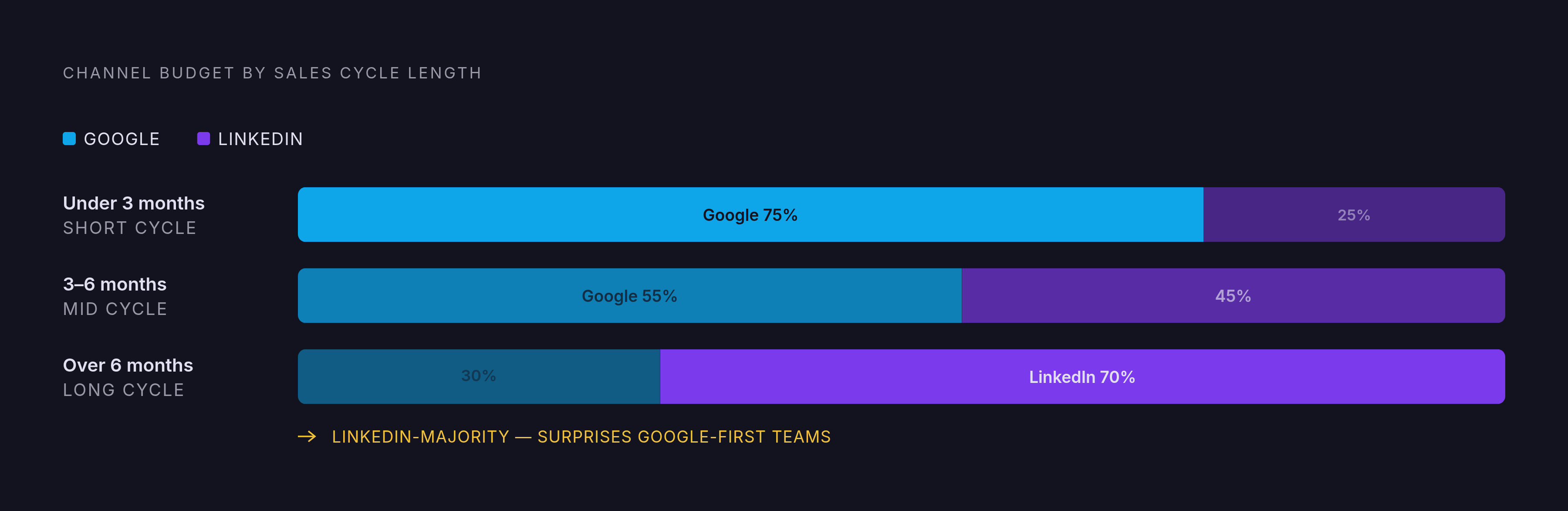
For cycles under three months, heavier Google weighting makes sense because demand capture dominates. For cycles of three to six months, a roughly equal split reflects the contribution of both awareness and capture. For cycles over six months, LinkedIn takes the larger share because relationships and awareness have longer to develop before a purchase.
That allocation can still go wrong if success means MQL volume. Inbound demo requests convert to revenue at a dramatically higher rate than content-download MQLs, so counting both as interchangeable rewards the easier event. A team should use pipeline outcomes to judge how the channels work together instead of naming a winner based on who has the most names.
How should a B2B team choose between hiring, a specialist, and full-stack delegation?
Hiring in-house provides ownership and institutional knowledge, but the year-one commitment includes salary, benefits, tools, and ramp time. One hire also needs support to cover ads, landing pages, attribution, and CRM feedback. Assigning the work to an existing generalist does not erase those demands. When that person also handles content, email, and social, campaign checks can become infrequent and lead-quality problems can remain undiagnosed for months.
A specialist agency or freelancer offers channel expertise at a lower cost than a full-time hire. The trade-off is scope. A specialist that cannot change the landing page may be optimizing traffic toward a destination it cannot improve, while separate CRM ownership leaves feedback unresolved. Check who owns the account too, because when the vendor has control, access to the optimization history built up over time can be at risk when the relationship ends.
Full-stack delegation brings ads, landing pages, attribution, and CRM feedback into one operating loop, so someone owns how they work together. For a leader asking who handles B2B paid media end to end without requiring them to manage an agency, that ownership boundary is the decisive comparison. Channel expertise alone is not the same service. The integrated model removes the need for the marketing leader to coordinate every hand-off as strategist, project manager, and quality control.
Commercial terms belong in that comparison too. A fee tied to media spend creates an incentive to recommend more spend, whereas a flat retainer separates the fee from budget growth. The other test is whether campaign evidence informs the next decision, including audience insights and what worked or failed. That history helps a system distinguish a creative problem from a landing-page problem or attribution gap instead of responding to every constraint with another account adjustment.
The governance calendar: what a team with no PPC headcount must do weekly, monthly, and each quarter
Weekly, review search term reports for query drift from expanded matching and add negatives before irrelevant intent absorbs more spend. Confirm that CRM-to-platform feedback is flowing, because a broken GCLID import can silently degrade the bidding model for weeks. Check creative fatigue as well, ruling out other causes before deciding what to change. New variants need attention rather than an assumption that the platform will proactively flag fatigue without fresh creative inputs.
Monthly, compare platform-reported conversions with CRM-recorded opportunities so inflated attribution does not become the basis for optimization. Revisit the Google and LinkedIn split if deal velocity changes or branded search volume moves in response to LinkedIn activity. Check the landing-page message match with the ad copy now in use, especially after AI Max creates new text assets.
Each quarter, reassess the conversion-event hierarchy against current sales qualification criteria. Revisit budget caps, bid floors, and approval thresholds because launch-day limits can become stale as account history and spend change. Assess incrementality by looking at the pipeline the program actually helped to create instead of taking platform-reported ROAS as the whole result.
This cadence is real work, even without a daily bid-tweaking ritual. It calls for someone who can connect sales judgment, measurement, creative, and spending authority often enough to keep them aligned. Every B2B growth leader running without PPC headcount eventually faces the same choice. The discipline must either be built in-house or delegated to a system designed to run it continuously.